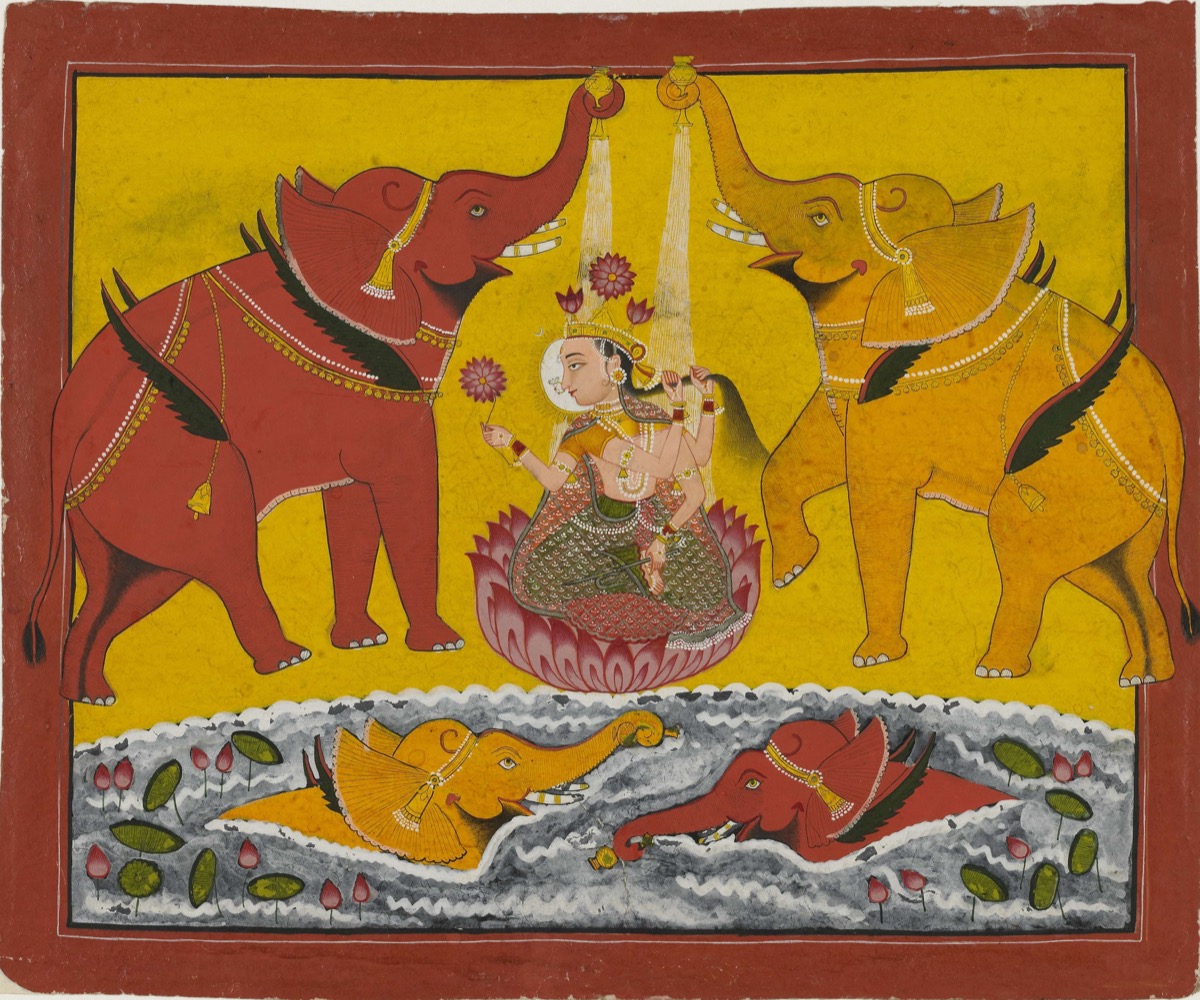
The Aṣṭalakṣmī Stotram (अष्टलक्ष्मी स्तोत्रम्, “Hymn to the Eight Lakṣmīs”) is one of the most beloved and widely recited devotional compositions in the Hindu tradition, celebrating the eight divine manifestations (aṣṭa rūpa) of Goddess Lakṣmī — the supreme embodiment of wealth (dhana), prosperity (samṛddhi), fortune (bhāgya), beauty (saundarya), and grace (kṛpā). Composed in the early 1970s by U.V. Śrīnivāsa Varadāchāriar (commonly known as Mukkur Śrīnivāsa Varadāchār), a distinguished theologian of the Śrī Vaiṣṇava tradition in Chennai, this stotram has become a cornerstone of Lakṣmī worship across India and the global Hindu diaspora.
The stotram’s genius lies in its elegant poetic structure: eight verses (padyāni), each dedicated to one of the eight forms of Lakṣmī, all following a common refrain — “Jaya jaya hē madhusūdanakāmini [name] lakṣmi sadā pālaya mām” (“Victory, victory! O beloved of Madhusūdana [Viṣṇu], O [name] Lakṣmī, always protect me!”). This refrain weaves together the dual theological assertion that Lakṣmī is both an independent cosmic power and the inseparable consort of Lord Viṣṇu.
The Concept of Aṣṭa Lakṣmī
Eight Sources of Wealth
The concept of Aṣṭa Lakṣmī (“Eight Lakṣmīs”) represents a profound Hindu theological insight: that wealth is not merely material but encompasses the totality of human well-being. The eight forms collectively symbolize eight sources of abundance that sustain human life at every level — spiritual, physical, intellectual, social, and material. This holistic vision of prosperity distinguishes the Hindu understanding of śrī (auspiciousness and abundance) from a narrow focus on financial wealth alone.
The Viṣṇu Purāṇa (1.8–9) establishes Lakṣmī as the eternal consort of Viṣṇu, declaring that just as Viṣṇu pervades the entire universe, so does Śrī Lakṣmī pervade everything as the principle of grace and abundance. The Śrī Sūktam, one of the most ancient Vedic hymns dedicated to Lakṣmī, invokes her as hiraṇyavarṇā (golden-hued) and padmasthitā (lotus-seated), establishing the imagery that the Aṣṭalakṣmī Stotram later elaborates in its eight verses.
The Eight Forms: An Overview
The eight manifestations worshipped in the stotram are:
- Ādi Lakṣmī (आदिलक्ष्मी) — The Primordial Lakṣmī, bestower of mokṣa (spiritual liberation)
- Dhānya Lakṣmī (धान्यलक्ष्मी) — The Lakṣmī of Grain, bestower of agricultural abundance
- Dhairya Lakṣmī (धैर्यलक्ष्मी) — The Lakṣmī of Courage, bestower of fortitude and valor
- Gaja Lakṣmī (गजलक्ष्मी) — The Lakṣmī of Elephants, bestower of royal splendor and animal wealth
- Santāna Lakṣmī (सन्तानलक्ष्मी) — The Lakṣmī of Progeny, bestower of offspring and family welfare
- Vijaya Lakṣmī (विजयलक्ष्मी) — The Lakṣmī of Victory, bestower of success in all endeavors
- Vidyā Lakṣmī (विद्यालक्ष्मी) — The Lakṣmī of Knowledge, bestower of learning and wisdom
- Dhana Lakṣmī (धनलक्ष्मी) — The Lakṣmī of Wealth, bestower of material riches and abundance
Some traditions list Vīra Lakṣmī (Courage Lakṣmī) instead of Dhairya Lakṣmī, though the attributes described are essentially identical. The ordering may also vary by regional tradition, but the eight forms remain consistent across all major recensions.
Verse-by-Verse Analysis
Verse 1: Ādi Lakṣmī — The Primordial Mother
Sumanasavandita sundari mādhavi candrasahōdari hēmamayē Munigaṇavandita mōkṣapradāyini mañjulabhāṣiṇi vēdanutē
The opening verse invokes Ādi Lakṣmī, the primordial and most ancient form of the Goddess. She is addressed as sundari (beautiful one), mādhavi (consort of Mādhava/Viṣṇu), candrasahōdari (sister of the Moon — both emerged from the churning of the cosmic ocean, samudra manthana), and hēmamayē (golden-formed). The sages (munigaṇa) venerate her, and she is mōkṣapradāyini — the bestower of liberation. This positioning of spiritual liberation as the first and most fundamental form of wealth reflects the Vedāntic priority of mokṣa among the four puruṣārthas (aims of human life).
Her epithet paṅkajavāsini (lotus-dweller) connects her to the primordial lotus that emerges from the cosmic waters, symbolizing creation, purity, and the unfolding of consciousness itself. As vēdanutē (praised by the Vedas), she is established as the subject of the most ancient scriptural devotion.
Verse 2: Dhānya Lakṣmī — The Goddess of Grain
Ayikalikalmaṣanāśini kāmini vaidikarūpiṇi vēdamayē Kṣīrasamudbhava maṅgalarūpiṇi mantranivāsini mantranutē
The second verse celebrates Dhānya Lakṣmī, the personification of agricultural abundance. She is kalikalmaṣanāśini — the destroyer of the impurities of the Kali age — and vaidikarūpiṇi — she whose form is the Vedas themselves. Her description as kṣīrasamudbhava (born from the ocean of milk) links her to the cosmic samudra manthana narrative, while maṅgalarūpiṇi (whose form is auspiciousness) establishes her as the very embodiment of sacred fortune.
In agrarian India, Dhānya Lakṣmī holds immense significance. The word dhānya encompasses all grains — rice, wheat, millet — that sustain life. Her worship reminds devotees that food security is itself a form of divine blessing, and that the earth’s fertility is a manifestation of the Goddess’s grace.
Verse 3: Dhairya Lakṣmī — The Goddess of Courage
Jayavaravarṇini vaiṣṇavi bhārgavi mantrasvarūpiṇi mantramayē Suragaṇapūjita śīghraphalaprada jñānavikāsini śāstranutē
Dhairya Lakṣmī embodies courage, fortitude, and inner strength. She is vaiṣṇavi (the power of Viṣṇu), bhārgavi (descended from the sage Bhṛgu — an important Lakṣmī epithet rooted in the Purāṇic narrative of her birth in the lineage of Bhṛgu), and mantrasvarūpiṇi (whose very form is mantra). She is suragaṇapūjita (worshipped by the hosts of devas) and śīghraphalaprada (the swift granter of results).
This form teaches that true courage (dhairya) is not mere physical bravery but a spiritual quality — the unwavering determination to uphold dharma in the face of adversity. The Bhagavad Gītā (2.14) echoes this: “mātrā-sparśās tu kauntēya śītōṣṇa-sukha-duḥkhadāḥ” — the contacts of the senses are transient; one must endure them with courage.
Verse 4: Gaja Lakṣmī — The Goddess of Royal Splendor
Jaya jaya durgatināśini kāmini sarvaphalaprada śāstramayē Rathagaja turagapadādi samāvṛta parijanamaṇḍita lōkanutē
The fourth verse honors Gaja Lakṣmī, perhaps the most iconographically recognizable form of the Goddess. She is durgatināśini (destroyer of misfortune), sarvaphalaprada (bestower of all fruits), and is surrounded by rathagaja turagapadādi — chariots, elephants, horses, and foot-soldiers, signifying royal power and sovereignty.
The Gaja Lakṣmī motif — Lakṣmī flanked by two elephants (gaja) who lustrate her with water from their trunks — is one of the oldest in Indian art, appearing on Mauryan-era coins (c. 3rd century BCE) and in the sculptural traditions of Sanchi, Bharhut, and Amaravati. The elephants symbolize both royal authority and the rain-clouds that bring agricultural prosperity, linking Gaja Lakṣmī to both kingship and fertility.
Verse 5: Santāna Lakṣmī — The Goddess of Progeny
Ayikhagavāhini mōhini cakriṇi rāgavivardhini jñānamayē Guṇagaṇavāridhi lōkahitaiṣiṇi svarasaptabhūṣita gānanutē
Santāna Lakṣmī governs the blessing of children and the continuation of the family lineage. She is khagavāhini (borne on a celestial bird, i.e., Garuḍa), cakriṇi (bearing the discus of Viṣṇu), jñānamayē (embodiment of wisdom), and guṇagaṇavāridhi (ocean of virtues). She is svarasaptabhūṣita — adorned with the seven musical notes — connecting her to the arts and cultural refinement.
In Hindu thought, santāna (progeny) is not merely biological reproduction but the perpetuation of dharma through the family. The Taittirīya Upaniṣad (1.11) instructs: “prajātantum mā vyavacchetsīḥ” — “Do not sever the thread of progeny.” Santāna Lakṣmī blesses families not just with children but with virtuous, dharmic offspring who uphold the family’s spiritual legacy.
Verse 6: Vijaya Lakṣmī — The Goddess of Victory
Jaya kamalāsani sadgatidāyini jñānavikāsini gānamayē Anudinamarcita kuṅkumadhūsarabhūṣita vāsita vādyanutē
Vijaya Lakṣmī bestows victory and success in all endeavors. She is kamalāsani (seated on a lotus), sadgatidāyini (bestower of righteous destiny), and jñānavikāsini (unfolder of knowledge). Her description as anudinamarcita (worshipped daily) and kuṅkumadhūsara (dusted with saffron-hued kuṅkuma) evokes the daily worship rituals where the Goddess is honored with vermillion and turmeric.
Vijaya Lakṣmī’s blessings extend beyond military or competitive victory to encompass triumph over one’s own inner obstacles — kāma (desire), krodha (anger), lobha (greed), moha (delusion), mada (pride), and mātsarya (envy) — the six enemies (ṣaḍripu) that hinder spiritual progress.
Verse 7: Vidyā Lakṣmī — The Goddess of Knowledge
Praṇata surēśvari bhārati bhārgavi śōkavināśini ratnamayē Maṇimayabhūṣita karṇavibhūṣaṇa śāntisamāvṛta hāsyamukhē
Vidyā Lakṣmī presides over knowledge, learning, and the arts. She is surēśvari (queen of the devas), bhārati (an epithet she shares with Sarasvatī, indicating the unity of wealth and knowledge), bhārgavi (daughter of Bhṛgu), and śōkavināśini (destroyer of sorrow). She is ratnamayē (jewel-formed), adorned with maṇimaya bhūṣaṇa (gem-studded ornaments), and her face radiates hāsya (gentle laughter) and śānti (peace).
The inclusion of Vidyā Lakṣmī among the eight forms carries the theological assertion that knowledge (vidyā) is a form of wealth — indeed, the most imperishable form. The Cāṇakya Nīti (4.18) declares: “vidyā nāma narasya rūpam adhikaṃ” — “Knowledge is a human being’s greatest beauty.” Unlike material wealth, which can be stolen, the wealth of knowledge increases when shared.
Verse 8: Dhana Lakṣmī — The Goddess of Material Wealth
Dhimidhimi dhindhimi dhindhimi dhindhimi dundubhināda supūrṇamayē Ghumaghuma ghuṅghuma ghuṅghuma ghuṅghuma śaṅkhanināda suvādyanutē
The final verse celebrates Dhana Lakṣmī with an extraordinary poetic device: the verse opens with onomatopoeic syllables mimicking the sounds of drums (dundubhi) and conch shells (śaṅkha), evoking a grand festival or royal celebration. This musicality makes the Dhana Lakṣmī verse the most immediately recognizable portion of the stotram.
She is supūrṇamayē (the complete fullness itself) and is praised by divine musical instruments. The placement of material wealth (dhana) as the eighth and final form is theologically significant: it suggests that material prosperity, while valid, is best understood as the culmination of a life grounded in spiritual liberation (Ādi Lakṣmī), sustenance (Dhānya Lakṣmī), courage (Dhairya Lakṣmī), royal dignity (Gaja Lakṣmī), family (Santāna Lakṣmī), victory (Vijaya Lakṣmī), and knowledge (Vidyā Lakṣmī).
The Theology of Prosperity in Hinduism
Lakṣmī and Viṣṇu: The Divine Partnership
The stotram’s recurring refrain — “madhusūdanakāmini” (beloved of Madhusūdana, a name of Viṣṇu) — anchors the theology of the hymn in the Śrī Vaiṣṇava understanding of Lakṣmī as the inseparable consort of Viṣṇu. In this tradition, Lakṣmī is not merely a derivative power but a co-eternal principle. The Lakṣmī Tantra, a Pāñcarātra text, declares that Lakṣmī is Viṣṇu’s śakti (dynamic power), and that without her, even Viṣṇu cannot perform the cosmic functions of creation, preservation, and dissolution.
The great Śrī Vaiṣṇava ācārya Rāmānuja (1017–1137 CE) formulated the doctrine of śrī as the mediating principle between the individual soul (jīvātman) and the Supreme (paramātman). In this theology, devotees approach Viṣṇu through the grace (kṛpā) of Lakṣmī, who serves as puruṣakāra — the compassionate intercessor. The Aṣṭalakṣmī Stotram, though composed much later, inherits and popularizes this profound theological vision.
Wealth as a Sacred Trust
Hinduism’s attitude toward wealth is neither ascetic rejection nor uncritical accumulation. The four puruṣārthas — dharma (righteousness), artha (prosperity), kāma (pleasure), and mokṣa (liberation) — establish artha as a legitimate life-goal, provided it is pursued within the framework of dharma. The Arthaśāstra of Kauṭilya (c. 4th century BCE) declares: “arthasya mūlaṃ dharmaḥ” — “The root of wealth is dharma.”
The eight forms of Lakṣmī embody this vision: true prosperity is holistic, integrating spiritual fulfillment, physical sustenance, moral courage, social dignity, family well-being, worldly success, intellectual growth, and material comfort. No single dimension of wealth is sufficient without the others.
The Aṣṭalakṣmī Temple at Besant Nagar, Chennai
History and Foundation
The most famous temple dedicated to the eight forms of Lakṣmī is the Śrī Aṣṭalakṣmī Kōvil (Ashtalakshmi Temple) at Besant Nagar, Chennai, situated on the shore of the Bay of Bengal. The temple was constructed on the wishes of Śrī Candraśēkarēndra Sarasvatī Svāmigal, the Śaṅkarācārya of the Kāñcī Maṭha (Kanchi Kamakoti Peetham), with Mukkur Śrīnivāsa Varadāchāriar — the very composer of the Aṣṭalakṣmī Stotram — serving as the driving force behind its realization.
The foundation stone was laid in January 1974, and the temple was completed and consecrated in 1976. The remarkably swift construction reflected the tremendous public devotion and collective effort that the project inspired.
Architecture: The Oṁkāra Kṣetra
The temple’s most striking feature is its architectural design in the shape of the sacred syllable Oṁ (ॐ), earning it the designation Oṁkāra Kṣetra. The temple rises in four levels, with the eight forms of Lakṣmī enshrined in separate sanctums across these levels. The main shrine of Goddess Mahālakṣmī with her consort Lord Viṣṇu occupies the second level.
The temple’s location facing the Bay of Bengal carries deep symbolic resonance: according to the samudra manthana (churning of the cosmic ocean) narrative of the Bhāgavata Purāṇa (8.8), Lakṣmī emerged from the ocean. The sea thus forms an integral part of the temple’s sacred landscape, reminding devotees of the Goddess’s oceanic origin.
Worship Traditions and Practice
Friday Lakṣmī Pūjā
Friday (Śukravāra) is the traditional day dedicated to Goddess Lakṣmī. The name itself derives from Śukra (Venus), the planet associated with beauty, love, and prosperity in Hindu astrology (jyotiṣa). Devotees recite the Aṣṭalakṣmī Stotram on Fridays as part of their regular worship, often accompanied by the lighting of ghee lamps (dīpa), offering of lotus flowers, and the preparation of sweet rice (pāyasa).
Dīpāvalī and Lakṣmī Pūjā
The Aṣṭalakṣmī Stotram holds special prominence during Dīpāvalī (Diwali), the festival of lights, when Lakṣmī Pūjā is performed across India on the amāvasyā (new moon) night of the month of Kārttika. Homes are illuminated with lamps to welcome the Goddess, and the recitation of the stotram is believed to invoke all eight dimensions of prosperity into the household.
Navaratri and Mahālakṣmī Worship
During Navarātri, the three central days (days 4–6) are traditionally dedicated to Lakṣmī worship. Reciting the Aṣṭalakṣmī Stotram during these days is considered especially auspicious, aligning with the festival’s broader theme of invoking the Divine Feminine (śakti) in her three primary aspects — Durgā (strength), Lakṣmī (prosperity), and Sarasvatī (wisdom).
Guidelines for Recitation
The complete recitation of the Aṣṭalakṣmī Stotram takes approximately 10–12 minutes when chanted with proper devotion and rhythm. Traditional guidelines suggest:
- Time: Early morning (brāhma muhūrta) or Friday evenings
- Setting: A clean, well-lit space before the image or idol of Lakṣmī
- Offerings: Lotus flowers, kumkum (vermillion), turmeric, and a ghee lamp
- Intention: Chant with sincere devotion (bhakti), understanding the meaning of each verse
- Regularity: Daily recitation is recommended; partial recitation focusing on specific forms is acceptable when time is limited
The Śrī Sūktam Connection
The Aṣṭalakṣmī Stotram stands in a long lineage of Lakṣmī devotion that begins with the Śrī Sūktam, a hymn appended to the Ṛg Veda (Khila 2.6). The Śrī Sūktam invokes Lakṣmī as hiraṇyavarṇāṃ hariṇīṃ suvarṇarajatasrajām — “the golden-hued one, resplendent, garlanded with gold and silver.” Many of the epithets and images in the Aṣṭalakṣmī Stotram — the lotus seat, the golden radiance, the association with elephants, the connection to Vedic chanting — directly echo the Śrī Sūktam’s imagery, creating a continuous thread of devotion spanning over three millennia.
The Lakṣmī Sahasranāma (Thousand Names of Lakṣmī) from the Skanda Purāṇa further elaborates the manifold aspects of the Goddess, many of which map onto the eight forms celebrated in the stotram. This rich intertextual tradition ensures that the Aṣṭalakṣmī Stotram, though relatively modern in composition, carries the full weight and authority of ancient Vedic and Purāṇic devotion.
The Stotram in Popular Culture
Since its composition in the 1970s, the Aṣṭalakṣmī Stotram has been popularized enormously through audiocassettes (1980s), CDs, and digital media. The Bombay Sisters (C. Saroja and C. Lalitha) and numerous other Carnatic musicians have recorded celebrated renditions. The hymn’s melodic structure, with its repetitive refrains and rhythmic syllables (especially the famous dhimidhimi dhindhimi of the Dhana Lakṣmī verse), makes it accessible even to those unfamiliar with Sanskrit, contributing to its status as one of the most recognizable Hindu devotional hymns worldwide.
Conclusion
The Aṣṭalakṣmī Stotram is far more than a devotional hymn — it is a comprehensive theology of prosperity articulated through sacred poetry. By celebrating eight distinct forms of Lakṣmī, it teaches that genuine abundance encompasses the full spectrum of human flourishing: from the highest spiritual liberation (mokṣa) to the most basic sustenance (dhānya), from inner courage (dhairya) to outward success (vijaya), from the wealth of knowledge (vidyā) to the wealth of family (santāna). In a world that often reduces prosperity to its purely material dimension, the Aṣṭalakṣmī Stotram offers a timeless reminder that the Goddess of Wealth blesses her devotees in eight sovereign forms — and that her fullest grace comes when all eight are honored together.
Jaya jaya hē madhusūdanakāmini — ādilakṣmi sadā pālaya mām!