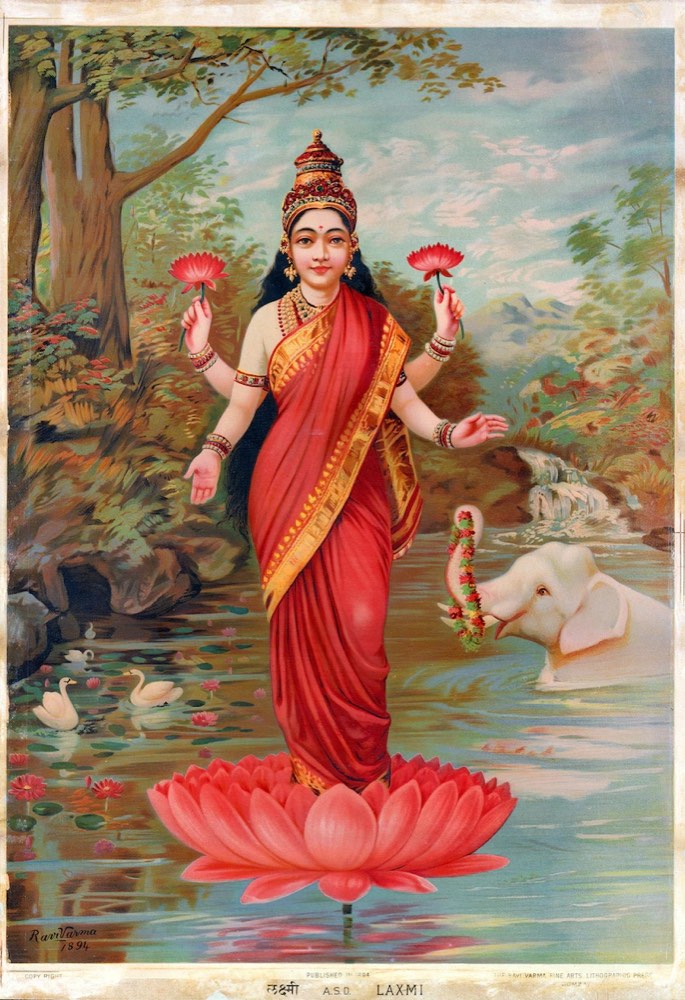
The Lakṣmī Chālīsā (लक्ष्मी चालीसा, “Forty Verses to Lakṣmī”) is one of the most widely recited devotional hymns in Hindu worship, comprising forty verses (chaupāī) dedicated to Goddess Lakṣmī — the divine consort of Lord Viṣṇu and the supreme embodiment of wealth (dhana), prosperity (samṛddhi), fortune (saubhāgya), beauty (saundarya), and grace (kṛpā). Recited by millions of Hindus during Dīpāvalī, on Fridays, and on Kojāgarī Pūrṇimā, the Lakṣmī Chālīsā occupies a central place in the devotional landscape of North India, serving as a bridge between the ancient Vedic hymns to Śrī and the living traditions of popular worship.
Origins and Attribution
The Lakṣmī Chālīsā is traditionally attributed to Paṇḍit Rāmdās, a devotional poet in the Vaiṣṇava tradition, though — like many chālīsā texts — the precise historical identity of the author remains uncertain. The language of the composition is a blend of Awadhī and Braj Bhāṣā Hindi, consistent with the devotional poetry of the 17th to 19th centuries CE. Some scholars have also attributed the text to Paṇḍit Sundaradās, though this claim lacks firm textual evidence.
What is certain is that the Lakṣmī Chālīsā draws its theological content from several major scriptural sources:
- The Śrī Sūktam — the ancient Vedic hymn to Goddess Śrī (Lakṣmī) from the Ṛg Veda Khilāni, which is the earliest literary celebration of Lakṣmī as the goddess of prosperity, beauty, and royal splendour.
- The Viṣṇu Purāṇa (1.8–9) — which narrates the emergence of Lakṣmī from the churning of the cosmic ocean (samudra-manthana) and establishes her eternal relationship with Viṣṇu.
- The Padma Purāṇa and Skanda Purāṇa — which contain extensive sections devoted to Lakṣmī worship, including her 108 names (aṣṭottara śatanāmāvalī) and the theology of the Aṣṭa Lakṣmī.
- The Lakṣmī Tantra — a Pāñcarātra Āgama text that presents Lakṣmī as Viṣṇu’s creative power (śakti) and the source of all manifested existence.
The Lakṣmī Chālīsā condenses the vast theological traditions surrounding the Goddess into an accessible, rhythmic Hindi composition that could be recited by anyone, regardless of Sanskrit learning or ritual training — a hallmark of the Bhakti movement’s democratising spirit.
Structure of the Lakṣmī Chālīsā
The Lakṣmī Chālīsā follows the standard chālīsā format established most famously by Tulasīdāsa’s Hanumān Chālīsā:
1. Opening Dohā (Couplets)
The hymn begins with invocatory couplets (dohā) that establish the mood of humble supplication. The poet invites Goddess Lakṣmī to take residence in the devotee’s heart:
मातु लक्ष्मी करि कृपा, करो हृदय में वास। मनोकामना सिद्ध करि, पुरवहु मेरी आस॥
O Mother Lakṣmī, bestow your grace and dwell within my heart. Fulfil my heart’s desires and satisfy my hopes.
This is followed by a soraṭhā (inverted dohā):
यही मोर अरदास, हाथ जोड़ विनती करुँ। सब विधि करौ सुवास, जय जननी जगदंबिका॥
This alone is my prayer, with folded hands I make this plea. In every way bestow your fragrant blessings, victory to you, O Mother of the Universe.
The opening dohā immediately establishes the two central themes of the Chālīsā: kṛpā (divine grace) and hṛdaya-vāsa (dwelling in the heart) — the idea that true prosperity begins not with external wealth but with the Goddess’s inner presence.
2. Forty Chaupāī (Quatrains)
The body of the hymn consists of forty four-line verses in the chaupāī metre, the same metre used in Tulasīdāsa’s Rāmacaritamānasa. The chaupāī is characterized by sixteen mātrā (syllabic units) per line, creating a natural, rhythmic cadence suited to both individual recitation and congregational singing.
The chaupāī section opens with the celebrated invocation:
सिंधु सुता मैं सुमिरौं तोही। ज्ञान बुद्धि विद्या दो मोही॥ तुम समान नहिं कोई उपकारी। सब विधि पुरवहु आस हमारी॥
O Daughter of the Ocean, I remember you. Grant me knowledge, intellect, and learning. There is none as beneficent as you. In every way, fulfil our hopes.
The address Sindhu Sutā (“Daughter of the Ocean”) is one of Lakṣmī’s most important epithets, referring to her mythological origin from the samudra-manthana — the churning of the Milk Ocean by the gods and demons. According to the Viṣṇu Purāṇa (1.9), when the ocean was churned, Lakṣmī emerged radiant and beautiful, seated on a lotus, choosing Viṣṇu as her eternal consort. This epithet thus encapsulates the Goddess’s cosmic origin and her inseparable bond with the Preserver deity.
3. Closing Dohā (Phala-śruti)
The hymn concludes with couplets containing the phala-śruti — the declaration of the fruits (phala) that accrue from sincere recitation:
त्राहि त्राहि दुखहारिणी, हरहु वेगि सब त्रास। जयति जयति जय लक्ष्मी, करहु शत्रु का नास॥
Protect me, protect me, O Remover of Sorrow, swiftly remove all fears. Victory, victory, victory to Lakṣmī — destroy our enemies.
The closing verses promise that anyone who recites the Lakṣmī Chālīsā with faith for forty days (chālīsa dina) — a number symbolically mirroring the forty verses — will receive the Goddess’s grace: wealth, health, progeny, and ultimately liberation (mukti).
Key Verse Themes and Meanings
Lakṣmī’s Cosmic Identity
The Chālīsā celebrates Lakṣmī in her fullest theological dimensions. She is addressed as:
- Jagadambikā (जगदंबिका) — “Mother of the Universe,” affirming her as the cosmic source of all creation
- Sindhu Sutā (सिंधु सुता) — “Daughter of the Ocean,” referencing the samudra-manthana
- Viṣṇupriyā (विष्णुप्रिया) — “Beloved of Viṣṇu,” establishing her inseparable identity with the Supreme
- Kṣīrasāgara Bālinī — “Dweller of the Milk Ocean,” referring to her celestial abode on Viṣṇu’s serpent-couch (śeṣa-śayyā) in the Ocean of Milk
The Iconography of the Goddess
Several chaupāī verses describe Lakṣmī’s visual form in rich detail, consistent with her traditional iconography:
- Four hands (caturbhujā) symbolising the four goals of human life: dharma (righteousness), artha (wealth), kāma (desire), and mokṣa (liberation)
- Lotus seat (padmāsanā) — the Goddess seated on an open lotus symbolising purity, beauty, and spiritual unfolding amidst the muddy waters of worldly existence
- Red garments (raktāmbarā) — representing active energy, fertility, and the creative power of nature
- Gold ornaments — signifying material prosperity and divine radiance
- White elephants (gaja) flanking the Goddess, pouring water from golden vessels — the celebrated Gaja Lakṣmī motif representing abundance, royal authority, and the blessings that flow from devoted worship
The Eight Forms of Lakṣmī (Aṣṭa Lakṣmī)
A significant theological thread in the Lakṣmī Chālīsā is the celebration of Aṣṭa Lakṣmī — the eight forms of Lakṣmī, each presiding over a distinct dimension of prosperity. While not all eight are named explicitly in every recension, the Chālīsā’s verses allude to the gifts that each form bestows:
-
Ādi Lakṣmī (आदि लक्ष्मी) — The Primordial Lakṣmī, the original form who serves and supports the spiritual aspirant’s journey toward liberation. She embodies compassion and eternal service.
-
Dhana Lakṣmī (धन लक्ष्मी) — The Lakṣmī of Wealth, who bestows monetary prosperity and material abundance. The Chālīsā’s repeated requests for dhana and sampatti invoke this form.
-
Dhānya Lakṣmī (धान्य लक्ष्मी) — The Lakṣmī of Grain, who ensures agricultural plenty and freedom from hunger. She represents the wealth of nourishment and sustenance.
-
Gaja Lakṣmī (गज लक्ष्मी) — The Lakṣmī of Elephants, who restores lost kingdoms and bestows power, prestige, and royal authority. The elephants flanking Lakṣmī in her iconography represent this form.
-
Santāna Lakṣmī (संतान लक्ष्मी) — The Lakṣmī of Progeny, who blesses devotees with healthy, virtuous children. The Chālīsā’s promise of putra-prāpti (obtaining sons) invokes this form.
-
Vīra Lakṣmī (वीर लक्ष्मी) — The Lakṣmī of Courage, also known as Dhairya Lakṣmī, who grants the strength and valour necessary to overcome obstacles on both material and spiritual paths.
-
Vijaya Lakṣmī (विजय लक्ष्मी) — The Lakṣmī of Victory, who ensures success in all righteous endeavours. The Chālīsā’s invocations of jayati jayati (“victory, victory”) resonate with this form.
-
Vidyā Lakṣmī (विद्या लक्ष्मी) — The Lakṣmī of Knowledge, who bestows intellectual and spiritual wisdom. The opening chaupāī’s request for jñāna, buddhi, and vidyā directly invokes this form.
The Aṣṭa Lakṣmī theology affirms that true prosperity is not merely financial — it encompasses health, knowledge, courage, progeny, victory, spiritual advancement, and ultimately liberation itself. The Lakṣmī Chālīsā, by invoking all these dimensions, offers a holistic vision of divine abundance.
Occasions for Recitation
Dīpāvalī (Diwali)
The most significant occasion for reciting the Lakṣmī Chālīsā is Dīpāvalī, the Festival of Lights, observed on the amāvasyā (new moon) of the month of Kārtika (October–November). On this night, Hindus across India perform Lakṣmī Pūjā — a formal worship of the Goddess with lamps, flowers, sweets, and recitation of Lakṣmī hymns. The Chālīsā is recited during or after the pūjā, often alongside the Lakṣmī Ārtī and the Śrī Sūktam.
The association of Lakṣmī with Dīpāvalī has multiple mythological roots. According to the Rāmāyaṇa tradition, Dīpāvalī celebrates the return of Lord Rāma (an avatāra of Viṣṇu) to Ayodhyā after defeating Rāvaṇa, and Lakṣmī — as Sītā — returns with him. The Purāṇic tradition holds that Lakṣmī emerged from the cosmic ocean on the Kārtika amāvasyā, and this is the night when she is believed to visit and bless homes that are clean, well-lit, and filled with devotion.
Fridays (Śukravāra)
Friday is traditionally sacred to Goddess Lakṣmī in the Hindu calendar. Many householders, particularly women, observe a Śukravāra Vrata (Friday fast) dedicated to Lakṣmī, during which the Chālīsā is recited along with the Lakṣmī Aṣṭottara and the Lakṣmī Ārtī. The association of Friday with Lakṣmī derives from the planet Śukra (Venus), which governs beauty, wealth, and material comfort — qualities associated with the Goddess.
Kojāgarī Pūrṇimā (Śārada Pūrṇimā)
Kojāgarī Pūrṇimā, the full-moon night of the month of Āśvina (September–October), is one of the most auspicious nights for Lakṣmī worship. The name derives from the Sanskrit phrase ko jāgarti? (“Who is awake?”) — a question that Goddess Lakṣmī is believed to ask as she traverses the earth on this luminous night. Those whom she finds awake in devotion receive her blessings of prosperity and grace.
In Bengal, this night is celebrated as Kojāgarī Lakṣmī Pūjā, a major autumn festival distinct from Dīpāvalī. Bengali households prepare cirer payesh (flattened rice pudding) as an offering and stay awake through the night playing games and reciting Lakṣmī hymns. In Maharashtra and Gujarat, the same night is observed as Śārada Pūrṇimā, with devotees drinking milk left under the moonlight, believed to be infused with amṛta (the nectar of immortality).
Navarātra and Other Occasions
The Lakṣmī Chālīsā is also recited on the eighth day of Navrātri, which is dedicated to the Goddess in her form as Mahālakṣmī. Additionally, the Chālīsā forms part of daily devotional practice for many Vaiṣṇava households, particularly in Uttar Pradesh, Bihar, Madhya Pradesh, and Rajasthan, where it is recited during morning or evening pūjā.
Theological Significance
Lakṣmī as Viṣṇu’s Śakti
The Lakṣmī Chālīsā, in accord with Vaiṣṇava theology, presents Lakṣmī not merely as Viṣṇu’s consort but as his śakti — the dynamic, creative power through which the Supreme Lord sustains and nourishes the cosmos. The Lakṣmī Tantra (a Pāñcarātra text) teaches that Viṣṇu and Lakṣmī are inseparable, like fire and heat, or a word and its meaning. Wherever Viṣṇu incarnates — as Rāma, as Kṛṣṇa, as Narasiṃha — Lakṣmī accompanies him: as Sītā, as Rukmiṇī, as Sūryamūkhī. The Chālīsā celebrates this eternal togetherness, addressing the Goddess as Viṣṇupriyā and Nārāyaṇī.
Material and Spiritual Prosperity
Unlike purely renunciatory traditions that treat wealth as an obstacle to spiritual progress, the Lakṣmī Chālīsā affirms the positive value of material prosperity when pursued with righteousness (dharma). The Goddess grants artha (wealth) and kāma (desire) as legitimate goals of human life, alongside dharma and mokṣa. This theological position is rooted in the Puruṣārtha doctrine — the four aims of human existence — which treats material well-being not as antithetical to spiritual growth but as its necessary foundation.
The Chālīsā is careful, however, to frame prosperity within a devotional context. Wealth is not sought for its own sake but as a manifestation of the Goddess’s grace (kṛpā). The closing verses remind the devotee that the ultimate fruit of Lakṣmī worship is not mere riches but liberation (mukti) — the soul’s return to its divine source.
Grace and Accessibility
Like all chālīsā texts, the Lakṣmī Chālīsā emphasises the accessibility of divine grace. The Goddess does not require elaborate Vedic rituals, expensive offerings, or Brahmanical intermediaries. She responds to sincere devotion (bhakti), heartfelt supplication (vinatī), and regular recitation (pāṭha). The phala-śruti promises that even the poorest, most suffering devotee — the blind, the deaf, the leper, the destitute — can receive the Goddess’s grace through faithful recitation for forty days.
This democratic theology was revolutionary in its historical context, opening the gates of divine prosperity to all castes, genders, and social classes — a core principle of the Bhakti movement that gave birth to the chālīsā genre.
Comparison with Other Lakṣmī Devotional Texts
Śrī Sūktam
The Śrī Sūktam is the most ancient hymn to Lakṣmī, appended to the Ṛg Veda Khilāni. Composed in Vedic Sanskrit, it celebrates Śrī (Lakṣmī) as the golden goddess of abundance, beauty, and royal fortune. While the Śrī Sūktam is a short, concentrated Sanskrit text requiring proper pronunciation and ritual context, the Lakṣmī Chālīsā is a longer, more accessible Hindi composition designed for popular devotion. The two texts complement each other: the Śrī Sūktam provides the ancient Vedic foundation, while the Chālīsā translates its theology into the language and metre of everyday worship.
Lakṣmī Aṣṭottara Śatanāmāvalī
The Lakṣmī Aṣṭottara (108 names of Lakṣmī) is a systematic enumeration of the Goddess’s epithets, each revealing a specific aspect of her divine nature. The Aṣṭottara is primarily a japa text — designed for meditative repetition with a rosary — while the Chālīsā is a stotra (hymn of praise) designed for recitative singing. In practice, devotees often combine both: reciting the Chālīsā for its narrative richness and emotional devotion, then performing the Aṣṭottara for focused contemplation of each divine name.
Lakṣmī Ārtī
The Lakṣmī Ārtī (“Oṃ Jaya Lakṣmī Mātā”) is a shorter devotional song typically sung at the conclusion of Lakṣmī Pūjā, accompanied by the waving of a lighted lamp (ārtī). While the Ārtī is a brief, joyful celebration, the Chālīsā is a more substantial theological composition. In most worship settings, the Chālīsā is recited first as the main devotional text, followed by the Ārtī as the closing ritual act.
Kanakadhārā Stotram
Ādi Śaṅkarācārya’s Kanakadhārā Stotram (“Hymn of the Golden Rain”) is a celebrated Sanskrit composition in which the philosopher-saint invoked Lakṣmī to shower gold upon a poor Brahmin woman who had offered him her last piece of fruit. While the Kanakadhārā is a sophisticated Sanskrit poem of high literary merit, the Lakṣmī Chālīsā serves the same devotional purpose in the vernacular — making the Goddess’s blessings accessible to those without Sanskrit education.
The Chālīsā Tradition and Lakṣmī Worship
The word chālīsā derives from the Hindi chālīs (चालीस), meaning “forty.” The chālīsā is a distinctively North Indian devotional genre that emerged during the Bhakti movement, characterised by:
- Fixed length: Exactly forty chaupāī verses, framed by dohā couplets
- Vernacular language: Composed in Awadhī, Braj Bhāṣā, or Khaṛī Bolī Hindi
- Accessible theology: Complex philosophical ideas expressed in simple, memorable verse
- Musical recitability: The chaupāī metre creates a natural rhythm suited to both solo and congregational recitation
The most famous chālīsā is the Hanumān Chālīsā of Tulasīdāsa, but the tradition encompasses dozens of texts. Among the goddess chālīsās, the Lakṣmī Chālīsā and the Durgā Chālīsā are the most widely recited. While the Durgā Chālīsā celebrates the fierce, protective aspects of the Divine Mother, the Lakṣmī Chālīsā celebrates her benevolent, nourishing, prosperity-bestowing nature — together, they represent complementary dimensions of Devī worship.
Recitation Practice and Benefits
Traditional guidelines for reciting the Lakṣmī Chālīsā include:
- Daily recitation during morning or evening pūjā, ideally facing east or north before an image or idol of the Goddess
- Lighting a ghee lamp (dīpa) and offering red flowers, kumkum, and sweets before beginning
- Recitation in multiples: Devotees may recite the Chālīsā 1, 5, 11, 21, 51, or 108 times depending on the intensity of their sādhana (spiritual practice)
- Forty-day vow (chālīsa-dina vrata): A sustained practice of daily recitation for forty consecutive days, believed to invoke the Goddess’s manifest grace
The traditional phala-śruti promises that sincere recitation brings freedom from disease, the blessing of children, the removal of poverty, protection from enemies, and ultimately spiritual liberation. These promises are understood not as magical guarantees but as expressions of faith in the transformative power of sustained devotion.
Conclusion
The Lakṣmī Chālīsā is far more than a prayer for material wealth — it is a comprehensive devotional text that celebrates the Goddess of Prosperity in all her dimensions: as the ocean-born beauty who chose Viṣṇu, as the Ādi Lakṣmī who guides souls toward liberation, as the Dhana Lakṣmī who removes poverty, and as the Vidyā Lakṣmī who illuminates the mind with knowledge. In its forty verses, the Chālīsā weaves together Vedic theology, Purāṇic mythology, Vaiṣṇava devotion, and the intimate, heartfelt supplication of a devotee seeking not just gold but grace. For the millions who recite it — on Dīpāvalī nights, on Friday mornings, on the moonlit Kojāgarī Pūrṇimā — the Lakṣmī Chālīsā remains a living scripture, a doorway through which the Goddess enters and blesses the human heart.