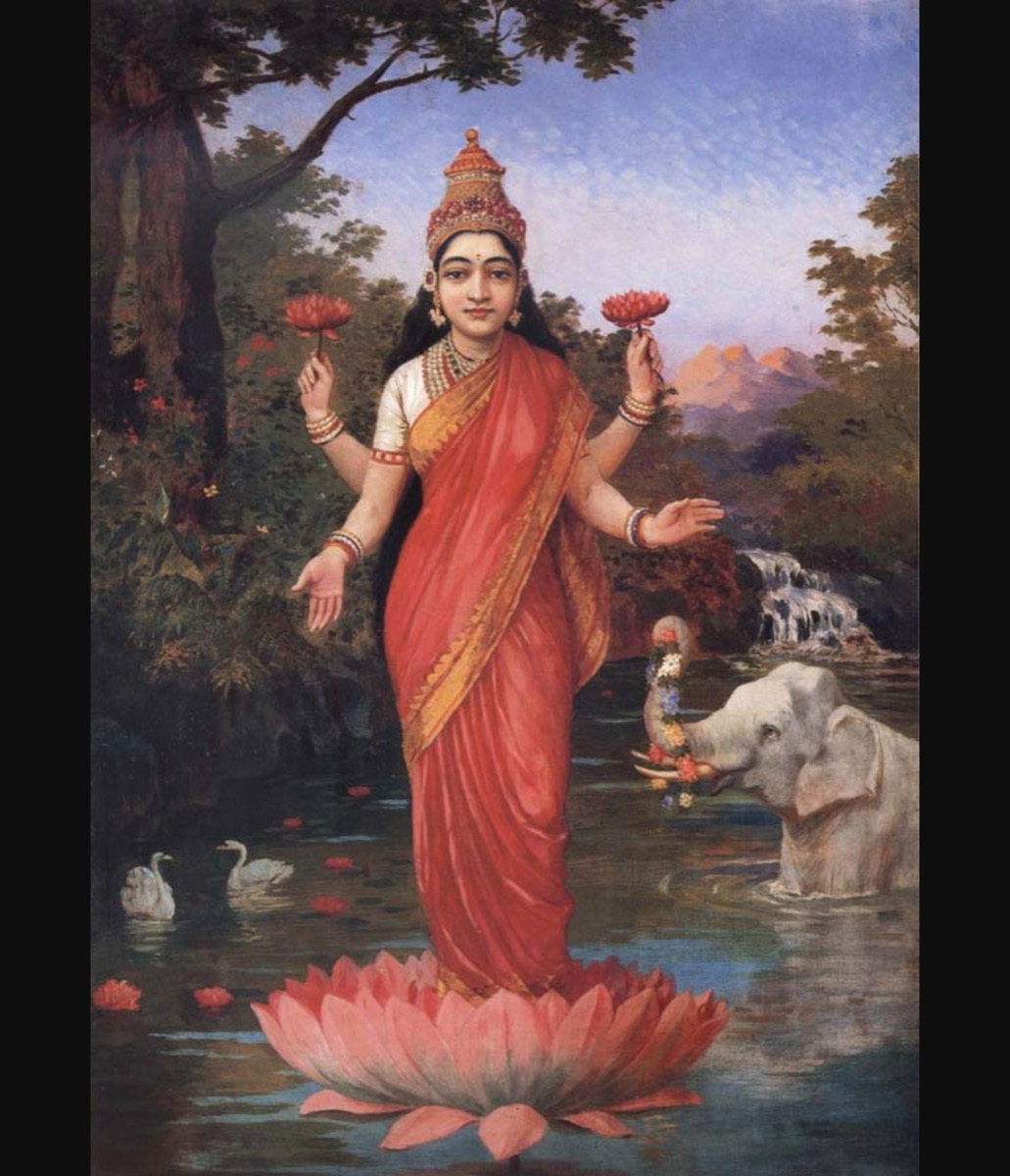
The Lakṣmī Aṣṭottara Śatanāmāvalī (लक्ष्मी अष्टोत्तर शतनामावली, “the garland of 108 names of Lakṣmī”) is one of the most widely recited devotional hymns in Hindu worship, enumerating 108 sacred names of Goddess Lakṣmī — the divine consort of Lord Viṣṇu and the supreme embodiment of wealth (dhana), prosperity (samṛddhi), beauty (saundarya), grace (kṛpā), and spiritual abundance (aiśvarya). The practice of chanting 108 names (aṣṭottara śatanāma) is one of the most ancient and revered forms of Hindu devotion, rooted in the belief that each name of the divine carries a specific vibrational power (nāma-śakti) that invokes and manifests the corresponding aspect of the deity in the devotee’s life.
The Tradition of 108 Names
Significance of the Number 108
The number 108 holds profound sacred significance in Hindu cosmology, mathematics, and spiritual practice. The Sūrya Siddhānta, the foundational text of Indian astronomy, records that the distance between the Sun and the Earth is approximately 108 times the Sun’s diameter, and the distance between the Moon and the Earth is approximately 108 times the Moon’s diameter. The Sanskrit alphabet contains 54 letters, each with a masculine (śiva) and feminine (śakti) aspect, yielding 108. The 27 nakṣatras (lunar mansions) each have 4 pādas (quarters), yielding 108. The mālā (rosary) used for japa (repetitive chanting) traditionally has 108 beads.
The aṣṭottara śatanāma tradition — the enumeration of 108 names — exists for virtually every major Hindu deity: Viṣṇu, Śiva, Gaṇeśa, Sarasvatī, Hanumān, and many others. These name-lists serve simultaneously as theological catalogues (defining the deity’s attributes and powers), devotional aids (providing structure for meditative repetition), and protective incantations (kavaca) believed to shield the devotee from misfortune.
Purāṇic Sources
The Lakṣmī Aṣṭottara Śatanāmāvalī draws from multiple Purāṇic sources, primarily the Padma Purāṇa and the Skanda Purāṇa, both of which contain extensive sections devoted to the glorification of Lakṣmī. The Padma Purāṇa (Uttara Khaṇḍa) provides one of the most authoritative lists of Lakṣmī’s 108 names, framed as a teaching from the sage Nārada to the devotees seeking prosperity and divine grace. The Skanda Purāṇa (Viṣṇu Khaṇḍa) offers a complementary list with some variations, reflecting regional and sectarian diversity in Lakṣmī worship.
The Viṣṇu Purāṇa (1.8–9), while not providing the full aṣṭottara, contains the foundational mythological account of Lakṣmī’s emergence from the churning of the cosmic ocean (samudra-manthana) and her eternal relationship with Viṣṇu, which provides the theological basis for many of her 108 names.
Key Epithets and Their Meanings
The 108 names of Lakṣmī can be grouped thematically to reveal the multiple dimensions of her divine nature:
Names Related to the Lotus (Padma)
The lotus (padma) is the primary symbol of Lakṣmī, appearing in nearly every visual representation and in numerous names:
- Padmā (पद्मा) — “She who is the lotus” — the most iconic name, identifying Lakṣmī with the lotus that blooms in muddy water yet remains immaculate, symbolizing spiritual purity amidst worldly existence.
- Padmālayā (पद्मालया) — “She whose abode is the lotus” — referring to her iconographic seat on a fully-bloomed lotus.
- Padmapriyā (पद्मप्रिया) — “She who loves the lotus” — indicating her intimate association with the flower.
- Padmamukhī (पद्ममुखी) — “She whose face is like a lotus” — a standard poetic epithet for divine beauty.
- Padmahastā (पद्महस्ता) — “She who holds a lotus in her hand” — describing her most common iconographic attribute.
- Kamalā (कमला) — “She of the lotus” — one of the most popular names, used as an independent name for Lakṣmī in many traditions. Kamalā is also one of the ten Mahāvidyās (great wisdom goddesses) in the Śākta tradition.
Names Related to Wealth and Prosperity
- Śrī (श्री) — “Prosperity, beauty, grace” — the most fundamental and ancient name of Lakṣmī, so closely identified with her that she is often called simply “Śrī.” The Vedic Śrī Sūktam (an appendix to the Ṛgveda) is the oldest hymn addressed to the goddess of prosperity.
- Dhanadhānyakī (धनधान्यकी) — “She who bestows wealth and grain.”
- Siddhi (सिद्धि) — “Accomplishment, perfection” — she who grants the successful completion of all endeavours.
- Hiraṇmayyī (हिरण्मयी) — “She who is golden” — connecting Lakṣmī with gold, the metal of permanence and purity.
- Lakṣmī (लक्ष्मी) — “She who is the goal/mark” — from the Sanskrit root lakṣ (to perceive, observe), indicating she is the ultimate aim of human aspiration.
- Vibhūti (विभूति) — “Divine splendour, power” — she who is the manifest glory of the Supreme.
Names Related to Viṣṇu
- Haripriyā (हरिप्रिया) — “The beloved of Hari (Viṣṇu)” — affirming her eternal conjugal relationship with the Supreme Lord.
- Viṣṇupatnī (विष्णुपत्नी) — “The wife of Viṣṇu.”
- Vaiṣṇavī (वैष्णवी) — “She who belongs to Viṣṇu.”
- Nārāyaṇī (नारायणी) — “She who is the śakti of Nārāyaṇa.”
Names Related to Cosmic Functions
- Prakṛti (प्रकृति) — “Primordial nature” — identifying Lakṣmī with the fundamental creative principle of the universe.
- Vikṛti (विकृति) — “Transformation” — she who drives cosmic evolution.
- Vidyā (विद्या) — “Knowledge” — she who is the form of all knowledge.
- Sarvabhūtahitapradā (सर्वभूतहितप्रदा) — “She who grants welfare to all beings.”
- Śraddhā (श्रद्धा) — “Faith” — she who is the form of devotional faith.
Names Related to Purity and Nourishment
- Sudhā (सुधा) — “Nectar” — she who is the divine ambrosia.
- Svāhā (स्वाहा) — the sacred exclamation that accompanies all Vedic fire offerings, identifying Lakṣmī with the very act of sacrifice.
- Svadhā (स्वधा) — the offering to the ancestors, connecting Lakṣmī with ancestral blessings.
- Nityapuṣṭā (नित्यपुष्टा) — “She who is eternally nourished” — indicating her inexhaustible abundance.
Connection to Friday Lakṣmī Pūjā
Friday (Śukravāra) is the day sacred to Goddess Lakṣmī in the Hindu calendar. The word Śukra refers to the planet Venus, which governs beauty, love, wealth, and material comfort — all domains of Lakṣmī’s sovereignty. The recitation of the Lakṣmī Aṣṭottara Śatanāmāvalī is a central component of Friday Lakṣmī pūjā, a weekly domestic worship observed by millions of Hindu households, particularly in South India and among Śrī Vaiṣṇava communities.
The Friday pūjā typically begins with the lighting of a lamp (dīpa), the offering of flowers (especially lotus, marigold, and jasmine), the recitation of the Śrī Sūktam (the Vedic hymn to Lakṣmī), followed by the chanting of the 108 names, and concludes with the distribution of prasāda (especially pongal, payasam, or fruits). Many households observe a partial fast on Friday, consuming only vegetarian food and abstaining from certain items, as a mark of devotion to the Goddess.
The 108 names are chanted with each name accompanied by the offering of a flower, a pinch of turmeric (haridrā), or a grain of rice — creating a physical “garland” (mālā) of offerings that mirrors the verbal garland of names.
Use in Dīpāvalī (Diwali) Worship
The Lakṣmī Aṣṭottara Śatanāmāvalī reaches its peak importance during Dīpāvalī (Diwali), the festival of lights, when Lakṣmī pūjā is the central religious observance. On the main night of Dīpāvalī (the amāvasyā or new moon night of the month of Kārttika), households perform an elaborate Lakṣmī pūjā that includes the chanting of the 108 names as a core liturgical element.
The theological connection between Lakṣmī and Dīpāvalī is rooted in the Padma Purāṇa and Skanda Purāṇa narratives that describe how Lakṣmī emerged from the cosmic ocean during the samudra-manthana on the night of kārttika amāvasyā, and how she chose Viṣṇu as her eternal consort on that auspicious night. The lighting of lamps on Dīpāvalī is understood as an invitation to Lakṣmī to enter the home — and the chanting of her 108 names ensures that she is welcomed with the fullness of devotion.
In the merchant communities of Gujarat, Rajasthan, and North India, Dīpāvalī also marks the beginning of the new financial year, and the Lakṣmī Aṣṭottara is chanted over account books, ledgers, and business premises as a prayer for commercial prosperity in the coming year.
Significance in Śrī Vaiṣṇava Tradition
The Lakṣmī Aṣṭottara Śatanāmāvalī holds a position of special theological importance in the Śrī Vaiṣṇava tradition founded by Rāmānujācārya (1017–1137 CE). In Śrī Vaiṣṇava theology, Lakṣmī (Śrī) is not merely a consort or subordinate deity but is the divine mediatrix (puruṣakāra) between the individual soul (jīvātman) and the Supreme Lord (Paramātman). She is the one who intercedes on behalf of the devotee, recommending the erring soul to Viṣṇu’s grace — much as a mother intercedes with a father on behalf of a wayward child.
The concept of Śrī as the co-equal partner of Nārāyaṇa is central to the Śrī Vaiṣṇava understanding of the divine. The compound Śrīman Nārāyaṇa — “Nārāyaṇa who is eternally accompanied by Śrī” — is the fundamental theological formula of the tradition. Lakṣmī’s 108 names, in this context, are not merely devotional epithets but theological propositions about the nature of divine grace, beauty, and redemptive power.
In the daily worship at Śrī Vaiṣṇava temples — particularly the great temples at Śrīraṅgam, Tirumala, and Kāñcīpuram — the Lakṣmī Aṣṭottara is recited as part of the regular liturgical cycle, alongside the Viṣṇu Sahasranāma and the hymns of the Āḻvār poet-saints. The Pāñcarātra Āgama texts, which govern Śrī Vaiṣṇava temple rituals, prescribe the recitation of the 108 names during the abhiṣeka (ritual bathing) of the Lakṣmī image and during the utsava (festival) processional worship.
Method of Chanting
Preparation
The traditional method of chanting the Lakṣmī Aṣṭottara involves the following preparation:
- Ācamana (ritual sipping of water for purification)
- Saṅkalpa (formal declaration of intent)
- Dhyāna (meditation on the form of Lakṣmī — seated on a lotus, golden-complexioned, four-armed, holding lotuses, with elephants performing abhiṣeka on either side)
- Recitation of the 108 names, each preceded by “Oṃ” and followed by “Namaḥ” (I bow)
- Phala-śruti (recitation of the promised benefits)
Benefits Described in Tradition
The Purāṇic phala-śruti (promise of fruits) associated with the Lakṣmī Aṣṭottara states that regular recitation brings: freedom from poverty (dāridrya-nāśana), the blessing of progeny, marital harmony, protection from misfortune, success in business and education, and ultimately, mokṣa (liberation). The Padma Purāṇa specifically states that one who chants the 108 names of Lakṣmī with devotion on a Friday, seated on a red cloth, facing east, with a ghee lamp burning, will never know want in this life or the next.
Lakṣmī in Broader Hindu Theology
The 108 names collectively paint a portrait of Lakṣmī that transcends the popular understanding of her as merely a “goddess of money.” She is Prakṛti (primordial nature), Vidyā (knowledge), Śraddhā (faith), Svāhā (sacred offering), Kṣamā (forgiveness), and Tuṣṭi (contentment). These names reveal that true wealth, in the Hindu understanding, encompasses not just material abundance but knowledge, faith, compassion, contentment, and spiritual liberation.
The Śrī Sūktam — the oldest Vedic hymn to Lakṣmī, appended to the Ṛgveda — establishes the template for this comprehensive understanding: “hiraṇyavarṇāṃ hariṇīṃ suvarṇarajatasrajām” — she is “golden-hued, deer-like, adorned with garlands of gold and silver.” But the same hymn also calls her “ārdrāṃ puṣkariṇīṃ puṣṭiṃ” — “moist, full of lotuses, nourishing” — connecting wealth with the fertility of the earth and the sustaining power of water.
The Lakṣmī Aṣṭottara Śatanāmāvalī, by enumerating 108 dimensions of the Goddess, invites the devotee into a relationship with the divine that is simultaneously material and spiritual, worldly and transcendent — a relationship in which the pursuit of prosperity is sanctified by devotion and the attainment of wealth is inseparable from the cultivation of virtue.