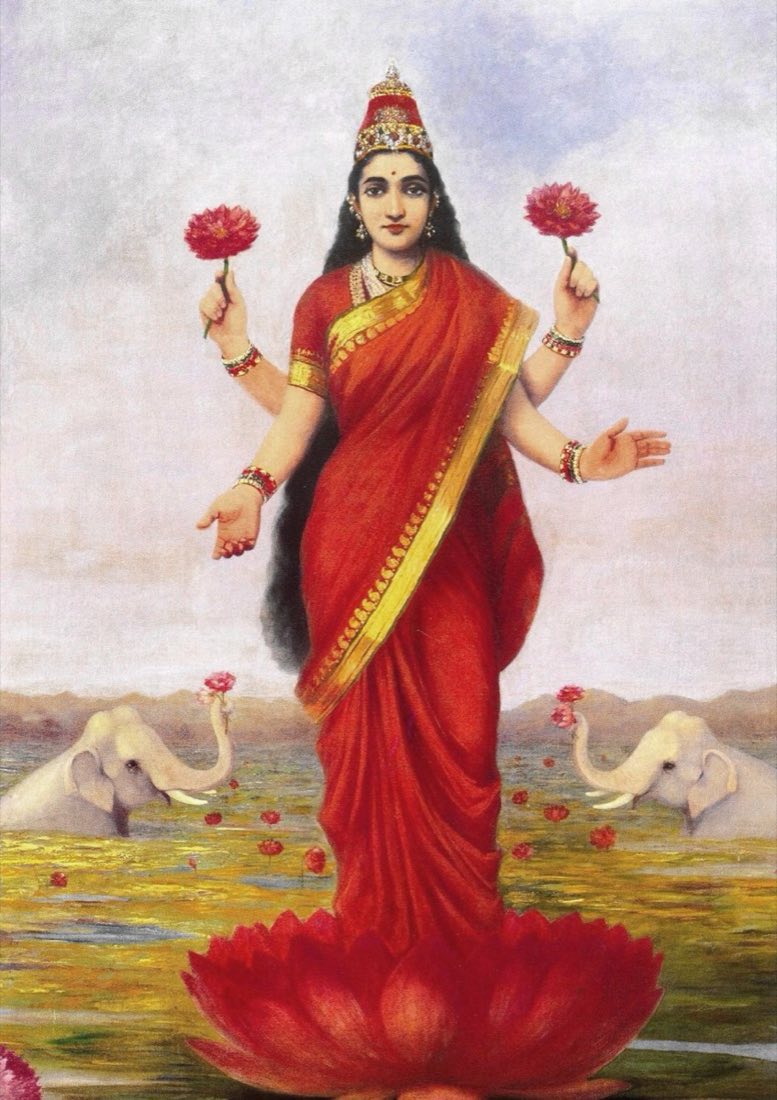
The Kanakadharā Stotram (“Hymn of the Golden Stream”) is a celebrated 21-verse Sanskrit hymn composed by Ādi Śaṅkarācārya (c. 788-820 CE), addressed to Goddess Lakṣmī — the divine consort of Lord Viṣṇu and the embodiment of prosperity, fortune, beauty, and grace. The name kanakadharā literally means “stream (dhārā) of gold (kanaka)”, referring to the miraculous shower of golden gooseberries that is said to have occurred when the young Śaṅkara completed this hymn.
The Kanakadharā Stotram is remarkable for its poetic beauty, theological depth, and the touching legend of compassion that surrounds its creation — a story that reveals Śaṅkara not merely as a philosopher but as a saint whose devotion moved the Goddess herself to intervene in the material world.
The Complete First Verse
अङ्गं हरेः पुलकभूषणमाश्रयन्ती भृङ्गाङ्गनेव मुकुलाभरणं तमालम्। अङ्गीकृताखिलविभूतिरपाङ्गलीला माङ्गल्यदास्तु मम मङ्गलदेवतायाः॥१॥
IAST Transliteration: Aṅgaṃ hareḥ pulakabhūṣaṇam āśrayantī bhṛṅgāṅganeva mukulābharaṇaṃ tamālam | Aṅgīkṛtākhilavibhūtir apāṅgalīlā māṅgalyadāstu mama maṅgaladevtāyāḥ ||1||
Translation: “She who rests upon the body of Hari (Viṣṇu), which is adorned with the jewels of divine ecstasy (goosebumps), like a female bee resting upon a tamāla tree adorned with flower buds — may the playful sidelong glance of that Goddess of auspiciousness, who has embraced all divine glory, grant me auspiciousness.”
The Legend of the Golden Āmalakī
The story behind the composition of the Kanakadharā Stotram is one of the most beloved episodes in the hagiographies (vijaya) of Ādi Śaṅkarācārya.
According to the Mādhavīya Śaṅkaravijaya and other biographical accounts, after young Śaṅkara received his sacred thread (upanayana) and began his life as a Vedic student (brahmacārī), he was required to beg for his daily food (bhikṣā) — a traditional practice for all students in the Gurukula system.
One day, the young Śaṅkara came to the door of a Brāhmaṇa woman who was so impoverished that she had absolutely nothing to offer him. Deeply embarrassed and pained by her inability to give alms to a student of the Vedas, she searched her entire house and could find only a single dry gooseberry (āmalakī or dhātrī phala). Despite her extreme poverty, she offered this last morsel to the boy with a heart full of devotion and selfless generosity.
Moved to tears by the woman’s extraordinary sacrifice — giving her last possession to a stranger when she herself had nothing — the young Śaṅkara composed the 21 verses of the Kanakadharā Stotram on the spot, praying to Goddess Lakṣmī to relieve the woman’s poverty.
As he completed the final verse, it is said that Lakṣmī, pleased by both the woman’s selfless charity and Śaṅkara’s compassionate prayer, caused a rain of golden āmalakī fruits (kanaka dhātrī phala) to shower down upon the woman’s humble dwelling, transforming her life of poverty into one of abundance.
This legend beautifully illustrates several Hindu principles:
- Dāna (charity) is powerful even — especially — when the giver has nothing
- Compassion (karuṇā) for others’ suffering moves the divine to act
- Devotion (bhakti) has the power to produce tangible results in the world
- The true saint works not for self-liberation alone but for the welfare of all beings
Structure and Poetic Form
The Kanakadharā Stotram consists of 21 verses (ślokas) composed in the Vasantatilakā metre — a classical metre of 14 syllables per quarter (pāda), with the pattern: ta-ta-ja-ga-ga (– – – ∪ – – ∪ – ∪ – – ∪ – –). This metre is celebrated for its elegance and is often used for hymns praising feminine beauty and divine grace.
Each verse centres on one or more aspects of Goddess Lakṣmī — her beauty, her relationship with Viṣṇu, her cosmic functions, or her compassionate nature — and concludes with a prayer requesting her grace.
Key Verses and Their Meanings
Verse 2: Lakṣmī’s Eyes as Instruments of Grace
कामं प्रतिदिनमुदारसद्गुणैरमन्दानुग्रहनैपुणैः।
The second verse describes Lakṣmī’s eyes as the instruments through which she distributes divine grace. Her glance (kaṭākṣa) is not merely beautiful but functionally powerful — it is through her sidelong looks that prosperity flows to devotees. This concept of kaṭākṣa (graceful glance) as the medium of divine blessing is central to Śrī Vaiṣṇava theology.
Verse 4: The Churning of the Ocean
बाहुभ्यामतिसुन्दरीं सरसिजां
This verse alludes to Lakṣmī’s emergence from the churning of the cosmic ocean (Samudra Manthana), as described in the Viṣṇu Purāṇa (1.9) and the Bhāgavata Purāṇa (8.8). When the gods and demons churned the ocean of milk, Lakṣmī emerged seated on a lotus, radiant and self-chosen — she placed her garland upon Viṣṇu, choosing him as her eternal consort. Śaṅkara invokes this primordial image to establish Lakṣmī’s cosmic origin and her inseparable bond with the Supreme Lord.
Verse 7: Lakṣmī and the Lotus
पद्मे स्थिता पद्मवर्णा
Lakṣmī is forever associated with the lotus (padma). She sits upon a lotus, holds lotuses in her hands, is lotus-eyed, and is lotus-complexioned. The lotus, which grows in muddy water but remains unstained, symbolizes:
- Purity in the midst of worldly existence
- Detachment from material conditions
- Transcendence — the ability to be in the world but not of it
- Beauty that arises naturally from divine grace
Verse 11: The Grace That Sustains the Three Worlds
विश्वामरेन्द्रपदविभ्रमदानदक्षम्
This verse celebrates Lakṣmī’s role as the sustainer of the cosmic order. It is her grace that empowers Indra to rule the heavens, Brahmā to create, and the entire hierarchy of gods to function. Without her anugraha (grace), no deity can exercise their cosmic function — a powerful statement of Lakṣmī’s supremacy.
Verse 19: The Prayer for Compassion
ईषन्नासस्य कृपादृष्ट्या त्वद्भक्ताय
Near the conclusion, Śaṅkara makes his direct appeal: “If even a fraction of your compassionate glance were to fall upon your devotee…” This verse captures the essence of the hymn — not a demand for wealth but a humble request that the Goddess’s natural compassion, which overflows ceaselessly, might be directed toward those in need.
Verse 21: The Concluding Prayer
The final verse summarizes the entire hymn’s purpose:
ईषत्त्वत्करुणानिरीक्षणसुधा- सन्धारणात्सन्ततं
“By the continuous flow of the nectar of your compassionate glance, may there be perpetual auspiciousness.”
The word sandhāraṇa (continuous flow) echoes the title kanakadharā (stream of gold), creating a poetic circle: the golden stream is not merely material wealth but the unceasing flow of divine compassion.
Theological Dimensions
Śrī as the Mediator of Grace
In both the Smārta and Śrī Vaiṣṇava traditions, Lakṣmī (Śrī) plays a unique theological role as the mediator between the supreme Lord and the individual soul. While Viṣṇu/Nārāyaṇa is the ultimate ground of all reality, it is Śrī who makes his grace accessible to finite beings.
The Śrī Sūkta (Ṛgveda Khila 2.6) — the oldest Vedic hymn to Lakṣmī — establishes this mediating function: “Ārdraṃ puṣkariṇīṃ puṣṭim…” (“She who is moist, who lives among lotuses, who nourishes…”). The “moisture” (ārdra) is the quality of compassion that softens the absolute majesty of the Lord, making it approachable.
Śaṅkara’s Kanakadharā Stotram stands in this ancient tradition, portraying Lakṣmī not as a subsidiary deity but as the essential divine quality without which the Absolute would remain inaccessible.
Lakṣmī and Viṣṇu: The Inseparable Pair
Throughout the hymn, Lakṣmī is described in relation to Hari (Viṣṇu). She rests on his chest (vakṣasthala), she adorns his body with her presence, she is his śakti and his beauty. This reflects the fundamental Vaiṣṇava teaching that Śrī and Nārāyaṇa form an eternal, inseparable pair (mithunatva).
The Viṣṇu Purāṇa (1.8.17) states: “Viṣṇu is the meaning, Śrī is the speech; he is the law, she is the policy; Viṣṇu is understanding, Śrī is intellect; he is dharma, she is virtuous action.” The Kanakadharā echoes this by showing that Lakṣmī’s beauty and grace are not independent attributes but expressions of her eternal relationship with the Lord.
Wealth as Divine Grace
The Kanakadharā Stotram presents a sophisticated theology of wealth (artha). Material prosperity is not depicted as inherently worldly or spiritually inferior. Rather, it is one of the four puruṣārthas (aims of human life), and when received as divine grace, it becomes a means of dharmic living — enabling charity (dāna), worship (pūjā), and the support of spiritual communities.
The legend itself illustrates this: the golden shower does not come to someone seeking wealth for selfish purposes but to a woman who gave away her last possession in an act of selfless dharma. Wealth flows most abundantly to those who are most generous — a paradox at the heart of the Lakṣmī tradition.
Ritual Use and Practice
Daily Recitation
The Kanakadharā Stotram is widely recited as a daily devotional practice, particularly:
- On Fridays — the day sacred to Lakṣmī
- During Dīpāvalī — the festival of lights celebrating Lakṣmī’s grace
- On Akṣaya Tṛtīyā — the day of imperishable prosperity
- During Śrāvaṇa māsa — the sacred month of devotional observances
- Every Pūrṇimā (full moon) — when Lakṣmī’s radiance is symbolically at its peak
Method of Recitation
Traditional practice prescribes:
- Bath and purity before recitation
- Sitting before an image or yantra of Lakṣmī, preferably on a lotus seat
- Lighting a ghee lamp and offering fresh lotus flowers or tulasī leaves
- Reciting the 21 verses with clear pronunciation and devotional feeling
- Concluding with prostrations (praṇāma) and distribution of prasāda
Akṣaya Tṛtīyā Connection
The Kanakadharā Stotram is especially associated with Akṣaya Tṛtīyā — the day believed to be the most auspicious in the Hindu calendar for beginning new ventures and invoking prosperity. Many families recite the stotram on this day to invoke Lakṣmī’s blessings for the coming year. The word akṣaya (“imperishable”) resonates with the hymn’s vision of divine wealth that, unlike material fortune, never diminishes.
The Śaṅkara Paradox: The Advaitin as Devotee
The Kanakadharā Stotram presents what might seem like a paradox: Ādi Śaṅkarācārya, the supreme exponent of Advaita Vedānta — the philosophy that declares the world ultimately unreal (mithyā) and Brahman alone as real — composing a hymn that requests material blessings from a personal deity.
This apparent contradiction dissolves when understood within Śaṅkara’s own framework. In his commentary on the Brahmasūtra (1.1.1), Śaṅkara distinguishes between the pāramārthika (ultimate) and vyāvahārika (conventional) levels of reality. At the ultimate level, there is only non-dual Brahman. But at the conventional level — the level at which most beings operate — devotion to a personal God, ethical action, and compassionate service are not merely legitimate but essential.
Śaṅkara composed hymns to Śiva, Viṣṇu, Gaṇeśa, the Devī, and Subrahmaṇya not as concessions to popular religion but as authentic expressions of the recognition that the personal God (saguṇa Brahman) is the face of the Absolute turned toward suffering beings in need.
The Kanakadharā Stotram, in this light, is not a contradiction of Advaita but its compassionate application: the philosopher who knows that Brahman alone is real nevertheless prays to the Goddess on behalf of a poor woman, because compassion (dayā) is itself an expression of the non-dual truth.
The Living Tradition
The Kanakadharā Stotram remains one of the most popular and widely recited Lakṣmī hymns in India today. It is chanted in homes, temples, and maṭhas across the subcontinent. The Śṛṅgeri Śāradā Pīṭham — the southern maṭha established by Śaṅkarācārya — maintains a continuous tradition of its recitation.
In South India, the hymn is especially popular during the Vasanta Navarātri (Spring Navarātri) and during the Kanakadhārā Yajña — a special fire ritual performed specifically with the recitation of these 21 verses. The legend of the golden gooseberries is retold in countless villages, reminding generations that the highest spiritual power responds not to elaborate rituals or profound philosophy, but to the simple, selfless act of a poor woman offering her last fruit to a hungry student.