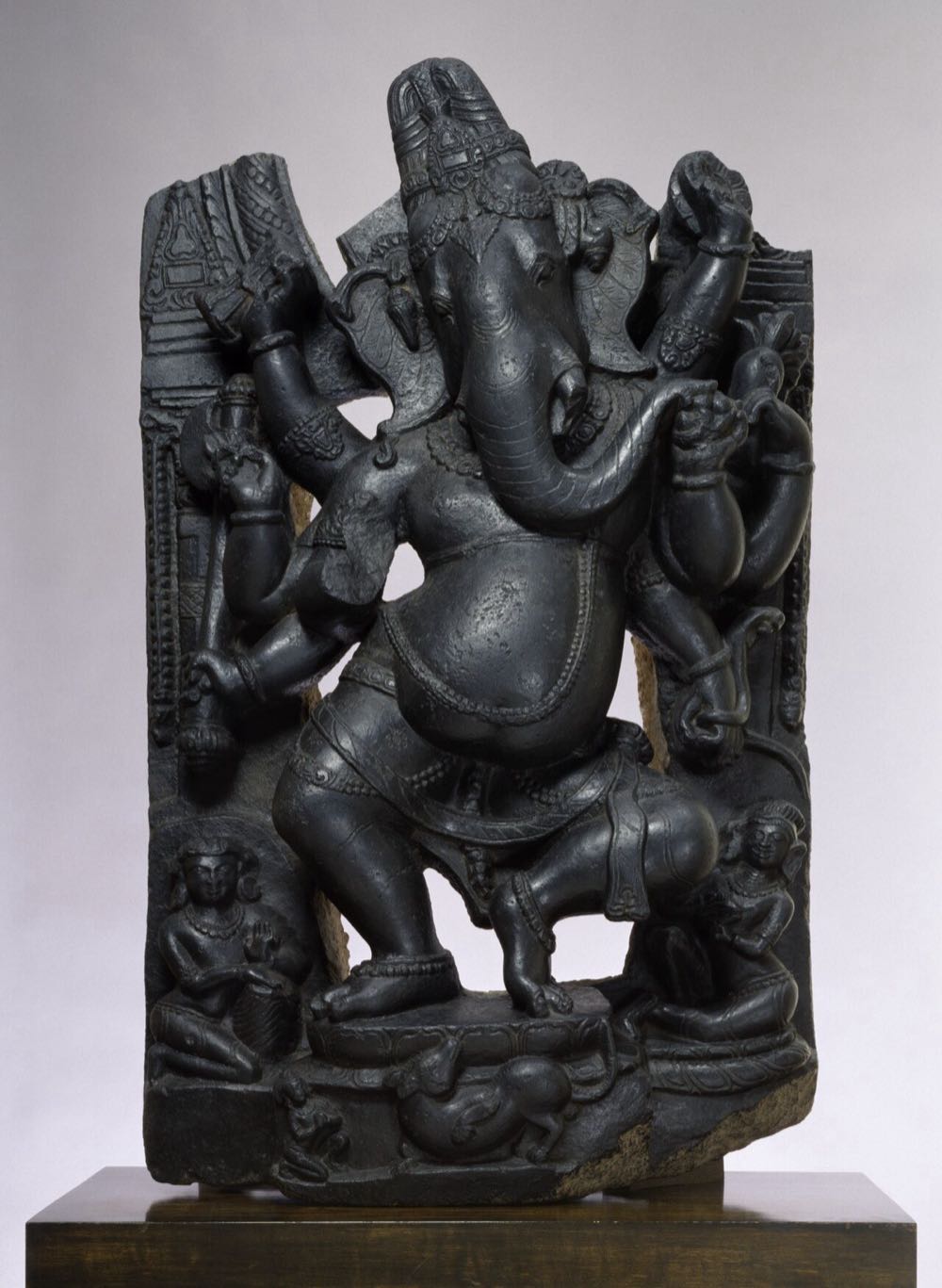
The Gaṇeśa Atharvaśīrṣa, also known as the Gaṇapati Upaniṣad, is one of the most philosophically significant and widely recited hymns dedicated to Lord Gaṇeśa. Attributed to the Atharva Veda tradition, this Upanishadic text boldly identifies Gaṇeśa — the elephant-headed deity beloved as the remover of obstacles — with Brahman itself, the ultimate reality of the universe. It is the foundational scripture of the Gāṇapatya sect, which regards Gaṇeśa as the Supreme Being, and remains central to Gaṇeśa worship across all Hindu traditions.
The Complete Opening Declaration
The hymn opens with one of the most direct theological assertions in all of Hindu scripture:
ॐ नमस्ते गणपतये। त्वमेव प्रत्यक्षं तत्त्वमसि। त्वमेव केवलं कर्तासि। त्वमेव केवलं धर्तासि। त्वमेव केवलं हर्तासि। त्वमेव सर्वं खल्विदं ब्रह्मासि। त्वं साक्षादात्मासि नित्यम्॥
IAST Transliteration: Oṃ Namaste Gaṇapataye | Tvam Eva Pratyakṣaṃ Tattvam Asi | Tvam Eva Kevalaṃ Kartāsi | Tvam Eva Kevalaṃ Dhartāsi | Tvam Eva Kevalaṃ Hartāsi | Tvam Eva Sarvaṃ Khalvidaṃ Brahmāsi | Tvaṃ Sākṣād Ātmāsi Nityam ||
Translation: “Oṃ! Salutations to Gaṇapati. You alone are the manifest Truth (Tattva). You alone are the sole Creator. You alone are the sole Sustainer. You alone are the sole Destroyer. You are indeed all this — Brahman. You are clearly the eternal Self (Ātman).”
Attribution and Textual History
The Gaṇeśa Atharvaśīrṣa belongs to the category of Atharvaśīrṣa texts — a group of short Upanishadic compositions appended to the Atharva Veda. The word atharvaśīrṣa literally means “the head (śīrṣa) of the Atharva [Veda],” signifying these texts as the crown or essence of Atharvanic knowledge.
The text is also commonly called the Gaṇapati Upaniṣad and is listed among the minor Upaniṣads in traditional catalogues. While mainstream Western scholarship dates its composition to approximately the 16th-17th century CE based on linguistic and historical analysis, the Indian devotional tradition regards it as part of the eternal Vedic revelation (śruti), transcending human authorship.
The Mudgala Purāṇa and Gaṇeśa Purāṇa both reference the theological framework of this text, and the colophon of the Atharvaśīrṣa itself names Atharvan — the legendary sage associated with the fourth Veda — as the original seer (ṛṣi) of this revelation, with Gaṇapati as both the deity (devatā) and the metre (chandas).
The “Tattvam Asi” Declaration
The phrase “Tvam eva pratyakṣaṃ tattvam asi” (“You alone are the manifest reality — That thou art”) is the theological heart of the Atharvaśīrṣa. This phrase deliberately echoes one of the Mahāvākyas (Great Sayings) of the Upaniṣads — “Tat tvam asi” (“That thou art”) from the Chāndogya Upaniṣad (6.8.7).
In the Chāndogya, the sage Uddālaka teaches his son Śvetaketu that the individual self (ātman) is identical with the universal reality (Brahman). The Atharvaśīrṣa transposes this teaching directly onto Gaṇeśa: it is Gaṇapati who is that Brahman, that ultimate reality which pervades all existence. The word pratyakṣam (“directly perceptible,” “manifest”) adds a crucial dimension — Gaṇeśa is not an abstract principle but a directly experienceable divine presence.
This identification is then systematically expanded through a series of attributions. Gaṇeśa is declared to be:
- Kartā (Creator) — the sole originator of all existence
- Dhartā (Sustainer) — the sole maintainer of all beings
- Hartā (Destroyer) — the sole dissolver at the end of cosmic cycles
These three functions correspond to the Trimūrti (Brahmā, Viṣṇu, Śiva), but the Atharvaśīrṣa subsumes all three under the single form of Gaṇeśa, establishing his supremacy as the Parabrahman.
The Philosophical Structure
The Atharvaśīrṣa proceeds through several layers of identification:
Cosmological Identity
Gaṇeśa is identified with the Pañcabhūtas (five elements) and the cosmic principles:
त्वं भूमिरापोऽनलोऽनिलो नभः। त्वं चत्वारि वाक्पदानि॥
“You are earth, water, fire, air, and space. You are the four levels of speech.”
The “four levels of speech” (catvāri vākpadāni) refer to the Vedic doctrine from the Ṛgveda (1.164.45) — Parā (transcendent), Paśyantī (visionary), Madhyamā (intermediary), and Vaikharī (articulate speech). By identifying Gaṇeśa with all four levels, the text positions him as the source of both cosmic manifestation and all forms of knowledge and expression.
Identity with Brahman
The text explicitly declares:
त्वं गुणत्रयातीतः। त्वं अवस्थात्रयातीतः। त्वं देहत्रयातीतः। त्वं कालत्रयातीतः।
“You are beyond the three guṇas. You are beyond the three states. You are beyond the three bodies. You are beyond the three times.”
This passage mirrors the classic Vedāntic description of Brahman as transcending the three guṇas (sattva, rajas, tamas), the three states of consciousness (waking, dreaming, deep sleep — as in the Māṇḍūkya Upaniṣad), the three bodies (gross, subtle, causal), and the three times (past, present, future).
The Mūlādhāra Connection
The Atharvaśīrṣa locates Gaṇeśa at the Mūlādhāra Cakra, the root energy centre at the base of the spine:
त्वं मूलाधारस्थितोऽसि नित्यम्।
“You are eternally situated in the Mūlādhāra.”
This aligns with the tantric tradition where Gaṇeśa guards the Mūlādhāra, the foundation of the kuṇḍalinī energy system. The practitioner must first worship Gaṇeśa — symbolising the removal of obstacles — before the kuṇḍalinī can begin its ascent through the higher cakras. This association is why Gaṇeśa is invoked at the beginning of all undertakings.
The Eight-Name Invocation (Aṣṭanāma)
One of the most celebrated portions of the Atharvaśīrṣa is the Aṣṭanāma (Eight Names) invocation:
एकदन्ताय विद्महे वक्रतुण्डाय धीमहि। तन्नो दन्ती प्रचोदयात्॥
This verse follows the structure of the Gāyatrī Mantra format, applying it specifically to Gaṇeśa. The eight names recited in the full passage are:
- Gaṇeśa — Lord of the gaṇas (attendant hosts)
- Ekadanta — The single-tusked one
- Heramba — The mother’s beloved protector
- Vighnanāśana — Destroyer of obstacles
- Lambodhara — The pot-bellied one
- Śūrpakarṇa — The winnow-eared one
- Gajānana — The elephant-faced one
- Vakratuṇḍa — The curved-trunk one
The text promises that one who recites these eight names at the beginning of study, at the time of worship, or before any undertaking will become free from all obstacles (vighnāni na bhavanti).
Meditation Instructions (Dhyāna Śloka)
The Atharvaśīrṣa provides specific meditation instructions for visualising Gaṇeśa:
एकदन्तं चतुर्हस्तं पाशमङ्कुशधारिणम्। रदं च वरदं हस्तैर्बिभ्राणं मूषकध्वजम्॥
“[Meditate upon] the single-tusked one, with four hands, bearing the noose (pāśa) and goad (aṅkuśa), holding a broken tusk (rada) and the gesture of blessing (varada), with the mouse as his banner.”
The four implements carry deep symbolic meaning:
- Pāśa (noose) — represents māyā (cosmic illusion) and the power to bind
- Aṅkuśa (goad) — represents the power to direct and control the mind
- Rada (broken tusk) — symbolises sacrifice and the pen of wisdom (Gaṇeśa is the scribe of the Mahābhārata)
- Varada mudrā — the gesture of bestowing boons and grace
The meditator is further instructed to visualise Gaṇeśa as red-complexioned (raktavarṇa), with a large belly (lambodara), ears like winnowing baskets (śūrpakarṇa), anointed with red sandalwood paste (raktacandana), and adorned with red flowers.
Use in Gaṇeśa Chaturthi
The Gaṇeśa Atharvaśīrṣa is the principal scriptural text recited during Gaṇeśa Chaturthi, the great annual festival celebrating Gaṇeśa’s birth. Observed primarily in the Hindu month of Bhādrapada (August-September), Gaṇeśa Chaturthi is marked by elaborate installations of Gaṇeśa mūrtis (clay images), extensive worship over one to eleven days, and culmination in the ceremonial immersion (visarjana) of the mūrti.
In Maharashtra, where Gaṇeśa Chaturthi is observed with extraordinary public devotion — a tradition revitalized by Lokmanya Bāl Gaṅgādhar Tilak in 1893 as a means of fostering national unity — the Atharvaśīrṣa is recited in homes, temples, and vast public maṇḍapas (pavilions). Many devotees observe the tradition of reciting the Atharvaśīrṣa 21 times on the day of Gaṇeśa Chaturthi, a practice believed to confer the same merit as a pilgrimage to the Aṣṭavināyaka — the eight ancient Gaṇeśa temples of Maharashtra.
The text is also recited daily by many devotees, particularly on Saṅkaṣṭī Chaturthi (the fourth day of every waning moon), Vināyaka Chaturthi (the fourth day of every waxing moon), and Tuesdays and Wednesdays, which are traditionally associated with Gaṇeśa worship.
The Gāṇapatya Tradition
The Atharvaśīrṣa is the central scripture of the Gāṇapatya sect, one of the six major traditions (ṣaṇmata) of Hinduism recognized by Ādi Śaṅkarācārya. The Gāṇapatyas regard Gaṇeśa not merely as the son of Śiva and Pārvatī, but as the Supreme Brahman from whom the entire universe emanates.
The Gaṇeśa Purāṇa and Mudgala Purāṇa elaborate this theology extensively. The Mudgala Purāṇa describes eight incarnations (avatāras) of Gaṇeśa, each appearing to overcome a specific cosmic demon representing a form of spiritual bondage. The Atharvaśīrṣa provides the Upanishadic philosophical foundation for these Purāṇic narratives — it is the doctrinal text that justifies the identification of Gaṇeśa with the Absolute.
The Concluding Promise (Phalaśruti)
The Atharvaśīrṣa concludes with a Phalaśruti (statement of fruits), enumerating the benefits of recitation:
- One who studies this Upaniṣad becomes like Brahman
- One is not obstructed by any obstacles
- One is freed from the five great sins and the five lesser sins
- Evening recitation destroys the sins committed during the day
- Morning recitation destroys the sins of the night
- One who recites this achieves knowledge of all Vedānta
यो दूर्वाङ्कुरैर्यजति स वैश्रवणोपमो भवति। यो लाजैर्यजति स यशोवान् भवति। स मेधावान् भवति।
“One who worships [Gaṇeśa] with dūrvā grass shoots becomes like Kubera (lord of wealth). One who worships with puffed rice becomes famous. One becomes endowed with intelligence.”
This Phalaśruti reflects the dual nature of the Atharvaśīrṣa — it simultaneously offers worldly blessings (wealth, fame, intelligence) and the highest spiritual realisation (becoming Brahman), embodying the Vedic principle that the sacred encompasses both material and transcendent dimensions of human aspiration.
The Atharvaśīrṣa in Daily Practice
Beyond festive occasions, the Gaṇeśa Atharvaśīrṣa serves as a daily devotional text for millions. It is typically recited:
- Before beginning study or intellectual work, invoking Gaṇeśa as the patron of learning
- At the start of any new venture, business, or journey, seeking removal of obstacles
- During Prāṇapratiṣṭhā (consecration) of Gaṇeśa images
- As part of Ṣoḍaśopacāra Pūjā (sixteen-step worship) of Gaṇeśa
- During Gaṇeśa Homa (fire rituals) dedicated to Gaṇeśa
The text’s relatively short length (approximately 28 verses) makes it ideal for complete daily recitation, and its philosophical density ensures that each recitation reveals new layers of meaning to the contemplative practitioner.
Significance and Legacy
The Gaṇeśa Atharvaśīrṣa occupies a unique position in Hindu sacred literature. It bridges the gap between Vedāntic philosophy and devotional practice, presenting the most approachable of Hindu deities — the beloved, elephant-headed Gaṇeśa — as the very embodiment of the Upanishadic Absolute. For the philosopher, it is a meditation on Brahman; for the devotee, it is a prayer to the remover of obstacles; for the seeker, it is an initiation into the mystery that the Ultimate Reality wears the gentle, playful form of Gaṇapati.
In the words of the text itself: “Tvam eva sarvaṃ khalvidaṃ brahmāsi” — “You are indeed all this Brahman.” In Gaṇeśa, the infinite becomes intimate, and the Absolute becomes accessible.