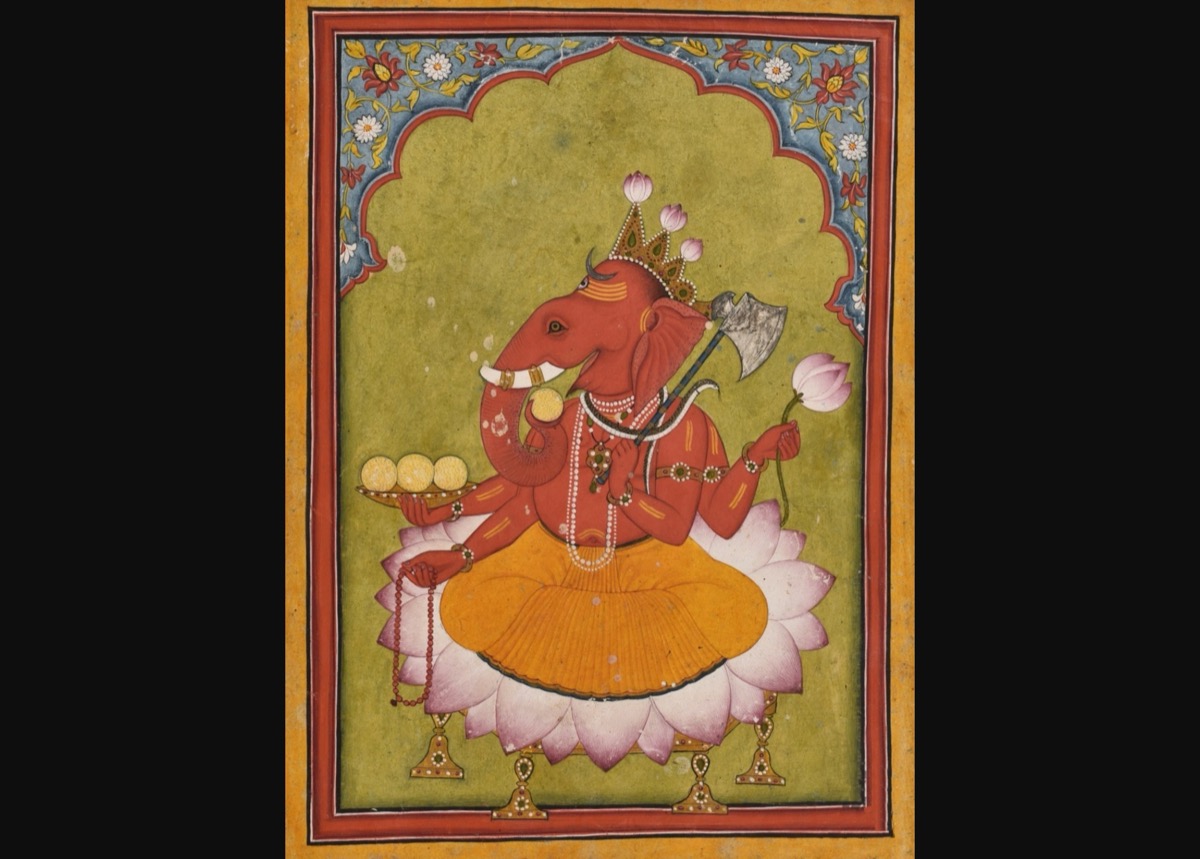
The Gaṇeśa Pañcaratnam (“Five Jewels of Gaṇeśa”) is a luminous devotional hymn attributed to Ādi Śaṅkarācārya (c. 788–820 CE). In five meticulously crafted verses, the stotra praises Lord Gaṇeśa — the beloved elephant-headed deity who is universally invoked at the commencement of all undertakings as the Vighneśvara (Lord of Obstacles). Each verse is a “jewel” (ratna) that illuminates a different facet of Gaṇeśa’s divine nature: His grace, His cosmic authority, His compassion, His supreme intelligence, and His role as the gateway to liberation.
The Significance of Gaṇeśa in Hindu Worship
Before any ritual, any journey, any new venture — Hindus invoke Gaṇeśa. This practice is rooted in the Ṛgveda itself, where the earliest form of Gaṇeśa-worship appears in the Bṛhaspati Sūkta (Ṛgveda 2.23.1): “Gaṇānāṃ tvā gaṇapatiṃ havāmahe” — “We invoke Thee, Lord of the Gaṇas, the Lord of hosts.” The Gaṇapati Atharvaśīrṣa Upaniṣad, a late Vedic text, declares Gaṇeśa to be identical with Brahman: “Tvaṃ Brahmā tvaṃ Viṣṇus tvaṃ Rudras tvaṃ Indras tvaṃ Agnis tvaṃ Vāyus tvaṃ Sūryas tvaṃ Candramās tvaṃ Brahma Bhūr Bhuvaḥ Svaḥ Oṃ” — “You are Brahmā, you are Viṣṇu, you are Rudra… you are the Brahman itself, the Earth, the Atmosphere, and Heaven, Om.”
The Gaṇeśa Purāṇa and Mudgala Purāṇa elaborate the theology of Gaṇeśa across his eight incarnations (aṣṭāvatāra), in which he takes various forms to vanquish different demons representing spiritual obstacles — ego, attachment, anger, greed, and delusion.
The Complete Stotra in Sanskrit
मुदाकरात्तमोदकं सदा विमुक्तिसाधकं कलाधरावतंसकं विलासिलोकरक्षकम्। अनायकैकनायकं विनाशितेभदैत्यकं नताशुभाशुनाशकं नमामि तं विनायकम्॥१॥
नतेतरातिभीकरं नवोदितार्कभास्वरं नमत्सुरारिनिर्जरं नताधिकापदुद्धरम्। सुरेश्वरं निधीश्वरं गजेश्वरं गणेश्वरं महेश्वरं तमाश्रये परात्परं निरन्तरम्॥२॥
समस्तलोकशङ्करं निरस्तदैत्यकुञ्जरं दरेतरोदरं वरं वरेभवक्त्रमक्षरम्। कृपाकरं क्षमाकरं मुदाकरं यशस्करं मनस्करं नमस्कृतां नमस्करोमि भास्करम्॥३॥
अकिञ्चनार्तिमार्जनं चिरन्तनोक्तिभाजनं पुरारिपूर्वनन्दनं सुरारिगर्वचर्वणम्। प्रपञ्चनाशभीषणं धनञ्जयादिभूषणं कपोलदानवारणं भजे पुराणवारणम्॥४॥
नितान्तकान्तदन्तकान्तिमन्तकान्तकात्मजं अचिन्त्यरूपमन्तहीनमन्तरायकृन्तनम्। हृदन्तरे निरन्तरं वसन्तमेव योगिनां तमेकदन्तमेव तं विचिन्तयामि सन्ततम्॥५॥
Verse-by-Verse Translation and Commentary
Verse 1: Vināyaka — The Remover of Obstacles
IAST: Mudākarāttamodakaṃ sadā vimuktisādhakaṃ kalādharāvataṃsakaṃ vilāsilokarakṣakam | anāyakaikanāyakaṃ vināśitebhadaityakaṃ natāśubhāśunāśakaṃ namāmi taṃ Vināyakam ||
Translation: “I bow to that Vināyaka, who joyfully holds the modaka (sweet dumpling) in His hand, who is forever the means to liberation, who wears the crescent moon as His crest-ornament, who is the protector of the playful worlds, who is the sole leader of the leaderless, who destroyed the elephant-demon, and who swiftly destroys the inauspiciousness of those who bow to Him.”
Commentary: The opening verse establishes Gaṇeśa’s most recognisable imagery. The modaka is not merely a sweet — it represents the bliss (ānanda) of Self-realisation, the sweetest fruit of spiritual practice that Gaṇeśa holds and offers to His devotees. The crescent moon (kalādhara) on His head links Him to His father Śiva (who bears the full moon) and to the waxing and waning cycles of cosmic time. The destruction of the elephant-demon (Gajāsura) references the Purāṇic narrative in which Gaṇeśa subdued a demonic elephant who terrorised the worlds — this is sometimes interpreted as Gaṇeśa conquering the very nature of the elephant (the animal body) through divine will.
Verse 2: The Supreme Lord Beyond All Lords
IAST: Natetarātibhīkaraṃ navoditārkabhāsvaraṃ namatsurarinirijjaraṃ natādhikāpaduddharam | sureśvaraṃ nidhīśvaraṃ gajeśvaraṃ gaṇeśvaraṃ maheśvaraṃ tamāśraye parātparaṃ nirantaram ||
Translation: “He who is frightening to the enemies of His devotees, who shines like the newly risen sun, before whom even the enemies of the gods (demons) bow, who lifts up those who are bowed down by great calamities — the Lord of the Gods, the Lord of Treasures, the Lord of Elephants, the Lord of the Gaṇas, the Great Lord — I take refuge in Him who is the Supreme beyond the supreme, eternally.”
Commentary: This verse is a masterpiece of ascending epithets. Śaṅkara stacks title upon title — Sureśvara (Lord of Gods), Nidhīśvara (Lord of the nine treasures — the Nava-Nidhis of Kubera), Gajeśvara (Lord of Elephants), Gaṇeśvara (Lord of the Gaṇas), and finally Maheśvara (the Great Lord — a title usually reserved for Śiva Himself). The climax is Parātpara — “the Supreme beyond the supreme,” a designation found in the Gaṇapati Atharvaśīrṣa (verse 2) affirming Gaṇeśa’s identity with the ultimate Brahman. The imagery of the newly risen sun (navoditārka) symbolises the dawn of knowledge that dispels the darkness of ignorance.
Verse 3: The Compassionate Sun of Auspiciousness
IAST: Samastalokśaṅkaraṃ nirastadaityakuñjaraṃ daretarodaraṃ varaṃ varebhavaktramakṣaram | kṛpākaraṃ kṣamākaraṃ mudākaraṃ yaśaskaraṃ manaskaraṃ namaskṛtāṃ namaskaromi bhāskaram ||
Translation: “He who is the cause of welfare for all the worlds, who has vanquished the demon-elephants, whose belly is large like a mountain, who is the bestower of boons with an elephant-face, the imperishable one — He who is an ocean of compassion, an ocean of forgiveness, an ocean of joy, the bestower of fame, the capturer of the hearts of those who prostrate before Him — I bow to Him who is the radiant sun.”
Commentary: The third verse celebrates Gaṇeśa’s infinite compassion. The cascade of compound epithets ending in -kara (meaning “mine” or “repository of”) — kṛpā-kara (compassion), kṣamā-kara (forgiveness), mudā-kara (joy), yaśas-kara (fame), manas-kara (capturer of minds) — creates a litany of divine qualities that overflow like jewels from an inexhaustible treasury. The term Bhāskara (“the one who illumines”) is the final comparison: Gaṇeśa is a sun that causes the lotus of the devotee’s heart to bloom.
Verse 4: The Protector of the Helpless
IAST: Akiñcanārtimārjanaṃ cirantanoktibhājanaṃ purāripūrvanandanaṃ surārigarvaccarvaṇam | prapañcanāśabhīṣaṇaṃ dhanañjayādibhūṣaṇaṃ kapoladānavāraṇaṃ bhaje purāṇavāraṇam ||
Translation: “He who cleanses the sorrows of the destitute, who is the vessel of eternal wisdom, who is the firstborn son of the Destroyer of Tripura (Śiva), who crushes the pride of the enemies of the gods — He who is fearsome to the dissolution of the universe, who is adorned with the fire Dhanañjaya and other glories, whose temples stream with rut (mada) — I worship the ancient, mighty Elephant.”
Commentary: Here Śaṅkara emphasises Gaṇeśa’s accessibility to the poorest and most helpless (akiñcana — “those who possess nothing”). The phrase cirantanoktibhājanam (“vessel of eternal teachings”) identifies Gaṇeśa as the divine scribe — the one who famously wrote the Mahābhārata as dictated by Vyāsa, using His own broken tusk as a pen. The reference to Purāri (Śiva, the destroyer of the three cities) as Gaṇeśa’s father places Him firmly in the Śaiva cosmic family. The final image of Purāṇa-vāraṇa (“the ancient elephant”) is both a literal description and a metaphysical title — the primordial cosmic elephant who existed before creation.
Verse 5: The One-Tusked Lord in the Heart
IAST: Nitāntakāntadantakāntimanakāntakātmajaṃ acintyarūpamantahīnamantarāyakṛntanam | hṛdantare nirantaraṃ vasantameva yogināṃ tamekadantameva taṃ vicintayāmi santatam ||
Translation: “He whose beautiful tusk shines with exceeding brilliance, who is the son of the Destroyer of Death (Śiva as Kālāntaka), whose form is inconceivable, who is infinite, who cuts asunder all obstacles — He who dwells ceaselessly in the hearts of yogis, that One-Tusked Lord alone do I contemplate always.”
Commentary: The final “jewel” turns inward. After the external descriptions of Gaṇeśa’s form, mythology, and cosmic functions, Śaṅkara directs the devotee to find Gaṇeśa within the heart (hṛdantare). The epithet Ekadanta (“One-Tusked”) — Gaṇeśa’s most distinctive physical feature — becomes here a symbol of single-pointed devotion and the sacrifice of wholeness for wisdom (the broken tusk used to write sacred knowledge). The phrase acintyarūpa (“of inconceivable form”) echoes the Vedāntic teaching that the divine ultimately transcends all conceptual limitation. The word antahīna (“infinite, without end”) establishes Gaṇeśa as the boundless Brahman itself, while antarāya-kṛntana (“cutter of obstacles”) reaffirms His practical function for the seeker.
The Phala-śruti
एतत्पञ्चरत्नं पठेद्गणेशसन्निधौ तस्य विघ्नः प्रणश्यन्ति विद्या सिद्धिं च विन्दति॥
Translation: “Whoever recites these five jewels in the presence of Gaṇeśa — their obstacles are destroyed and they attain perfection in knowledge.”
Recitation Practice
When to Recite
- Before any new undertaking — studies, business ventures, journeys, rituals
- On Gaṇeśa Caturthī — the fourth day of each lunar fortnight sacred to Gaṇeśa
- On Vināyaka Caturthī (Gaṇeśa Chaturthi) — the great annual festival in Bhādrapada month
- During Saṅkaṣṭa Caturthī — the monthly Gaṇeśa fast day
- At the beginning of any pūjā — as Gaṇeśa is always worshipped first
Traditional Method
- Sit before an image or idol of Gaṇeśa
- Offer dūrvā grass (sacred to Gaṇeśa), modakas, and red flowers
- Chant “Oṃ Gaṃ Gaṇapataye Namaḥ” three times
- Recite all five verses with devotion, visualising each description
- Conclude with the phala-śruti and 108 repetitions of the Gaṇeśa Mūla Mantra
Musical Tradition
The Gaṇeśa Pañcaratnam is one of the most frequently set compositions in South Indian devotional music. Its rhythmic structure — based on the sragdharā and drutavilambita metres — creates a natural musical flow. The stotra is commonly chanted in the rāga Nāṭa or Hamsadhvani in Carnatic music tradition, and forms an essential part of the Gaṇeśa Pūjā liturgy in temples across Tamil Nadu, Karnataka, and Andhra Pradesh.
Symbolism of Gaṇeśa’s Form as Described in the Stotra
Each physical attribute described in the Pañcaratnam carries philosophical meaning:
- Elephant head — supreme wisdom; the large head symbolises thinking big, the trunk represents Oṃ
- Single tusk — retention of the good (whole tusk), rejection of the bad (broken tusk); or the sacrifice of personal wholeness for the service of sacred knowledge
- Large belly — the capacity to digest peacefully all experiences of life, both pleasant and unpleasant
- Modaka — the sweetness (madhura) of the Ātman, the bliss that lies at the core of realisation
- Mouse vehicle — the mind (manas), which like a mouse is restless and nibbles everywhere; Gaṇeśa’s mastery of the mouse signifies control of the mind
The Gaṇapati Atharvaśīrṣa affirms: “Tvameva pratyakṣaṃ tattvam asi” — “You are the directly perceivable Reality.” Through the five jewels of the Pañcaratnam, Śaṅkara leads the devotee from the perceivable form of the elephant-headed God to the imperishable, formless truth that resides within every heart.