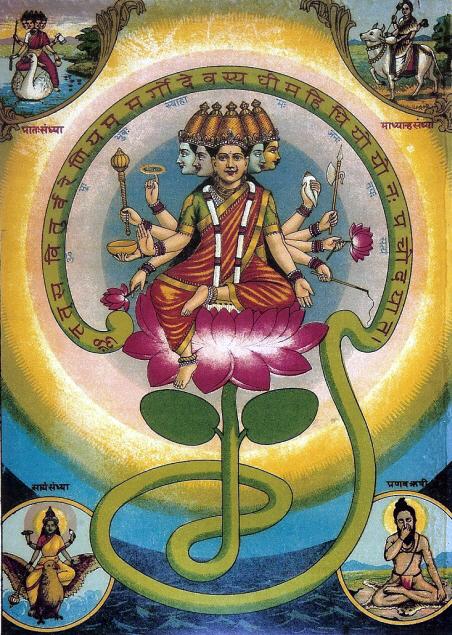
The Gāyatrī Mantra is universally regarded as the holiest verse in all of Hindu scripture. Drawn from the Ṛgveda (3.62.10), this twenty-four-syllable hymn is addressed to Savitṛ, the divine luminous power that impels all of creation. Its recitation forms the core of the Sandhyāvandana — the thrice-daily Vedic worship performed at dawn, noon, and dusk — and has been chanted without interruption for over three thousand years.
The Complete Mantra
The mantra consists of three parts: the Praṇava (Oṃ), the Mahāvyāhṛtis (the three cosmic utterances), and the Gāyatrī verse itself.
ॐ भूर्भुवः स्वः तत्सवितुर्वरेण्यं भर्गो देवस्य धीमहि। धियो यो नः प्रचोदयात्॥
IAST Transliteration: Oṃ Bhūr Bhuvaḥ Svaḥ | Tat Savitur Vareṇyaṃ Bhargo Devasya Dhīmahi | Dhiyo Yo Naḥ Pracodayāt ||
Word-by-Word Translation
The Vyāhṛtis (Cosmic Utterances)
- Oṃ — The primordial sound, the essence of all Vedas (Māṇḍūkya Upaniṣad 1)
- Bhūḥ — The physical plane (earth); the gross body
- Bhuvaḥ — The atmospheric plane; the subtle body; prāṇa (vital breath)
- Svaḥ — The celestial plane (heaven); the causal body; bliss
The Gāyatrī Verse
- Tat — That (the Supreme Reality)
- Savituḥ — Of Savitṛ, the divine impeller, the luminous creative power of the sun
- Vareṇyam — Most excellent, worthy of adoration
- Bhargaḥ — Radiance, spiritual effulgence, the light that dispels ignorance
- Devasya — Of the divine, of the resplendent Lord
- Dhīmahi — We meditate upon, we contemplate
- Dhiyaḥ — Our intellects, our understanding, our power of discrimination (buddhi)
- Yaḥ — Who
- Naḥ — Our
- Pracodayāt — May He inspire, illuminate, impel
Complete Translation
“We meditate upon the most excellent radiance of the divine Savitṛ. May He illuminate our intellects.”
Scriptural Source and Dating
The Gāyatrī Mantra appears in Ṛgveda 3.62.10, within the hymn cycle attributed to the ṛṣi (seer) Viśvāmitra, son of Gāthin. The verse belongs to Maṇḍala III, one of the “family books” of the Ṛgveda, which scholars generally date to the early Vedic period (circa 1500-1200 BCE).
The mantra also appears in the Śukla Yajurveda (36.3), the Sāmaveda (Uttarārcika 1462), and numerous Upaniṣads, demonstrating its centrality across all Vedic branches. The Chāndogya Upaniṣad (3.12.1-6) devotes an entire section to expounding the Gāyatrī’s cosmic significance, declaring: “Gāyatrī is everything here — whatever being exists” (Chāndogya Upaniṣad 3.12.1).
The Bṛhadāraṇyaka Upaniṣad (5.14.1-8) similarly identifies the Gāyatrī with speech, the earth, the body, the heart, and the vital breaths — making it a microcosmic mirror of all reality.
The Gāyatrī Metre
The word “gāyatrī” refers both to the specific mantra and to the Vedic metre (chandas) in which it is composed. The Gāyatrī metre consists of three lines (pādas) of eight syllables each, totalling twenty-four syllables. According to the Chāndogya Upaniṣad (3.12.5), these twenty-four syllables correspond to the twenty-four cosmic principles.
The Ṛgveda Prātiśākhya notes that Gāyatrī is the most commonly occurring metre in the Ṛgveda, comprising roughly one-quarter of all its hymns — a testament to its primacy among the Vedic metres.
Commentary from the Ācāryas
Ādi Śaṅkarācārya (Advaita Vedānta)
In his commentary on the Chāndogya Upaniṣad (3.12), Śaṅkara interprets the Gāyatrī as pointing directly to Brahman, the non-dual Absolute. For Śaṅkara, Savitṛ is not merely the physical sun but the inner light of pure consciousness (cit) that illuminates all knowing. The “bharga” (radiance) is the self-luminous nature of Ātman, and the prayer “may He illuminate our intellects” is ultimately a prayer for the removal of avidyā (ignorance) — the fundamental misidentification of the Self with the body-mind complex.
Śaṅkara writes in his Chāndogya Bhāṣya: “The Gāyatrī, though expressed in the form of a prayer to an external deity, is in truth a meditation on the Self, for Savitṛ — the impeller of all — is none other than Brahman.”
Rāmānujācārya (Viśiṣṭādvaita Vedānta)
Rāmānuja, in his Vedārthasaṅgraha and commentaries, understands the Gāyatrī as a prayer to Nārāyaṇa as the inner controller (antaryāmin) of the solar orb. For Rāmānuja, the devotee is not praying for abstract knowledge but for divine grace (prasāda) to direct the intellect toward God. The relationship between the devotee and Savitṛ is one of loving dependence (śeṣa-śeṣin bhāva) — the soul belongs to God and seeks His guidance.
Rāmānuja emphasizes that the word dhīmahi (“we meditate”) implies a community of devotees engaged in collective worship, reflecting the Viśiṣṭādvaita emphasis on the saṅgha (spiritual community).
Madhvācārya (Dvaita Vedānta)
Madhva identifies Savitṛ directly with Viṣṇu-Nārāyaṇa, the Supreme Independent Being (Svatantra). In his Ṛg Bhāṣya, Madhva stresses the absolute distinction between the dependent soul (jīva) and the independent Lord (Īśvara). The prayer “pracodayāt” (may He impel) is significant for Madhva because it acknowledges that even the capacity to think, meditate, and know is entirely dependent on God’s will. The soul can do nothing without the Lord’s enabling grace (preraṇā).
For Madhva, the Gāyatrī is a perpetual acknowledgement of the soul’s utter dependence on Viṣṇu for every faculty of cognition and action.
Significance in Daily Practice
Sandhyāvandana
The Gāyatrī Mantra is the centrepiece of Sandhyāvandana, the daily Vedic worship prescribed for all initiated Hindus (dvijas). The practice is performed at three sandhyā (junction) times:
- Prātaḥ Sandhyā — Dawn, as the stars fade and the sun rises
- Mādhyāhnika Sandhyā — Midday, when the sun reaches its zenith
- Sāyam Sandhyā — Dusk, as the sun sets
At each sandhyā, the Gāyatrī is chanted a minimum of 10 times, with traditional prescriptions calling for 108 repetitions at each sitting. The practice is accompanied by prāṇāyāma (breath regulation), ācamana (ritual sipping of water), mārjana (sprinkling), and arghya (offering of water to the sun).
The Manusmṛti (2.78) declares: “A Brāhmaṇa who silently recites the Gāyatrī three times a day is freed from all sins, just as a serpent is freed from its skin.” Manu further states (2.77): “Even if a Brāhmaṇa does nothing else, the mere practice of Gāyatrī japa makes him worthy of the name.”
Upanayana and Initiation
The Gāyatrī Mantra is traditionally transmitted during the Upanayana (sacred thread ceremony), which marks a young person’s formal initiation into Vedic study. The guru whispers the mantra into the student’s right ear — a transmission that represents the spiritual rebirth (dvija, “twice-born”) of the initiate.
The Āśvalāyana Gṛhya Sūtra (1.20-22) prescribes the specific procedure: the teacher faces east, the student faces west, and the mantra is imparted while both hold a covering cloth between them, symbolising the sacredness and intimacy of the transmission.
Goddess Gāyatrī
In the Purāṇic tradition, the mantra is personified as Goddess Gāyatrī (also called Sāvitrī), a form of Sarasvatī or of the Supreme Goddess herself. She is typically depicted with five heads — representing the five prāṇas (vital airs) and the five elements — and ten arms, seated upon a lotus.
The five heads are said to represent the five faces of Śiva (Sadyojāta, Vāmadeva, Aghora, Tatpuruṣa, and Īśāna) or the five stages of cosmic manifestation. The famous Raja Ravi Varma oleograph depicts her in this five-headed form, surrounded by the text of the mantra, with the three sandhyā timings shown in medallions.
The Devī Bhāgavata Purāṇa (12.6-8) describes elaborate worship rituals for Goddess Gāyatrī and presents her as the Vedamātā — the Mother of the Vedas — from whom all scripture flows.
The Gāyatrī in the Bhagavad Gītā
Lord Kṛṣṇa himself affirms the supremacy of the Gāyatrī in the Bhagavad Gītā (10.35): “Among the metres I am Gāyatrī” (gāyatrī chandasām aham). By identifying Himself with the Gāyatrī metre, Kṛṣṇa establishes it as the most divine of all poetic forms — the metre that most fully embodies the presence of God in the world of sound.
Philosophical Dimensions
The Gāyatrī Mantra encapsulates the three essential acts of spiritual life:
- Recognition (tat savitur) — acknowledging the existence of a transcendent divine reality
- Meditation (vareṇyaṃ bhargo devasya dhīmahi) — contemplating the radiant nature of that reality
- Prayer (dhiyo yo naḥ pracodayāt) — seeking divine guidance for the intellect
This three-fold structure mirrors the Vedāntic teaching of śravaṇa (hearing the truth), manana (reflecting upon it), and nididhyāsana (deeply meditating until direct realisation arises), as described in the Bṛhadāraṇyaka Upaniṣad (2.4.5).
The mantra’s prayer is notably not for material wealth, health, or power, but for the illumination of the intellect — the one faculty through which liberation (mokṣa) becomes possible. This makes the Gāyatrī fundamentally a prayer for wisdom itself, placing it at the very foundation of the Hindu spiritual path.
Universality and Living Tradition
While the Gāyatrī was traditionally restricted to initiated males of the three upper varṇas, many modern reform movements — beginning with Svāmī Dayānanda Sarasvatī and the Ārya Samāj in the 19th century — have advocated its universal recitation. Today, the mantra is chanted by millions worldwide, transcending the boundaries of caste, gender, and geography, fulfilling its own inner promise: the illumination of all minds, everywhere.
The Gāyatrī remains a living, breathing tradition — not a museum piece but a daily practice that connects the modern practitioner to an unbroken chain of Vedic sages stretching back to Viśvāmitra himself. In the words of the Chāndogya Upaniṣad (3.12.6): “Gāyatrī is indeed all this, whatever here exists.”