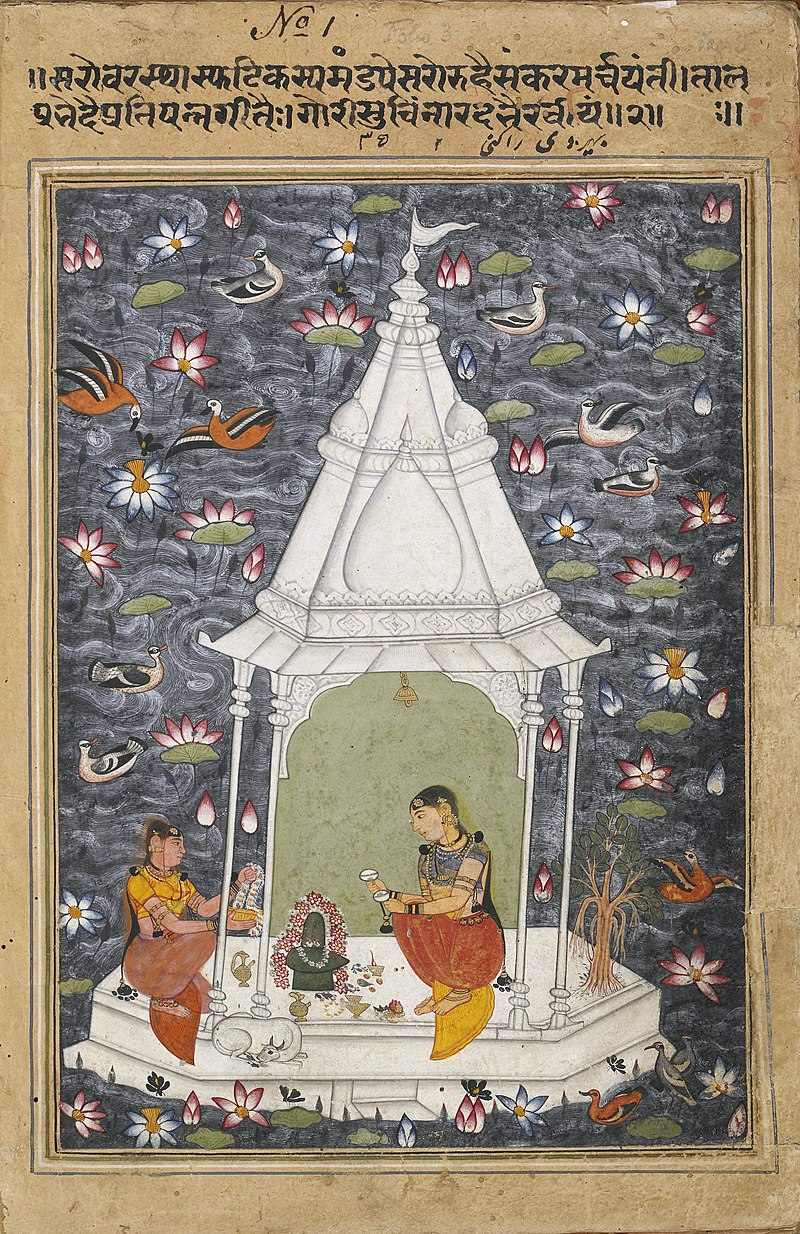
The Mahāmṛtyuñjaya Mantra is one of the most ancient and powerful mantras in the entire Vedic corpus. Found in the Ṛgveda (7.59.12), this sacred verse is addressed to Tryambaka — the Three-Eyed One, an epithet of Lord Śiva — and is renowned as the “Great Death-Conquering Mantra” (mahā = great, mṛtyu = death, jaya = victory). Alongside the Gāyatrī Mantra, it is considered one of the two most potent mantras in Hinduism, and its chanting has been an unbroken tradition for over three millennia.
The Complete Mantra
ॐ त्र्यम्बकं यजामहे सुगन्धिं पुष्टिवर्धनम्। उर्वारुकमिव बन्धनान्मृत्योर्मुक्षीय मामृतात्॥
IAST Transliteration: Oṃ Tryambakaṃ Yajāmahe Sugandhiṃ Puṣṭivardhanam | Urvārukamiva Bandhanān Mṛtyor Mukṣīya Māmṛtāt ||
Word-by-Word Translation
- Oṃ — The primordial sacred syllable, the essence of all Vedic utterance (Māṇḍūkya Upaniṣad 1)
- Tryambakam — The Three-Eyed One (tri = three, ambaka = eye); an epithet of Śiva referring to His three eyes: the sun, the moon, and the fire of inner wisdom
- Yajāmahe — We worship, we adore, we offer sacrifice to (yaj = to worship)
- Sugandhim — The sweet-fragranced one; He whose spiritual fragrance pervades all existence; also interpreted as one whose good qualities are known far and wide
- Puṣṭivardhanam — The nourisher of all beings; He who increases prosperity, fullness, and well-being (puṣṭi = nourishment/prosperity, vardhana = one who increases)
- Urvārukam — Like a ripe gourd (cucumber/watermelon); the urvāruka is a fruit that detaches naturally from its stalk when fully ripe
- Iva — Just as, like
- Bandhanāt — From bondage, from the stem; the attachment that binds the fruit to the vine
- Mṛtyoḥ — From death; from the cycle of mortality
- Mukṣīya — May I be liberated, may I be released (muc = to free)
- Mā — Not (used here as an emphatic particle reinforcing the prayer)
- Amṛtāt — From immortality; meaning “but not from immortality” — i.e., may I be freed from death but not from the nectar of eternal life
Complete Translation
“We worship the Three-Eyed One (Lord Śiva), who is fragrant and who nourishes all beings. As the ripe gourd is effortlessly released from its bondage to the vine, so may we be liberated from death — but not from immortality.”
Scriptural Source and Dating
The Mahāmṛtyuñjaya Mantra appears in Ṛgveda 7.59.12, within Maṇḍala VII, which is attributed to the ṛṣi (seer) Vasiṣṭha Maitrāvaruṇi and his lineage. Maṇḍala VII is one of the oldest “family books” of the Ṛgveda, generally dated by scholars to the early Vedic period (circa 1500-1200 BCE).
The mantra is part of a longer hymn dedicated to Rudra-Tryambaka, a deity later identified with Śiva in the Purāṇic tradition. The entire hymn (Ṛgveda 7.59) contains verses praising Rudra as both a fierce and compassionate deity — the destroyer of evil and the healer of diseases.
The same mantra also appears in the Yajurveda (Taittirīya Saṁhitā 1.8.6 and Vājasaneyi Saṁhitā 3.60), where it forms part of the Tryambaka Homa — a fire ritual specifically prescribed for healing, protection from untimely death, and the attainment of longevity. The Atharvaveda also references this mantra in the context of healing ceremonies (Atharvaveda 14.1.17).
Tryambaka: The Three-Eyed Lord
The epithet Tryambaka (Three-Eyed) is central to understanding this mantra. The three eyes of Śiva represent:
- The Sun (right eye) — the illuminating power of waking consciousness and worldly knowledge
- The Moon (left eye) — the reflective power of intuition, the mind, and inner experience
- Fire (the third eye, at the forehead) — the eye of transcendent wisdom (jñāna-netra), which sees beyond duality and can reduce ignorance to ashes
The Śvetāśvatara Upaniṣad (3.1-2) describes this cosmic being: “The One who rules the worlds with his ruling powers, who stands over all beings as their inner ruler… He is Rudra, the sole lord.” The third eye represents the opening of higher consciousness — the faculty through which the practitioner transcends the duality of life and death.
An alternative interpretation, found in the commentary of Sāyaṇa, derives ambaka from ambā (mother), making Tryambaka mean “He who has three mothers” — the three mothers being the three aspects of cosmic energy: Icchā-śakti (will), Jñāna-śakti (knowledge), and Kriyā-śakti (action).
The Symbolism of the Gourd
The imagery of the urvāruka (ripe gourd or cucumber) separating naturally from its stalk is one of the most beautiful metaphors in Vedic literature. Several layers of meaning exist:
Effortless liberation: Just as a fully ripened fruit detaches from its vine without any pulling or tearing, the devotee prays for a natural, graceful release from the bondage of mortality — not through violent struggle but through spiritual maturation.
Readiness and ripeness: The metaphor implies that liberation comes when the soul is spiritually ripe. The gourd does not detach prematurely; it waits until it is full and complete. Similarly, the devotee seeks the full development of spiritual wisdom before release.
Preservation of wholeness: When the gourd separates, it remains whole and intact — it is not destroyed. Likewise, the soul freed from the body at the time of death retains its essential nature. It is liberated from mortality (mṛtyu) but not from immortality (amṛtāt) — it moves from the perishable to the imperishable.
The Śatapatha Brāhmaṇa (2.6.2.12) elaborates on this symbolism in the context of the Tryambaka ritual, noting that the gourd offering represents the devotee’s surrender of the body while retaining the immortal Self.
The Healing Tradition
The Mahāmṛtyuñjaya Mantra holds a unique position as the foremost healing mantra (ārogya mantra) in the Hindu tradition. Its therapeutic applications are extensively documented:
Āyurvedic Context
In the Suśruta Saṁhitā and other Āyurvedic texts, the recitation of this mantra is prescribed as a complementary practice during medical treatment. The mantra is chanted over water, medicinal herbs, or vibhūti (sacred ash) to consecrate them before application. The understanding is that the mantra activates the healing potency inherent in the substance.
The Tryambaka Homa
The Tryambaka Homa is a Vedic fire ritual specifically centred on this mantra. As described in the Taittirīya Brāhmaṇa (1.6.10) and the Āpastamba Śrauta Sūtra, the ritual is performed for:
- Recovery from serious illness
- Protection from untimely death (apamṛtyu)
- Longevity and vitality
- Safe passage during dangerous times (war, epidemics, natural disasters)
- Spiritual purification and liberation
The homa involves offering ājya (clarified butter), samidh (sacred fuel sticks), and specific herbs into the consecrated fire while chanting the mantra 108 or 1,008 times.
Mahāmṛtyuñjaya Japa
Daily recitation (japa) of this mantra is widely practised for general well-being and spiritual protection. Traditional prescriptions include:
- 108 repetitions daily using a rudrākṣa mālā (rosary of Rudrākṣa beads sacred to Śiva)
- One lakh (100,000) repetitions as a puraścaraṇa (intensive practice) for specific healing intentions
- Chanting during the Pradoṣa period (twilight hours sacred to Śiva)
- Special recitation during Mahāśivarātrī — the Great Night of Śiva
The Story of Mārkaṇḍeya
The most celebrated narrative associated with the Mahāmṛtyuñjaya Mantra is the story of the sage Mārkaṇḍeya, told in the Śiva Purāṇa, the Mārkaṇḍeya Purāṇa, and the Skanda Purāṇa.
Mārkaṇḍeya was the son of the sage Mṛkaṇḍu. Before his birth, Lord Śiva offered his parents a choice: a long-lived but ordinary son, or a supremely wise son who would live only sixteen years. They chose wisdom over longevity. As Mārkaṇḍeya’s sixteenth birthday approached, the boy — who had become a devoted worshipper of Śiva — clung to the Śivaliṅga in deep meditation, chanting the Mahāmṛtyuñjaya Mantra.
When Yama, the Lord of Death, arrived with his noose to claim the boy’s life, Mārkaṇḍeya refused to let go of the liṅga. Yama cast his noose around both the boy and the liṅga. At that moment, Lord Śiva burst forth from the liṅga in His terrible form as Kālakāla (the Death of Death) and struck Yama with His trident, slaying Death himself.
Śiva then declared that Mārkaṇḍeya would remain forever sixteen — an eternal youth, immortal, beyond the reach of death. This narrative establishes the mantra’s supreme power: it is the hymn that conquered Death, not through evasion but through the direct intervention of the Lord when called upon with absolute devotion.
Commentary from the Ācāryas
Sāyaṇa’s Vedic Commentary
Sāyaṇa (14th century), the great commentator on the Vedas under the patronage of the Vijayanagara Empire, provides the most authoritative traditional interpretation. He glosses tryambakam as “the three-eyed deity, Rudra,” and emphasizes the ritual context: the mantra is the central utterance of the Tryambaka ritual performed for the attainment of longevity (āyuṣya) and freedom from disease. Sāyaṇa interprets sugandhim not merely as physical fragrance but as the “fragrance of knowledge and virtue” that emanates from Śiva.
Ādi Śaṅkarācārya
Śaṅkara, though he did not compose a separate commentary on this Ṛgvedic hymn, references the Tryambaka concept extensively in his commentary on the Śvetāśvatara Upaniṣad and his Dakṣiṇāmūrti Stotra. For Śaṅkara, the “liberation from death” sought in this mantra is ultimately liberation from the cycle of birth and death (saṁsāra) through the realisation of the non-dual Self. The “immortality” (amṛta) is not endless life in a body but the recognition that the Ātman was never born and never dies.
Abhinavagupta (Kashmir Śaivism)
Abhinavagupta (10th-11th century), the great master of Kashmir Śaivism, interprets the three eyes of Tryambaka as the three powers of Śiva: icchā (will), jñāna (knowledge), and kriyā (action) — which correspond to the three energies (śaktis) through which the Absolute manifests the universe. In the Tantrāloka, Abhinavagupta explains that the liberation sought in this mantra is not escape from the world but the recognition that one’s own consciousness is identical with Śiva-consciousness. Death, in this framework, is not physical death but the contraction of awareness; immortality is the expansion into infinite consciousness.
Philosophical Dimensions
The Mahāmṛtyuñjaya Mantra encapsulates three profound spiritual movements:
-
Adoration and surrender (tryambakaṃ yajāmahe) — The devotee begins by acknowledging and worshipping the transcendent Lord. The word yajāmahe (we sacrifice/worship) implies an act of self-offering, not merely petition.
-
Recognition of divine nature (sugandhiṃ puṣṭivardhanam) — The Lord is recognized as the source of all nourishment and vitality. His “fragrance” pervades all existence, sustaining every being. This is not a distant deity but the innermost life-force of all creatures.
-
Prayer for liberation (urvārukamiva bandhanān mṛtyor mukṣīya māmṛtāt) — The culminating prayer is not for worldly goods but for the ultimate freedom: release from the bondage of death while retaining the nectar of immortality. The metaphor of the gourd ensures this is understood as a natural, non-violent process — the spiritual equivalent of a fruit coming to perfect ripeness.
The mantra’s closing phrase — māmṛtāt (“not from immortality”) — is especially significant. It clarifies that the prayer is not for mere survival or physical longevity, but for the attainment of that deathless state which is the birthright of every soul. The devotee asks: free me from death, yes — but do not separate me from the immortal essence that is my true nature.
Living Tradition
Today, the Mahāmṛtyuñjaya Mantra is chanted in Hindu households and temples across the world. It is recited during times of illness, at the bedside of the dying, in hospitals, during natural disasters, and in daily worship. It is sung during the abhiṣeka (ritual bathing) of the Śivaliṅga, woven into the Rudrābhiṣeka ceremony, and chanted during the auspicious hours of Pradoṣa.
In the words of the Vedic tradition, the Mahāmṛtyuñjaya is not merely a prayer for physical survival — it is the eternal human cry for that which lies beyond all death: the immortal, the imperishable, the deathless Self that Śiva, the Three-Eyed Lord, reveals to those who call upon Him with sincerity and devotion.