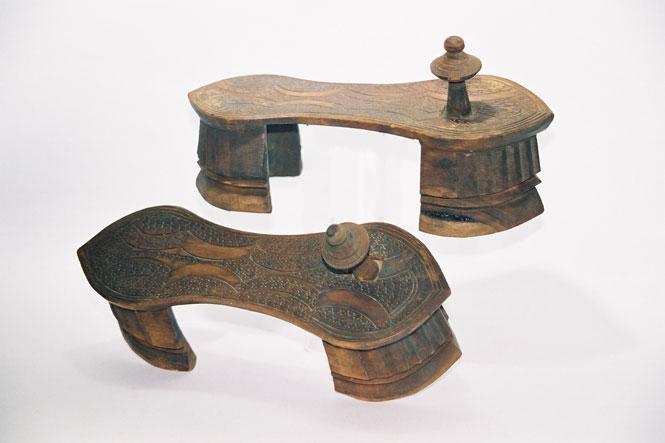
The Guru Padukā Stotram is a nine-verse devotional hymn attributed to Ādi Śaṅkarācārya (788-820 CE) that venerates the pādukā (sacred sandals) of the guru as the supreme symbol of spiritual grace. In the Hindu tradition, the guru’s sandals are not mere footwear but a living embodiment of the teacher’s presence, wisdom, and transformative power. By worshipping the pādukā, the disciple expresses the deepest form of surrender — bowing not merely before the guru’s person but before the very ground the guru walks upon.
The Opening Verse
The stotram begins with one of the most powerful images in all devotional literature:
अनन्तसंसारसमुद्रतार नौकायिताभ्यां गुरुभक्तिदाभ्यां वैराग्यसाम्राज्यदपूजनाभ्यां नमो नमः श्रीगुरुपादुकाभ्याम्
Anantasaṃsārasamudratāra Naukāyitābhyāṃ Gurubhaktidābhyāṃ Vairāgyasāmrājyadapūjanābhyāṃ Namo Namaḥ Śrīgurupādukābhyām
“Salutations again and again to the holy sandals of the guru, which serve as the boat to cross the endless ocean of saṃsāra, which bestow devotion to the guru, and whose worship grants the empire of dispassion (vairāgya).”
This single verse encapsulates the entire theology of the stotram: the guru’s pādukā are the vessel of liberation, the source of devotion, and the gateway to renunciation.
The Nine Verses: A Complete Guide
Each of the nine verses follows the same structural pattern, ending with the refrain “Namo Namaḥ Śrīgurupādukābhyām” (“I bow again and again to the sacred sandals of the guru”). This repetitive structure serves as a meditative anchor, deepening the disciple’s surrender with each iteration.
Verse 1: The Boat Across Saṃsāra
The pādukā are compared to a boat (nauka) that carries the devotee across the ocean of endless rebirth (ananta-saṃsāra-samudra). This nautical metaphor is one of the most ancient in Indian spiritual literature, appearing in the Śvetāśvatara Upaniṣad (1.2): “Those who know Brahman cross over death.” The image suggests that the disciple, drowning in the waves of birth, death, and suffering, finds in the guru’s grace a vessel sturdy enough to navigate to the far shore of liberation.
Verse 2: The Full Moon of Knowledge
कवित्ववाराशिनिशाकरभ्यां दौर्भाग्यदावांबुदमालिकाभ्याम् दूरीकृतानम्रविपत्तिताभ्यां नमो नमः श्रीगुरुपादुकाभ्याम्
“Salutations to the guru’s sandals, which are like the full moon to the ocean of poetic inspiration, which are like rain clouds that extinguish the forest fire of misfortune, and which remove the calamities of those who bow before them.”
Here the pādukā are the full moon (niśākara) whose gentle light causes the ocean of kavitva (poetic wisdom and eloquence) to swell and rise, just as the physical moon governs the tides. The verse also introduces the image of the pādukā as rain clouds that extinguish the wildfire of the disciple’s accumulated misfortunes.
Verse 3: The Destroyer of Sins
नता ययोः श्रीपतितां समीयुः कदाचिदप्याशु दरिद्रवर्याः मूकाश्च वाचस्पतितां हि ताभ्यां नमो नमः श्रीगुरुपादुकाभ्याम्
“Those who bow before these sandals, even the most wretched among the poor quickly attain the status of Śrī (Lakṣmī’s) lord, and the mute become masters of speech — to those sandals I bow.”
This verse affirms the transformative power of guru-bhakti: the poorest becomes wealthy, not in material terms but in spiritual abundance, and the mute becomes eloquent — a reference to the awakening of spiritual knowledge (jñāna) and the capacity to articulate the highest truths.
Verse 4: The Jewelled Splendour
नालीकनीकाशपदाह्रताभ्यां नानाविमोहादिनिवारिकाभ्याम् नमज्जनाभीष्टततिप्रदाभ्यां नमो नमः श्रीगुरुपादुकाभ्याम्
“Salutations to the guru’s sandals, whose beauty rivals the lotus, which dispel the many forms of delusion, and which fulfil the desires of those who bow before them.”
The lotus (nālīka) comparison is richly layered: in Hindu iconography, the lotus grows from muddy waters but remains unstained — just as the guru’s wisdom emerges in the world of māyā but is never tainted by it.
Verse 5: The Dispeller of Darkness
नृपालिमौलिव्रजरत्नकान्ति सरिद्विराजत्झषकन्यकाभ्याम् नृपत्ववाप्तिविजयप्रदाभ्यां नमो नमः श्रीगुरुपादुकाभ्याम्
“Salutations to the guru’s sandals, which shine with the lustre of the jewels from the crowns of kings who bow before them, which gleam like fish-maidens in the river of radiance, and which bestow the victory of sovereignty.”
This verse depicts the universal sovereignty of the guru’s pādukā: even kings (nṛpāli) bow before them, and the jewels from their crowns create a shimmering river of light around the sandals.
Verses 6-9: Deepening Surrender
The remaining verses continue the pattern of accumulating metaphors, each adding a new dimension to the pādukā’s glory:
- Verse 6: The pādukā are compared to a wish-fulfilling gem (cintāmaṇi) and to the divine tree Kalpavṛkṣa that grants all desires
- Verse 7: They are the sun that destroys the darkness of ignorance, the mantra that destroys the poison of worldly attachment
- Verse 8: They purify the mind like the waters of the Gaṅgā, washing away the accumulated karmic residue of countless lifetimes
- Verse 9: The final verse is the ultimate expression of surrender, declaring that the pādukā alone are the disciple’s refuge, wealth, and liberation
The Symbolism of Pādukā in Hindu Tradition
The veneration of the guru’s sandals has deep roots in Hindu culture, extending far beyond the literary tradition of stotras into daily worship practice:
The Rāmāyaṇa Precedent
The most famous pādukā in Hindu narrative are those of Lord Rāma, which his brother Bharata placed upon the throne of Ayodhyā during Rāma’s fourteen-year exile. The Ayodhyā Kāṇḍa of the Vālmīki Rāmāyaṇa (2.112) describes how Bharata, refusing to rule in his own right, governed the kingdom as a regent — with Rāma’s sandals (pādukā) placed on the royal seat as the true sovereign. This act established the pādukā as a symbol of the absent lord’s authority and presence.
The Guru’s Feet in the Upaniṣads
The Vedic tradition places supreme importance on the guru’s feet (caraṇa). The very word Upaniṣad is traditionally interpreted as “sitting near” (upa-ni-ṣad) — sitting at the feet of the teacher. The Muṇḍaka Upaniṣad (1.2.12) instructs:
तद्विज्ञानार्थं स गुरुमेवाभिगच्छेत् समित्पाणिः श्रोत्रियं ब्रह्मनिष्ठम्
“To know That (Brahman), let him approach, with fuel in hand (as a sign of humility), a guru who is learned in the scriptures and established in Brahman.”
The Taittirīya Upaniṣad (1.11.2) goes further: “Ācāryādevobhava” — “Treat the teacher as God.” The pādukā are an extension of this principle: if the guru’s feet are divine, then the sandals that touch those feet absorb their sanctity.
Pādukā Pūjā in Temple Worship
In many Hindu temples and monasteries (maṭha), the guru’s pādukā are worshipped with the full honours of deity worship:
- Abhiṣeka: The sandals are bathed with water, milk, honey, and other sacred substances
- Alaṅkāra: They are decorated with flowers, sandalwood paste, and turmeric
- Āratī: Lights are waved before them
- Mantra chanting: The Guru Padukā Stotram or other guru-stotras are recited
This practice is particularly prominent in the Śaṅkara maṭhas (the four monastic centres established by Śaṅkarācārya at Śṛṅgeri, Dvārakā, Purī, and Jyotirmaṭha), where the pādukā of the founding ācārya and successive gurus are preserved and worshipped.
The Guru-Śiṣya Paramparā
The Guru Padukā Stotram cannot be understood apart from the guru-śiṣya paramparā (the chain of teacher and disciple) that forms the backbone of Hindu knowledge transmission. In Vedānta, spiritual knowledge is not something that can be learned from books alone — it must be transmitted from a realised teacher (sad-guru) to a qualified student (adhikārin) through direct instruction and the teacher’s grace (kṛpā).
Śaṅkarācārya and His Guru Govindapāda
Śaṅkarācārya himself was the devoted disciple of Govinda Bhagavatpāda, who in turn was a student of Gauḍapāda, the author of the Māṇḍūkya Kārikā. This three-generation lineage — Gauḍapāda to Govinda to Śaṅkara — represents one of the most celebrated paramparās in Indian intellectual history. Śaṅkara’s own deep reverence for his guru finds expression in the Guru Padukā Stotram, where every verse breathes with the gratitude of a disciple who has received the supreme gift: the knowledge of Brahman.
The Advaita Paradox of Guru Worship
A fascinating philosophical tension runs through the Guru Padukā Stotram. In Advaita Vedānta, the ultimate truth is that there is no distinction between the guru, the disciple, and Brahman — all are one non-dual reality. Yet the stotram is an act of devotion from the disciple to the guru, which presupposes duality.
Śaṅkara resolves this paradox in the Vivekacūḍāmaṇi (verse 1): “I bow to the guru who, with the collyrium-stick of knowledge, opened my eyes that were blinded by the darkness of ignorance.” The guru-disciple relationship belongs to the realm of vyāvahārika (conventional reality) — it is the very ladder by which the student climbs to pāramārthika (absolute reality), at which point the distinction between guru and disciple dissolves. The pādukā, then, are the last symbol the aspirant grasps before the final dissolution of duality.
Guru Pūrṇimā: The Festival of the Guru
The Guru Padukā Stotram holds special significance on Guru Pūrṇimā (also called Vyāsa Pūrṇimā), the full-moon day in the Hindu month of Āṣāḍha (June-July). This day is dedicated to the veneration of all spiritual teachers and is observed across all Hindu traditions — Vedānta, Yoga, Bhakti, and Tantra.
On Guru Pūrṇimā:
- Disciples visit their guru and offer worship at the guru’s feet
- The Guru Padukā Stotram is chanted in temples, ashrams, and homes
- In the four Śaṅkara maṭhas, special pūjā is performed to the pādukā of the entire ācārya lineage
- In the Nātha and Siddha traditions, practitioners honour the guru-paramparā with elaborate rituals
- In the Guru Granth Sahib tradition of Sikhism, the principle of guru veneration — which has Hindu roots — is similarly celebrated
The day is also sacred to the sage Vyāsa, the compiler of the Vedas and the Mahābhārata, who is regarded as the Ādi-guru (primordial teacher) of the Hindu tradition. The Guru Gītā from the Skanda Purāṇa declares: “The guru is Brahmā, the guru is Viṣṇu, the guru is Lord Maheśvara (Śiva); the guru is verily the Supreme Brahman. To that Śrī Guru I bow.”
The Stotram’s Enduring Message
The Guru Padukā Stotram distils the essence of the guru-disciple relationship into nine luminous verses. Its message is deceptively simple: everything the aspirant seeks — liberation from suffering, the light of knowledge, the wealth of inner peace, the power of eloquence, the empire of dispassion — is available through surrender to the guru’s grace, symbolised by the humble wooden sandals.
In a tradition where the Supreme Brahman is said to be beyond all names, forms, and attributes, the pādukā serve as the most tangible, most accessible point of contact between the finite and the infinite. They remind the disciple that the highest wisdom is not found in abstract speculation but in the living relationship with a teacher who has walked the path before — and whose very footprints upon the earth are worthy of worship.
As the stotram concludes with its ninth refrain — Namo Namaḥ Śrīgurupādukābhyām — the disciple’s surrender is complete. In bowing to the guru’s sandals, one bows to the entire lineage of teachers stretching back to the beginning of time, to the Vedas themselves, and ultimately to Brahman — the sole reality that the guru’s grace reveals.