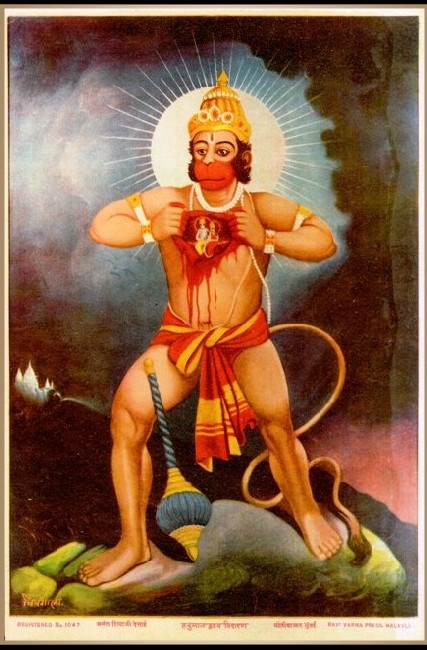
The Hanumān Bāhuk (हनुमान बाहुक, literally “Hanumān’s Arm”) is one of the most emotionally raw and autobiographically revealing compositions in all of Hindi devotional literature. Composed by Gosvāmī Tulsīdās (c. 1532—1623 CE) during a period of excruciating arm pain (bāhu-pīḍā), this poem of 44 verses is a desperate, impassioned, and ultimately triumphant appeal to Lord Hanumān for relief from physical suffering. Unlike the majestic sweep of the Rāmcharitmānas or the structured devotion of the Hanumān Chālīsā, the Hanumān Bāhuk lays bare the poet’s mortal vulnerability — a saint crying out to his Lord not from a position of composure but from the depths of agony.
The Circumstances of Composition
Tulsīdās’s Affliction
According to traditional accounts preserved in the Mūla Gosvāmī Carita and other hagiographic texts, Tulsīdās composed the Hanumān Bāhuk during his later years in Vārāṇasī (Banāras), when he was struck by a severe and persistent pain in his arms. The condition is variously described as rheumatism, paralysis, or an acute inflammatory ailment. The poet himself uses the term bāhu-pīḍā (arm-affliction) and describes symptoms that suggest intense, burning pain radiating through both arms, rendering him unable to write or perform daily worship.
The traditional dating places the composition around 1600 CE, when Tulsīdās was approximately 68 years old. By this time he had already completed his magnum opus, the Rāmcharitmānas, and the Hanumān Chālīsā. The Bāhuk thus belongs to the poet’s final creative period, and its raw emotional quality may owe something to the accumulated spiritual authority and unselfconscious intimacy of a life spent in devotion.
The Legend of the Healing
The most widely told version of the story relates that Tulsīdās, having exhausted all medical remedies, turned to Hanumān in a state of absolute surrender. He composed the Bāhuk as a direct, personal petition — not a formal hymn for public worship, but a private cry for help. According to tradition, upon completing the recitation, Hanumān himself appeared and touched the poet’s arms, instantly curing the affliction. This miraculous healing became the foundation of the Bāhuk’s reputation as a powerful ārogya-stotra (healing hymn).
Structure and Literary Form
The Hanumān Bāhuk consists of 44 verses (some recensions count 45 or 46, depending on whether certain introductory or concluding couplets are included). The poem is composed primarily in Braj Bhāṣā, the literary dialect of the Mathura-Agra region, unlike the Hanumān Chālīsā which uses Avadhī. This choice of Braj is significant: while Avadhī was Tulsīdās’s preferred language for narrative works, Braj Bhāṣā was the dominant literary language of lyric poetry in his era, associated with the intimate, personal expression of poets like Sūrdās and the Aṣṭachāp poets.
The verses employ a variety of metres, including kavitt, savvaiyā, and chhand, giving the poem a rhythmic diversity that mirrors the emotional turbulence of its content. Unlike the Chālīsā’s uniform chaupāī structure, the Bāhuk shifts between rapid, urgent stanzas and longer, more meditative passages.
The Opening Verses
The poem opens with a vivid invocation of Hanumān’s physical splendour — his vermillion-coloured body (sindūra sama barana), his mighty arms (bāhu visālā), and his role as the destroyer of enemies. But almost immediately, Tulsīdās turns the focus inward to his own suffering:
सरन गहे हनुमान, महा बलवान बजरंगी। बाहु-पीर हरहु मोरी, मोको तुम हो अंगी॥
“I have taken refuge in Hanumān, the mighty Vajrāṅgī. Remove my arm-pain, for you are my very own.”
The word aṅgī (“my own,” “my intimate companion”) is particularly striking — it expresses a relationship that goes beyond formal worship to a kind of familial, almost possessive, intimacy.
Key Themes
Autobiographical Anguish
The Hanumān Bāhuk is remarkable for its unflinching depiction of physical suffering. Tulsīdās does not spiritualize or allegorize his pain — he describes it with visceral directness:
- His arms burn as if consumed by fire (agni sama jvarā)
- He cannot lift his hands to perform worship (pūjā karata na bane)
- Sleep has abandoned him; he writhes through the nights
- He has tried every remedy — herbal medicines, oils, mantras from other practitioners — and nothing has worked
This frankness is rare in devotional literature, where saints are typically portrayed as transcending bodily concerns. Tulsīdās instead presents his humanity as the very ground of his devotion: it is precisely because he is suffering that he needs Hanumān.
The Catalogue of Hanumān’s Powers
Interwoven with the personal lament is a systematic catalogue of Hanumān’s divine attributes and legendary deeds, drawn from the Rāmāyaṇa and Purāṇic traditions:
- The Sanjeevani episode: Hanumān carried the entire Droṇagiri mountain to save Lakṣmaṇa — surely he can heal one devotee’s arms (verses 8—10)
- The burning of Laṅkā: He whose tail set an entire city ablaze possesses power over fire and disease (verse 14)
- The ocean-crossing: He who leapt across the ocean can leap across the ocean of the poet’s suffering (verse 18)
- The gift of the eight siddhis and nine nidhis: Blessed by Sītā Mātā herself, Hanumān has the power to grant any boon (verse 22)
Each exploit is cited not merely as praise but as evidence — logical arguments for why Hanumān can and should intervene. The rhetorical strategy is that of an advocate presenting a case: “You have done these mighty deeds; is my small affliction beyond you?”
Complaints and Reproaches
One of the most distinctive features of the Bāhuk is Tulsīdās’s willingness to reproach Hanumān for apparent inaction. In several verses, the poet expresses a lover’s frustration:
- “I have served you my whole life — where are you now?” (verse 25)
- “Others call upon you for trivial boons and receive them. Am I, your lifelong devotee, less worthy?” (verse 28)
- “If you will not help me, to whom shall I turn?” (verse 32)
This tone of loving complaint (māna or ulāhanā) has deep roots in the Bhakti tradition, particularly in the poetry of the viraha (separation) tradition. It reflects not a loss of faith but an intensification of it — the devotee who complains to God does so because he expects God to respond.
Surrender and Resolution
The final section of the Bāhuk moves from complaint to surrender (śaraṇāgati). Tulsīdās acknowledges that his suffering may be the fruit of past karma, but insists that Hanumān’s grace (kṛpā) is more powerful than any karmic debt:
तुलसी कर्म-प्रभाव भयो बाधा अब बहुतो। राम-दूत कृपा करो, काटो कलेस सबहिं तो॥
“Tulsīdās says: the power of karma has brought much affliction. O messenger of Rāma, show mercy — cut away all my distress.”
The poem concludes with a declaration of total dependence: there is no other refuge, no other healer, no other hope. This radical surrender is the theological climax of the work.
Relationship to the Hanumān Chālīsā
The Hanumān Bāhuk and the Hanumān Chālīsā are often regarded as companion texts, though they differ profoundly in tone, purpose, and literary character:
| Feature | Hanumān Chālīsā | Hanumān Bāhuk |
|---|---|---|
| Language | Avadhī | Braj Bhāṣā |
| Verses | 40 chaupāī + 2 dohā | 44 verses (mixed metres) |
| Tone | Celebratory praise | Personal anguish and plea |
| Purpose | General devotional recitation | Specific healing supplication |
| Perspective | Universal devotee | Tulsīdās himself, named |
| Emotional register | Joy, reverence, confidence | Pain, reproach, surrender |
The Chālīsā is a hymn for all occasions and all devotees; the Bāhuk is one man’s crisis made into poetry. Together, they represent the full spectrum of Bhakti experience — from collective celebration to solitary suffering.
The Bāhuk in Healing Traditions
The Hanumān Bāhuk has occupied a special place in Hindu healing traditions for over four centuries:
Recitation for the Sick
The Bāhuk is widely recited at the bedside of those suffering from chronic pain, paralysis, and diseases of the arms and limbs. In many North Indian families, the Bāhuk is the first text turned to when conventional medicine fails, reflecting the belief that the poem’s power is not merely psychological but spiritually efficacious.
Tuesday and Saturday Practice
Like the Hanumān Chālīsā, the Bāhuk is especially associated with Tuesday (Maṅgalavāra) and Saturday (Śanivāra) worship of Hanumān. Devotees who suffer from the astrological affliction of Śani (Saturn) — associated with chronic illness and physical hardship — are often advised to recite the Bāhuk as a remedial practice.
Temple Traditions
At the Sankat Mochan Temple in Vārāṇasī (founded by Tulsīdās himself), the Bāhuk is recited as part of special healing services. Devotees bring offerings of sindūr (vermillion), tel (oil), and laddū (sweets) to Hanumān while priests recite the Bāhuk on their behalf.
The Bāhuk and Āyurveda
Some traditional Āyurvedic practitioners in North India incorporate the Bāhuk’s recitation alongside herbal treatments for joint diseases (vāta-vyādhi), viewing the spiritual and medical approaches as complementary rather than contradictory. The poem itself references various failed medical treatments, suggesting that Tulsīdās saw spiritual healing as the final recourse when physical medicine proves inadequate.
Literary Significance
The Hanumān Bāhuk holds a distinguished place in Hindi literature beyond its devotional function:
Pioneer of Confessional Poetry
The Bāhuk is one of the earliest examples of confessional poetry in the Hindi literary tradition. By placing his own name, body, and suffering at the centre of the work, Tulsīdās created a template for the personal devotional lyric that would influence subsequent Bhakti poets.
Braj Bhāṣā Mastery
The poem’s use of Braj Bhāṣā demonstrates Tulsīdās’s command of both major literary dialects of his era. The Braj verses display a lyrical suppleness and emotional immediacy that complement the more stately Avadhī of his Rāma-centric works.
Rhetorical Brilliance
The Bāhuk’s argument-from-precedent structure — citing Hanumān’s past deeds as evidence of his capacity to heal — represents a sophisticated form of devotional rhetoric that draws on the traditions of Indian logic (nyāya) and courtly petition (vijñāpti).
The Bāhuk in the Tulsīdās Canon
The Hanumān Bāhuk belongs to the collection of Tulsīdās’s shorter works, often published alongside the Kavitāvalī, Gītāvalī, Vinaya Patrikā, and other lyric compositions. Within this corpus, the Bāhuk stands out for its urgency and personal focus. The Vinaya Patrikā (“Petition of Humility”) shares the Bāhuk’s tone of supplication, but addresses Śrī Rāma rather than Hanumān and is a much longer, more varied work.
Scripture References
- Hanumān Bāhuk, verses 1—44 (complete text)
- Rāmcharitmānas, Sundarakāṇḍa (Hanumān’s exploits referenced in the Bāhuk)
- Vālmīki Rāmāyaṇa, Sundarakāṇḍa and Yuddhakāṇḍa (the Sanjeevani and Laṅkā episodes)
- Vinaya Patrikā by Tulsīdās (companion devotional petition to Rāma)
- Kavitāvalī by Tulsīdās (contains additional Braj Bhāṣā verses on Hanumān)
The Hanumān Bāhuk endures not because it is a polished liturgical composition but because it is the opposite — a cry wrung from a human being in extremity, addressed to the one being in whom he has absolute faith. In its willingness to combine praise with protest, theology with tears, and argument with surrender, the Bāhuk offers a model of devotion that embraces the full complexity of the human condition. For those who suffer and who pray, it remains, after four centuries, a companion in the dark.