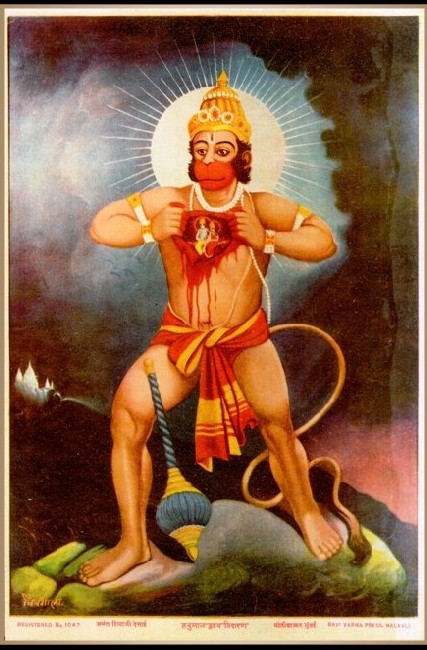
The Hanuman Chalisa (हनुमान चालीसा, literally “Forty [verses] of Hanuman”) is one of the most widely recited devotional hymns in all of Hinduism. Composed by the great poet-saint Gosvami Tulsidas (c. 1532—1623 CE) in the Awadhi dialect of Hindi, this prayer of forty chaupai (quatrains) celebrates the virtues, exploits, and divine nature of Lord Hanuman — the ideal devotee of Sri Rama. It is estimated that the Hanuman Chalisa is recited by tens of millions of Hindus every day, making it arguably the single most popular devotional text in India.
Tulsidas: The Poet Behind the Prayer
Gosvami Tulsidas was born in the 16th century, most likely around 1532 CE in the town of Rajapur (present-day Uttar Pradesh). He is best known as the author of the monumental Sri Ramcharitmanas, the retelling of Lord Rama’s story in Awadhi that transformed North Indian devotional life. Tulsidas was a lifelong devotee of Sri Rama and His faithful servant Hanuman.
According to traditional accounts, Tulsidas composed the Hanuman Chalisa during a period of personal distress. One prominent legend places the composition during a time when the poet was imprisoned by the Mughal emperor Akbar (or one of his officials). In his captivity, Tulsidas fervently prayed to Hanuman, and the resulting verses are said to have manifested as the Chalisa. When an army of monkeys allegedly descended upon Delhi, the emperor released the saint. While the historical details vary across retellings, the spirit of the story captures the deep faith that pervades every line of the poem.
Tulsidas lived during the height of the Bhakti movement in North India, an era when poet-saints like Kabir, Surdas, and Mirabai were composing devotional literature in vernacular languages rather than Sanskrit, making spiritual wisdom accessible to ordinary people. The Hanuman Chalisa belongs to this great tradition of popular devotion.
Structure of the Hanuman Chalisa
The Hanuman Chalisa follows a precise poetic structure rooted in the Awadhi literary tradition:
-
Two opening doha (couplets): These invocatory verses serve as a prayer for purification of the mind and an appeal for strength and wisdom. In the first doha, Tulsidas cleanses the mirror of his mind with the dust from his Guru’s lotus feet; in the second, he acknowledges his own limited intellect and invokes Hanuman to grant strength, wisdom, and knowledge.
-
Forty chaupai (quatrains): The core body of the Chalisa consists of exactly 40 verses in the chaupai metre, each containing four metrical lines. These verses systematically praise Hanuman’s qualities, recount his mighty deeds from the Ramayana, and affirm his spiritual powers.
-
One closing doha (couplet): The final couplet serves as a phalashruti — a declaration of the fruit one obtains from reciting the hymn. It promises that whoever recites these verses with devotion will receive Hanuman’s grace.
The word “Chalisa” itself derives from the Hindi word chalis (चालीस), meaning “forty,” referring to the forty chaupai that form the heart of the composition.
Key Themes and Verse-by-Verse Highlights
Invocation and Humility (Doha 1—2)
The opening doha are a masterpiece of devotional humility. Tulsidas declares that he polishes the mirror of his mind with the dust from his Guru’s lotus feet (Sriguru carana saroja raja) so that he may narrate the pure glory of Sri Rama. In the second doha, he frankly acknowledges his lack of intellect (buddhihina) and asks the Son of the Wind (Pavana-kumara) for strength (bala), wisdom (buddhi), and knowledge (bidya), and to remove his afflictions (kalesa bikara).
Praise of Hanuman’s Form and Nature (Chaupai 1—5)
The first five chaupai establish Hanuman’s cosmic stature. He is called an “ocean of knowledge and virtue” (jnana guna sagara), the one who illuminates the three worlds (tihu loka ujagara), the messenger of Rama with incomparable strength (atulita bala dhama), son of Anjani and the Wind God (Anjani-putra pavanasuta). His body is described as strong as a thunderbolt (bajrangi), dispelling evil thoughts and accompanying those of good mind (kumati nivara sumati ke sangi).
Hanuman’s Physical Splendour (Chaupai 6—10)
These verses describe Hanuman’s golden complexion (kancana barana), his curling hair, and the sacred thread and earrings he wears. He holds Rama’s banner (Rama-dhvaja) in his hand and wears the sacred thread on his shoulder. He is described as an incarnation of Shiva (Sankara suvana), adored by Kesari-nandana, and his glory pervades the world.
Exploits from the Ramayana (Chaupai 11—25)
The central section recounts Hanuman’s legendary deeds:
- Service to Sri Rama: Hanuman’s unwavering devotion is highlighted — he lives only to serve Rama, and Rama’s work is his sole purpose (Rama kaja karibe ko atura).
- Meeting Sita in Lanka: Tulsidas recounts how Hanuman leapt across the ocean to Lanka, assuming a tiny form (sukshma rupa dhari Siyahi dikhava) to meet Sita in Ashoka Vatika and deliver Rama’s ring.
- Burning of Lanka: After delivering the message, Hanuman set Lanka ablaze with his burning tail (Lanka ko jari), an act of divine retribution against the demon king Ravana.
- Slaying of demons: He killed demons and rakshasas, performing terrifying feats (bhima rupa dhari asura samhare).
- The Sanjeevani episode: Perhaps the most beloved exploit — when Lakshmana lay mortally wounded in battle, Hanuman flew to the Himalayas and, unable to identify the specific herb, uprooted the entire Dronagiri mountain (Sanjeevani hatha ke jaba liye / Lachimana jivaye Sri Raghubira harashiye) and brought it back, saving Lakshmana’s life and causing Sri Rama to embrace Hanuman with joy.
- Devotion acknowledged by Rama: Sri Rama declared Hanuman as dear to Him as His own brother Bharata (tumha mama priya Bharatahi sama bhai), the highest honour a devotee could receive.
Spiritual Powers and Boons (Chaupai 26—35)
The later chaupai describe the supernatural powers and boons bestowed upon Hanuman:
- The eight siddhis and nine nidhis (ashta siddhi nau nidhi ke data) are at his command, granted by Mother Sita herself.
- He holds the elixir of Rama’s devotion (Rama rasayana) and remains eternally in service across all ages (yuga yuga).
- He protects devotees from all afflictions — those who take refuge in Hanuman need fear nothing (jo saranagata kuta ko rakhavara).
- Only Hanuman can control his own immense power — no one else can challenge him (apana teja samharo apai).
- His roar shakes the three worlds, and ghosts and evil spirits dare not approach those who chant “Mahavira” (bhuta pisacha nikata nahi avai).
The Closing Verses and Phalashruti (Chaupai 36—40 and Final Doha)
The closing section is an exhortation to devotion. Tulsidas declares that whoever recites the Chalisa one hundred times will be freed from worldly bondage and attain great bliss (jo sata bara patha kara koi / chhutahi bandi maha sukha hoi). All afflictions cease, and all pains are destroyed. The hymn concludes with the affirmation that Hanuman, the destroyer of demons, should always be remembered, and that Rama resides forever in his heart.
The final doha seals the promise: “Hail, hail, hail Lord Hanuman! Bestow your grace upon me as my Guru.”
The Hanuman Chalisa in Hindu Devotional Life
The Hanuman Chalisa occupies a unique place in Hindu worship. Unlike many Sanskrit stotras that require priestly mediation, the Chalisa is composed in Awadhi — a vernacular language accessible to all. This accessibility is central to its popularity: it belongs to the people, not to the priestly class alone.
Recitation Traditions
- Daily practice: Millions recite the Chalisa as part of their morning or evening prayers, often after lighting a lamp before an image of Hanuman.
- Tuesday and Saturday worship: These days are especially sacred to Hanuman. Temples overflow with devotees who gather for collective recitation, often accompanied by the offering of sindoor (vermillion), oil, and flowers.
- Times of difficulty: The Chalisa is widely turned to during periods of fear, illness, or hardship. Its verses are believed to provide protection from evil spirits, black magic, and misfortune (bhuta pisacha nikata nahi avai / Mahavira jaba nama sunave).
- Collective recitation (path): Group recitations, especially 108 rounds or continuous 24-hour sessions (akhand path), are organized in temples and homes across India.
Regional Popularity
While the Hanuman Chalisa originates in the Awadhi-speaking heartland of North India, its reach extends across the entire subcontinent. It is recited in Maharashtra, Gujarat, Rajasthan, Madhya Pradesh, Bihar, and well beyond. South Indian Hanuman temples have adopted Hindi recitation alongside regional stotras. The Indian diaspora has carried the Chalisa to every continent.
Musical Renditions
The Hanuman Chalisa has been set to music by countless artists, from classical vocalists to Bollywood playback singers. Notable recordings by artists like Hari Om Sharan, Gulshan Kumar, and more recently Shankar Mahadevan have made the Chalisa one of the most-streamed devotional tracks globally.
Theological Significance
The Hanuman Chalisa encapsulates several core tenets of the Ramaite Bhakti tradition:
- Dasya bhakti (devotion through service): Hanuman is the supreme exemplar of selfless service to God. His entire being is oriented toward Rama.
- Guru-bhakti: The opening doha’s reverence for the Guru reflects the importance of the spiritual teacher in the devotional path.
- Accessibility of grace: The Chalisa teaches that divine grace is available to all who call upon Hanuman with sincerity — no special qualification is needed.
- Power through devotion: Hanuman’s immense physical and supernatural powers are presented not as ends in themselves but as fruits of his unwavering devotion to Rama.
- Protection and fearlessness: A recurring promise of the Chalisa is that Hanuman’s devotees are freed from fear — of death, evil spirits, and worldly suffering.
Historical and Cultural Impact
The Hanuman Chalisa has shaped Hindu religious culture in profound ways. It popularised the worship of Hanuman as an independent deity (rather than solely as a character in the Ramayana). The spread of Hanuman temples across India — from the grand Sankat Mochan Temple in Varanasi (founded by Tulsidas himself) to roadside shrines at every crossroad — owes much to the devotional fervour that the Chalisa inspires.
In popular culture, the Chalisa has become a touchstone of faith. It appears in films, is played on loudspeakers during festivals, and is taught to children as one of their first prayers. Its opening words — Jai Hanuman gyan gun sagar — are among the most recognised lines in all of Indian devotional literature.
Scripture References
- Sri Ramcharitmanas, Sundara Kanda (Hanuman’s journey to Lanka)
- Valmiki Ramayana, Sundara Kanda (the original account of Hanuman’s exploits)
- Hanuman Chalisa, Doha 1—2 and Chaupai 1—40
- Bhagavad Gita 11.40 (universal form, paralleling Hanuman’s cosmic nature)
The Hanuman Chalisa is not merely a prayer to be recited; it is a living relationship between devotee and deity. In its forty verses, Tulsidas distilled the essence of Hanuman’s character — strength wedded to humility, power inseparable from devotion — and gave the world a hymn that continues to comfort, protect, and inspire across the centuries.