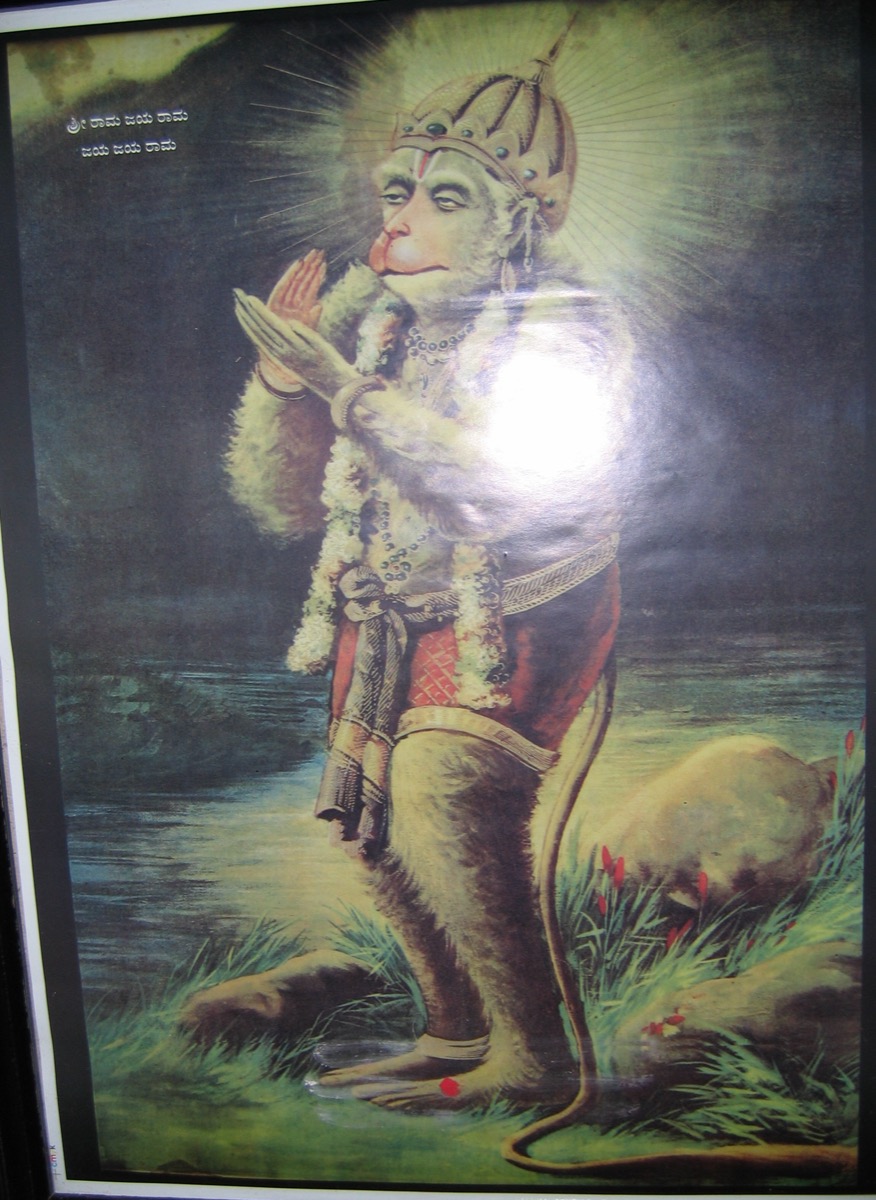
The Hanumān Vaḍavānala Stotra (श्री हनुमद् वडवानल स्तोत्र) is one of the most powerful and esoteric hymns dedicated to Lord Hanumān in the entire Hindu devotional canon. Composed by Vibhīṣaṇa — the righteous brother of the demon-king Rāvaṇa and a lifelong devotee of Śrī Rāma — this stotra invokes Hanumān in his most terrifying, all-consuming form: that of the Vaḍavānala, the submarine fire that burns ceaselessly beneath the ocean. Where gentler hymns like the Hanumān Chālīsā approach the deity through loving devotion, the Vaḍavānala Stotra is a tantric invocation that summons the full, unrestrained fury of Hanumān’s divine power to incinerate every obstacle, affliction, and malevolent force that threatens the devotee.
The stotra belongs to the category of tāmasika stotras (hymns invoking fierce, destructive divine energy) and is classified within the tradition as a kavaca (spiritual armour) — a mantra-shield that wraps the practitioner in Hanumān’s impenetrable protection. Its recitation is prescribed for the most challenging circumstances: severe illness, planetary afflictions (especially those of Śani/Saturn), black magic, spirit possession, and deep existential crisis.
The Meaning of Vaḍavānala: Submarine Fire
The word Vaḍavānala (वडवानल) is a compound of two Sanskrit terms: vaḍavā (वडवा), meaning a mare or specifically the mythological mare-shaped submarine fire, and anala (अनल), meaning fire. In Hindu cosmology, the Vaḍavānala is the cosmic fire that burns perpetually at the bottom of the ocean, held in check by the waters yet never extinguished. The Viṣṇu Purāṇa (2.4.8—12) describes it as the fire that will eventually consume the worlds at the time of pralaya (cosmic dissolution). The Mahābhārata (Ādi Parva 1.232) and the Śiva Purāṇa also reference this apocalyptic fire.
By invoking Hanumān as the Vaḍavānala, the stotra identifies him with this inextinguishable, all-consuming power. Just as the submarine fire can never be quenched by the ocean, Hanumān’s protective fury can never be overcome by any force of darkness. The metaphor is deliberately extreme: the devotee is not asking for gentle assistance but for the deployment of cosmic, annihilating fire against their afflictions.
This imagery also connects to a historical episode from the Rāmāyaṇa. When Hanumān set Laṅkā ablaze with his burning tail, the fire that consumed the golden city was not ordinary fire — it was the fire of divine justice, the visible manifestation of the Vaḍavānala principle. The stotra thus recalls Hanumān’s proven capacity for divine destruction in the service of righteousness.
Vibhīṣaṇa: The Composer and His Context
The attribution of this stotra to Vibhīṣaṇa is both historically fascinating and spiritually significant. Vibhīṣaṇa, though born a rākṣasa (demon), was a devoted follower of dharma from birth. The Vālmīki Rāmāyaṇa (Yuddha Kāṇḍa) portrays him as the only member of Rāvaṇa’s court who opposed the abduction of Sītā and urged his brother to return her to Rāma. For this righteous counsel, he was banished from Laṅkā and sought refuge with Śrī Rāma, who not only accepted him but crowned him king of Laṅkā after Rāvaṇa’s defeat.
Vibhīṣaṇa’s composition of this stotra is significant because he composed it from a position of extreme vulnerability. Surrounded by demonic forces, expelled from his homeland, and facing the wrath of the most powerful rākṣasa king, Vibhīṣaṇa turned to Hanumān — the one divine being whose power could match and exceed even the combined forces of the rākṣasa armies. The stotra thus carries the authenticity of a prayer born not from comfortable devotion but from genuine existential despair, and its power is said to reflect that intensity.
Structure and Content of the Stotra
The Hanumān Vaḍavānala Stotra follows a distinct structural pattern that sets it apart from most Hindu hymns. Rather than being organized into discrete, metrically regular verses (śloka or chandas), it is composed primarily in prose-mantra format — long, flowing sentences packed with epithets, bīja mantras, and protective invocations. This structure is characteristic of tantric literature and kavaca texts.
Viniyoga (Ritual Application)
The stotra opens with its viniyoga, establishing the formal framework:
- Ṛṣi (Seer): Śrī Rāmacandra
- Devatā (Deity): Śrī Vaḍavānala Hanumān
- Bīja (Seed syllable): Hrāṃ (ह्रां)
- Śakti (Power syllable): Hrīṃ (ह्रीं)
- Kīlaka (Locking syllable): Sauṃ (सौं)
- Purpose: Removal of all obstacles (vighna), destruction of enemies, cure of diseases, increase of lifespan, health and wealth, destruction of sins, and the pleasure of Śrī Sītā-Rāmacandra.
The viniyoga is not mere ritual formality; it establishes the stotra’s mantra-śāstra credentials. Every potent stotra in the tantric tradition must declare its seer, deity, seed syllable, and purpose, and the viniyoga serves as the spiritual “activation key.”
Dhyāna (Meditation Verse)
Before the main stotra, the devotee recites the famous dhyāna śloka:
मनोजवं मारुततुल्यवेगं जितेन्द्रियं बुद्धिमतां वरिष्ठम्। वातात्मजं वानरयूथमुख्यं श्रीरामदूतं शरणं प्रपद्ये॥
Manojavaṃ mārutatulyavēgaṃ jitēndriyaṃ buddhimatāṃ variṣṭham, Vātātmajaṃ vānarayūthamukhyaṃ Śrīrāmadūtaṃ śaraṇaṃ prapadyē.
“I take refuge in the messenger of Śrī Rāma, who is swift as thought, equal to the wind in speed, master of the senses, foremost among the wise, son of the Wind God, and chief of the monkey hosts.”
This dhyāna verse, also used before the Hanumān Chālīsā, establishes the devotee’s mental image of Hanumān before the fierce invocations begin.
The Main Invocation: Verse-by-Verse Analysis
The main body of the stotra begins with the powerful opening:
ॐ ह्रां ह्रीं ॐ नमो भगवते श्रीमहाहनुमते…
This opening string of bīja mantras — Oṃ Hrāṃ Hrīṃ — immediately signals the tantric nature of the composition. Unlike devotional hymns that begin with simple salutations, the Vaḍavānala Stotra deploys seed syllables that are believed to activate specific energy centres and invoke Hanumān’s protective power at the subtlest level.
The opening passage then cascades through a remarkable series of 108 epithets and descriptions of Hanumān, each invoking a specific power:
Prakaṭa-parākrama (प्रकटपराक्रम) — “whose valour is manifest” — establishes Hanumān as no hidden or abstract power but a visibly, demonstrably mighty deity.
Vajra-dēha (वज्रदेह) — “whose body is adamantine” — invokes the indestructibility of Hanumān’s physical form, a quality that makes him the ideal protector.
Rudrāvatāra (रुद्रावतार) — “incarnation of Rudra” — identifies Hanumān as a direct manifestation of Lord Śiva in his fierce aspect, elevating his status from a devotee of Rāma to a cosmic deity in his own right. This identification is supported by the Śiva Purāṇa and various Āgama texts.
Laṅkāpurī-dahana (लङ्कापुरीदहन) — “the burner of Laṅkā” — recalls the defining act that demonstrates the Vaḍavānala principle: Hanumān’s setting ablaze of Rāvaṇa’s golden citadel.
Daśa-śiraḥ-kṛtāntaka (दशशिरःकृतान्तक) — “destroyer of the ten-headed one” — credits Hanumān as the ultimate cause of Rāvaṇa’s destruction, since without Hanumān’s service, Rāma could not have crossed the ocean or rescued Sītā.
Sītā-āśvāsana (सीताश्वासन) — “the consoler of Sītā” — beautifully balances the fierce epithets with a reminder of Hanumān’s tender compassion, his gentle reassurance to the captive Sītā in the Aśoka garden.
Protective Petitions
The middle and later sections of the stotra shift from praise to petition, asking Hanumān to protect the devotee from specific afflictions:
- Sarva-graha-nivāraṇa (सर्वग्रहनिवारण) — Protection from all planetary afflictions, particularly those of malefic planets like Śani (Saturn), Rāhu, and Kētu.
- Sarva-jvarōccāṭana (सर्वज्वरोच्चाटन) — Expulsion of all fevers and diseases.
- Ḍākinī-Śākinī-vidhvaṃsana (डाकिनी-शाकिनी-विध्वंसन) — Destruction of Ḍākinīs and Śākinīs (female malevolent spirits in tantric cosmology).
- Nāga-bandha release from the bondage of serpent-spirits like Ananta, Vāsuki, Takṣaka, Kāliya, and Karkoṭaka.
- Brahma-rākṣasa destruction — protection from the most powerful class of demons.
The stotra concludes with the powerful seed syllables “Huṃ Phaṭ Svāhā” (हुं फट् स्वाहा), the classical tantric formula for sealing a protective mantra and sending the invoked energy forth to accomplish its purpose.
The Vaḍavānala Stotra as Kavaca (Spiritual Armour)
In the Hindu tantric tradition, certain stotras function as kavaca — literally “armour” — texts that are believed to create an impenetrable shield of divine energy around the reciter. The Hanumān Vaḍavānala Stotra is considered one of the most potent kavaca compositions in the Hanumān bhakti tradition, comparable in protective power to the Nārasiṃha Kavacam and the Devī Kavacam.
The kavaca function operates through the principle of dig-bandhana (directional sealing). The stotra’s references to Hanumān’s sovereignty over all directions (sakala-diṅmaṇḍala) and all three worlds (jagat-tritaya) effectively seal the devotee in a sphere of protection that extends in every direction and across all planes of existence — physical, astral, and causal.
Practitioners report that regular recitation creates a palpable sense of inner strength and fearlessness. In traditional sādhana (spiritual practice), the stotra is often combined with the Pañcamukhī Hanumān Yantra — the geometric diagram representing Hanumān’s five-faced form — to amplify its protective effects.
Connection to Pañcamukhī Hanumān
The Vaḍavānala Stotra has a deep theological and practical connection to the Pañcamukhī (five-faced) form of Hanumān. In the world of tantra and mantra sādhana, every potent stotra has an associated yantra, and for the Vaḍavānala Stotra, that yantra is the Pañcamukhī Hanumān Yantra.
The five faces of Pañcamukhī Hanumān are:
- Hanumān (East) — the primary monkey face, conferring purity of mind and removal of sins
- Narasiṃha (South) — the lion-man face, destroying fear and conferring victory over enemies
- Garuḍa (West) — the eagle face, driving away evil spells, black magic, and all poisonous effects
- Varāha (North) — the boar face, warding off troubles caused by adverse planetary influences and conferring prosperity
- Hayagrīva (Upward) — the horse face, bestowing knowledge, good progeny, and spiritual liberation
Each face corresponds to a specific protective function mentioned in the Vaḍavānala Stotra. When the stotra mentions protection from planetary afflictions, it invokes the Varāha face; when it speaks of destroying Ḍākinīs and Śākinīs, it calls upon the Narasiṃha face; when it seeks to neutralize poisons and black magic, the Garuḍa face is activated. The stotra thus functions as a verbal activation of all five faces of Pañcamukhī Hanumān.
The Pañcamukha tradition has its scriptural basis in the Rāmāyaṇa episode where Hanumān assumed five faces to extinguish five lamps simultaneously in the underworld (Pātāla) during the rescue of Rāma and Lakṣmaṇa from the clutches of Ahirāvaṇa (Mahīrāvaṇa), the demon-sorcerer. This episode, described in detail in the Ānanda Rāmāyaṇa and various regional Rāmāyaṇa traditions, establishes the Pañcamukhī form as Hanumān’s ultimate battle configuration.
Remedial Astrological Use: Saturn (Śani) Afflictions
One of the most widely known applications of the Vaḍavānala Stotra is as a Jyotiṣa (Hindu astrological) remedy for the afflictions caused by Śani (Saturn). The connection between Hanumān and Śani is one of the most celebrated in Hindu mythology and astrology.
According to popular tradition, Śani once afflicted Hanumān during the latter’s period of service to Rāma. Hanumān, however, was so powerful that Śani himself was overpowered and imprisoned. Śani begged for release and promised that he would never trouble any devotee of Hanumān. This mythological episode, recounted in numerous Purāṇa commentaries and folk traditions, forms the basis for the widespread practice of worshipping Hanumān to mitigate Śani-related afflictions.
The Vaḍavānala Stotra is specifically recommended during:
- Śani Sāḍēsātī (Saturn’s seven-and-a-half year transit over the natal Moon)
- Śani Ḍhaiyyā (Saturn’s two-and-a-half year adverse transit)
- Śani Mahādaśā (Saturn’s major period in the Vimśottarī daśā system)
- Śani-Rāhu or Śani-Kētu conjunctions in the natal chart
The prescribed practice involves reciting the stotra daily for a period of 21, 40, or 108 days, ideally on Tuesdays (Hanumān’s day) and Saturdays (Śani’s day). Accompanying practices include offering oil (tēla) to Hanumān, donating black sesame seeds (kālā tila) or black lentils (urad dāla), and feeding monkeys. The stotra’s mention of sarva-graha-nivāraṇa (removal of all planetary afflictions) directly addresses this remedial function.
Comparison with Hanumān Chālīsā and Bajrang Bāṇ
The Vaḍavānala Stotra occupies a unique position in the triad of powerful Hanumān hymns, each serving a distinct devotional purpose:
Hanumān Chālīsā
The Hanumān Chālīsā, composed by Gosvāmī Tulasīdāsa (c. 1532—1623 CE) in Awadhī Hindi, is the most widely recited Hanumān hymn. Its 40 verses (plus two dōhā couplets) are accessible, devotional, and suitable for daily recitation by anyone. The Chālīsā operates through sāttvika bhakti (pure, gentle devotion) — it praises Hanumān’s virtues, recounts his heroic deeds, and gently asks for blessings. It is the foundational text of Hanumān worship.
Bajrang Bāṇ
The Bajrang Bāṇ, also attributed to Tulasīdāsa, is significantly fiercer. It is a spiritual “arrow” (bāṇ) aimed at the devotee’s afflictions and is reserved for times of acute crisis. The Bajrang Bāṇ includes conditional threats — the devotee essentially tells Hanumān that if protection is not granted, the devotee’s faith will be shaken. This audacious approach places it in the rājasika (passionate, urgent) category.
Vaḍavānala Stotra
The Vaḍavānala Stotra goes further still, entering the tāmasika (fierce, destructive) domain. It does not merely ask Hanumān for help; it invokes the full spectrum of Hanumān’s destructive power through tantric bīja mantras and elaborate ritual framework. It is the most esoteric of the three, requiring greater discipline in practice and ideally the guidance of a qualified guru. While the Chālīsā is a song of love and the Bajrang Bāṇ is an arrow of urgency, the Vaḍavānala Stotra is a fire of annihilation — the submarine fire that consumes all negativity.
| Aspect | Hanumān Chālīsā | Bajrang Bāṇ | Vaḍavānala Stotra |
|---|---|---|---|
| Author | Tulasīdāsa | Tulasīdāsa (attr.) | Vibhīṣaṇa |
| Language | Awadhī Hindi | Awadhī Hindi | Sanskrit |
| Nature | Sāttvika (pure) | Rājasika (urgent) | Tāmasika (fierce) |
| Bīja Mantras | None | Minimal | Extensive |
| Daily recitation | Yes | Situational | Prescribed periods |
| Tantric elements | None | Moderate | Extensive |
| Associated Yantra | None specific | None specific | Pañcamukhī Hanumān Yantra |
Recitation Guidelines and Practice
Traditional authorities prescribe the following guidelines for Vaḍavānala Stotra recitation:
- Timing: Early morning (brāhma-muhūrta, approximately 4:00—6:00 AM) or during evening sandhyā (twilight). Tuesdays and Saturdays are especially auspicious.
- Direction: Face east or south while reciting.
- Purity: Maintain physical cleanliness (bath before recitation), vegetarian diet, and brahmacarya (celibacy) during the practice period.
- Lamp: Light a ghee or mustard oil lamp before Hanumān’s image.
- Mālā: Use a red coral (moonga) or rudrakṣa mālā of 108 beads for counting repetitions.
- Minimum period: 21 days of unbroken daily recitation for basic efficacy; 40 days for deeper results; 108 days for the full siddhi (perfection) of the mantra.
- Offering: Offer red sindūr (vermillion), red flowers, and jaggery (guḍa) to Hanumān after recitation.
The stotra should be recited with full concentration, clear pronunciation of each syllable, and unwavering faith. Mispronunciation of bīja mantras is traditionally cautioned against, and beginners are advised to learn the correct pronunciation from a knowledgeable practitioner before undertaking independent recitation.
The Phala-Śruti: Promised Benefits
The phala-śruti (statement of results) at the conclusion of the stotra enumerates the benefits of regular recitation:
- Complete removal of all vighna (obstacles) from spiritual and material life
- Destruction of all enemies, both visible and invisible
- Freedom from all diseases and promotion of robust health
- Sarva-rāja-kula-sammohanārtha — the ability to favourably influence rulers and authority figures
- Destruction of all pāpa (sins) accumulated across lifetimes
- Attainment of the grace of Śrī Sītā-Rāmacandra
The stotra’s viniyoga explicitly states these purposes, making them not merely traditional claims but integral components of the mantra’s intended function.
Spiritual Significance in the Modern Context
In contemporary Hindu practice, the Vaḍavānala Stotra has experienced a significant revival. As devotees face the pressures of modern life — health anxieties, financial uncertainties, relationship challenges, and the pervasive sense of invisible negative influences — the stotra’s promise of comprehensive protection resonates deeply.
The stotra’s tantric framework also appeals to practitioners who seek something more powerful than conventional devotional hymns. The inclusion of bīja mantras, the kavaca structure, and the connection to the Pañcamukhī Yantra provide a complete spiritual practice system that goes beyond simple recitation into the realm of structured sādhana.
At the same time, traditional teachers emphasise that the stotra’s power ultimately derives not from its tantric mechanics but from the devotee’s śraddhā (faith) and bhakti (devotion). As the viniyoga itself states, the ultimate purpose is Śrī Sītā-Rāmacandra-prītyartham — “for the pleasure of Śrī Sītā and Rāmacandra.” The fierce external form of the stotra conceals a heart of pure devotion, just as Hanumān’s terrifying battle form conceals his infinitely tender heart, forever devoted to his Lord.
Thus the Vaḍavānala Stotra stands as one of the great monuments of Hindu devotional literature — a composition born from real suffering, fired in the furnace of genuine spiritual crisis, and carrying within its potent syllables the inextinguishable flame of Hanumān’s eternal protection.