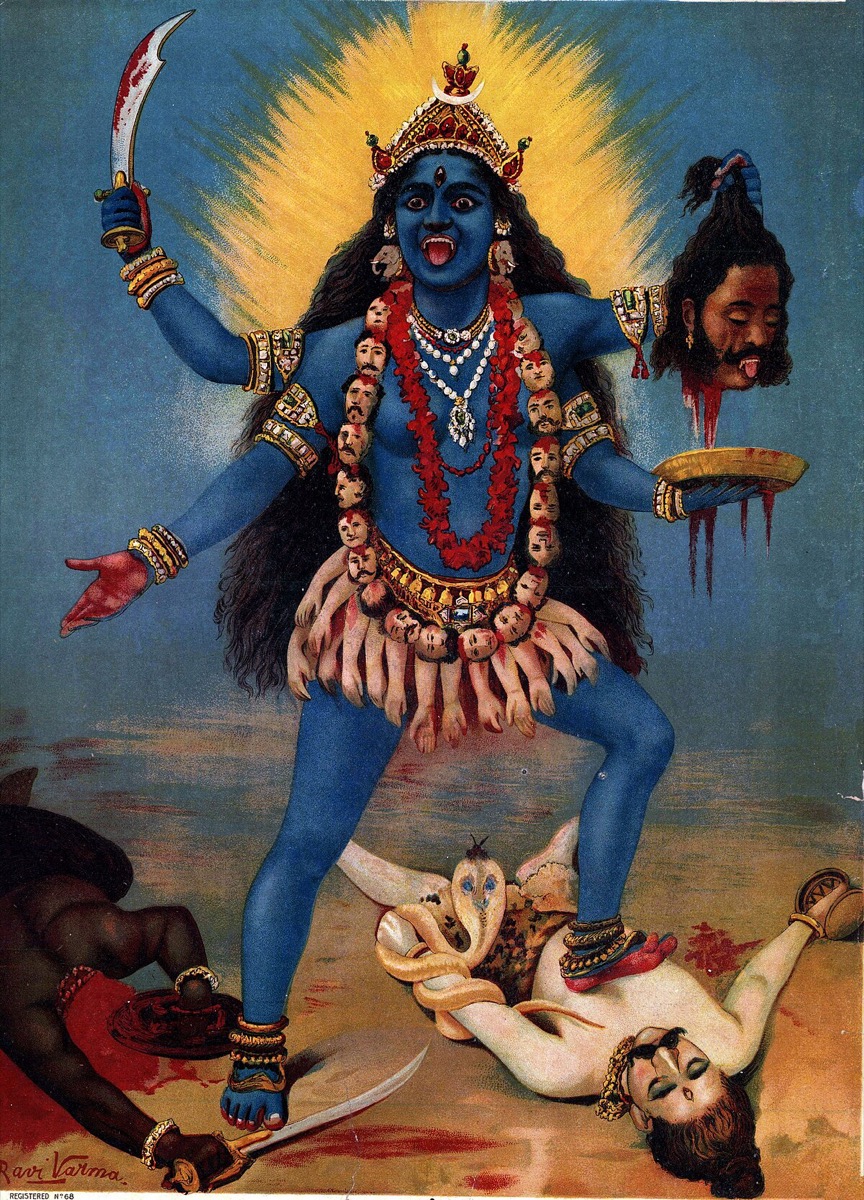
The Kālī Kavacam (“The Armor of Kālī”), also known as the Trailokya Vijayam (“Victory over the Three Worlds”), is one of the most potent protective hymns in the Śākta tantric tradition. Preserved in the seventh chapter (ullāsa) of the Mahānirvāṇa Tantra, this sacred text invokes Goddess Kālī — the supreme deity of the Kālikula tradition — to envelop the devotee in an impenetrable shield of divine energy. Systematically calling upon the Goddess’s various names and aspects to protect every part of the body from head to toe, the Kavacam transforms the practitioner’s physical form into a living temple of the Dark Goddess, armored against all adversity — spiritual, material, and supernatural.
The Opening Verse: Viniyoga
ॐ त्रैलोक्यविजयस्यास्य कवचस्य ऋषिः शिवः। छन्दोऽनुष्टुप् देवता च आद्या कालि प्रकीर्तिता। मायाबीजं बीजमिति रामा शक्तिरुदाहृता। क्रीं कीलकं काम्यसिद्धौ विनियोगः प्रकीर्तितः॥
IAST Transliteration: Oṃ trailokyavijayasyāsya kavacasya ṛṣiḥ śivaḥ | Chando’nuṣṭup devatā ca ādyā kāli prakīrtitā | Māyābījaṃ bījam iti rāmā śaktir udāhṛtā | Krīṃ kīlakaṃ kāmyasiddhau viniyogaḥ prakīrtitaḥ ||
Translation: “Oṃ! The seer (ṛṣi) of this Armor that brings Victory over the Three Worlds is Śiva. The meter is Anuṣṭup. The presiding deity is Ādyā Kālī, the Primordial Kālī. The seed-mantra (bīja) is the Māyā Bīja (Hrīṃ). The power (śakti) is Rāmā. The lock (kīlaka) is Krīṃ. Its application (viniyoga) is declared for the fulfilment of desires (kāmyasiddhi).”
This viniyoga verse establishes the sacred pedigree of the text. In tantric practice, every mantra or kavacam must declare its ṛṣi (the sage who first revealed it), chandas (meter), devatā (deity), bīja (seed syllable), śakti (energizing power), kīlaka (the “lock” that seals and activates the mantra), and viniyoga (intended purpose). The Kālī Kavacam uniquely claims Lord Śiva himself as its ṛṣi — the supreme authority in tantric revelation — establishing this text as direct divine speech, not human composition.
The Kavacham Genre in Hindu Sacred Literature
The Sanskrit word kavaca (कवच) literally means “armor” or “breastplate” — the protective shield worn by warriors in battle. In the realm of sacred literature, a kavacam is a category of devotional hymn in which a deity is invoked to protect every limb, organ, and aspect of the devotee’s existence. The genre occupies a distinct position among Hindu prayer forms:
- Stotram — a hymn of praise glorifying the deity’s qualities
- Sahasranāma — a litany of a thousand divine names
- Kavacam — a protective invocation mapping divine names onto the devotee’s body
- Argalā — a “bolt” prayer that unlocks blessings
- Kīlakam — a “pin” prayer that seals spiritual protection
The kavacam tradition appears across all major sampradāyas. The Nārāyaṇa Kavacam from the Śrīmad Bhāgavatam (6.8) protects Vaiṣṇava devotees. The Devī Kavacam from the Mārkaṇḍeya Purāṇa invokes Durgā’s nine forms. The Narasiṃha Kavacam from the Brahma Purāṇa summons the fierce half-lion avatar. The Kālī Kavacam stands alongside these as the premier protective text of the Kālikula (Kālī-family) tantric lineage.
What distinguishes the kavacam from mere prayer is its performative dimension. The practitioner does not simply request protection in the abstract — rather, through nyāsa (ritual placement of mantras on the body), each verse is physically enacted, the devotee touching each body part while reciting the corresponding protective syllable. The body itself becomes the ritual ground, each limb consecrated as sacred territory under the Goddess’s guardianship.
Goddess Kālī: Iconography and Mythology
To understand the Kavacam, one must first understand the deity it invokes. Kālī (काली), whose name derives from the Sanskrit root kāla (time/death/darkness), is the supreme goddess of the Kālikula tradition and one of the Daśa Mahāvidyās (Ten Great Wisdom Goddesses) of Śākta Tantra.
Her classical iconography, as described in texts like the Devī Māhātmya, the Kālīkulārṇava Tantra, and the Mahānirvāṇa Tantra itself, presents a figure of terrifying beauty:
- Dark complexion (śyāmā) — dark as a storm cloud or the depths of space, representing the formless brahman before creation
- Four arms — the upper left hand holds a bloodied khaḍga (sword, severing ignorance); the lower left holds a severed muṇḍa (head, the severed ego); the upper right hand displays abhaya mudrā (the gesture of fearlessness); the lower right shows vara mudrā (the gesture of boon-granting)
- Garland of fifty skulls (muṇḍamālā) — representing the fifty letters of the Sanskrit alphabet, symbolising the Goddess as the source of all language and knowledge
- Skirt of severed arms — representing karma cut away from the devotee
- Protruding tongue — in the Dakṣiṇā Kālī form, the tongue protrudes as a sign of modesty or lajjā, as she realizes she is standing upon her consort Śiva
- Standing upon Śiva — Śiva lies supine beneath her feet, representing the relationship between Śakti (dynamic creative power) and Śiva (passive consciousness); without Śakti, Śiva is śava (a corpse)
- Three eyes — representing the sun, moon, and fire; the power to perceive past, present, and future
- Dishevelled hair — symbolizing freedom from all social conventions and the untamed power of nature
The Devī Māhātmya (Mārkaṇḍeya Purāṇa 81-93) describes Kālī’s emergence from the furrowed brow of Goddess Durgā during the battle against the demons Caṇḍa and Muṇḍa. She appears as a gaunt, horrifying figure who devours the demon armies, earning the epithet Cāmuṇḍā. In the Kālīkulārṇava Tantra, however, Kālī is not a subordinate emanation but the supreme reality (paramā prakṛti) from whom all other deities emerge.
The Body-Part Protection Structure
The heart of the Kālī Kavacam follows the classical kavacam format — a systematic invocation of divine protection for each part of the body, moving from head to feet. Each verse pairs a specific body part with a name or epithet of Kālī:
ह्रीमाद्या मे शिरः पातु श्रीं कालि वदनं मम। हृदयं क्रीं परा शक्तिः पायात् कण्ठं परात्परा॥
“Hrīṃ — may Ādyā (the Primordial) protect my head. Śrīṃ — may Kālī protect my face. May Krīṃ, the Supreme Śakti, reside in my heart. May Parātparā (the Greater than the Greatest) protect my throat.”
The kavacam proceeds with meticulous thoroughness:
| Body Part | Protecting Deity/Name |
|---|---|
| Head (śiras) | Ādyā (the Primordial One), with bīja Hrīṃ |
| Face (vadana) | Śrī Kālī, with bīja Śrīṃ |
| Heart (hṛdaya) | Parā Śakti (Supreme Power), with bīja Krīṃ |
| Throat (kaṇṭha) | Parātparā (Greater than the Greatest) |
| Eyes (netra) | Jagaddhātrī (Sustainer of the World) |
| Ears (karṇa) | Śaṅkarī (She who bestows auspiciousness) |
| Nose (nāsikā) | Mahāmāyā (the Great Illusion) |
| Tongue (rasanā) | Sarvamaṅgalā (All-Auspicious One) |
| Teeth (danta) | Kaumārī (the Maiden Goddess) |
| Cheeks (kapolau) | Kamalālayā (She who dwells in the Lotus) |
| Lips and chin (oṣṭha/cibuka) | Karahāsinī (She whose smile destroys) |
| Neck (grīvā) | Kuleśānī (Sovereign of the Kula) |
| Arms and shoulders (bāhu/skandha) | Vardā and Kapardīnī |
| Back (pṛṣṭha) | Trailokya Tāriṇī (Savior of the Three Worlds) |
| Waist (kaṭi) | Kāmāthāsanā |
| Navel (nābhi) | Viśālākṣī (Wide-Eyed One) |
| Thighs (ūru) | Kalyāṇī (the Beneficent) |
| Feet (pāda) | Pārvatī (Daughter of the Mountain) |
| Entire body (sarvāṅga) | Jayā Durgā and Sarvasiddhidā (Giver of All Perfections) |
This systematic mapping reveals a profound theological insight: the human body is not merely a vessel of flesh but a microcosm of the divine. Each body part, when consecrated through the kavacam, becomes an altar upon which the Goddess resides. The practitioner’s eyes become the eyes of Jagaddhātrī, the heart becomes the seat of Parā Śakti, the throat becomes the dwelling of Parātparā. The boundary between devotee and deity dissolves — this is the tantric concept of dehatattva, the theology of the body as sacred.
The Tantric Framework: Kālikula Tradition
The Kālī Kavacam belongs to the Kālikula (Family of Kālī), one of the two great streams of Śākta Tantra. The other stream is the Śrīkula (Family of Tripurasundarī/Lalitā), which predominates in South India. The Kālikula tradition prevails in northern and eastern India, particularly in Bengal, Assam, Bihar, and Odisha.
The Kālikula encompasses several major tantric texts:
- Mahānirvāṇa Tantra — the source of this Kavacam, presenting a reformed, accessible form of tantric worship
- Kālīkulārṇava Tantra — an ocean of Kālikula knowledge
- Rudrayāmala Tantra — another important source of Kālī kavacams (a distinct version of the Kālikā Kavacam is found here, attributed to Bhairava as ṛṣi)
- Kālī Tantra — dedicated specifically to Kālī worship
- Tārā Tantra — devoted to Tārā, Kālī’s Buddhist-influenced tantric sister form
Within this tradition, the Daśa Mahāvidyā (Ten Great Wisdom Goddesses) represent ten aspects of the supreme feminine divine, with Kālī occupying the first and foremost position:
- Kālī — time, transformation, liberation
- Tārā — compassionate guidance across the ocean of existence
- Tripurasundarī (Ṣoḍaśī) — beauty and the three cities of consciousness
- Bhuvaneśvarī — sovereign of the worlds
- Chinnamastā — self-sacrifice and kuṇḍalinī
- Bhairavī — fierce transformative fire
- Dhūmāvatī — the void, widowhood, dissolution
- Bagalāmukhī — the power to paralyze enemies
- Mātaṅgī — outcaste wisdom, the tantric Sarasvatī
- Kamalā — the tantric Lakṣmī, abundance
Dakṣiṇā Kālī and Śmaśāna Kālī
The Kavacam invokes Kālī primarily in her Dakṣiṇā Kālī form — the “benevolent” or “southern” Kālī, the most widely worshipped manifestation. The distinction between the two primary forms is theologically significant:
Dakṣiṇā Kālī (“The Gracious Kālī”):
- Steps forward with her right foot, resting upon Śiva’s chest
- Holds the sword in her left hand
- Her right hand displays abhaya mudrā (fearlessness)
- Represents the compassionate destroyer — she removes suffering and grants liberation with maternal tenderness
- Popularized by Kṛṣṇānanda Āgamavāgīśa, the renowned 17th-century Bengali tāntrika, in his seminal work Tantrasāra
- The form worshipped at Dakṣiṇeśvara and most mainstream Kālī temples
Śmaśāna Kālī (“The Cremation-Ground Kālī”):
- Steps forward with her left foot
- Holds the sword in her right hand (the more aggressive posture)
- Associated with the śmaśāna (cremation ground), where tantric sādhanā is performed amidst corpses and funeral pyres
- Worshipped by the vīra (heroic) practitioner who has transcended the ordinary dualities of pure/impure, auspicious/inauspicious
- The form venerated at Tārāpīṭha and among Āghora and Kaula traditions
The Kavacam’s address to Kālī as Ādyā Kālī (“the Primordial Kālī”) encompasses both forms, suggesting an original unity that predates the theological distinction. The Mahānirvāṇa Tantra itself, in the voice of Śiva speaking to Pārvatī, presents Kālī as the supreme reality beyond all differentiation.
The Three Bīja Mantras
Central to the Kavacam’s protective power are three bīja (seed) mantras that appear throughout the text:
-
Hrīṃ (ह्रीं) — the Māyā Bīja, the seed of illusion and creation. It is the primordial vibration of Kālī’s creative power, associated with the heart-centre and the manifestation of the universe.
-
Śrīṃ (श्रीं) — the Lakṣmī Bīja, the seed of abundance, beauty, and grace. In the context of the Kālī Kavacam, it invokes the Goddess’s nurturing, protective dimension.
-
Krīṃ (क्रीं) — the Kālī Bīja, the most characteristic seed syllable of Goddess Kālī. It combines ka (Kālī), ra (Brahman/fire), ī (Mahāmāyā), and the bindu (anusvāra, the point of cosmic dissolution). This bīja serves as the kīlaka (lock/key) of the Kavacam, the syllable that activates and seals the entire protective armor.
The interplay of these three bījas in the Kavacam creates a triple layer of protection: Hrīṃ creates the energetic field, Śrīṃ fills it with grace, and Krīṃ locks it in place with Kālī’s own essence.
The Great Kālī Temples: Living Seats of the Kavacam
The Kālī Kavacam is not merely a textual artifact — it is a living prayer recited daily in thousands of homes and temples across India, particularly in Bengal and eastern India. Three temples stand as the pre-eminent centres of Kālī worship:
Dakṣiṇeśvara Kālī Mandir (Kolkata)
Built in 1855 by Rāṇī Rāśmoṇī, the great philanthropist and devotee, on the eastern bank of the Hooghly River. The temple enshrines Bhavataraṇī (“She who liberates from the ocean of existence”), a form of Dakṣiṇā Kālī. The temple gained worldwide fame through its association with Śrī Rāmakṛṣṇa Paramahaṃsa (1836-1886), who served as its priest and experienced profound mystical visions of the Goddess here. Rāmakṛṣṇa’s ecstatic worship transformed Dakṣiṇeśvara from a regional temple into a global symbol of Kālī devotion. The Kavacam is recited daily as part of the temple’s elaborate ritual cycle.
Kālīghāṭ Kālī Mandir (Kolkata)
One of the 51 Śakti Pīṭhas (seats of Śakti), the Kālīghāṭ temple marks the spot where, according to the Devī Bhāgavata Purāṇa, the toes of Satī’s right foot fell when Viṣṇu’s Sudarśana Cakra dismembered her corpse to end Śiva’s cosmic dance of grief. The city of Kolkata (Calcutta) itself derives its name from Kālīghāṭ. The temple, in its present form dating to approximately 200 years ago though referenced in 15th-century literature, houses a distinctive image of Kālī: a black stone figure with a protruding gold tongue and three enormous eyes. The Kālīghāṭ Paṭ school of painting, depicting folk interpretations of Kālī, emerged from the pilgrimage culture surrounding this temple.
Tārāpīṭha (Birbhum, West Bengal)
Located in the Birbhum district of West Bengal, Tārāpīṭha is one of the most important tantric pīṭhas in India. The temple is dedicated to Mā Tārā, a fierce form closely associated with Kālī. It is the only major temple in India where the deity is worshipped with pañcamakāra (the “five M’s” of tantric ritual) openly. The great 18th-century tantric saint Vaṃśīvaṭa Bābā (Bāmākṣepā, 1837-1911) practised his legendary sādhanā in the cremation ground adjacent to this temple. The Kālī Kavacam and related tantric protective prayers are integral to the ritual practices here, where practitioners seek the fierce grace of the Goddess in the most liminal of sacred spaces.
Use in Śākta Sādhanā
The Kavacam is not a casual prayer but a structured component of Śākta sādhanā (spiritual practice in the Goddess tradition). Its proper use involves several layers:
Purification and Preparation: Before reciting the Kavacam, the practitioner performs ācamana (sipping of sanctified water), prāṇāyāma (breath regulation), and saṅkalpa (declaration of intent). The Mahānirvāṇa Tantra prescribes that the Kavacam be recited after bathing and performing morning worship.
Nyāsa (Ritual Body Mapping): The practitioner touches each body part while reciting the corresponding protective verse — the forehead for Ādyā, the face for Kālī, the heart for Parā Śakti, and so on. This practice of nyāsa transforms the physical body into a consecrated vessel, each limb charged with divine energy.
Dhyāna (Meditation on the Form): Before the Kavacam proper, a dhyāna śloka (meditation verse) describes the form of Kālī to be visualized — dark-complexioned, four-armed, garlanded with skulls, standing upon Śiva. This visualization anchors the protective energy in the practitioner’s consciousness.
Pūrṇāhuti (Completion): The Kavacam concludes with the phalāśruti (declaration of fruits), which states that the devotee who recites this armor with full devotion every morning will have all desires fulfilled. Reciting the Kavacam one thousand times (sahasra-pāṭha) with proper ritual observance is said to confer siddhi (spiritual accomplishment), enabling “victory, enjoyment, and liberation” (vijaya, bhoga, mokṣa).
Kālī Pūjā: The Living Festival
The Kavacam holds special significance during Kālī Pūjā, celebrated on the new moon night (amāvasyā) of the month of Kārtika (October-November), coinciding with the Dīpāvalī festival across much of India. In Bengal, this night belongs not to Lakṣmī (as in western and northern India) but to Kālī — the Dark Goddess who illuminates the darkness of ignorance.
During Kālī Pūjā, the Kavacam is recited as part of the elaborate ritual sequence that includes:
- Ṣoḍaśopacāra Pūjā — worship with sixteen offerings
- Puṣpāñjali — offering of flowers with sacred mantras
- Bali — symbolic or actual offering (depending on tradition)
- Āratī — the offering of flame and light
The night-long vigil (rātrijāgaraṇa) on Kālī Pūjā is considered the most auspicious time for Kavacam recitation. The Mahānirvāṇa Tantra also recommends recitation on Amāvasyā (new moon), Caturdaśī (fourteenth lunar day), and Maṅgalavāra (Tuesday) — days sacred to the Goddess.
The Phalāśruti: Fruits of Recitation
The concluding section of the Kavacam declares its extraordinary benefits:
“The aspirant who recites this Kavacam with full feeling every morning, after respectfully invoking the Goddess, has all desires fulfilled.”
According to the text, regular practice yields:
- Protection from enemies, evil spirits, disease, and misfortune
- Fearlessness (abhaya) — the devotee walks without fear in all circumstances
- Fulfilment of desires — whether material prosperity, offspring, knowledge, or liberation
- Spiritual accomplishment (siddhi) — mastery of the mantras and communion with the Goddess
- Victory (vijaya) — success in all righteous undertakings
The text further prescribes the creation of a protective talisman (yantra): the Kavacam inscribed with sandalwood paste, turmeric, saffron, and vermilion on birch bark or copper, then worn on the body (on the topknot, right arm, neck, or waist) as a perpetual shield.
The Kavacam as Tantric Theology
Beyond its practical protective function, the Kālī Kavacam embodies a profound theological vision. In the Śākta worldview, the Goddess is not external to the devotee — she is the devotee, the universe, and the consciousness that perceives both. The Kavacam does not ask Kālī to come from elsewhere to protect the body; rather, it reveals that she is already present in every atom of the practitioner’s being. The recitation is an act of recognition (pratyabhijñā), not supplication.
When the devotee declares “May Ādyā protect my head,” the deeper meaning is: “May I recognize that my head is already the dwelling place of the Primordial Goddess.” The kavacam thus functions as a map of awakening — a systematic journey through the body that transforms biological matter into conscious divinity.
This is the ultimate teaching of the Kālikula tradition: there is no place where Kālī is not. The darkness she represents is not the absence of light but the womb of all possibility — the infinite potential from which creation, preservation, and dissolution ceaselessly arise. To don the armor of Kālī is to recognize oneself as inseparable from that boundless creative darkness, protected not by an external force but by the Goddess who is one’s own deepest nature.
As the Mahānirvāṇa Tantra declares through the voice of Śiva: at the end of time, Kālī devours even the devourer of time himself. She is the final reality — beginningless, endless, and utterly beyond all fear.