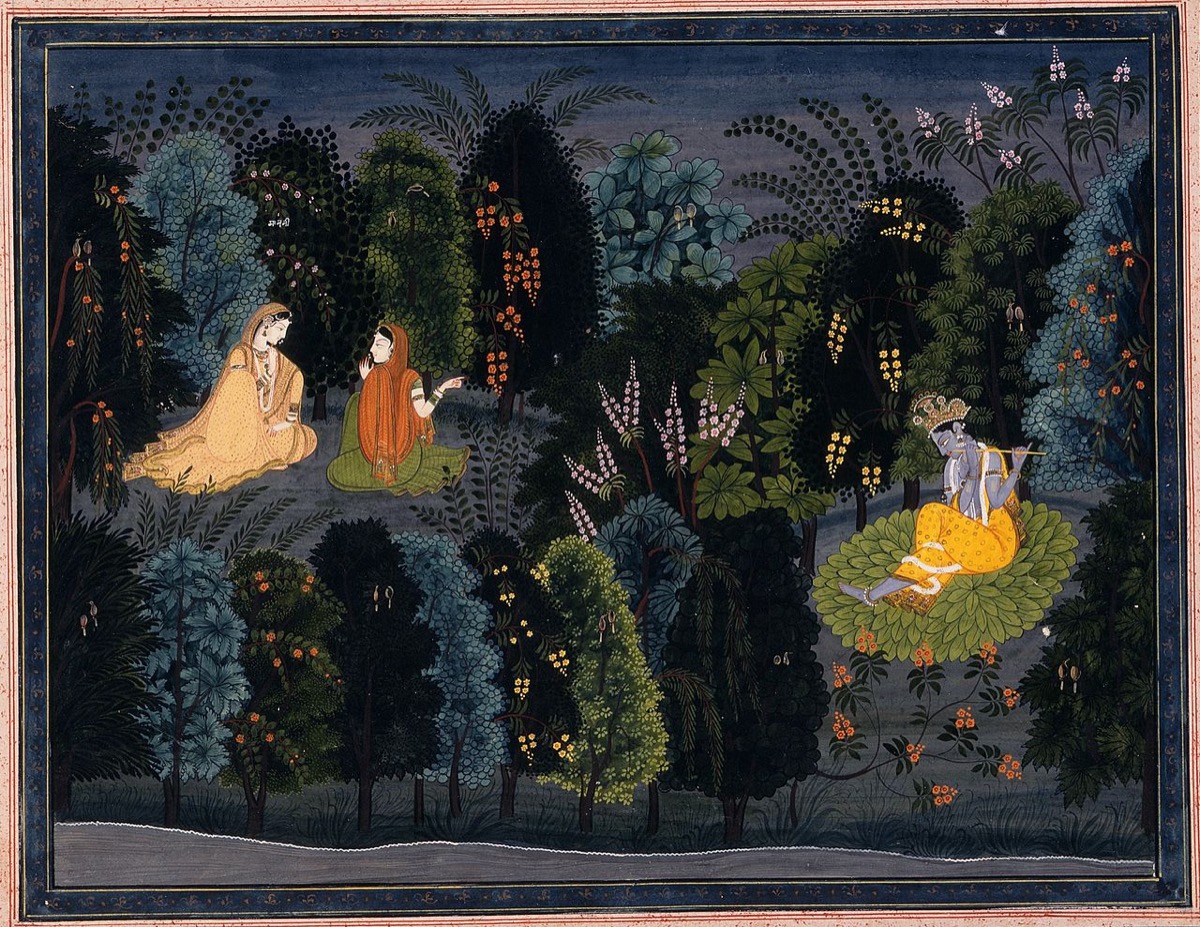
The Kṛṣṇa Chālīsā (कृष्ण चालीसा, “Forty Verses to Kṛṣṇa”) is one of the most cherished devotional hymns in the Vaiṣṇava tradition of Hinduism. Comprising forty verses (chaupāī) framed by invocatory and concluding couplets (dohā), this prayer celebrates Lord Kṛṣṇa — the eighth avatāra of Viṣṇu, the enchanting flute-player of Vṛndāvana, the charioteer of Arjuna, and the supreme teacher of the Bhagavad Gītā. Recited by millions during Janmāṣṭamī (Kṛṣṇa’s birthday), on Wednesdays, Ekādaśī days, and throughout the year, the Kṛṣṇa Chālīsā occupies a beloved place in North Indian Kṛṣṇa devotion alongside the more ancient Bhāgavata Purāṇa hymns and the Viṣṇu Sahasranāma.
Origins and Attribution
The Kṛṣṇa Chālīsā is attributed to the Bhakti poet Sundardās (c. 1596—1689 CE), a Vaiṣṇava saint of the Dadu Panth tradition who composed devotional works in Braj Bhāṣā and Khaṛī Bolī Hindi. Some scholars note that the attribution is traditional rather than historically certain, as multiple versions of the Kṛṣṇa Chālīsā circulate across different Vaiṣṇava sampradāyas. Regardless of precise authorship, the text belongs firmly to the popular devotional tradition (loka-paramparā) of North India, composed between the 16th and 18th centuries CE.
The Kṛṣṇa Chālīsā draws its narrative content from several scriptural sources:
- The Bhāgavata Purāṇa (especially the Tenth Canto, Daśama Skandha) — the most extensive scriptural account of Kṛṣṇa’s birth, childhood miracles in Gokula and Vṛndāvana, the rāsa-līlā, and his later life as king of Dvārakā.
- The Bhagavad Gītā (chapters 1—18 of the Mahābhārata’s Bhīṣma Parva) — Kṛṣṇa’s discourse to Arjuna on dharma, karma, jñāna, and bhakti on the battlefield of Kurukṣetra.
- The Mahābhārata — episodes such as the protection of Draupadī’s honour, the friendship with Sudāmā, and Kṛṣṇa’s role as diplomat and charioteer.
- The Gīta Govinda of Jayadeva — which celebrates Kṛṣṇa’s romantic love with Rādhā, echoed in the Chālīsā’s descriptions of Kṛṣṇa’s enchanting beauty.
Structure of the Kṛṣṇa Chālīsā
The Kṛṣṇa Chālīsā follows the standard chālīsā format that emerged during the Bhakti movement:
1. Opening Dohā (Couplets)
Two invocatory couplets that establish the visual portrait of Kṛṣṇa and set the devotional mood. The poet describes Kṛṣṇa’s flute (baṃśī), his dark complexion (nīla jalada tana śyāma), his lotus-like eyes, his yellow garment (pītāmbara), and his captivating beauty.
2. Forty Chaupāī (Quatrains)
The body of the hymn, consisting of forty four-line verses in the chaupāī metre. These verses trace the entire arc of Kṛṣṇa’s divine life — from his miraculous birth in the prison of Kaṃsa, through his childhood exploits in Gokula and Vṛndāvana, to his role in the Mahābhārata and the teaching of the Gītā, culminating in the spiritual benefits of his worship.
3. Closing Dohā
The concluding couplets contain the phala-śruti — the declaration of the fruits that accrue from sincere recitation — promising the devotee the eight siddhis (spiritual perfections), the nine nidhis (treasures), and the four padārthas (aims of life).
The Opening Verses: Portrait of the Enchanter
The Kṛṣṇa Chālīsā opens with one of the most vivid poetic portraits of Kṛṣṇa in Hindi devotional literature:
बंशी शोभित कर मधुर, नील जलद तन श्याम। अरुण अधर जनु बिम्बफल, नयन कमल अभिराम॥ पूर्ण इन्दु अरविन्द मुख, पीताम्बर शुभ साज। जय मनमोहन मदन छवि, कृष्णचन्द्र महाराज॥
The sweet flute gracing his hands, his dark body like a rain-laden cloud. His ruddy lips like the bimba fruit, his lotus-eyes supremely captivating. His face a full moon, a lotus bloom; yellow silk his auspicious attire. Hail to the Enchanter whose beauty surpasses Kāmadeva himself — Kṛṣṇacandra Mahārāja!
These opening lines establish the mādhurya (sweetness) that defines Kṛṣṇa bhakti. Unlike the martial grandeur of the Hanumān Chālīsā or the cosmic power invoked in the Durgā Chālīsā, the Kṛṣṇa Chālīsā begins with aesthetic rapture — the devotee is first captivated by Kṛṣṇa’s beauty before being drawn into the narrative of his divine deeds. This reflects the theological principle of the Bhāgavata tradition: Kṛṣṇa attracts the soul not through fear or awe, but through irresistible love (prema).
Key Themes and Verse Meanings
Birth and Divine Parents
The first chaupāīs celebrate Kṛṣṇa’s lineage and miraculous birth:
जय यदुनंदन जय जगवंदन। जय वसुदेव देवकी नन्दन॥ जय यशुदा सुत नन्द दुलारे। जय प्रभु भक्तन के दृग तारे॥
Hail, joy of the Yadu clan, worshipped by the world! Hail, son of Vasudeva and Devakī! Hail, child of Yaśodā, darling of Nanda! Hail, O Lord, the light of your devotees’ eyes!
This opening verse encapsulates one of the deepest mysteries of Kṛṣṇa theology: he is simultaneously the son of Vasudeva and Devakī (his biological parents in the prison of Kaṃsa) and the beloved child of Yaśodā and Nanda (his foster parents in Gokula). As the Bhāgavata Purāṇa narrates (10.3), newborn Kṛṣṇa was carried across the flooded Yamunā by Vasudeva and placed in Yaśodā’s arms while she slept. The Chālīsā honours both sets of parents, affirming that Kṛṣṇa’s love is not bound by biological lineage.
Childhood Miracles (Bāla-Līlā)
A substantial portion of the Chālīsā is devoted to Kṛṣṇa’s childhood exploits — the episodes most beloved in popular devotion:
The Slaying of Pūtanā: The demoness Pūtanā, sent by Kaṃsa, came to Gokula disguised as a beautiful woman and offered her poison-smeared breast to the infant Kṛṣṇa. The divine child sucked out her life-force along with the poison, killing her instantly (Bhāgavata Purāṇa 10.6).
The Butter Thief (Mākhana-Chor): The Chālīsā celebrates Kṛṣṇa’s mischievous theft of butter from the houses of the gopīs — an episode that, in Vaiṣṇava theology, symbolizes the Lord’s playful desire to steal the devotee’s heart.
The Subduing of Kāliya: One of the most dramatic episodes retold in the Chālīsā describes Kṛṣṇa’s dance upon the hoods of the serpent Kāliya in the Yamunā river (Bhāgavata Purāṇa 10.16—17). The verse states:
नाथि कालियहिं को तुम लीन्हो। चरण चिन्ह दै निर्भय कीन्हो॥
You subdued the serpent Kāliya and, granting the mark of your feet, bestowed fearlessness upon all.
Kṛṣṇa did not kill Kāliya but banished him to the ocean, leaving the imprint of his divine feet on the serpent’s hoods as a mark of grace — a powerful image of the Lord who conquers evil through mercy rather than destruction.
The Lifting of Govardhana
The Govardhana episode is one of the theological centrepieces of the Chālīsā:
लखत लखत ब्रज चहत बहायो। गोवर्धन नख धरि बचायो॥
When Vraja was about to be swept away before all eyes, you lifted Govardhana upon your fingernail and saved them.
When Indra, angered by the cessation of his worship, unleashed a devastating storm upon Vraja, the young Kṛṣṇa lifted the entire Govardhana mountain on his little finger and held it aloft for seven days as an umbrella for the cowherds and their cattle (Bhāgavata Purāṇa 10.24—25). This episode marks Kṛṣṇa’s assertion of divine authority over the Vedic gods and establishes the principle that sincere devotion to the personal God supersedes ritualistic worship of nature deities.
The Rāsa-Līlā and Kṛṣṇa’s Beauty
Several verses celebrate the rāsa-līlā — Kṛṣṇa’s moonlit dance with the gopīs of Vṛndāvana. The Chālīsā describes his flute music drawing the gopīs irresistibly from their homes, the circular dance under the autumn moon, and Kṛṣṇa multiplying himself so that each gopī believed she was dancing with him alone (Bhāgavata Purāṇa 10.29—33). In Gauḍīya Vaiṣṇava theology, the rāsa-līlā represents the highest expression of divine love (prema-rasa), where the soul’s longing for God finds its ultimate fulfilment.
The Protection of Draupadī
The Chālīsā recounts Kṛṣṇa’s protection of Draupadī when Duḥśāsana attempted to disrobe her in the Kaurava court:
दुःशासन की भुजा उखारी। छीर सिन्धु सम साड़ी विस्तारी॥
When Draupadī’s honour was threatened and no one in the assembly came to her aid, she called upon Kṛṣṇa with absolute surrender. Kṛṣṇa responded by making her sari endless, so that Duḥśāsana could never reach its end. This episode illustrates the Vaiṣṇava teaching that complete surrender (śaraṇāgati) to the Lord guarantees his unfailing protection, regardless of worldly circumstances.
The Friendship with Sudāmā
दीन सुदामा के दुख टारो। तंदुल तीन मुठी मुख डारो॥
You removed poor Sudāmā’s suffering; you ate with relish three handfuls of beaten rice.
The story of Kṛṣṇa and his impoverished Brahmin friend Sudāmā (also called Kuchelā in South Indian tradition) is one of the most emotionally resonant episodes in the Bhāgavata Purāṇa (10.80—81). When Sudāmā visited Kṛṣṇa in Dvārakā, ashamed of his poverty, the Lord received him with overwhelming affection and ate the humble offering of beaten rice (tanḍula) with delight. In return, without Sudāmā’s asking, Kṛṣṇa transformed his humble home into a golden palace. The Chālīsā celebrates this as the paradigm of Kṛṣṇa’s love: he values devotion over material offerings.
The Bhagavad Gītā
निज गीता के ज्ञान सुनाये। भक्तन हृदय सुधा सरसाये॥
You communicated the wisdom of your Gītā and filled the hearts of your devotees with nectar.
The Chālīsā acknowledges Kṛṣṇa’s supreme role as the teacher of the Bhagavad Gītā — the 700-verse discourse delivered to Arjuna on the battlefield of Kurukṣetra (Mahābhārata, Bhīṣma Parva, chapters 23—40). The Gītā’s teachings on karma-yoga (selfless action), jñāna-yoga (knowledge), and bhakti-yoga (devotion) are distilled in the Chālīsā into a single image: the nectar (sudhā) of divine wisdom flooding the devotee’s heart.
The Closing Dohā: Fruits of Recitation
The Kṛṣṇa Chālīsā concludes with its phala-śruti:
यह चालीसा कृष्ण का, पाठ करै उर धारि। अष्ट सिद्धि नवनिधि फल, दै श्याम दातारि॥
Whoever recites this Chālīsā of Kṛṣṇa, enshrining it in the heart, shall receive the eight siddhis and the nine nidhis as fruits — bestowed by Śyāma, the generous Lord.
The eight siddhis are the supernatural perfections described in Yoga and Sāṃkhya philosophy: aṇimā (becoming infinitely small), mahimā (becoming infinitely large), garimā (becoming heavy), laghimā (becoming light), prāpti (reaching anywhere), prākāmya (fulfilling desires), īśitva (lordship), and vaśitva (control over all). The nine nidhis are the nine treasures of Kubera, symbolizing every form of wealth and abundance. The promise of the phala-śruti is not merely material but spiritual: through devoted recitation, the devotee attains mastery over the self and union with the divine.
When to Recite the Kṛṣṇa Chālīsā
Janmāṣṭamī
The most auspicious occasion for reciting the Kṛṣṇa Chālīsā is Janmāṣṭamī — the celebration of Kṛṣṇa’s birth on the eighth day (aṣṭamī) of the dark fortnight of Bhādrapada (August—September). On this night, temples and homes resound with the Chālīsā, often accompanied by abhiṣeka (ritual bathing of Kṛṣṇa’s image), bhajana singing, and the dramatic enactment of Kṛṣṇa’s birth at midnight (nandotsava).
Wednesdays and Ekādaśī
Many devotees recite the Kṛṣṇa Chālīsā on Wednesdays, the day traditionally associated with Kṛṣṇa worship in the Hindu weekly calendar. Ekādaśī — the eleventh day of each lunar fortnight, sacred to Viṣṇu — is another especially meritorious occasion. Devotees often combine Ekādaśī fasting with Chālīsā recitation, creating a practice that unites vrata (vow) with japa (recitation).
Daily Devotion
The traditional prescription calls for recitation during the brāhma-muhūrta (the auspicious pre-dawn hour, approximately 4:00—6:00 AM) or during the evening sandhyā (twilight). The devotee should sit before an image or mūrti of Kṛṣṇa, light a lamp and incense, offer flowers, and recite the Chālīsā with focused devotion (ekāgra-citta). A practice of forty consecutive days (chālīsa dina) of unbroken recitation is believed to bring a tangible experience of Kṛṣṇa’s grace.
Kṛṣṇa’s Forms Celebrated in the Chālīsā
The Kṛṣṇa Chālīsā celebrates the remarkable range of Kṛṣṇa’s forms and aspects, each revealing a different dimension of the divine:
Bāla-Kṛṣṇa (The Divine Child)
The mischievous butter thief, the crawler who shows the entire universe in his mouth to Yaśodā (Bhāgavata Purāṇa 10.8.37—39), the playful infant who breaks the butter-pots and runs from his mother’s reproach. This form embodies vātsalya-rasa — the tender love between parent and child.
Veṇugopāla (The Flute-Playing Cowherd)
Kṛṣṇa standing beneath a kadamba tree, playing his enchanting flute, with peacock feather in his crown and garland of forest flowers. His music draws not only the gopīs but all of creation — rivers slow their flow, cows stop grazing, birds fall silent. This form embodies mādhurya-rasa — the sweetness of divine love.
Pārtha-Sārathi (Arjuna’s Charioteer)
Kṛṣṇa on the battlefield of Kurukṣetra, guiding Arjuna’s chariot, delivering the eternal wisdom of the Gītā. This form embodies sakhya-rasa — the love between friends — and reveals Kṛṣṇa as the supreme guide who leads the soul from delusion to liberation.
Dvārakādhīśa (Lord of Dvārakā)
Kṛṣṇa as the king of the golden city of Dvārakā, the husband of Rukmiṇī and the sixteen thousand queens, the consummate statesman and diplomat. This form shows that Kṛṣṇa’s divinity does not withdraw from the complexities of worldly life but transforms them.
Viśvarūpa (The Cosmic Form)
The terrifying and awe-inspiring form revealed to Arjuna in the eleventh chapter of the Gītā, where Kṛṣṇa displays the entire universe within his body — all beings, all worlds, all time. This form, referenced in the Chālīsā, affirms that the gentle flute-player of Vṛndāvana is simultaneously the infinite, all-encompassing Supreme Being.
Comparison with Other Kṛṣṇa Stotras
The Kṛṣṇa Chālīsā exists within a rich ecosystem of devotional compositions to Kṛṣṇa:
| Composition | Language | Verses | Focus |
|---|---|---|---|
| Kṛṣṇa Chālīsā | Braj/Hindi | 40 chaupāī | Complete life narrative |
| Madhurāṣṭakam | Sanskrit | 8 | Kṛṣṇa’s sweetness |
| Kṛṣṇāṣṭakam (Achyutāṣṭakam) | Sanskrit | 8 | Kṛṣṇa’s divine names |
| Kṛṣṇa Ārtī | Hindi | ~12 | Worship ritual song |
| Viṣṇu Sahasranāma | Sanskrit | 1000 names | Kṛṣṇa as Viṣṇu |
| Bhaja Govindam | Sanskrit | 31 | Detachment and devotion |
What distinguishes the Kṛṣṇa Chālīsā from Sanskrit stotras is its accessibility. Composed in the vernacular Hindi of the Bhakti movement, it requires no Sanskrit learning. Its chaupāī metre creates a natural, singable rhythm that lends itself to congregational recitation. Where the Madhurāṣṭakam focuses on aesthetic rapture and the Gītā on philosophical teaching, the Kṛṣṇa Chālīsā offers a complete narrative arc — from birth to cosmic revelation — in a compact, devotionally charged form.
The Chālīsā Tradition and Its Democratic Spirit
The word chālīsā derives from the Hindi chālīs (चालीस), meaning “forty.” The chālīsā is a distinctively North Indian devotional genre that emerged during the Bhakti movement (15th—18th centuries). Its characteristics include:
- Fixed length: Exactly forty chaupāī verses, framed by opening and closing dohā couplets
- Vernacular language: Composed in Awadhī, Braj Bhāṣā, or Khaṛī Bolī Hindi — not Sanskrit
- Narrative structure: Unlike many stotras that are lists of names or attributes, chālīsās typically tell a story
- Musical recitability: The chaupāī metre creates a natural rhythm suited to communal singing
- Universal access: No caste, gender, or educational prerequisite for recitation
The most famous chālīsā is unquestionably the Hanumān Chālīsā of Goswāmī Tulasīdāsa, but the tradition encompasses dozens of texts: the Śiva Chālīsā, Durgā Chālīsā, Gaṇeśa Chālīsā, and many more. The Kṛṣṇa Chālīsā ranks among the most widely recited of these, particularly in the Vaiṣṇava heartlands of Mathurā, Vṛndāvana, Dvārakā, and Nathdvāra.
Devotional Significance in Vaishnavism
Kṛṣṇa as Svayam Bhagavān
For many Vaiṣṇava traditions — particularly Gauḍīya Vaishnavism founded by Śrī Caitanya Mahāprabhu and the Puṣṭimārga of Vallabhācārya — Kṛṣṇa is not merely an avatāra of Viṣṇu but Svayam Bhagavān — the Supreme Personality of Godhead himself, of whom all other forms (including Viṣṇu) are manifestations. The Kṛṣṇa Chālīsā reflects this theology: it addresses Kṛṣṇa not as one among many gods but as the ultimate source and sustainer of all.
The Five Rasas
The Chālīsā, in its comprehensive sweep through Kṛṣṇa’s life, touches upon all five primary rasas (emotional flavours) of Kṛṣṇa bhakti as systematized by Rūpa Goswāmī in his Bhakti-rasāmṛta-sindhu:
- Śānta-rasa (peaceful contemplation) — the cosmic vision of Kṛṣṇa’s supremacy
- Dāsya-rasa (servitude) — the devotee’s prayer for Kṛṣṇa’s protection
- Sakhya-rasa (friendship) — Kṛṣṇa’s bond with Arjuna and Sudāmā
- Vātsalya-rasa (parental love) — Yaśodā’s love for the divine child
- Mādhurya-rasa (romantic love) — Kṛṣṇa’s enchanting beauty and the rāsa-līlā
By encompassing all five rasas, the Kṛṣṇa Chālīsā offers every devotee a point of entry, regardless of their dominant emotional disposition.
Śaraṇāgati (Surrender)
The overarching spiritual message of the Kṛṣṇa Chālīsā is śaraṇāgati — complete surrender to the Lord. Every episode narrated — Draupadī’s cry for help, Sudāmā’s humble offering, Arjuna’s confusion resolved by the Gītā, the gopīs’ unconditional love — demonstrates a single truth: those who surrender to Kṛṣṇa with sincerity are never abandoned. This mirrors Kṛṣṇa’s own promise in the Bhagavad Gītā (18.66):
Sarva-dharmān parityajya mām ekaṃ śaraṇaṃ vraja / ahaṃ tvāṃ sarva-pāpebhyo mokṣayiṣyāmi mā śucaḥ
“Abandon all dharmas and take refuge in me alone. I shall liberate you from all sins — do not grieve.”
Conclusion
The Kṛṣṇa Chālīsā is far more than a devotional poem — it is a compact scripture, a spiritual biography, and a living prayer that connects millions of Hindus to the enchanting, protecting, liberating presence of Lord Kṛṣṇa. In its forty verses, it encompasses the cosmic mythology of the Bhāgavata Purāṇa, the philosophical depth of the Bhagavad Gītā, the sweetness of the Gīta Govinda, and the deeply personal faith of a devotee drawn irresistibly by the sound of Kṛṣṇa’s flute. For those who recite it with love, the Kṛṣṇa Chālīsā remains what its closing dohā promises: a path to the eight siddhis, the nine treasures, and the supreme treasure of all — the grace of Śyāmasundara himself.