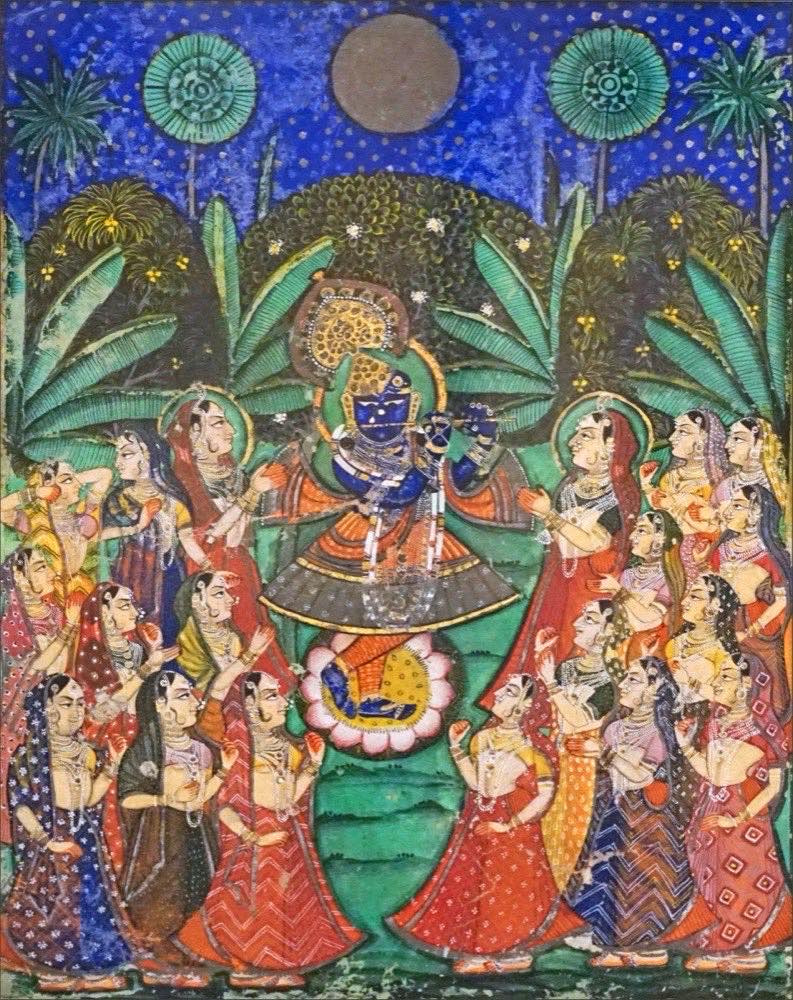
The Madhurāṣṭakam (मधुराष्टकम्, “The Eight Verses of Sweetness”) is one of the most beloved devotional poems in all of Vaiṣṇava literature. Composed by Śrī Vallabhācārya (1479–1530 CE), the founder of the Puṣṭimārga (“Path of Divine Grace”), this hymn celebrates the all-pervading sweetness — mādhurya — of Lord Śrī Kṛṣṇa. In just eight compact verses, each line building upon the single word madhuram (“sweet”), Vallabhācārya creates a luminous cascade of devotion that encompasses every aspect of the Lord’s being: His body, His actions, His companions, and even the landscape that surrounds Him.
The Madhurāṣṭakam is recited daily in Puṣṭimārga temples (havelis) across India, particularly during the sevā (worship service) of Śrīnāthajī at Nathdwara, Rajasthan. Its hypnotic repetition of madhuram has made it one of the most recognisable and widely sung Kṛṣṇa stotras in the Hindu devotional world.
The Complete Text
Verse 1 — The Sweetness of Kṛṣṇa’s Form
अधरं मधुरं वदनं मधुरं नयनं मधुरं हसितं मधुरम्। हृदयं मधुरं गमनं मधुरं मधुराधिपतेरखिलं मधुरम्॥१॥
Adharaṃ madhuraṃ vadanaṃ madhuraṃ nayanaṃ madhuraṃ hasitaṃ madhuram | Hṛdayaṃ madhuraṃ gamanaṃ madhuraṃ madhurādhipater akhilaṃ madhuram ||1||
His lips are sweet, His face is sweet, His eyes are sweet, His smile is sweet. His heart is sweet, His gait is sweet — everything about the Lord of Sweetness is sweet.
The hymn opens with the most intimate features of Kṛṣṇa’s divine form (divya maṅgala vigraha). The lips (adhara) that play the flute and speak words of love, the face (vadana) that enchants the three worlds, the lotus eyes (nayana) that shower grace upon the devotee, and the smile (hasita) that steals the hearts of the gopīs — each is suffused with an inexhaustible sweetness. Even His heart (hṛdaya) and the way He walks (gamana) radiate this divine quality.
Verse 2 — The Sweetness of Kṛṣṇa’s Character
वचनं मधुरं चरितं मधुरं वसनं मधुरं वलितं मधुरम्। चलितं मधुरं भ्रमितं मधुरं मधुराधिपतेरखिलं मधुरम्॥२॥
Vacanaṃ madhuraṃ caritaṃ madhuraṃ vasanaṃ madhuraṃ valitaṃ madhuram | Calitaṃ madhuraṃ bhramitaṃ madhuraṃ madhurādhipater akhilaṃ madhuram ||2||
His speech is sweet, His character is sweet, His garments are sweet, His posture is sweet. His movements are sweet, His wandering is sweet — everything about the Lord of Sweetness is sweet.
Here Vallabhācārya moves from physical appearance to conduct. Kṛṣṇa’s words (vacana) — whether instructing Arjuna on the battlefield or calling the gopīs from their homes — carry a sweetness that transcends mere eloquence. His character (carita), His yellow silken garments (vasana), the graceful way He bends and turns (valita), and His playful wandering (bhramita) through the lanes of Vṛndāvana — all embody the same divine quality.
Verse 3 — The Sweetness of Kṛṣṇa’s Flute and Feet
वेणुर्मधुरो रेणुर्मधुरः पाणिर्मधुरः पादौ मधुरौ। नृत्यं मधुरं सख्यं मधुरं मधुराधिपतेरखिलं मधुरम्॥३॥
Veṇur madhuro reṇur madhuraḥ pāṇir madhuraḥ pādau madhurau | Nṛtyaṃ madhuraṃ sakhyaṃ madhuraṃ madhurādhipater akhilaṃ madhuram ||3||
His flute is sweet, the dust (of His feet) is sweet, His hands are sweet, His feet are sweet. His dance is sweet, His friendship is sweet — everything about the Lord of Sweetness is sweet.
This verse reaches into the iconic imagery of Kṛṣṇa. The veṇu (flute) is the instrument through which Kṛṣṇa calls all beings back to Him — its melody, says the Śrīmad Bhāgavatam (10.21), causes rivers to stop flowing and trees to shed tears of bliss. The dust (reṇu) of His lotus feet is the most sought-after blessing in Vaiṣṇava devotion. His dance (nṛtya) — the Rāsa Līlā — and His friendship (sakhya) with the cowherds are both expressions of unlimited sweetness.
Verse 4 — The Sweetness of Kṛṣṇa’s Daily Life
गीतं मधुरं पीतं मधुरं भुक्तं मधुरं सुप्तं मधुरम्। रूपं मधुरं तिलकं मधुरं मधुराधिपतेरखिलं मधुरम्॥४॥
Gītaṃ madhuraṃ pītaṃ madhuraṃ bhuktaṃ madhuraṃ suptaṃ madhuram | Rūpaṃ madhuraṃ tilakaṃ madhuraṃ madhurādhipater akhilaṃ madhuram ||4||
His song is sweet, His drinking is sweet, His eating is sweet, His sleeping is sweet. His form is sweet, His forehead mark is sweet — everything about the Lord of Sweetness is sweet.
Vallabhācārya here sanctifies the everyday activities of the Lord. In Puṣṭimārga theology, every aspect of Kṛṣṇa’s daily routine (nityalīlā) is an act of grace. When Śrīnāthajī “eats” the offerings prepared by devotees, that act is madhura. When He “sleeps” during the śayana sevā, even that repose is suffused with beauty. His divine form (rūpa) and the tilaka mark on His forehead are each objects of loving contemplation.
Verse 5 — The Sweetness of Kṛṣṇa’s Actions
करणं मधुरं तरणं मधुरं हरणं मधुरं स्मरणं मधुरम्। वमितं मधुरं शमितं मधुरं मधुराधिपतेरखिलं मधुरम्॥५॥
Karaṇaṃ madhuraṃ taraṇaṃ madhuraṃ haraṇaṃ madhuraṃ smaraṇaṃ madhuram | Vamitaṃ madhuraṃ śamitaṃ madhuraṃ madhurādhipater akhilaṃ madhuram ||5||
His actions are sweet, His crossing (of the Yamunā) is sweet, His stealing is sweet, His remembrance is sweet. His utterances are sweet, His tranquility is sweet — everything about the Lord of Sweetness is sweet.
This verse celebrates Kṛṣṇa’s legendary deeds. His taraṇa (crossing) refers to the child Kṛṣṇa’s crossing of the Yamunā during the Kāliya episode (Bhāgavatam 10.16). His haraṇa (stealing) points to the beloved tales of the butter thief (navanīta-cora) — Kṛṣṇa stealing butter from the gopīs’ homes, an act that paradoxically steals the hearts of devotees. Even the mere smaraṇa (remembrance) of Kṛṣṇa is inherently sweet — a central teaching of Puṣṭimārga.
Verse 6 — The Sweetness of Kṛṣṇa’s Surroundings
गुञ्जा मधुरा माला मधुरा यमुना मधुरा वीची मधुरा। सलिलं मधुरं कमलं मधुरं मधुराधिपतेरखिलं मधुरम्॥६॥
Guñjā madhurā mālā madhurā yamunā madhurā vīcī madhurā | Salilaṃ madhuraṃ kamalaṃ madhuraṃ madhurādhipater akhilaṃ madhuram ||6||
His guñjā berry (necklace) is sweet, His garland is sweet, the Yamunā is sweet, its waves are sweet. Its waters are sweet, its lotuses are sweet — everything about the Lord of Sweetness is sweet.
Vallabhācārya extends the sphere of sweetness beyond Kṛṣṇa’s person to the sacred landscape of Vraja (Braj). The guñjā berries that Kṛṣṇa wears as a forest necklace, the flower garlands (mālā) offered to Him, the holy Yamunā river and its gentle waves (vīcī), its sacred waters (salila), and the lotuses (kamala) that bloom upon its surface — all are permeated by the Lord’s mādhurya. In Puṣṭimārga, the Braj landscape is not mere geography but an extension of Kṛṣṇa’s own body.
Verse 7 — The Sweetness of Kṛṣṇa’s Divine Play
गोपी मधुरा लीला मधुरा युक्तं मधुरं मुक्तं मधुरम्। दृष्टं मधुरं शिष्टं मधुरं मधुराधिपतेरखिलं मधुरम्॥७॥
Gopī madhurā līlā madhurā yuktaṃ madhuraṃ muktaṃ madhuram | Dṛṣṭaṃ madhuraṃ śiṣṭaṃ madhuraṃ madhurādhipater akhilaṃ madhuram ||7||
His gopīs are sweet, His play is sweet, His union is sweet, His separation is sweet. His glance is sweet, His nobility is sweet — everything about the Lord of Sweetness is sweet.
This verse touches the deepest mysteries of Kṛṣṇa bhakti. The gopīs — the cowherd women of Vṛndāvana — represent the pinnacle of selfless devotion in the Bhāgavatam (10.29-33). Their divine līlā (play) with Kṛṣṇa, both in union (yukta) and in the anguish of separation (mukta), is sweet. Even viraha (separation) is madhura — for in Puṣṭimārga theology, the pain of longing for God is itself a form of grace, intensifying the devotee’s love. Kṛṣṇa’s sidelong glance (dṛṣṭa) and His noble, composed bearing (śiṣṭa) complete this portrait of divine enchantment.
Verse 8 — The Sweetness of Kṛṣṇa’s Pastoral World
गोपा मधुरा गावो मधुरा यष्टिर्मधुरा सृष्टिर्मधुरा। दलितं मधुरं फलितं मधुरं मधुराधिपतेरखिलं मधुरम्॥८॥
Gopā madhurā gāvo madhurā yaṣṭir madhurā sṛṣṭir madhurā | Dalitaṃ madhuraṃ phalitaṃ madhuraṃ madhurādhipater akhilaṃ madhuram ||8||
His cowherd boys are sweet, His cows are sweet, His staff is sweet, His creation is sweet. His trampling (of evil) is sweet, His fruition is sweet — everything about the Lord of Sweetness is sweet.
The final verse returns to the pastoral world of Vṛndāvana. The gopas (cowherd boys) — Śrīdāmā, Sudāmā, and the other companions of Kṛṣṇa’s childhood — are sweet. The cows (gāvas) He tends are sweet. His herding staff (yaṣṭi) is sweet. His entire creation (sṛṣṭi) is sweet. His dalita (crushing/trampling of demons and evil) and His phalita (the fruit or accomplishment of His deeds) — all radiate the all-encompassing sweetness of the Lord who is Himself the source and substance of all mādhurya.
The Refrain: Madhurādhipater Akhilaṃ Madhuram
Every verse concludes with the same magnificent refrain: मधुराधिपतेरखिलं मधुरम् — “Everything about the Lord of Sweetness (Madhurādhipati) is sweet.” This refrain serves as both a theological declaration and a meditative anchor. The title Madhurādhipati (“Lord of Sweetness” or “Sovereign of all that is Sweet”) identifies Kṛṣṇa not merely as one who possesses sweetness but as its very source and ruler. All sweetness in creation derives from Him and returns to Him.
The word madhura appears seven times in each verse (six attributes plus the refrain), and across all eight verses it occurs fifty-six times — creating a cascading, incantatory effect that mirrors the devotee’s experience of being progressively immersed in Kṛṣṇa’s mādhurya.
Vallabhācārya: The Poet-Philosopher
Śrī Vallabhācārya (1479–1530 CE) was born into a Telugu Brāhmaṇa family at Campāraṇya (modern Chhattisgarh). A child prodigy in Vedic learning, he embarked upon extensive pilgrimages across India, debating scholars of rival philosophical schools and establishing his own system of Śuddhādvaita (“Pure Non-Dualism”). Unlike Śaṅkara’s Advaita, which holds the phenomenal world to be māyā (illusion), Vallabhācārya taught that the world is real and is itself a manifestation of Brahman — specifically of Kṛṣṇa, who is both the efficient and material cause of all creation.
According to Puṣṭimārga tradition, Vallabhācārya composed the Madhurāṣṭakam at Govardhana Hill in Braj, where he had a vision of Śrīnāthajī — the self-manifested image of Kṛṣṇa as a seven-year-old child lifting Govardhana. The legend holds that Kṛṣṇa Himself appeared to Vallabhācārya on the midnight of Śrāvaṇa Śukla Ekādaśī, and in an overflow of devotional ecstasy, the ācārya spontaneously composed these eight verses.
Vallabhācārya authored numerous works, including the Aṇubhāṣya (commentary on the Brahmasūtras), the Subodhinī (commentary on the Śrīmad Bhāgavatam), and the Ṣoḍaśa Granthas (Sixteen Works), which form the devotional and philosophical foundation of Puṣṭimārga.
Theological Significance: Mādhurya Rasa
The Madhurāṣṭakam is rooted in the theology of mādhurya rasa — the aesthetic-devotional experience of divine sweetness that is considered the highest of all rasas (devotional moods) in Vaiṣṇava theology.
The Śrīmad Bhāgavatam, which Vallabhācārya regarded as the supreme scripture, presents five primary relationships (rasas) that the devotee can cultivate with Kṛṣṇa:
- Śānta (peaceful reverence)
- Dāsya (servitude)
- Sakhya (friendship)
- Vātsalya (parental love)
- Mādhurya (conjugal or romantic love)
Of these, mādhurya rasa is held to contain all the others within itself, making it the most complete and intense form of devotion. The gopīs of Vṛndāvana, especially Śrī Rādhā, embody this rasa perfectly. When Vallabhācārya declares everything about Kṛṣṇa to be madhura, he is asserting that Kṛṣṇa’s being is itself the fountainhead of this supreme rasa.
In Puṣṭimārga specifically, however, the emphasis is typically on vātsalya rasa — the parental love for Kṛṣṇa as the divine child. The worship of Śrīnāthajī as the child Kṛṣṇa reflects this. Yet the Madhurāṣṭakam bridges both rasas, celebrating both the child’s playful sweetness and the beloved Lord’s enchanting beauty.
Connection to the Śrīmad Bhāgavatam
The imagery of the Madhurāṣṭakam draws directly from the Śrīmad Bhāgavatam, particularly from the Tenth Canto, which narrates Kṛṣṇa’s life in Vṛndāvana:
- The Veṇugīta (10.21): The gopīs describe the irresistible sound of Kṛṣṇa’s flute, which corresponds to verse 3 of the Madhurāṣṭakam.
- The Rāsa Līlā (10.29-33): The divine dance with the gopīs corresponds to verses 3 and 7.
- The Butter Theft (10.9): The playful stealing of butter corresponds to the haraṇa in verse 5.
- The Kāliya episode (10.16): Kṛṣṇa’s crossing of the Yamunā corresponds to taraṇa in verse 5.
- The Govardhana Līlā (10.24-25): Kṛṣṇa lifting Govardhana Hill resonates with dalita (crushing/subduing) in verse 8.
Vallabhācārya’s Subodhinī commentary on the Bhāgavatam provides the philosophical lens through which each of these episodes reveals a deeper dimension of Kṛṣṇa’s mādhurya.
Literary Beauty: The Art of Repetition
The Madhurāṣṭakam is a masterpiece of anuprāsa (alliterative repetition), the most prominent literary device in Sanskrit kāvya (poetry). The relentless repetition of madhuram is not monotonous but ecstatic — it mirrors the devotee’s experience of discovering sweetness in every direction, in every aspect of the Lord, without end.
The hymn also displays remarkable structural symmetry. Each verse contains exactly six attributes followed by the refrain, and the attributes progress logically:
- Verses 1-2: Kṛṣṇa’s physical form and personal qualities
- Verses 3-4: His actions and daily life
- Verse 5: His heroic and playful deeds
- Verse 6: His sacred surroundings (Vraja landscape)
- Verse 7: His intimate relationships (gopīs, divine play)
- Verse 8: His pastoral community and cosmic role
This progression moves from the most personal and visible aspects of Kṛṣṇa to the most cosmic, arriving at sṛṣṭi (creation itself) as sweet — a theological statement that all of reality is an expression of divine mādhurya.
Puṣṭimārga: The Path of Grace
The Madhurāṣṭakam cannot be fully understood apart from the Puṣṭimārga tradition in which it lives. Puṣṭi means “nourishment” or “grace,” and the path teaches that liberation comes not through the soul’s own efforts (as in karma yoga or jñāna yoga) but through Kṛṣṇa’s freely bestowed grace. The devotee’s role is not to strive but to surrender (samarpana) — to offer one’s self, one’s possessions, and one’s actions entirely to the Lord.
The central mantra of Puṣṭimārga is “Śrī Kṛṣṇaḥ Śaraṇaṃ Mama” — “May Lord Kṛṣṇa be my sole refuge.” The Madhurāṣṭakam expresses the devotional atmosphere that naturally arises from this surrender: when the devotee sees everything as Kṛṣṇa’s, everything becomes sweet.
In Puṣṭimārga haveli worship, the daily routine of Śrīnāthajī is served through eight sevās (worship services) corresponding to different times of day — from the maṅgalā (morning awakening) to the śayana (nighttime rest). The Madhurāṣṭakam, with its celebration of Kṛṣṇa’s eating, sleeping, and daily activities (verse 4), mirrors this sevā structure perfectly.
Popular Renditions and Living Tradition
The Madhurāṣṭakam remains one of the most frequently recited and sung Kṛṣṇa stotras across India. It is performed during temple services, bhajan gatherings, and religious festivals — especially during Janmāṣṭamī (Kṛṣṇa’s birthday) and Annakūṭa (the Govardhana Pūjā festival central to Puṣṭimārga).
Classical and devotional musicians have set the Madhurāṣṭakam to numerous rāgas. Its simple yet profound structure makes it accessible to all devotees, from learned paṇḍits to village singers. The hymn’s universality lies in its central insight: that the divine is not austere or remote but overwhelmingly, intimately, inexhaustibly sweet.
For the Puṣṭimārga devotee, the Madhurāṣṭakam is not merely a poem to be recited but a lens through which to perceive all of reality. When the devotee truly apprehends that madhurādhipater akhilaṃ madhuram — that everything about the Lord of Sweetness is sweet — then the entire world is transfigured into a revelation of Kṛṣṇa’s grace.