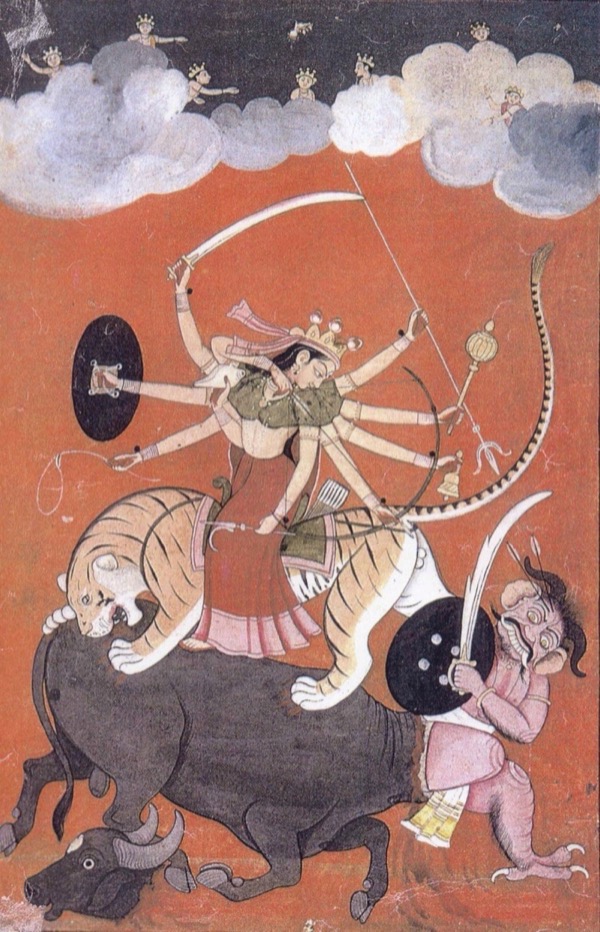
The Mahiṣāsura Mardinī Stotram is one of the most electrifying hymns in all of Sanskrit devotional literature. Known popularly by its opening words “Aigiri Nandinī”, this twenty-one-verse composition is attributed to Ādi Śaṅkarācārya (788-820 CE), the great philosopher-saint of Advaita Vedānta. The stotram celebrates the cosmic triumph of Goddess Durgā — the invincible warrior form of the Divine Mother — over Mahiṣāsura, the shape-shifting buffalo demon who had terrorised the three worlds and usurped the throne of Indra.
The Opening Verse
The stotram opens with one of the most recognisable invocations in Hindu devotional music:
अयि गिरिनन्दिनि नन्दितमेदिनि विश्वविनोदिनि नन्दनुते गिरिवरविन्ध्यशिरोऽधिनिवासिनि विष्णुविलासिनि जिष्णुनुते
Ayi Girinandini Nanditamedini Viśvavinodini Nandanute Girivaravindhyaśiro’dhivāsini Viṣṇuvilāsini Jiṣṇunute
“O Daughter of the Mountain, You who delight the earth, who bring joy to the universe, praised by Nanda! O You who dwell upon the peak of the great Vindhya mountain, who are the grace of Viṣṇu, praised by the victorious Indra!”
Authorship and Historical Context
The attribution of the Mahiṣāsura Mardinī Stotram to Ādi Śaṅkarācārya is a matter of traditional reverence rather than scholarly certainty. Śaṅkara is credited with composing numerous stotras to various deities — including hymns to Śiva, Viṣṇu, Devī, and Gaṇeśa — as part of his broader programme of integrating the diverse devotional streams of Hinduism under the philosophical umbrella of Advaita Vedānta.
What makes this attribution particularly interesting is that Śaṅkara, the arch-proponent of non-dual Brahman, was equally at home composing passionate devotional poetry to the Goddess in her most fierce and active form. In his Prapañcasāra Tantra and Saundaryalaharī, Śaṅkara demonstrates deep familiarity with Śākta traditions, and the Mahiṣāsura Mardinī Stotram fits within this broader devotional corpus.
The stotram draws its narrative content primarily from the Devī Māhātmyam (also called the Durgā Saptaśatī or Caṇḍī Pāṭha), which comprises chapters 81-93 of the Mārkaṇḍeya Purāṇa. This text, composed between the 5th and 6th centuries CE, is the foundational scripture of Śākta Hinduism and provides the most detailed account of Durgā’s battle with Mahiṣāsura.
The Myth of Mahiṣāsura
The story of Mahiṣāsura is central to understanding the stotram. According to the Devī Māhātmyam (chapters 2-4), Mahiṣāsura was an asura (demon) who obtained a boon from Brahmā through severe austerities. The boon stipulated that no male being — neither deva, asura, nor human — could slay him. Emboldened by this apparent invincibility, Mahiṣāsura waged war against the devas, defeated Indra, and seized control of Svarga (heaven).
The desperate devas, led by Brahmā, approached Viṣṇu and Śiva for aid. In response, the combined fury (tejas) of all the gods converged into a single, blazing form — the Goddess Durgā, also called Caṇḍikā and Ambikā. Each deity contributed a weapon: Śiva gave his trident, Viṣṇu his discus, Vāyu his bow, Agni his spear, Indra his thunderbolt, and Kāla his sword. Thus armed with divine weaponry and mounted upon a lion, Durgā rode into battle against Mahiṣāsura and his demon armies.
The battle raged for nine days — the mythological basis for the nine nights of Navarātri — and culminated in Durgā’s decisive victory. The demon repeatedly changed form — from buffalo to lion to elephant to warrior — but the Goddess matched each transformation. Finally, as Mahiṣāsura emerged from the neck of his buffalo form, Durgā pierced him with her trident and beheaded him with her sword. The heavens resounded with the rejoicing of the devas, and the universe was restored to order.
Structure and Poetic Analysis
The Mahiṣāsura Mardinī Stotram consists of twenty-one verses (ślokas), each following a consistent structural pattern. Every verse ends with the refrain:
जय जय हे महिषासुरमर्दिनि रम्यकपर्दिनि शैलसुते
Jaya Jaya He Mahiṣāsuramardini Ramyakapardini Śailasute
“Victory, victory to You, O Slayer of the buffalo demon, O beautiful-tressed Daughter of the Mountain!”
This refrain functions as a dhruvapadā (anchor verse), a common structural device in Sanskrit stotra literature. Its repetition creates a powerful rhythmic pulse that drives the hymn forward and embeds the core identity of the Goddess — as Mahiṣāsuramardini (the crusher of Mahiṣāsura), as Ramyakapardini (the one with beautiful braided hair), and as Śailasutā (the daughter of the mountain, i.e., Pārvatī) — into the listener’s consciousness with each iteration.
Rhythmic and Musical Qualities
The stotram is composed in a metre known as Gīti or a variant of Pādākulaka, characterised by long, rolling compounds (samāsa) that create a distinctive galloping rhythm. The extensive use of:
- Alliteration (anuprāsa): Repeated consonant sounds, such as nandini-nanditamedini-vinodini-nandanute
- Internal rhyme: Sound patterns that mirror within each line
- Compound chains: Long nominal compounds (samāsa) that unfold layer upon layer of imagery
This rhythmic quality has made the stotram exceptionally popular in musical renditions. The metre mimics the thundering hooves of the Goddess’s lion and the clash of cosmic battle, creating an auditory experience that is simultaneously devotional and dramatic.
Verse-by-Verse Themes
Verses 1-7: Invocation and Attributes
The opening verses establish the Goddess’s identity through a cascade of epithets. She is addressed as:
- Girinandini — Daughter of the Mountain (Himavān)
- Viśvavinodini — She who delights the universe
- Vindhyaśiroadhivāsini — Dweller on the peak of Vindhya
- Niśumbhaśumbhavadhodani — Destroyer of the demons Niśumbha and Śumbha
- Suravaravarṣiṇi — She who showers blessings upon the gods
Verses 8-14: The Battle Narrative
The central verses describe the cosmic battle in vivid detail. The Goddess wields her trident, sword, bow, and discus against the demon armies. The poet describes rivers of blood flowing on the battlefield, the thundering of war drums, and the terror of the fleeing demons. Key imagery includes:
धुनुरणुसंगमरणविलोलम् कनकपिशंगपृषत्कनिशंगम्
“The golden-hued arrows fly restlessly in the tumult of battle, from quivers gleaming like gold…”
Verses 15-21: Triumph and Praise
The concluding verses celebrate the Goddess’s victory and enumerate her cosmic attributes. She is praised as the source of all creation, the sustainer of dharma, and the ultimate refuge of the devotee. The final verses reach a crescendo of devotional intensity, with the poet surrendering entirely to the Goddess’s grace.
Key Verses with Translation
Verse 2
सुरवरवर्षिणि दुर्धरधर्षिणि दुर्मुखमर्षिणि हर्षरते त्रिभुवनपोषिणि शंकरतोषिणि किल्बिषमोषिणि घोषरते
“O You who shower boons upon the gods, who humble the invincible, who endure the wicked, who delight in joy! O nourisher of the three worlds, who please Śaṅkara (Śiva), who steal away sins, who delight in the cosmic sound!”
Verse 11
अयि शतखण्ड विखण्डितरुण्ड वितुण्डितशुण्ड गजाधिपते रिपुगजगण्ड विदारणचण्ड पराक्रमशुण्ड मृगाधिपते
“O You whose lion tears apart the cheeks of the enemy elephants with fierce prowess, O Lord of the forest beasts, who shatters a hundred headless trunks!”
Philosophical Dimensions
While the stotram operates on the surface level as a battle narrative, it carries profound philosophical implications:
The Triumph of Consciousness over Ignorance
In the Advaita reading, Mahiṣāsura represents tamas (inertia) and avidyā (ignorance) — the buffalo nature (mahiṣa) of dull, obstinate attachment to the material world. The Goddess represents Parā Śakti (supreme consciousness-power) that dispels this darkness. The battle is not merely external but is waged within every aspirant’s mind between the forces of clarity and delusion.
Śakti as the Dynamic Aspect of Brahman
For Śaṅkara, the Goddess is not separate from Brahman but is Brahman’s own dynamic power (śakti). The Devī Māhātmyam (1.78) declares: “By You this universe is borne, by You this world is created; by You it is protected, O Devī, and You always consume it at the end.” The stotram thus celebrates not merely a mythological victory but the eternal activity of consciousness itself.
The Nine Nights: Inner Transformation
The nine days of battle correspond to the Navarātri observance, during which devotees undertake spiritual practices to progressively purify the mind. The first three days, dedicated to Durgā (the destroyer of negativity), parallel the early battle verses. The middle three days, dedicated to Lakṣmī (prosperity), correspond to the restoration of cosmic order. The final three days, dedicated to Sarasvatī (wisdom), represent the dawn of spiritual knowledge.
Significance During Navarātri
The Mahiṣāsura Mardinī Stotram occupies a central place in Navarātri celebrations across India, particularly during Śarad Navarātri (September-October) and Vasanta Navarātri (March-April). It is recited during:
- Durgā Pūjā proceedings, especially in Bengal, Odisha, and Assam
- Navarātri garbā and daṇḍiyā rās nights in Gujarat
- Temple rituals at major Śākta pilgrimage centres such as Vaiṣṇo Devī, Kāmākhyā, and Kolhāpur Mahālakṣmī
In South India, the stotram is a staple of Carnatic musical renditions during the Navarātri festival, particularly in the Mysuru Dasara celebrations and the Sarasvatī Pūjā traditions of Tamil Nadu and Karnataka.
Musical Legacy
The Mahiṣāsura Mardinī Stotram has been set to music in virtually every regional tradition of Indian devotional music:
- Carnatic classical: Rendered in rāgas such as Tōḍi, Bhairavī, and Dēś by artists like M.S. Subbulakshmi and Bombay Jayashri
- Hindustani classical: Adapted into bhajan form in rāgas like Durgā and Bhairavī
- Film and devotional: Numerous recordings by artists like Mahālakṣmī Ayyar and Uma Mohan have made the stotram accessible to a global audience
The distinctive rhythm of the stotram — with its long, rolling compounds and thundering refrain — lends itself naturally to musical performance. The galloping metre creates an almost trance-like quality when chanted rhythmically, drawing the listener into the cosmic drama of the Goddess’s battle.
The Stotram in Contemporary Practice
Today, the Mahiṣāsura Mardinī Stotram remains one of the most widely chanted Devī hymns in the Hindu world. It is recited daily by Śākta practitioners, during Friday and Tuesday Devī worship, and with particular fervour during the nine nights of Navarātri. The hymn’s vivid imagery, powerful rhythm, and theological depth make it equally accessible to the scholar and the simple devotee.
As the refrain resounds — Jaya Jaya He Mahiṣāsuramardini Ramyakapardini Śailasute — it carries the eternal message of the triumph of divine grace over the darkest forces of ignorance and oppression, a message as relevant today as when the words first flowed from the poet’s pen over a millennium ago.