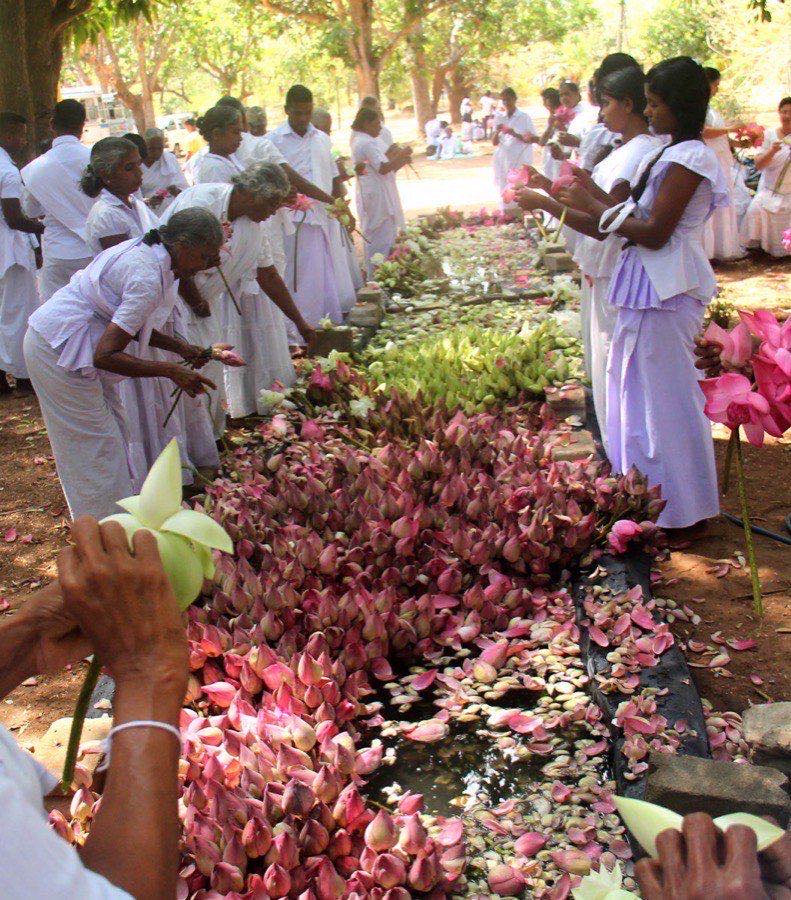
Mantra Puṣpam — the “Flower of Mantras” — is one of the most beloved and widely chanted Vedic hymns in the living Hindu tradition. Drawn from the Taittirīya Āraṇyaka (1.22) of the Kṛṣṇa Yajurveda, this sublime composition is recited at the conclusion of virtually every temple worship service and elaborate pūjā across India. As priests and devotees offer handfuls of flowers to the deity, the rhythmic cadences of Mantra Puṣpam fill the sanctum — transforming a simple floral offering into a profound declaration of cosmic knowledge.
The Complete Mantra
The core of Mantra Puṣpam consists of a series of structurally parallel verses, each exploring the relationship between water (āpaḥ) and a different cosmic element. The opening verse establishes the central theme:
योऽपां पुष्पं वेद पुष्पवान् प्रजावान् पशुमान् भवति। चन्द्रमा वा अपां पुष्पम्। पुष्पवान् प्रजावान् पशुमान् भवति। य एवं वेद॥
IAST Transliteration: Yo’pāṃ puṣpaṃ veda puṣpavān prajāvān paśumān bhavati | Candramā vā apāṃ puṣpam | Puṣpavān prajāvān paśumān bhavati | Ya evaṃ veda ||
Translation: “One who knows the flower of water becomes endowed with flowers, progeny, and cattle. The moon indeed is the flower of water. One who thus knows becomes endowed with flowers, progeny, and cattle.”
Source and Historical Context
Mantra Puṣpam belongs to the Taittirīya Āraṇyaka, the “Forest Text” associated with the Taittirīya school of the Kṛṣṇa Yajurveda. The Āraṇyakas occupy a unique position in Vedic literature — they stand between the ritual-focused Brāhmaṇas and the philosophical Upaniṣads, serving as contemplative texts meant for recitation in the solitude of the forest (araṇya).
The Taittirīya Āraṇyaka comprises ten chapters (praśnas), and Mantra Puṣpam appears in the first chapter (1.22). This placement within the Āraṇyaka is significant: the hymn bridges ritualistic observance and metaphysical insight, making it ideal for the transitional moment at the end of worship when the devotee moves from external ritual to internal contemplation.
The Taittirīya school itself is one of the most important branches of the Kṛṣṇa Yajurveda, named after the sage Tittiri. It produced some of the most influential texts in Vedic literature, including the Taittirīya Saṃhitā, Taittirīya Brāhmaṇa, Taittirīya Āraṇyaka, and the celebrated Taittirīya Upaniṣad.
Structure: The Cosmic Elements as Flowers
The genius of Mantra Puṣpam lies in its systematic exploration of natural phenomena through the metaphor of the flower (puṣpam). Just as a flower is the finest expression of a plant — its beauty, fragrance, and fruit-bearing potential concentrated in one form — each cosmic element possesses a “flower,” an essential quality that represents its highest expression.
The hymn moves through six primary elements, each linked to water in a chain of cosmic interdependence:
1. The Moon (Candramā) — The Flower of Water
Candramā vā apāṃ puṣpam
The moon is the flower of water. In Vedic cosmology, the moon governs the tides and the flow of water on earth. The moon’s cool, luminous beauty — reflected perfectly in still water — makes it the natural “blossom” of the aquatic element. The connection also reflects the Vedic understanding that the moon nourishes medicinal herbs and vegetation through its influence on moisture and growth.
2. Fire (Agni) — The Flower of the Moon
Agnirvā apāṃ puṣpam
Fire is the flower of water. This paradoxical statement reveals a deep Vedic insight: fire (agni) arises from water through lightning during storms, and the submarine fire (Vaḍavāgni) burns eternally beneath the ocean. Fire also represents the transformative power that converts water into steam, clouds, and rain — the cycle of creation and dissolution.
3. Wind (Vāyu) — The Flower of Fire
Vāyurvā apāṃ puṣpam
Wind is the flower of water. The wind drives clouds across the sky, determines where rain falls, and moves water through rivers and seas. Without wind, the water cycle would cease. Wind also fans the flames of fire, connecting it to the previous element in an unbroken chain.
4. The Sun (Āditya) — The Flower of Wind
Ādityovā apāṃ puṣpam
The sun is the flower of water. The sun’s heat drives evaporation, drawing water upward to form clouds. The Vedic seers understood this relationship intuitively: Sūrya is the great engine behind the water cycle, the celestial fire that transforms earthly water into heavenly rain. The Ṛgveda (1.164.51) declares: “The waters, which are the heart of the sun, descend as rain.”
5. The Stars (Nakṣatras) — The Flower of the Sun
Nakṣatrāṇi vā apāṃ puṣpam
The stars are the flower of water. The twenty-seven nakṣatras (lunar mansions) govern the seasons and the agricultural calendar, determining the rhythm of monsoons and rainfall. In Vedic astrology (jyotiṣa), the position of stars directly influences the timing and abundance of rains — making them, in a very real sense, the celestial flowers that bring forth terrestrial waters.
6. Rain (Parjanya) — The Flower of the Stars
Parjanyovā apāṃ puṣpam
Rain is the flower of the stars. Parjanya, the Vedic deity of rain clouds, is the final link in the cosmic chain. The stars influence the seasons, the seasons bring clouds, and the clouds release rain — completing the cycle that begins and ends with water.
The Refrain: Knowledge as the True Offering
Each verse follows an identical refrain structure:
“Puṣpavān prajāvān paśumān bhavati | Ya evaṃ veda”
“One who knows thus becomes endowed with flowers, progeny, and cattle.”
The repeated phrase “ya evaṃ veda” — “one who thus knows” — is one of the most characteristic expressions in Vedic literature. It transforms the entire hymn from a mere description of nature into a meditation on knowledge itself. The blessings of abundance (puṣpavān), progeny (prajāvān), and prosperity (paśumān) flow not from performing a ritual but from understanding the deep connections between cosmic elements.
This emphasis on knowledge (vidyā) as the source of all blessings places Mantra Puṣpam firmly in the philosophical tradition of the Upaniṣads, where knowing (jñāna) is superior to mere doing (karma).
Philosophical Depth: The Water-Knowledge Metaphor
At its deepest level, Mantra Puṣpam teaches that all of creation is interconnected through a single sustaining principle — water (āpaḥ). Water is not merely a physical substance but a metaphor for the flow of experience and consciousness that pervades all existence.
The 19th-century commentator Sāyaṇācārya interprets āpaḥ (waters) in this context as representing the continuous stream of experiences that constitute life. The “flower” (puṣpam) of water is the knowledge or wisdom that blooms when one contemplates these experiences with discernment.
In this reading:
- Water represents the ceaseless flow of experience
- The Moon (mind) reflects consciousness like moonlight reflects sunlight
- Fire (the perceiving ego) burns through experiences, transforming them into knowledge
- Wind (the principle of contact) connects the individual consciousness to the world
- The Sun (the witness) observes all experience without attachment
- Stars (fixed principles) represent the eternal laws governing creation
- Rain (unmanifest potential) represents desires and karmic seeds awaiting manifestation
The culminating insight is that Brahman — the absolute reality — is the ultimate support (ādhāra) of all these interconnections. One who truly “knows the flower of water” perceives the divine unity underlying the apparent multiplicity of creation.
The Concluding Section: Invocation of Kubera and Viṣṇu
The final portion of Mantra Puṣpam shifts from cosmological meditation to devotional invocation. The hymn calls upon Kubera Vaiśravaṇa, the lord of wealth and guardian of the north, and then invokes Viṣṇu as the supreme sustainer:
तदस्तु मित्रावरुणौ तदस्त्विन्द्राग्नी तदस्त्वश्विनौ देवौ।
“May Mitra and Varuṇa grant this; may Indra and Agni grant this; may the twin Aśvins grant this.”
This invocation connects the abstract cosmological teaching to the practical context of worship: having contemplated the interconnected nature of all creation, the devotee now seeks the blessings of the guardian deities. The progression from knowledge to prayer to offering mirrors the three-fold structure of Vedic worship: jñāna (knowledge), upāsanā (devotion), and karma (action).
The hymn concludes with the universal peace invocation:
ॐ शान्तिः शान्तिः शान्तिः॥
“Oṃ. Peace, peace, peace.”
The triple śānti dispels suffering at three levels: ādhyātmika (arising from the self), ādhibhautika (arising from other beings), and ādhidaivika (arising from cosmic forces).
Role in Temple Worship
Mantra Puṣpam holds a unique and irreplaceable position in Hindu temple liturgy. It is chanted during the puṣpāñjali — the flower offering that marks the culmination of formal pūjā — in temples following both the Āgamic (South Indian) and Smārta (pan-Indian) traditions.
The Puṣpāñjali Ritual
The word puṣpāñjali combines puṣpa (flower) and añjali (the gesture of cupped hands). During this rite:
- The priest completes the main worship — including abhiṣeka (ritual bathing), alaṅkāra (adornment), and naivedya (food offering)
- Devotees gather handfuls of flowers, typically lotus petals, jasmine, marigold, or tulasī leaves
- As the priest chants Mantra Puṣpam, devotees hold the flowers in cupped hands at chest height
- At the concluding verses, the flowers are showered upon or placed at the feet of the deity
- The gesture symbolises the offering of all one’s accumulated knowledge and merit to the Lord
The timing is deliberate: by placing this hymn at the end of worship, the tradition ensures that the final act of pūjā is not merely a physical offering but a surrender of knowledge. The flowers represent the “puṣpam” (flower/essence) of the devotee’s understanding, offered back to the divine source from which all knowledge flows.
Regional Traditions
In South Indian temples, particularly those dedicated to Viṣṇu in the Śrī Vaiṣṇava tradition, Mantra Puṣpam is chanted daily during the evening Ekānta Sevā (the closing ritual when the deity is ceremonially put to rest). At Tirumala Tirupati, one of the world’s most visited pilgrimage centres, the hymn resounds through the sanctum every evening as priests offer final flowers to Lord Veṅkaṭeśvara.
In Śaiva temples, the hymn is chanted during the concluding dīpārādhana (lamp worship), with flowers offered alongside the waving of camphor flames.
In North Indian and Bengali traditions, the Mantra Puṣpam text is sometimes incorporated into the broader mantrapuṣpāñjali ceremony during Durgā Pūjā and other major festivals, where thousands of devotees simultaneously offer flowers while Vedic priests chant the hymn.
Method of Chanting
Mantra Puṣpam is chanted in the Kṛṣṇa Yajurveda svara (tonal) system, which uses three pitch levels:
- Udātta (raised pitch, unmarked) — the default high tone
- Anudātta (low pitch, marked with an underline) — the preparatory low tone
- Svarita (falling pitch, marked with a vertical line above) — the combined tone
The characteristic melodic pattern of Yajurvedic chanting — with its gentle rises and falls — gives Mantra Puṣpam a distinctive, meditative quality that is instantly recognisable to anyone who has attended temple worship in India. The svara markings are preserved in traditional pāṭhaśālā (Vedic school) manuscripts and are transmitted orally from teacher to student.
For devotees who have not undergone formal Vedic training, many temples encourage the chanting of the mantra in a simpler, eka-svara (single-tone) mode, making this sublime hymn accessible to all.
The Living Tradition
Mantra Puṣpam is not merely an ancient text preserved in manuscripts — it is a living, breathing part of daily Hindu worship. Every evening, across thousands of temples from Kedārnāth to Rāmeśvaram, from Jagannātha Purī to Dvārakā, this hymn marks the moment when the day’s worship reaches its culmination. The simple act of offering flowers while chanting these verses connects the modern devotee to a tradition stretching back over three millennia.
The hymn’s enduring power lies in its central teaching: that true offering is not the flower in one’s hand but the knowledge in one’s heart. The physical flower wilts and falls, but the “flower of understanding” — the recognition that all creation is woven together by a single divine thread — remains the eternal offering, the imperishable puṣpam that never fades.
As the Taittirīya Āraṇyaka declares: “Puṣpavān prajāvān paśumān bhavati — ya evaṃ veda” — one who truly knows this becomes endowed with all abundance. The flower of knowledge is the highest flower of all.