The Narasiṃha Kavacam (नृसिंह कवचम्, “The Armor of Narasiṃha”) is one of the most revered protective hymns in the Vaishnava tradition. Preserved in the Brahmāṇḍa Purāṇa and also known as the Trailokya Vijaya Kavacam (“The Armor of Victory Over the Three Worlds”), this powerful stotra was originally narrated by the child-devotee Prahlāda to invoke the all-encompassing protection of Lord Narasiṃha — the fierce half-man, half-lion avatāra of Vishnu. Comprising approximately 31 verses, the Kavacam systematically invokes Narasiṃha’s protective power over every part of the devotee’s body, every direction of space, and every conceivable form of danger — functioning as an impenetrable spiritual suit of armor against all evil.
The Opening Verses
नृसिंहकवचं वक्ष्ये प्रह्लादेनोदितं पुरा। सर्वरक्षाकरं पुण्यं सर्वोपद्रवनाशनम्॥१॥ सर्वसम्पत्करं चैव स्वर्गमोक्षप्रदायकम्। ध्यात्वा नृसिंहं देवेशं हेमसिंहासनस्थितम्॥२॥
IAST Transliteration: nṛsiṃhakavacaṃ vakṣye prahlādenoditaṃ purā | sarvarakṣākaraṃ puṇyaṃ sarvopadravanāśanam ||1|| sarvasampatkараṃ caiva svargamokṣapradāyakam | dhyātvā nṛsiṃhaṃ deveśaṃ hemasiṃhāsanasthitam ||2||
Translation: “I shall now recite the Narasiṃha Kavacam, formerly spoken by Prahlāda. It is most sacred, the bestower of all protection, and the destroyer of all calamities. It grants all prosperity and bestows both heavenly pleasures and liberation. One should meditate upon Lord Narasiṃha, the Lord of the gods, seated upon a golden throne.”
The Concept of Kavacam in Hindu Worship
The Sanskrit word kavaca (कवच) literally means “armor,” “breastplate,” or “shield” — the protective covering a warrior wears into battle. In the context of Hindu devotional literature, a Kavacam is a special category of stotra (hymn) that invokes a deity’s protection over every part of the devotee’s physical body, mental faculties, and spiritual being. The underlying metaphor is both vivid and powerful: just as a soldier girds himself with physical armor before entering battle, the devotee dons the spiritual armor of divine names and attributes before facing the challenges of worldly existence.
Kavacam stotras follow a distinctive structural pattern that sets them apart from other forms of devotional poetry:
- Aṅga-rakṣā (limb-protection): Each body part — from the crown of the head to the soles of the feet — is individually entrusted to a specific form, name, or attribute of the deity.
- Dik-rakṣā (directional protection): The eight cardinal and intermediate directions, plus the zenith and nadir, are each guarded by a manifestation of the deity.
- Phala-śruti (fruit of recitation): The concluding section describes the specific benefits the devotee receives from faithful recitation.
This pattern appears across Hindu traditions: the Devī Kavacam of the Mārkaṇḍeya Purāṇa invokes the nine forms of Durgā, the Nārāyaṇa Kavacam of the Bhāgavata Purāṇa calls upon Vishnu’s various manifestations, and the Narasiṃha Kavacam harnesses the fierce protective energy of the man-lion incarnation. Among these, the Narasiṃha Kavacam is particularly esteemed for its association with overcoming extreme danger, as it originates from the lips of Prahlāda — the supreme exemplar of faith under persecution.
Source Text: The Brahmāṇḍa Purāṇa
The Narasiṃha Kavacam finds its canonical home in the Brahmāṇḍa Purāṇa, one of the eighteen major Purāṇas (mahāpurāṇas) of Hindu scripture. The Brahmāṇḍa Purāṇa, whose name means “the Purāṇa of the Cosmic Egg (brahmāṇḍa),” is a vast encyclopedic text dealing with cosmology, genealogy, geography, and devotional practices. It is traditionally attributed to the sage Vyāsa and is considered one of the more ancient of the Purāṇas.
The Kavacam is specifically designated as belonging to the Trailokya Vijaya (“Victory Over the Three Worlds”) section, indicating its function as a hymn of cosmic conquest — the spiritual victory of divine protection over all forces of evil across the three realms of existence: bhūloka (earth), svarloka (heaven), and pātāla (the netherworld). This title signals that the protection afforded by Narasiṃha is not limited to the earthly plane but extends across the entire cosmological spectrum.
Prahlāda: The Narrator and Supreme Devotee
The Narasiṃha Kavacam derives extraordinary authority from its narrator — Prahlāda Mahārāja, the five-year-old prince of the asuras (demons) whose story is one of the most celebrated narratives in all of Hindu scripture. The son of the demon-king Hiraṇyakaśipu, Prahlāda was an unwavering devotee of Lord Vishnu from the very womb, despite his father’s implacable hatred of the god.
Hiraṇyakaśipu had obtained a seemingly invincible boon from Lord Brahmā: he could not be killed by any created being, not indoors or outdoors, not by day or by night, not on the earth or in the sky, not by weapon or by hand, not by man or beast. Drunk with this apparent invulnerability, Hiraṇyakaśipu declared himself the supreme lord of the universe and prohibited all worship of Vishnu. When his own son refused to abandon his devotion, the demon-king subjected Prahlāda to every imaginable torment — hurling him from cliffs, casting him into fire, feeding him to serpents, drowning him in the ocean. Yet Prahlāda emerged unscathed from every ordeal, his faith unshaken, his lips ceaselessly chanting the names of Hari.
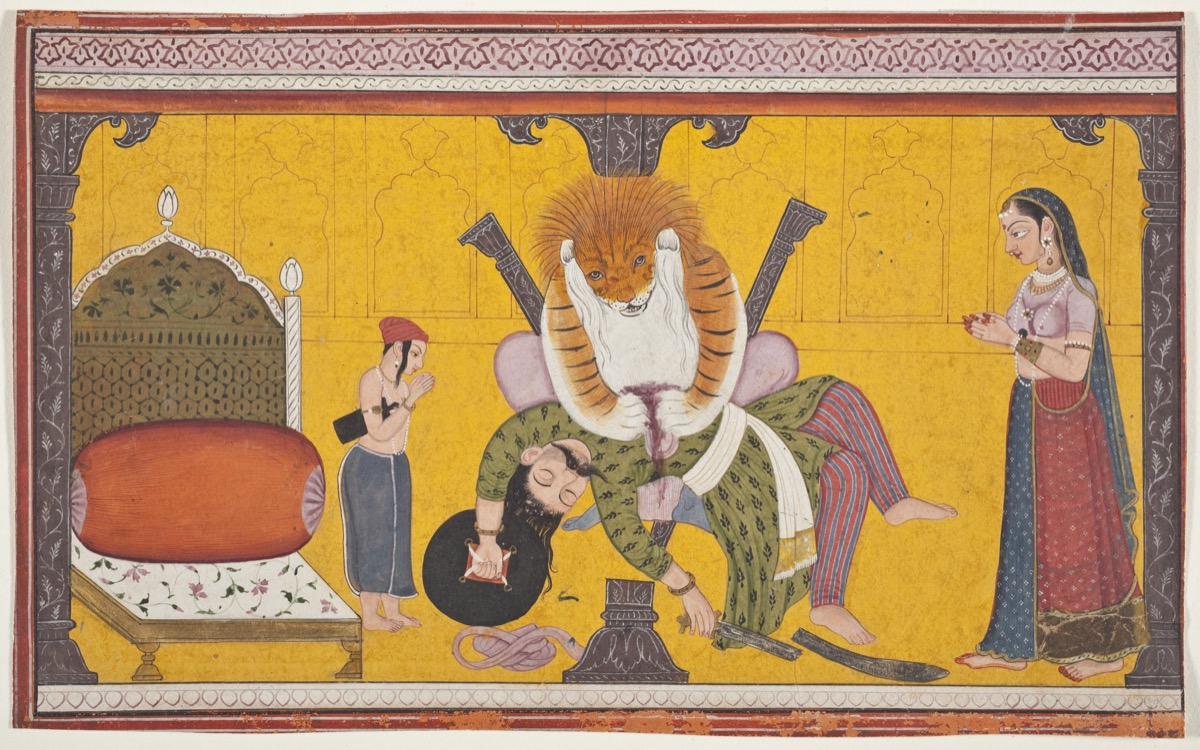
When Hiraṇyakaśipu mockingly asked Prahlāda whether his Vishnu was present in a particular pillar of the palace, Prahlāda calmly replied that the Lord is present everywhere — in every atom of creation. In a rage, Hiraṇyakaśipu struck the pillar with his fist, and from the shattered column emerged Lord Narasiṃha — neither fully man nor fully beast, with the head and claws of a lion and the torso of a man. At twilight (neither day nor night), on the threshold of the doorway (neither indoors nor outdoors), placing the demon across His lap (neither on earth nor in the sky), Narasiṃha tore Hiraṇyakaśipu apart with His bare claws (neither weapon nor tool), fulfilling every condition of Brahmā’s boon while rendering it void.
It is from this supremely tested devotee — who experienced divine protection at its most dramatic — that the Narasiṃha Kavacam originates. Prahlāda’s authority to compose a protective hymn is unmatched: he had personally witnessed the Lord emerge from the impossible to destroy invincible evil.
The Dhyāna Śloka: Meditating on Narasiṃha’s Form
Before the protective invocations begin, the Kavacam prescribes a meditation (dhyāna) on the form of Lord Narasiṃha:
ध्यात्वा नृसिंहं देवेशं हेमसिंहासनस्थितम्। विवृतास्यं त्रिनयनं शरदिन्दुसमप्रभम्॥ लक्ष्म्यालिङ्गितवामाङ्गं विभूतिभिरुपाश्रितम्। चतुर्भुजं कोमलाङ्गं स्वर्णकुण्डलशोभितम्॥
dhyātvā nṛsiṃhaṃ deveśaṃ hemasiṃhāsanasthitam | vivṛtāsyaṃ trinayanaṃ śaradindusamaprabham || lakṣmyāliṅgitavāmāṅgaṃ vibhūtibhir upāśritam | caturbhujaṃ komalāṅgaṃ svarṇakuṇḍalaśobhitam ||
Translation: “One should meditate upon Lord Narasiṃha, the Lord of the gods, seated upon a golden throne, with His mouth wide open, having three eyes, radiant as the autumn moon. His left side is embraced by Goddess Lakṣmī, He is surrounded by divine glories, four-armed, with beautiful limbs, adorned with golden earrings.”
This meditative visualization establishes the form of Narasiṃha in the devotee’s consciousness: simultaneously fierce (vivṛtāsya — open-mouthed, ready to devour evil) and beautiful (komalāṅga — with gentle limbs), terrible to the wicked yet tender to devotees. The presence of Lakṣmī at His left side transforms the ferocious Ugra Narasiṃha into the pacified Lakṣmī-Narasiṃha, the form in which the Lord’s wrath — which had terrified even the gods after slaying Hiraṇyakaśipu — was calmed by the Goddess’s loving touch.
Body-Part Protection: The Aṅga-Rakṣā
The heart of the Narasiṃha Kavacam is its systematic invocation of Lord Narasiṃha’s protection over every part of the devotee’s body. Each verse assigns a specific aspect, name, or form of Narasiṃha to guard a particular limb or organ. The progression follows the traditional pattern from head to feet:
Head and Sensory Organs
नृसिंहो मे शिरः पातु लोकरक्षात्मसम्भवः।
“May Lord Narasiṃha, who was born for the protection of all the worlds, protect my head.”
The head (śiras) is the seat of consciousness and the highest point of the body — it receives the first and most fundamental protection. From there, the Kavacam proceeds to shield:
- Forehead (lalāṭa): Protected by Narasiṃha in His form as the destroyer of the demon
- Eyes (netra): Guarded by He whose eyes are the sun, moon, and fire
- Ears (karṇa): Protected by the Lord who is praised by the Vedas
- Nose (nāsikā): Shielded by the bestower of life-breath
- Mouth (mukha): Protected by He whose roar shakes the three worlds
Throat, Arms, and Torso
- Throat (kaṇṭha): Guarded by the Lord whose voice terrified the demons
- Shoulders (skandha): Protected by the four-armed divine form
- Arms (bāhu): Shielded by the Lord whose arms destroyed Hiraṇyakaśipu
- Heart (hṛdaya): The seat of the spiritual self, guarded by the indwelling Narasiṃha — the Lord who resides within every being, as Prahlāda himself declared
- Navel (nābhi): Protected by the Lord of yoga
- Stomach (udara): Shielded by the omnipotent one
Lower Body
- Hips (kaṭi): Protected by He who bears the universe
- Thighs (ūru): Guarded by the original Kāmadeva (God of love) — a name indicating Narasiṃha’s supreme attractiveness
- Knees (jānu): Protected by the Lord who took the man-lion form
- Calves (jaṅgha): Shielded by He who removes the burden of the earth
- Feet (pāda): Protected by the Lord whose feet are worshipped by all the gods
This head-to-foot progression is more than poetic convention — it reflects the Vedāntic principle that the divine pervades the entire body (sarvāṅga-vyāpaka). By individually consecrating each limb, the devotee transforms the physical body itself into a temple of Narasiṃha, where no part remains unprotected or unsanctified.
Directional Protection: The Dik-Rakṣā
After covering every body part, the Kavacam extends its protective scope outward to encompass all spatial directions:
सर्वतः पातु मे नृसिंहो भक्तप्रियः।
“May Narasiṃha, the lover of devotees, protect me from all directions.”
The text systematically invokes Narasiṃha’s guardianship in each of the traditional eight directions (aṣṭa-dik), plus the zenith and nadir:
- East (pūrva): May the most ferocious one protect me
- South (dakṣiṇa): May the Supreme Viṣṇu protect me
- West (paścima): May the Lord of all protect me
- North (uttara): May the Imperishable One protect me
- Northeast (aiśānya): May the Lord in the form of half-man, half-lion protect me
- Southeast (āgneya): May the destroyer of fear protect me
- Southwest (nairṛtya): May the Lord of Lakṣmī protect me
- Northwest (vāyavya): May the all-pervading one protect me
- Above (ūrdhva): May the supreme Lord protect me from above
- Below (adhas): May Narasiṃha protect me from below
This directional protection ensures that no attack can reach the devotee from any quarter — the armor is not merely a frontal shield but a complete sphere of divine guardianship.
The Narasiṃha Avatāra: The Fierce Protector
Understanding the full power of the Narasiṃha Kavacam requires appreciating the unique nature of the Narasiṃha avatāra among Lord Vishnu’s ten primary incarnations (daśāvatāra). While avatāras like Rāma and Kṛṣṇa are characterized by beauty, grace, and mādhurya (sweetness), Narasiṃha embodies raw, overwhelming vīrya (heroic power) and ugratva (ferocity). He is the avatāra who manifests specifically to destroy that which appears indestructible — to shatter the illusion of invincible evil.
The Narasiṃha form itself is a theological paradox made flesh: He is simultaneously man and beast, gentle and terrible, beautiful and awe-inspiring. This viparīta (contradictory) nature is precisely what makes Him the ultimate protector — He transcends all categories and limitations, including the carefully constructed conditions of Hiraṇyakaśipu’s boon. Where other forms of divine intervention might be constrained, Narasiṃha shatters all constraints.
In Vaishnava theology, Narasiṃha represents the principle that God will go to any length — even assuming a form unprecedented in cosmic history — to protect His devotee. The Bhāgavata Purāṇa (7.8.17) records that even Brahmā was astonished at the form, never having seen or imagined anything like it. This is protection at its most absolute: when all known remedies fail, the Lord invents a new one.
When to Recite the Narasiṃha Kavacam
Traditional texts and ācāryas prescribe the recitation of the Narasiṃha Kavacam for several specific purposes:
Protection from Evil and Black Magic
The Kavacam is considered one of the most powerful remedies against abhicāra (sorcery), bhūta-preta-piśāca (ghosts and malevolent spirits), and all forms of supernatural harassment. The fierce lion-roar of Narasiṃha is said to scatter all dark forces.
Overcoming Fear
Those suffering from chronic anxiety, nightmares, phobias, or paralysing fear are advised to recite this Kavacam daily. Prahlāda himself was fearless in the face of his father’s murderous rage because of his connection with Narasiṃha — the Kavacam transmits that same fearlessness.
Legal and Adversarial Situations
The Trailokya Vijaya designation indicates victory over all opponents. Devotees facing lawsuits, false accusations, hostile rivals, or unjust persecution invoke the Kavacam for divine justice and vindication.
Protection During Travel
The directional protection verses make the Kavacam especially suitable for recitation before journeys, ensuring safety from all quarters.
Daily Practice
Many Vaishnava devotees include the Narasiṃha Kavacam in their daily sandhyā-vandana (twilight prayers), particularly during the sandhyā (twilight) period — the very time at which Lord Narasiṃha manifested.
The Phala-Śruti: Fruits of Recitation
The concluding verses of the Kavacam describe its benefits in characteristically sweeping terms:
इदं नृसिंहकवचं प्रह्लादमुखमण्डितम्। भक्तिमान् यः पठेन्नित्यं सर्वपापैः प्रमुच्यते॥
idaṃ nṛsiṃhakavacaṃ prahlādamukhamaṇḍitam | bhaktimān yaḥ paṭhen nityaṃ sarvapāpaiḥ pramucyate ||
“This Narasiṃha Kavacam, adorned by (having come from) the mouth of Prahlāda — one who recites it daily with devotion is freed from all sins.”
The phala-śruti further promises:
- Sarva-rakṣā — complete protection from all dangers
- Sarva-sampat — attainment of all forms of wealth and prosperity
- Svarga-mokṣa-pradāyaka — the bestowal of both heavenly pleasure and ultimate liberation
- Sarva-pāpa-nāśana — destruction of all accumulated sins
- Roga-nivṛtti — freedom from disease
- Vijaya — victory in all undertakings
The inclusion of both material (svarga, wealth, health) and spiritual (mokṣa, freedom from sin) benefits reflects the comprehensive nature of Narasiṃha’s protection — He guards not only the body and worldly interests but also the soul’s eternal journey.
Ahobilam and the Nine Forms of Narasiṃha
The most sacred center of Narasiṃha worship is Ahobilam (also spelled Ahobalam) in the Nallamala Hills of Andhra Pradesh, where tradition holds that Lord Narasiṃha manifested in nine distinct forms (Nava-Narasiṃha). Each of these nine shrines, scattered across the forested hills, corresponds to a different aspect of the Lord’s protective power:
- Jwālā Narasiṃha — the Lord in blazing, fiery form
- Ahobila Narasiṃha — the supreme form, at the spot of Hiraṇyakaśipu’s slaying
- Mālikārjuna Narasiṃha — the Lord adorned with garlands
- Krōḍa Narasiṃha — the Lord in boar-lion combined form
- Kāraṇḍa Narasiṃha — the Lord in the forest
- Bhārgava Narasiṃha — the Lord associated with sage Bhṛgu
- Yōgānanda Narasiṃha — the Lord in yogic bliss
- Chatravaṭa Narasiṃha — the Lord under the banyan tree
- Pāvana Narasiṃha — the Lord of purification
Other major Narasiṃha temples include the Siṃhācalam temple in Visakhapatnam (where Narasiṃha appears as Varāha-Narasiṃha), the ancient Namakkal Narasiṃhaswāmy temple in Tamil Nadu, and the Yoga-Narasiṃha temple at Melukote in Karnataka. Each of these sacred sites carries its own tradition of Kavacam recitation and worship.
Comparison with Other Kavacam Traditions
The Narasiṃha Kavacam belongs to a rich family of protective hymns across Hindu traditions. Comparing it with its major counterparts reveals both shared structures and distinctive emphases:
Devī Kavacam (Mārkaṇḍeya Purāṇa)
The Devī Kavacam, forming part of the Durgā Saptaśatī, invokes the nine forms of Durgā (Navadurgā) for protection. While it shares the body-part and directional protection pattern with the Narasiṃha Kavacam, its character is distinctly Śākta — it emphasizes the Goddess’s maternal protectiveness and her cosmic power (śakti) as the fundamental energy of the universe. Its narrator is the sage Mārkaṇḍeya receiving instruction from Brahmā.
Nārāyaṇa Kavacam (Bhāgavata Purāṇa)
The Nārāyaṇa Kavacam from the Sixth Canto of the Bhāgavata Purāṇa was taught by Viśvarūpa to Indra before the battle against the demon Vṛtrāsura. It invokes Vishnu’s various avatāras and attributes for limb-by-limb protection and is notable for its elaborate nyāsa (ritual touching) section. While both the Nārāyaṇa and Narasiṃha Kavacams are Vaishnava texts, the Narasiṃha Kavacam carries a more intensely fierce (ugra) energy, befitting its origin in a context of extreme persecution.
Distinctive Features of the Narasiṃha Kavacam
What distinguishes the Narasiṃha Kavacam from its counterparts is:
- The narrator’s authority: Prahlāda’s testimony carries the weight of personal experience — he speaks not from theoretical knowledge but from having been rescued by Narasiṃha from certain death.
- The intensity of protection: The ugra (fierce) aspect of Narasiṃha makes this Kavacam especially potent against the most extreme forms of danger and evil.
- The Trailokya Vijaya dimension: The explicit promise of victory across all three worlds (triloka) goes beyond mere defense to assert active cosmic triumph.
Traditional Recitation Practice
The traditional method of reciting the Narasiṃha Kavacam involves several preparatory and accompanying practices:
- Ācamana (ritual sipping of water) for purification
- Prāṇāyāma (breath control) to steady the mind
- Saṅkalpa (formal resolution) stating the purpose of the recitation
- Viniyoga: The ṛṣi (seer) is Prahlāda, the chandas (metre) is anuṣṭubh, and the devatā (deity) is Śrī Narasiṃha
- Dhyāna: Meditation on the four-armed Narasiṃha seated on a golden throne with Lakṣmī
- Pāṭha: Recitation of the Kavacam proper
- Phala-śruti: Reading of the concluding benefits section
The ideal time for recitation is sandhyā (twilight), commemorating the time at which Narasiṃha manifested. Many devotees also recite it at midnight, considered a particularly potent hour for protective mantras. Regular daily recitation is considered superior to occasional intensive practice — the armor is most effective when worn constantly.
Theological Significance
The Narasiṃha Kavacam encapsulates a profound theological truth: that divine protection is not passive but intensely active. The God who emerges from a stone pillar to save His devotee is not a distant, abstract principle but a fiercely engaged personal presence. Every verse of the Kavacam affirms that there is no corner of existence — no body part, no direction, no situation — where the Lord’s protective reach does not extend.
For Prahlāda, this was not a matter of faith but of direct experience. The Kavacam he composed is, in effect, a testimony: “I was thrown from a cliff, and He caught me. I was cast into fire, and He cooled the flames. I was fed to serpents, and He turned their venom to nectar. There is no danger from which He cannot save you.” This experiential authority gives the Narasiṃha Kavacam its extraordinary power in Hindu devotional life — it is not merely a prayer for protection but the battle-cry of one who has been protected against all odds.
The enduring popularity of this Kavacam across centuries and across all Vaishnava communities — from South Indian Śrī Vaishnavism to North Indian Gauḍīya traditions — testifies to the universal human need for the assurance that there exists a power greater than any evil, a protector who will go to any length to shelter those who trust in Him. In the fierce, compassionate, impossible form of Lord Narasiṃha, Hindu devotees find precisely that assurance.