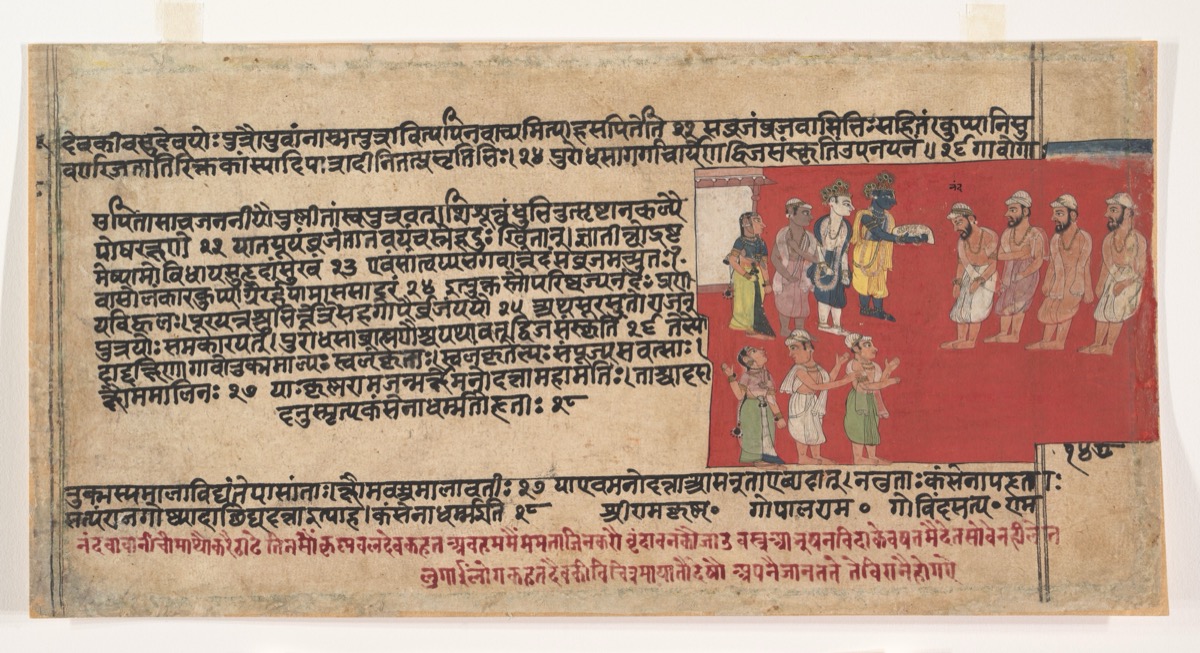
The Nārāyaṇa Kavacham (नारायण कवचम्, “The Armor of Nārāyaṇa”) is one of the most potent protective hymns in Hindu scripture. Found in the Sixth Canto, Chapter 8 of the Shrīmad Bhāgavata Purāṇa, this stotra is a divine invocation that systematically calls upon the various forms, weapons, and attributes of Lord Vishnu to create an impenetrable spiritual shield around the devotee. The word kavacham literally means “armor” or “protective covering,” and this hymn serves as a verbal and meditative armament against all forms of physical, mental, and spiritual adversity.
The Narrative Context: Vishvarūpa and Indra
The Nārāyaṇa Kavacham arises within one of the most dramatic episodes of the Bhāgavata Purāṇa. After the great sage Durvāsā cursed Indra, the king of the devas, for disrespecting a garland offered by Lakshmi, the devas lost their divine lustre and power. The asuras (demons), led by Vṛtrāsura, seized the opportunity to wage war against the weakened gods.
In this dire situation, Lord Brahmā advised Indra to approach Vishvarūpa (also known as Tvashṭā’s son), the son of the sage Tvashṭā, who served as the priest (purohita) of the devas. Vishvarūpa, though of mixed divine-demonic lineage, was a devoted Vaishnava and possessed deep knowledge of protective mantras.
Before teaching Indra the strategy for battle, Vishvarūpa imparted the Nārāyaṇa Kavacham — a hymn of invincible protection that would render Indra impervious to the weapons and sorcery of the asuras (Bhāgavata Purāṇa 6.8.1-4).
Structure of the Kavacham
The Nārāyaṇa Kavacham follows a precise ritual structure:
1. Viniyoga (Statement of Purpose)
The hymn begins with a formal viniyoga identifying the sage (ṛṣi) as Vishvarūpa, the metre (chandas) as anuṣṭubh, and the deity (devatā) as Shrī Mahā Viṣṇu. The purpose is declared as protection from all dangers (sarva-bhaya-nivṛtti).
2. Nyāsa (Ritual Touching)
The practitioner performs aṅga-nyāsa and kara-nyāsa — the ritual touching of various body parts while chanting specific mantras. This process symbolically installs the divine presence in each limb of the body:
- Hṛdayāya (heart) — Oṁ Namo Bhagavate Nārāyaṇāya
- Śirase (head) — Oṁ Namo Bhagavate Vāsudevāya
- Śikhāyai (crown tuft) — Oṁ Namo Bhagavate Saṅkarṣaṇāya
- Kavachāya (torso) — Oṁ Namo Bhagavate Pradyumnāya
- Astrāya (weapon/defense) — Oṁ Namo Bhagavate Aniruddhāya
These five invocations correspond to the Pañcha-vyūha — the five divine emanations in Vaishnava theology.
3. Dhyānam (Meditation)
A meditation verse invokes the cosmic form of Lord Vishnu — four-armed, bearing the conch (śaṅkha), discus (cakra), mace (gadā), and lotus (padma), adorned with the Kaustubha gem, the Śrīvatsa mark, and the garland of forest flowers (Vanamālā).
4. The Kavacham Proper: Limb-by-Limb Protection
The heart of the stotra is a systematic invocation in which each part of the body is entrusted to a specific form or attribute of Lord Vishnu:
- Head: Protected by the four-faced form (Chaturmukha) of Nārāyaṇa
- Forehead: Shielded by Narasiṁha, the man-lion avatāra
- Eyes: Guarded by Yogeśvara (the Lord of Yoga)
- Ears: Protected by the Dikkāla form that pervades all directions and time
- Nostrils: Guarded by the boar incarnation, Varāha
- Mouth: Protected by Urugāya (He who is sung in great hymns)
- Throat: Shielded by Vishnu’s Sudarśana Cakra
- Arms: Protected by Gadādhara (the mace-bearer)
- Heart: Guarded by the Lord who wears the Kaustubha gem
- Navel: Protected by Padmanābha (from whose navel the lotus of creation springs)
- Thighs: Guarded by Hari (the remover of sins)
- Knees and shins: Protected by Trivikrama (He who measured the three worlds)
- Feet: Shielded by Upendra (the younger brother of Indra, i.e., Vāmana)
5. Protection of Directions and Times
Beyond the physical body, the Kavacham extends protection to all directions (diśā) and times (kāla):
- East: Protected by Matsya (the fish avatāra)
- South: Guarded by Vāmana (the dwarf incarnation)
- West: Protected by Kūrma (the tortoise avatāra)
- North: Shielded by Nṛsiṁha (the man-lion)
- Above: Protected by Madhusūdana (the slayer of Madhu)
- Below: Guarded by Trivikrama
6. Phala Stuti (Fruits of Recitation)
The concluding section describes the immense spiritual benefits. Vishvarūpa declares that one who recites this Kavacham with faith and devotion becomes free from all fear, illness, black magic, planetary afflictions, and demonic attacks (Bhāgavata Purāṇa 6.8.32-42).
Philosophical Significance
The Nārāyaṇa Kavacham embodies several key principles of Vaishnava theology:
Śaraṇāgati (Surrender)
The entire hymn is an act of total surrender (prapatti) to the Lord. By entrusting every limb and every moment to Vishnu’s protection, the devotee enacts the fundamental Vaishnava principle that the Lord alone is the ultimate refuge. The Kavacham demonstrates that divine protection is not earned through personal power but received through humble dependence on God.
Viśvarūpa (Universal Form)
The systematic invocation of different forms of Vishnu across the body reflects the theological understanding that the Divine pervades all of creation. Just as the Viśvarūpa darśana in the Bhagavad Gītā (Chapter 11) reveals Krishna’s cosmic form, the Kavacham reveals Nārāyaṇa’s presence in every direction, every moment, and every atom of the devotee’s being.
Nāma-Māhātmya (Glory of Divine Names)
Each invocation in the Kavacham uses a specific divine name — Nārāyaṇa, Vāsudeva, Narasiṁha, Varāha, Trivikrama, and so on. Vaishnava theology holds that the divine name is non-different from the Lord himself (nāma and nāmī are identical). Thus, by uttering these names, the devotee invokes the actual presence and power of each divine form.
Traditional Recitation Practice
The traditional method for reciting the Nārāyaṇa Kavacham follows a prescribed sequence:
- Āchamana: Ritual sipping of water for purification
- Prāṇāyāma: Controlled breathing to calm the mind
- Saṅkalpa: Declaration of intention, invoking the purpose of protection
- Viniyoga: Formal identification of the hymn’s ṛṣi, chandas, and devatā
- Nyāsa: Ritual installation of mantras on body parts
- Dhyāna: Meditation on the form of Lord Vishnu
- Kavacham recitation: The protective verses, chanted with clear pronunciation
- Phala Stuti: Recitation of the concluding benefits section
A complete recitation typically takes 15 to 20 minutes. It is traditionally performed in the early morning, after bathing and before beginning the day’s activities. Many devotees also recite it during eclipses, on Ekādaśī, or during times of particular danger or difficulty.
The Kavacham in Devotional Life
In Temple Worship
The Nārāyaṇa Kavacham is recited daily in many Vaishnava temples across India, particularly those affiliated with the Gauḍīya and Shrī Vaishnava traditions. At the ISKCON temples worldwide, it forms part of the regular devotional programme, especially during Nṛsiṁha Jayantī celebrations.
In Domestic Practice
Families in the Vaishnava tradition often recite the Kavacham during gṛha-praveśa (house-warming), before undertaking journeys, or during illness. Parents may recite it over young children as a form of spiritual protection.
In Tantric Traditions
The Kavacham tradition is not unique to the Bhāgavata — similar protective hymns exist for Śiva (Śiva Kavacham), Devī (Devī Kavacham), and other deities. However, the Nārāyaṇa Kavacham holds a special place because of its Purāṇic authority and the completeness of its protective schema.
Connection to the Vṛtrāsura Episode
The Nārāyaṇa Kavacham is inseparable from the larger narrative of the Vṛtrāsura battle in the Sixth Canto. Armed with this divine protection, Indra was able to face the formidable demon Vṛtrāsura — who, paradoxically, was himself a great devotee of Vishnu. The episode teaches that divine protection does not make one invincible through force, but rather aligns one’s actions with dharma. Even Vṛtrāsura, as he fell in battle, attained liberation through his devotion to Nārāyaṇa.
This narrative context elevates the Kavacham beyond a mere protective charm into a profound teaching about faith, duty, and divine grace. The true “armor” is not physical imperviousness but the unshakeable conviction that the Lord protects those who take refuge in Him.
The Enduring Legacy
The Nārāyaṇa Kavacham remains one of the most widely recited protective hymns in Hinduism. Its appeal lies in its combination of ritual precision (the systematic invocation of each body part), theological depth (the mapping of Vishnu’s cosmic forms onto the human body), and narrative power (its origin in a moment of cosmic crisis).
As Vishvarūpa assures Indra (Bhāgavata Purāṇa 6.8.32):
“One who accepts this armor of Nārāyaṇa, with faith and devotion, becomes fearless in the face of all dangers — from enemies, from disease, from the forces of nature, and from the demons of the mind.”
In a world filled with uncertainty, the Kavacham offers the devotee not a guarantee of worldly invincibility, but something far greater: the assurance that one who dwells in the remembrance of Nārāyaṇa is never truly unprotected.