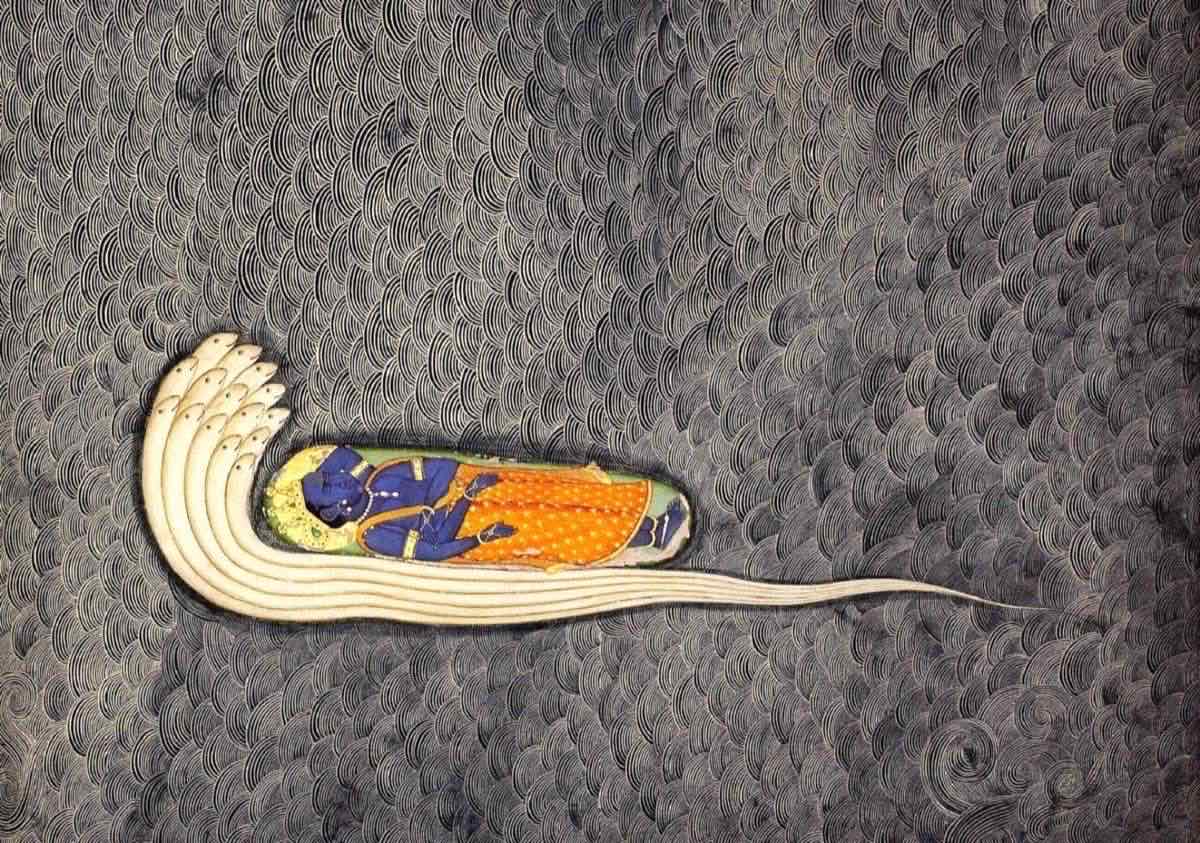
The Nārāyaṇa Sūktam is one of the most exalted Vedic hymns in the Hindu tradition, a luminous declaration of Lord Nārāyaṇa as the Supreme Absolute who pervades, sustains, and transcends all of creation. Found in the Taittirīya Āraṇyaka (10th Prapāṭhaka, 13th Anuvāka) of the Kṛṣṇa Yajurveda — a section also known as the Mahānārāyaṇa Upaniṣad — this hymn moves from the cosmic to the intimate, beginning with Nārāyaṇa’s universal sovereignty and culminating in His radiant presence within the lotus of the human heart.
The Complete Hymn
The Nārāyaṇa Sūktam comprises thirteen verses followed by a closing Nārāyaṇa Gāyatrī and a triple peace invocation. The hymn falls into three natural sections: the cosmic vision (verses 1-5), the heart meditation (verses 6-11), and the supreme identity (verses 12-13).
ॐ सहस्रशीर्षं देवं विश्वाक्षं विश्वशम्भुवम्। विश्वं नारायणं देवमक्षरं परमं पदम्॥
IAST Transliteration: Oṃ sahasraśīrṣaṃ devaṃ viśvākṣaṃ viśvaśambhuvam | Viśvaṃ nārāyaṇaṃ devam akṣaraṃ paramaṃ padam ||
Verse-by-Verse Translation
Part I: The Cosmic Vision (Verses 1-5)
Verse 1: Sahasraśīrṣaṃ devaṃ viśvākṣaṃ viśvaśambhuvam | Viśvaṃ nārāyaṇaṃ devam akṣaraṃ paramaṃ padam ||
“This universe is the Eternal Being, Nārāyaṇa — the imperishable, the supreme, the goal. Multi-headed and multi-eyed, omnipresent and omniscient, the resplendent one, the source of delight for the whole universe.”
The opening verse establishes the foundational teaching of the hymn: the entire cosmos is not merely created by Nārāyaṇa but is Nārāyaṇa. The epithet sahasraśīrṣam (“thousand-headed”) echoes the Puruṣa Sūkta (Ṛgveda 10.90.1), deliberately linking the two great hymns. He is akṣaram — the imperishable syllable, the indestructible ground of all being — and paramaṃ padam, the supreme state to which all souls aspire.
Verse 2: Viśvataḥ paramam nityaṃ viśvaṃ nārāyaṇaṃ harim | Viśvam evedaṃ puruṣas tad viśvam upajīvati ||
“The universe is the Supreme Being (Puruṣa) alone; hence it subsists on That — the Eternal which transcends it, the Omnipresent Absolute, Hari, who destroys all sins.”
Here the hymn affirms both the immanence and transcendence of Nārāyaṇa. He is nitya (eternal) and parama (beyond), yet the universe lives (upajīvati) entirely upon Him. The name Hari — “the remover” — signals His capacity to destroy ignorance and sin.
Verse 3: Patiṃ viśvasyātmeśvaraṃ śāśvataṃ śivam acyutam | Nārāyaṇaṃ mahājñeyaṃ viśvātmānaṃ parāyaṇam ||
“The protector of the universe, the Lord of all souls, the perpetual, the auspicious, the indestructible — Nārāyaṇa, the supreme object worthy of being known, the soul of all beings, the unfailing refuge.”
Nine attributes unfold in rapid succession: pati (protector), ātmeśvara (lord of the self), śāśvata (eternal), śiva (auspicious), acyuta (unfalling), mahājñeya (most worthy of knowledge), viśvātmā (universal soul), and parāyaṇa (supreme refuge). Together they form a comprehensive theological portrait of Nārāyaṇa as the ultimate ground, goal, and guardian of all existence.
Verse 4: Nārāyaṇaḥ paraṃ brahma tattvaṃ nārāyaṇaḥ paraḥ | Nārāyaṇaḥ paro jyotir ātmā nārāyaṇaḥ paraḥ || Nārāyaṇaḥ paro dhyātā dhyānaṃ nārāyaṇaḥ paraḥ ||
“Nārāyaṇa is the Supreme Absolute. Nārāyaṇa is the Supreme Reality. Nārāyaṇa is the Supreme Light. Nārāyaṇa is the Supreme Self. Nārāyaṇa is the Supreme Meditator. Nārāyaṇa is the Supreme Meditation.”
This is the theological climax of the first section. In six majestic declarations, Nārāyaṇa is identified with every category of ultimate reality: Brahman (the Absolute), Tattva (Reality), Jyoti (Light), Ātmā (Self), Dhyātā (the one who meditates), and Dhyāna (meditation itself). The last identification is extraordinary — Nārāyaṇa is not only the object of meditation but the very act and agent of contemplation. There is nothing beyond Him in which to take refuge.
Verse 5: Yac ca kiñcij jagat sarvaṃ dṛśyate śrūyate’pi vā | Antar bahiś ca tat sarvaṃ vyāpya nārāyaṇaḥ sthitaḥ ||
“Whatever all this universe is — seen or heard of — pervading all this from inside and outside alike, stands supreme the Eternal Divine Being, Nārāyaṇa.”
This verse draws together the cosmic vision. Nārāyaṇa is not located in one place, not above or below, not inside or outside exclusively — He pervades (vyāpya) the totality of experience, everything that can be perceived through any sense or known through any testimony.
Part II: The Lotus of the Heart (Verses 6-11)
The hymn now shifts inward, from the macrocosm to the microcosm, describing the mystical anatomy of the spiritual heart — the dahara vidyā (meditation on the small space within the heart) that is one of the most celebrated teachings of the Upaniṣads.
Verse 6: Anantam avyayaṃ kaviṃ samudre’ntaṃ viśvaśambhuvam | Padmakośa pratīkāśaṃ hṛdayaṃ cāpy adhomukham ||
“He is the Limitless, the Imperishable, the Omniscient, residing in the ocean of the heart, the cause of happiness for the universe — (manifesting) in the ether of the heart, which is comparable to an inverted bud of the lotus flower.”
The transition is breathtaking. The same Nārāyaṇa who spans the thousand-headed cosmos now reveals Himself in the hṛdaya — the spiritual heart — described as an inverted lotus bud (padmakośa). The Chāndogya Upaniṣad (8.1.1) teaches this same doctrine: “Within this city of Brahman (the body), there is a small lotus, a dwelling-place, and within it a small space (dahara ākāśa). What is within that space should be sought, should be known.”
Verse 7: Adho niṣṭyā vitasty ante nābhyām upari tiṣṭhati | Jvālāmālākulaṃ bhāti viśvasyāyatanaṃ mahat ||
“Below the Adam’s apple, at a distance of a span, and above the navel, the heart — the great abode of the universe — effulges, as if adorned with garlands of flames.”
The hymn provides precise anatomical location: the spiritual heart resides midway between the throat (niṣṭyā, the collarbone region) and the navel (nābhi), approximately one vitasti (span of a hand, about nine inches) below the throat. This is not the physical cardiac organ but the hṛdaya-puṇḍarīka, the subtle lotus centre where consciousness is said to be seated during the waking state.
Verse 8: Santataṃ śilābhis tu lambaty ākośasannibham | Tasyānte suṣiraṃ sūkṣmaṃ tasmin sarvaṃ pratiṣṭhitam ||
“Surrounded on all sides by nerve-currents, the lotus-bud of the heart is suspended in an inverted position. In it is a subtle space — a narrow aperture — and therein is to be found the substratum of all things.”
The nāḍīs (subtle energy channels) radiate from this heart-lotus like the veins of a leaf. Within the innermost chamber (suṣira) of this suspended lotus resides the ground of all reality. This passage directly parallels the Kaṭha Upaniṣad (2.3.17): “The Puruṣa, of the size of a thumb, resides in the middle of the body.”
Verse 9: Tasya madhye mahān agnir viśvārcir viśvatomukhaḥ | So’grabhug vibhajan tiṣṭhan āhāram ajaraḥ kaviḥ ||
“In that space within the heart resides the Great Flaming Fire — undecaying, all-knowing — with tongues spread in all directions, with faces turned everywhere, consuming all food presented before it and assimilating it into itself.”
The jāṭharāgni — the inner fire of consciousness — burns eternally within the heart-space. It is viśvatomukhaḥ (facing all directions) and ajaraḥ (ageless), consuming and distributing the vital energy of food throughout the body. This teaching connects to the Praśna Upaniṣad (4.3-4), which describes how the prāṇa distributes itself through the body like a sovereign distributing duties to officials.
Verse 10: Tiryag ūrdhvam adhaḥ śāyī raśmayas tasya santatāḥ | Santāpayati svaṃ deham āpādatalamastakam | Tasya madhye vahniśikhā aṇīyordhvā vyavasthitaḥ ||
“His rays, spreading all around — sideways, above, and below — warm up the whole body from the soles of the feet to the crown of the head. In the centre of that flame abides the tongue of fire, the topmost among all subtle things.”
The cosmic fire within the heart radiates its warmth and consciousness through every cell of the body. Yet at the very centre of this great fire there is something still more subtle — the vahniśikhā, the tongue or tip of the flame, finer than anything else in existence.
Verse 11: Nīlatoyadamadhyasthād vidyullekheva bhāsvarā | Nīvāraśūkavat tanvī pītā bhāsvaty aṇūpamā ||
“Brilliant like a streak of lightning set in the midst of blue rain-bearing clouds, slender like the awn of a paddy grain, yellow like gold in colour, in subtlety comparable to the minute atom — this tongue of fire glows splendid.”
This verse is among the most celebrated in all Vedic literature for its sheer poetic beauty. The luminous Self is compared to three exquisite images: lightning flashing through dark monsoon clouds, the impossibly fine awn (śūka) of an unhusked rice grain, and a particle of gold-dust. Each image captures a different quality — brilliance against darkness, extreme fineness, and precious radiance.
Part III: The Supreme Identity (Verses 12-13)
Verse 12: Tasyāḥ śikhāyā madhye paramātmā vyavasthitaḥ | Sa brahma sa śivaḥ sa hariḥ sendraḥ so’kṣaraḥ paramaḥ svarāṭ ||
“In the middle of that flame, the Supreme Self dwells. This Self is Brahmā (the Creator), Śiva (the Destroyer), Hari (the Protector), Indra (the Ruler) — the Imperishable, the Absolute, the Autonomous Being.”
The mystical journey reaches its destination. Within the subtlest point of the heart-flame, the Paramātmā — the Supreme Self — resides. And this Paramātmā is identical with all the great deities: Brahmā, Śiva, Hari, and Indra. He is svarāṭ — self-luminous, self-ruling, dependent on nothing else for His existence. This is the ultimate teaching of the Nārāyaṇa Sūktam: the cosmic Lord who spans the universe and the intimate Presence within the heart are one and the same Supreme Being.
Verse 13: Ṛtaṃ satyaṃ paraṃ brahma puruṣaṃ kṛṣṇapiṅgalam | Ūrdhvaretaṃ virūpākṣaṃ viśvarūpāya vai namo namaḥ ||
“Prostrations again and again to the Omni-formed Being — the Truth, the Cosmic Law, the Supreme Absolute, the Puruṣa of blue-decked golden hue, the celibate, the All-seeing One. Salutations to the Lord of Universal Form!”
The hymn concludes with a full-bodied prostration (namo namaḥ) to the Viśvarūpa — the Universal Form. The epithet kṛṣṇapiṅgalam (“dark-blue and tawny-gold”) describes the complexion of Nārāyaṇa, evoking both the dark colour of Lord Viṣṇu and the golden radiance of the inner flame. He is ṛta (cosmic order) and satya (truth) — the immutable law that governs all existence.
The Nārāyaṇa Gāyatrī
ॐ नारायणाय विद्महे वासुदेवाय धीमहि। तन्नो विष्णुः प्रचोदयात्॥ ॐ शान्तिः शान्तिः शान्तिः॥
Oṃ nārāyaṇāya vidmahe vāsudevāya dhīmahi | Tanno viṣṇuḥ pracodayāt || Oṃ śāntiḥ śāntiḥ śāntiḥ ||
“We commune with Nārāyaṇa and meditate on Vāsudeva. May that Viṣṇu direct us to the Great Goal. Om. Peace, Peace, Peace.”
The hymn closes with a Gāyatrī-metre invocation that weaves together three names — Nārāyaṇa, Vāsudeva, and Viṣṇu — affirming their identity as one Supreme Being. The triple śāntiḥ (peace) invokes freedom from the three kinds of suffering: ādhyātmika (from within), ādhibhautika (from other beings), and ādhidaivika (from natural forces).
Relationship to the Puruṣa Sūkta
Swami Krishnananda calls the Nārāyaṇa Sūktam “the mystical appendix to the Puruṣa Sūkta of the Veda.” While the Puruṣa Sūkta (Ṛgveda 10.90) contemplates the Supreme Being as an impersonal, all-encompassing cosmic principle from whom the universe is projected through a primordial sacrifice, the Nārāyaṇa Sūktam offers “a devout, touching, feeling-full and personal address to the Creator of the universe.”
The two hymns are traditionally chanted together in Vaiṣṇava temple liturgy, with the Puruṣa Sūkta presenting the philosophical framework and the Nārāyaṇa Sūktam providing the devotional heart. Together with the Viṣṇu Sūkta and the Śrī Sūkta, they form a quartet of hymns known as the Pañca Sūktam that constitutes the core of Śrī Vaiṣṇava daily worship.
The Dahara Vidyā: Heart-Space Meditation
The heart-lotus meditation of verses 6-11 belongs to one of the most profound contemplative traditions in the Upaniṣads — the dahara vidyā (meditation on the small space). The Chāndogya Upaniṣad (8.1.1-3) teaches: “As vast as this external space is the space within the heart. In it are contained both heaven and earth, both fire and air, both sun and moon, lightning and stars. Whatever is here in this world and whatever is not — all that is contained within the heart.”
The Nārāyaṇa Sūktam transforms this philosophical teaching into a vivid meditative practice. The seeker is instructed to visualise:
- The inverted lotus of the heart, suspended between throat and navel
- The great fire blazing within, with flames in all directions
- The subtle tongue of flame at the fire’s centre — golden, fine as a rice-awn
- The Paramātmā dwelling within that subtlest point
This progressive inward movement — from cosmos to body, from body to heart, from heart to fire, from fire to flame-tip, from flame-tip to the Supreme Self — is one of the great meditative journeys in Hindu scripture. The practitioner who follows this path discovers that the Lord who encompasses the thousand-headed universe has been residing within their own heart all along.
Philosophical Significance
The Nārāyaṇa Sūktam holds a unique position in Vedānta because it serves as a proof-text for multiple philosophical schools:
In Viśiṣṭādvaita Vedānta (Rāmānujācārya), the hymn is among the most important scriptural authorities. Verse 4 — “Nārāyaṇaḥ paraṃ brahma” — directly identifies Nārāyaṇa with Brahman, establishing that the Supreme Absolute is not an impersonal principle but the personal Lord Nārāyaṇa. The Śrī Vaiṣṇava tradition considers this verse the definitive answer to the question “Who is Brahman?”
In Advaita Vedānta (Śaṅkarācārya), the hymn demonstrates that the external cosmos and the inner Self are non-different (ananya). Verse 12 — declaring the Paramātmā to be simultaneously Brahmā, Śiva, Hari, and Indra — points to the non-dual reality underlying all divine names and forms.
In Dvaita Vedānta (Madhvācārya), the hymn’s repeated assertion of Nārāyaṇa’s supremacy (paraḥ, “supreme”) over all other deities supports the doctrine of Viṣṇu-sarvottamatva — the absolute supremacy of Viṣṇu above all other beings.
Use in Temple Worship and Daily Practice
The Nārāyaṇa Sūktam occupies a central place in Hindu liturgical life:
- Temple Abhiṣeka: Chanted during the ceremonial bathing (abhiṣeka) of the deity in Viṣṇu and Nārāyaṇa temples across India, particularly in the great temple centres of Tirumala, Śrīraṅgam, and Guruvāyūr
- Pañca Sūktam: Recited daily as part of the Pañca Sūktam sequence in Śrī Vaiṣṇava temples, alongside the Puruṣa Sūkta, Viṣṇu Sūkta, Śrī Sūkta, and Bhū Sūkta
- Sahasranāma Pārāyaṇa: Often chanted as a prelude to the Viṣṇu Sahasranāma, setting the theological foundation before the thousand names are recited
- Sandhyāvandana: The Nārāyaṇa Gāyatrī at the hymn’s close is used by many Vaiṣṇava practitioners as part of their daily sandhyā worship
- Funeral Rites: Chanted during antyeṣṭi (last rites) to invoke Nārāyaṇa’s grace for the departing soul
The hymn is chanted in the traditional Yajurvedic svara (Vedic accent system), with the characteristic three-tone pattern (udātta, anudātta, svarita) that distinguishes Vedic recitation from later devotional chanting. This precise tonal rendering is believed to activate the full spiritual potency of the mantras.
The Name Nārāyaṇa
The name Nārāyaṇa itself carries profound etymological significance. The Manusmṛti (1.10) offers one derivation: “The waters are called nārā, for they are the offspring of Nara (the cosmic Puruṣa); since they were His first resting-place (ayana), He is called Nārāyaṇa.” The Mahābhārata (Śānti Parva 341.41) gives another: “Nārāyaṇa is He in whom all beings find their abode (ayana).”
Thus Nārāyaṇa means both “He whose abode is the primordial waters” and “He who is the abode of all beings” — the cosmic ocean and the refuge of every soul. Both meanings resonate with the Nārāyaṇa Sūktam’s teaching: the Lord rests on the cosmic ocean of the heart (samudre’ntam, verse 6) while simultaneously being the supreme refuge (parāyaṇam, verse 3) of all creation.
Living Tradition
The Nārāyaṇa Sūktam continues to be chanted daily in thousands of temples and homes across India and the global Hindu diaspora. Its movement from the cosmic to the personal — from the thousand-headed Lord spanning the universe to the golden flame flickering in the human heart — encapsulates the entire arc of Hindu spiritual seeking. The worshipper who chants these verses is reminded that they need not search the heavens for God; as the hymn reveals with luminous clarity, the Supreme Nārāyaṇa dwells within, “brilliant like a streak of lightning set in the midst of blue rain-bearing clouds.”