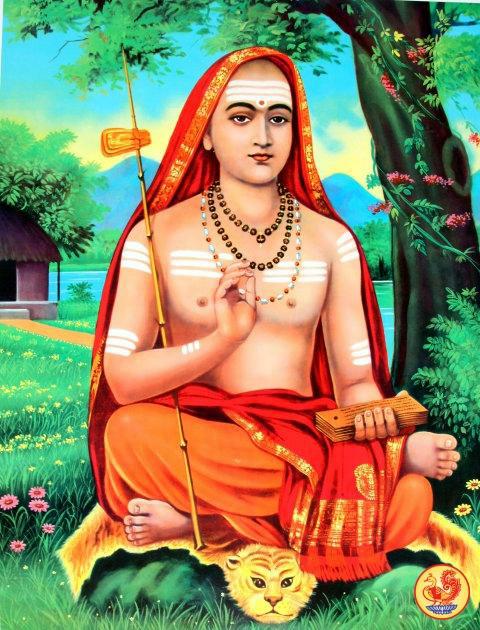
The Nirvāṇa Ṣaṭkam (also known as Ātma Ṣaṭkam) is a six-verse composition by Ādi Śaṅkarācārya (788-820 CE) that distils the entire philosophy of Advaita Vedānta into a single, luminous declaration: “I am not the mind, nor the intellect, nor the ego — I am Consciousness-Bliss; I am Śiva, I am Śiva.” Through the method of systematic negation (neti neti), Śaṅkara strips away every layer of false identification until only the pure, unconditioned Self remains.
The Immortal Refrain
Each of the six verses ends with the same thunderous declaration:
चिदानन्दरूपः शिवोऽहं शिवोऽहम्
IAST: Cidānanda-rūpaḥ Śivo’haṃ Śivo’ham
Translation: “I am of the nature of Consciousness-Bliss; I am Śiva, I am Śiva.”
Here, “Śiva” does not refer to the sectarian deity of Śaivism but to the ultimate auspicious reality — from the root śī (auspiciousness). The word cidānanda compounds cit (pure consciousness) and ānanda (bliss), the two defining attributes of Brahman as described in the Taittirīya Upaniṣad (2.1): “Satyaṃ jñānam anantaṃ brahma” — Brahman is truth, knowledge, and infinity.
The Context of Composition
Traditional hagiographies, particularly the Śaṅkara Digvijaya of Mādhava-Vidyāraṇya, narrate that the young Śaṅkara composed this hymn during his journey to find a guru. When he arrived at the cave of Svāmī Govindapāda on the banks of the Narmadā River, the master asked: “Who are you?” (Ko’si?). Instead of giving his name, lineage, or caste, the eight-year-old Śaṅkara responded with these six verses — a spontaneous expression of Self-knowledge that so impressed Govindapāda that he immediately accepted the boy as his disciple.
Whether historically accurate or not, this narrative perfectly frames the Nirvāṇa Ṣaṭkam’s philosophical purpose: it is an answer to the most fundamental question of human existence — “Who am I?” (Ko’ham?) — and the answer transcends all conventional categories of identity.
Verse-by-Verse Analysis
Verse 1: Negation of the Inner Instruments
मनोबुद्ध्यहङ्कार चित्तानि नाहं न च श्रोत्रजिह्वे न च घ्राणनेत्रे। न च व्योम भूमिर्न तेजो न वायुः चिदानन्दरूपः शिवोऽहं शिवोऽहम्॥
“I am not the mind, nor the intellect, nor the ego, nor the memory-substance (citta). I am not the ears, nor the tongue, nor the nose, nor the eyes. I am not space, nor earth, nor fire, nor air. I am of the nature of Consciousness-Bliss; I am Śiva, I am Śiva.”
This opening verse negates the antaḥkaraṇa (inner instrument) — the four-fold psychological apparatus of manas (mind), buddhi (intellect), ahaṅkāra (ego-sense), and citta (memory/subconscious). It also negates the jñānendriyas (organs of perception: hearing, taste, smell, sight) and the pañca mahābhūtas (five great elements: space, earth, fire, air — with water implied). By negating these, Śaṅkara declares that the Self is neither the psychological personality nor the physical universe.
Verse 2: Negation of Vital Functions
न च प्राणसंज्ञो न वै पञ्चवायुः न वा सप्तधातुर्न वा पञ्चकोशः। न वाक्पाणिपादं न चोपस्थपायु चिदानन्दरूपः शिवोऽहं शिवोऽहम्॥
“I am not the vital breath (prāṇa), nor the five vital airs. I am not the seven bodily constituents (dhātus), nor the five sheaths (kośas). I am not the organs of speech, hands, feet, nor the organs of reproduction and excretion. I am of the nature of Consciousness-Bliss; I am Śiva, I am Śiva.”
This verse targets the prāṇamaya and annamaya dimensions of existence. The pañca vāyu (five vital airs: prāṇa, apāna, vyāna, udāna, samāna), the sapta dhātu (seven bodily tissues in Āyurveda: plasma, blood, muscle, fat, bone, marrow, reproductive fluid), and the pañca kośa (five sheaths taught in the Taittirīya Upaniṣad 2.2-5: anna, prāṇa, mano, vijñāna, ānanda) are all negated. The karmendriyas (organs of action: speech, grasping, locomotion, reproduction, excretion) are also transcended.
Verse 3: Negation of Psychological States
न मे द्वेषरागौ न मे लोभमोहौ मदो नैव मे नैव मात्सर्यभावः। न धर्मो न चार्थो न कामो न मोक्षः चिदानन्दरूपः शिवोऽहं शिवोऽहम्॥
“I have neither aversion nor attachment, neither greed nor delusion. I have no pride, no jealousy. I have no dharma (duty), no artha (wealth), no kāma (desire), no mokṣa (liberation). I am of the nature of Consciousness-Bliss; I am Śiva, I am Śiva.”
This is perhaps the most radical verse. Śaṅkara negates not only the ṣaḍ ripus (six enemies: desire, anger, greed, delusion, pride, jealousy) but also the puruṣārthas — the four goals of human life (dharma, artha, kāma, mokṣa) that form the very foundation of Hindu ethical life. The stunning implication is that even the desire for liberation is a limitation imposed on the Self by the mind. The Ātman is already liberated; it does not need to “attain” mokṣa because it was never bound.
This echoes Śaṅkara’s teaching in the Vivekacūḍāmaṇi (verse 574): “There is neither birth nor death, neither a bound nor a struggling soul, neither a seeker nor one liberated — this is the ultimate truth.”
Verse 4: Negation of Virtue and Sin
न पुण्यं न पापं न सौख्यं न दुःखं न मन्त्रो न तीर्थं न वेदा न यज्ञाः। अहं भोजनं नैव भोज्यं न भोक्ता चिदानन्दरूपः शिवोऽहं शिवोऽहम्॥
“I have no virtue (puṇya) nor sin (pāpa), no pleasure nor sorrow. I have no mantra, no pilgrimage, no Vedas, no rituals. I am neither the act of enjoying, nor the object enjoyed, nor the enjoyer. I am of the nature of Consciousness-Bliss; I am Śiva, I am Śiva.”
Here Śaṅkara transcends the entire framework of Vedic religion — mantras, tīrthas, Vedas, and yajñas — from the standpoint of the absolute Self. This is not a rejection of religious practice but a recognition that from the paramārthika (ultimate) perspective, the Ātman is beyond all duality, including the duality of sacred and profane. The triad of bhokta (experiencer), bhojya (experienced), and bhojana (experience) — which constitutes the entirety of saṃsāric existence — is negated in one stroke.
Verse 5: Negation of Death and Social Identity
न मे मृत्युशङ्का न मे जातिभेदः पिता नैव मे नैव माता न जन्मः। न बन्धुर्न मित्रं गुरुर्नैव शिष्यं चिदानन्दरूपः शिवोऽहं शिवोऽहम्॥
“I have no fear of death, no distinction of caste. I have no father, no mother, no birth. I have no kinsman, no friend, no guru, no disciple. I am of the nature of Consciousness-Bliss; I am Śiva, I am Śiva.”
This verse dismantles every social and biological identity. The Self has no jāti (caste/birth), no family relationships, and — most remarkably for a teaching attributed to a guru — no guru-disciple relationship. Even the sacred bond of teacher and student belongs to the world of names and forms, not to the unconditioned Ātman. The negation of mṛtyu-śaṅkā (fear of death) is especially powerful: since the Self was never born, it cannot die.
This mirrors the Kaṭha Upaniṣad (1.2.18): “The Self is not born, nor does it die. It did not come into being and will not come into being. Unborn, eternal, everlasting, ancient — it is not slain when the body is slain.”
Verse 6: Negation of All Modification
अहं निर्विकल्पो निराकाररूपो विभुत्वाच्च सर्वत्र सर्वेन्द्रियाणाम्। न चासङ्गतं नैव मुक्तिर्न मेयः चिदानन्दरूपः शिवोऽहं शिवोऽहम्॥
“I am without modification (nirvikalpa), without form (nirākāra). I am all-pervading (vibhu), present everywhere through all the senses yet beyond them. I have neither attachment nor liberation, nor any measure. I am of the nature of Consciousness-Bliss; I am Śiva, I am Śiva.”
The final verse positively describes the Self: it is nirvikalpa (free from all mental constructs), nirākāra (formless), and vibhu (all-pervading). The Self pervades all sense experience — it is the very awareness in which seeing, hearing, and thinking occur — yet it is not any particular sensation or thought. Even liberation (mukti) and bondage (saṅga) are negated as categories applicable only to the apparent individual, not to the infinite Self.
The Neti Neti Method
The philosophical engine of the Nirvāṇa Ṣaṭkam is the ancient Upaniṣadic method of neti neti (“not this, not this”). This method of negation originates in the Bṛhadāraṇyaka Upaniṣad (2.3.6), where the sage Yājñavalkya describes Brahman by negating everything that Brahman is not: “Now therefore the description of Brahman: ‘Not this, not this’ (neti neti). For there is no other and more appropriate description than this ‘not this.’”
Śaṅkara systematises this method across six verses, negating in sequence:
- The mind, senses, and elements
- The vital forces, body, and sheaths
- Emotional states and life goals
- Religious practices and experiential categories
- Social identities and relationships
- All forms and modifications
What remains after this comprehensive negation is not nothing — it is Sat-Cit-Ānanda (Being-Consciousness-Bliss), the irreducible reality that cannot be negated because it is the very ground of all negation.
The Advaita Philosophy Expressed
The Nirvāṇa Ṣaṭkam is a perfect poetic expression of Śaṅkara’s three-fold Advaita teaching:
- Brahma satyam — Brahman alone is real
- Jagan mithyā — The world is apparent, not ultimately real
- Jīvo brahmaiva nāparaḥ — The individual self is none other than Brahman
By negating everything that the ego identifies with — body, mind, emotions, social roles, religious identity — Śaṅkara reveals that what we truly are has always been the unlimited, unconditioned, ever-free Consciousness. The apparent bondage of the individual soul is itself an illusion (māyā), and the “attainment” of liberation is simply the recognition of what has always been the case.
The Living Legacy
The Nirvāṇa Ṣaṭkam continues to be one of the most widely chanted and studied compositions in the Hindu contemplative tradition. It is regularly recited in the maṭhas (monasteries) established by Śaṅkara — at Śṛṅgerī, Dvārakā, Purī, and Jyotirmaṭh — as well as in Advaita study circles worldwide. Modern teachers such as Svāmī Vivekānanda, Svāmī Chinmayānanda, and Svāmī Dayānanda Sarasvatī have popularised its study, making it one of the most accessible entry points into Advaita Vedānta.
The hymn’s genius lies in its simplicity: six verses, a single method (negation), and one conclusion — Cidānanda Rūpaḥ Śivo’haṃ Śivo’ham. In that refrain echoes the voice of every Upaniṣad, every sage, and every seeker who has ever dared to ask the question “Who am I?” and found, at the end of all searching, the infinite silence of the Self.