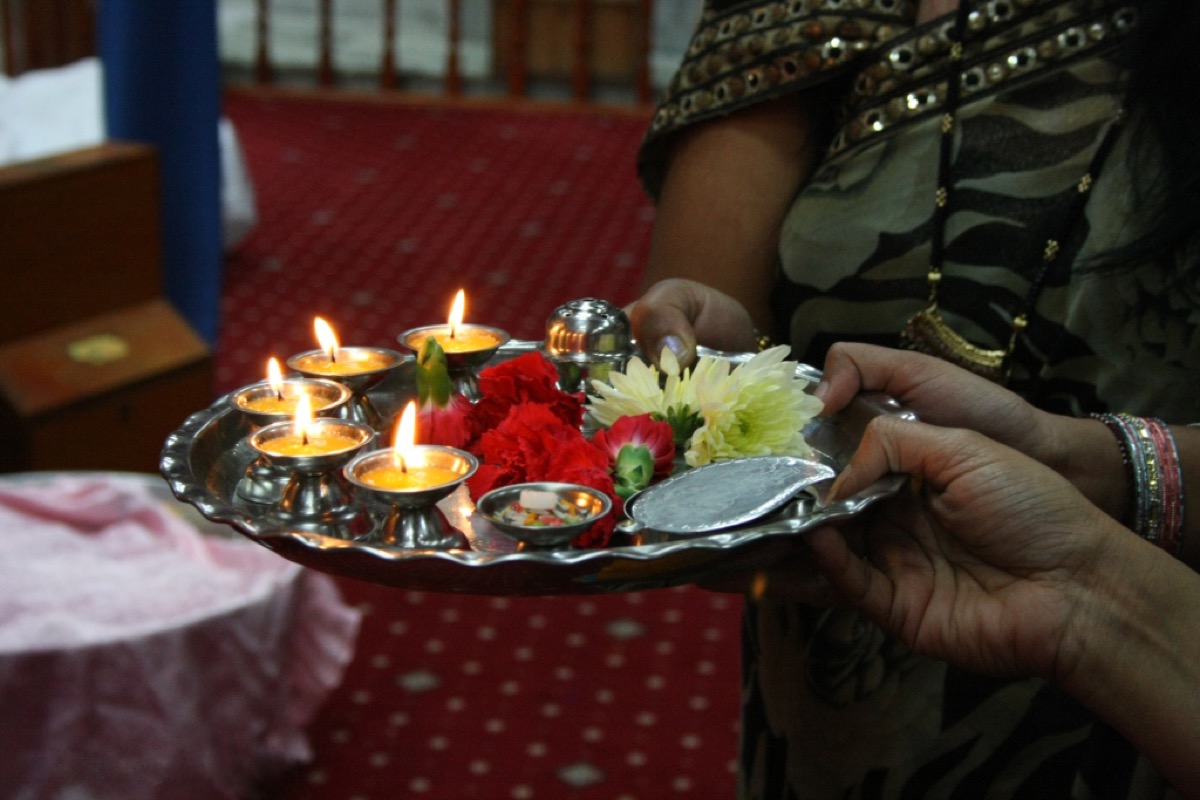
Om Jai Jagdīsh Hare (ॐ जय जगदीश हरे, “Glory to the Lord of the Universe”) is arguably the most universally recognized devotional hymn in all of Hinduism. Sung every evening in millions of homes and thousands of temples across India and the global Hindu diaspora, this ārtī transcends sectarian boundaries: Vaiṣṇavas, Śaivas, Śāktas, and followers of every sampradāya join their voices in this prayer. Composed by Paṇḍit Shraddhā Rām Phillaurī in the 1870s in the Punjab region, and later immortalized in Indian cinema, it has earned the title of “national ārtī” — the one prayer that every Hindu knows by heart, regardless of region, caste, or theological affiliation.
The hymn addresses God not by a sectarian name but as Jagadīsha (“Lord of the World”) and Hari (“the Remover [of suffering]”), inviting worshippers of every tradition to see their own chosen deity in its verses. This universality is precisely what has made it the default closing prayer for Hindu worship across the globe.
The Ārtī Tradition in Hindu Worship
What Is Ārtī?
Ārtī (also spelled āratī or āratrikā) derives from the Sanskrit ā-rātrika, meaning “that which removes darkness (rātri).” It is one of the sixteen prescribed acts of worship (ṣoḍaśa upacāra) in Hindu pūjā. In its essential form, ārtī involves the circular waving of a lighted lamp — traditionally fuelled by ghee (clarified butter) or camphor (karpūra) — before the deity’s image (mūrti), accompanied by devotional singing, the ringing of bells (ghaṇṭā), and the blowing of the conch shell (śaṅkha).
The practice descends from the Vedic fire rituals (yajña), though the elaborate congregational form as practised today crystallized during the medieval Bhakti movement (6th-17th centuries CE). The Vedic concept of offering agni (fire) to the divine was transformed into a more intimate, participatory act of devotion.
The Five Daily Ārtīs
In traditional temple worship, five ārtīs punctuate the day:
- Maṅgala Ārtī — performed at dawn, awakening the deity
- Śṛṅgāra Ārtī — in the early morning, after the deity is adorned
- Rājabhoga Ārtī — at midday, accompanying the noon offering
- Sandhyā Ārtī — at dusk, the most widely attended ārtī of the day
- Śayana Ārtī — at night, as the deity retires to rest
Om Jai Jagdīsh Hare is most commonly associated with the Sandhyā Ārtī — the evening prayer performed at sunset — though it is equally sung during morning worship, Satyānārāyaṇa Kathā, and virtually any Hindu religious occasion.
Symbolism of the Ārtī Ritual
The ārtī ritual carries multiple layers of meaning:
- Illumination: The lamp reveals the deity’s form to worshippers in the dim temple sanctum
- Offering of light: Fire, the purest of the five elements (pañca-bhūta), symbolizes the devotee’s surrender of the ego
- Communal worship: Ārtī is the most participatory element of temple service, with the entire congregation singing together
- Receiving blessings: After the ārtī, devotees pass their hands over the flame and touch them to their foreheads, receiving the sanctified light (divya jyoti)
The pañcārtī — the five-wick lamp representing the five elements (earth, water, fire, air, ether) — is waved in clockwise circles before the deity, typically three, five, or seven times.
The Composer: Paṇḍit Shraddhā Rām Phillaurī
Life and Legacy (1837-1881)
Paṇḍit Shraddhā Rām Phillaurī (September 1837 - 24 June 1881) was born into a Brahmin family in Phillaur, a town in the Jalandhar district of Punjab. A polymath of extraordinary range, he mastered Sanskrit, Persian, Urdu, English, astrology, music, and the Gurmukhī script, producing significant works in both Hindi and Punjabi literature.
Phillaurī was far more than a poet. At the age of nineteen, during the Indian Rebellion of 1857, he began publicly preaching the Mahābhārata as a means of instilling civilizational pride in Indians and encouraging resistance against British colonial rule. The British government, alarmed by his influence, expelled him from his native village around 1865.
Social Reform and Religious Mission
After returning from exile, Phillaurī devoted himself to preaching Vaiṣṇava Hinduism and social reform. He established satras (institutional centres of the Ekasaraṇa Vaiṣṇava tradition) and opened the Hari Gyān Mandir in Lahore in 1880 — an institution that taught the Vedas, provided social services for widows, and opposed child marriage. He was simultaneously a Sanātanī missionary, a social reformer, and a literary pioneer who played a pivotal role in the renaissance of the Hindi language.
His literary legacy includes Bhāgyavatī (1877), considered one of the first novels in Hindi literature. But it is his composition of Om Jai Jagdīsh Hare that has granted him immortality in the hearts of Hindu families worldwide.
Composition of the Ārtī (c. 1870)
The exact circumstances of the composition remain a matter of scholarly discussion. According to widely accepted tradition, Phillaurī composed Om Jai Jagdīsh Hare around 1870, during or shortly after his period of exile from Phillaur. Some accounts suggest he created the ārtī to attract and hold people’s attention during his religious lectures (kathā pravachana), composing it as a simple, melodic prayer suitable for both household devotion and temple ritual.
Crucially, Phillaurī did not compose the key phrase entirely from original inspiration. The words “jaya jagadīsha hare” (जय जगदीश हरे) appear in the Gīta Govinda of Bhakta Kavi Jayadeva Gosvāmī, the celebrated 12th-century Sanskrit poet of Bengal. Phillaurī took these three words from Jayadeva’s masterwork and expanded them into a complete, multi-verse ārtī in accessible Hindi — a creative act that bridged medieval Sanskrit devotional poetry with the language of the common people.
Text and Verse-by-Verse Meaning
The ārtī consists of a refrain (dhruva-pada) and eight verses (pada), each followed by the refrain. The language is a blend of Khaṛī Bolī Hindi with devotional vocabulary drawn from Sanskrit and Braj Bhāṣā.
Refrain (Dhruva-pada)
ॐ जय जगदीश हरे, स्वामी जय जगदीश हरे। भक्त जनों के संकट, दास जनों के संकट, क्षण में दूर करे॥
Om, glory to the Lord of the Universe! O Svāmī, glory to the Lord of the Universe! The troubles of Your devotees, the troubles of Your servants — You remove in an instant.
The refrain establishes the hymn’s theological foundation: God as Jagadīsha (Lord of the entire world, not of one sect alone) and Hari (He who removes suffering). The promise that He dispels His devotees’ saṅkaṭa (afflictions) “in an instant” (kṣaṇa meṃ) echoes the Bhagavad Gītā’s assurance: kṣipraṃ bhavati dharmātmā (“quickly he becomes righteous,” BG 9.31).
Verse 1: The Fruit of Meditation
जो ध्यावे फल पावे, दुख बिनसे मन का। सुख-सम्पत्ति घर आवे, कष्ट मिटे तन का॥
Those who meditate upon You receive the fruit; the sorrows of the mind are destroyed. Happiness and prosperity come to the home; the sufferings of the body vanish.
This verse promises both material and spiritual rewards for devotion, a theme deeply rooted in the Bhakti tradition’s accessibility to householders.
Verse 2: Surrender and Refuge
मात-पिता तुम मेरे, शरण गहूँ मैं किसकी। तुम बिन और न दूजा, आस करूँ मैं जिसकी॥
You are my Mother and Father — in whom else shall I seek refuge? Besides You there is none other in whom I place my hope.
This verse echoes the famous tvameva mātā ca pitā tvameva prayer, declaring God as the devotee’s sole parent and protector. The intensity of surrender here mirrors the śaraṇāgati theology central to both Vaiṣṇava and Śaiva traditions.
Verse 3: The Supreme Being
तुम पूरण परमात्मा, तुम अंतर्यामी। पारब्रह्म परमेश्वर, तुम सब के स्वामी॥
You are the complete Supreme Soul, You are the Inner Dweller. You are Parabrahman, the Supreme Lord, the Master of all.
Here the theology reaches its peak: God is identified simultaneously as Pūrṇa Paramātmā (the complete Supreme Self), Antaryāmī (the indwelling witness of all hearts, as described in the Bṛhadāraṇyaka Upaniṣad 3.7), Parabrahman (the Absolute of Vedānta), and Parameśvara (the Supreme Lord of theistic traditions). This verse deliberately encompasses the entire spectrum of Hindu theology — Advaita, Viśiṣṭādvaita, and Dvaita alike.
Verse 4: The Ocean of Compassion
तुम करुणा के सागर, तुम पालनकर्ता। मैं मूरख खल कामी, कृपा करो भर्ता॥
You are the Ocean of Compassion, You are the Sustainer. I am foolish, wicked, and lustful — bestow Your grace, O Lord.
The contrast between the divine attributes and human frailty is a hallmark of Bhakti poetry. The devotee’s self-abasement (mūrkha, khala, kāmī) mirrors the humility expressed in the Śrī Vaiṣṇava ālvār hymns and in Tulsīdās’s Vinaya Patrikā.
Verse 5: Darkness and Ignorance
तुम हो एक अगोचर, सबके प्राणपति। किस विधि मिलूँ दयामय, तुमको मैं कुमति॥
You are the One Imperceptible, the Lord of all life-breath. How shall I, of dull intellect, meet You, O Merciful One?
This verse explores the devotional paradox: the desire to experience a God who is agochara (imperceptible to the senses). The term prāṇapati (“Lord of the vital breath”) connects to the Prāṇa-vidyā of the Upaniṣads (Praśna Upaniṣad 2.1-13).
Verse 6: The Removal of Sin
दीनबन्धु दुखहर्ता, ठाकुर तुम मेरे। अपने हाथ उठाओ, अपनी शरण लगाओ॥
O Friend of the lowly, Remover of suffering — You are my Lord. Raise Your hands [in blessing], take me into Your refuge.
The epithet Dīnabandhu (“Friend of the lowly”) is a beloved title of Viṣṇu emphasizing God’s special concern for the destitute and downtrodden — a theological emphasis that made the Bhakti movement revolutionary in its social implications.
Verse 7: Desire for Devotion
विषय विकार मिटाओ, पाप हरो देवा। श्रद्धा भक्ति बढ़ाओ, संतन की सेवा॥
Remove worldly desires and vices, take away my sins, O God. Increase my faith and devotion, and [grant me] service to the saints.
The verse moves from negative prayer (removing viṣaya vikāra — worldly passions) to positive aspiration: śraddhā (faith), bhakti (devotion), and santana kī sevā (service to holy persons). The last phrase reflects the Bhakti tradition’s emphasis on satsaṅga — the company of saints as essential to spiritual progress.
Verse 8: The Closing Prayer
ॐ जय जगदीश हरे, स्वामी जय जगदीश हरे।
The ārtī closes as it opened, completing the devotional circle. The final repetition of the refrain brings the congregation together one last time before the lamp is offered to all present.
Musical Structure and Rāga
Om Jai Jagdīsh Hare follows a melodic framework rooted in the Hindustānī classical tradition. Musicologists have variously analysed its rāga basis:
- Rāga Desh: The most commonly cited rāga association. Rāga Desh is an evening rāga (sandhyā-kālīna) in the Khamāj thāṭa, which makes it ideally suited for the sandhyā ārtī — the evening prayer time when the hymn is most often performed.
- Rāga Chāyanat and Śuddha Kalyāṇ: Some musicological analyses identify elements of these rāgas, particularly in certain regional renditions.
The melody is structured in a simple, repetitive pattern that encourages congregational participation. Unlike classical compositions that demand trained voices, the ārtī’s melodic range is deliberately limited, making it accessible to every devotee regardless of musical training. The tāla (rhythmic cycle) is typically Dādra (6 beats) or Keharwa (8 beats), both common in devotional music.
The musical simplicity is itself a theological statement: the ārtī belongs to everyone, not to trained musicians alone. This democratic quality of the melody mirrors the Bhakti movement’s insistence that God is accessible to all, regardless of learning or social position.
Popularization Through Cinema
Purab Aur Paschim (1970)
While Om Jai Jagdīsh Hare had been widely known in North Indian households since the late 19th century, its transformation into a pan-Indian “national ārtī” owes much to the Hindi film Purab Aur Paschim (“East and West,” 1970), directed by and starring Manoj Kumar. In this patriotic drama about the clash between Indian and Western values, the ārtī is performed in a climactic temple scene, sung by Mahendra Kapoor, Brij Bhushan Kabra, and Shyamā Chittar, with music composed by Kalyāṇjī-Ānandjī.
The film’s enormous commercial success carried the ārtī into every corner of India — including South India, the Northeast, and regions where it had previously been less familiar. Scholars have described this as a case of Bollywood cinema functioning as a vehicle of religious standardization: what had been a primarily North Indian devotional composition became, through the medium of popular cinema, a truly national prayer.
The cultural historian has noted that by the late 1980s, Om Jai Jagdīsh Hare was increasingly associated with younger, educated urban Hindus whose understanding of religious ritual had been shaped more by Hindi cinema than by local temple traditions. Rather than diminishing the ārtī’s sanctity, this cinematic popularization paradoxically strengthened its status as a universal Hindu prayer.
Other Film and Media Appearances
The ārtī has appeared in numerous subsequent Hindi films and television serials, invariably in scenes depicting Hindu religious observance. Its presence in popular media has made it one of the most recorded devotional compositions in Indian music history, with versions by virtually every major devotional singer in Hindi.
The Universal Ārtī: Theological Inclusiveness
What makes Om Jai Jagdīsh Hare unique among Hindu devotional compositions is its deliberate theological universality. Unlike most ārtīs, which are addressed to specific deities — Ārtī Kuñjabihārī Kī to Kṛṣṇa, Om Jai Śiv Oṅkārā to Śiva, Jai Ambē Gaurī to the Devī — this hymn uses names and attributes that transcend sectarian boundaries:
- Jagadīsha (“Lord of the World”) — applicable to Viṣṇu, Śiva, or the formless Brahman
- Hari (“Remover”) — while traditionally a Vaiṣṇava epithet, widely understood as a universal divine name
- Parabrahman — the Absolute of Vedānta, beyond all form
- Antaryāmī — the Inner Controller, recognized in all schools of Hindu philosophy
- Dīnabandhu — “Friend of the lowly,” an epithet transcending sectarian lines
This universality was almost certainly intentional on Phillaurī’s part. As a Vaiṣṇava preacher addressing mixed audiences across Punjab, he needed a prayer that every Hindu could sing without theological discomfort. The result is a composition that functions as a theological “common ground” — a rarity in Hindu devotional literature, which tends toward the specific and particular.
Om Jai Jagdīsh Hare vs. Deity-Specific Ārtīs
Hindu worship employs both universal and deity-specific ārtīs. A comparison illuminates the special character of Om Jai Jagdīsh Hare:
| Feature | Om Jai Jagdīsh Hare | Deity-Specific Ārtīs |
|---|---|---|
| Addressee | Universal God (Jagadīsha) | Specific deity (Kṛṣṇa, Śiva, Devī) |
| Language | Khaṛī Bolī Hindi | Braj Bhāṣā, Sanskrit, regional languages |
| Theology | Inclusive, pan-Hindu | Sect-specific |
| Usage | Any occasion, any deity | Specific deity’s worship |
| Origin | 19th-century composition | Often medieval or ancient |
| Popularization | Cinema, mass media | Temple tradition, oral transmission |
In practice, Hindu worship often combines both: a deity-specific ārtī is sung first (e.g., Ārtī Kuñjabihārī Kī in a Kṛṣṇa temple), followed by Om Jai Jagdīsh Hare as the closing universal prayer.
Role in Home Worship and Temple Ceremonies
Domestic Worship (Gṛha-Pūjā)
In millions of Hindu households, Om Jai Jagdīsh Hare is performed during the evening sandhyā pūjā before the family altar (ghar-mandira). The ritual typically proceeds as follows:
- Preparation: The lamp (dīpaka) is lit with ghee or oil; incense (agarbattī) is ignited
- Invocation: The family gathers before the household shrine
- Ārtī: One family member waves the lamp in clockwise circles while all sing Om Jai Jagdīsh Hare
- Distribution of light: The flame is offered to each family member, who passes their hands over it and touches their foreheads
- Prasāda: Sacred offerings are distributed
The ārtī serves as the anchor of daily household devotion. Many Hindus who may not perform elaborate pūjā rituals still sing this ārtī every evening — it represents the irreducible minimum of daily worship.
Temple Ceremonies
In temple settings, Om Jai Jagdīsh Hare is typically performed during the sandhyā ārtī (evening ārtī). The ritual is more elaborate than its domestic counterpart:
- A pañcārtī (five-wick lamp) or elaborate multi-tiered lamp is used
- The temple priest (pujārī) performs the ārtī before the main deity
- The congregation stands and sings, accompanied by bells, drums, and cymbals
- At major temples, the ārtī may involve multiple priests and elaborate choreography
The hymn is also the standard closing prayer for Satyānārāyaṇa Kathā (the recitation of the Satyānārāyaṇa Vrata story), one of the most commonly performed domestic religious ceremonies in Hindu households.
Legacy and Cultural Significance
Om Jai Jagdīsh Hare occupies a unique position in Hindu devotional culture. It is simultaneously:
- A 19th-century composition that feels ancient — most devotees are unaware of its relatively recent origins
- A North Indian hymn that has become pan-Indian through cinema and mass media
- A Vaiṣṇava prayer that is sung in Śiva temples, Devī temples, and before formless representations of the divine
- A simple congregational hymn that carries profound theological content spanning Vedānta, Bhakti, and theistic philosophy
Paṇḍit Shraddhā Rām Phillaurī, who died in 1881 at the age of 43, could not have imagined that his composition — born of the creative expansion of three words from Jayadeva’s 12th-century Gīta Govinda — would become the single most widely sung prayer in the Hindu world. His ārtī has crossed every boundary of region, language, caste, and sect to become what no other Hindu devotional composition has fully achieved: a universal prayer for all Hindus.
In homes from Varanasi to Vancouver, from Chennai to Colombo, from Kathmandu to Kuala Lumpur, the evening lamp is lit and the ancient words ring out: Om jaya jagadīsha hare — “Glory to the Lord of the Universe.” In that moment, the entire Hindu world is united in a single prayer.