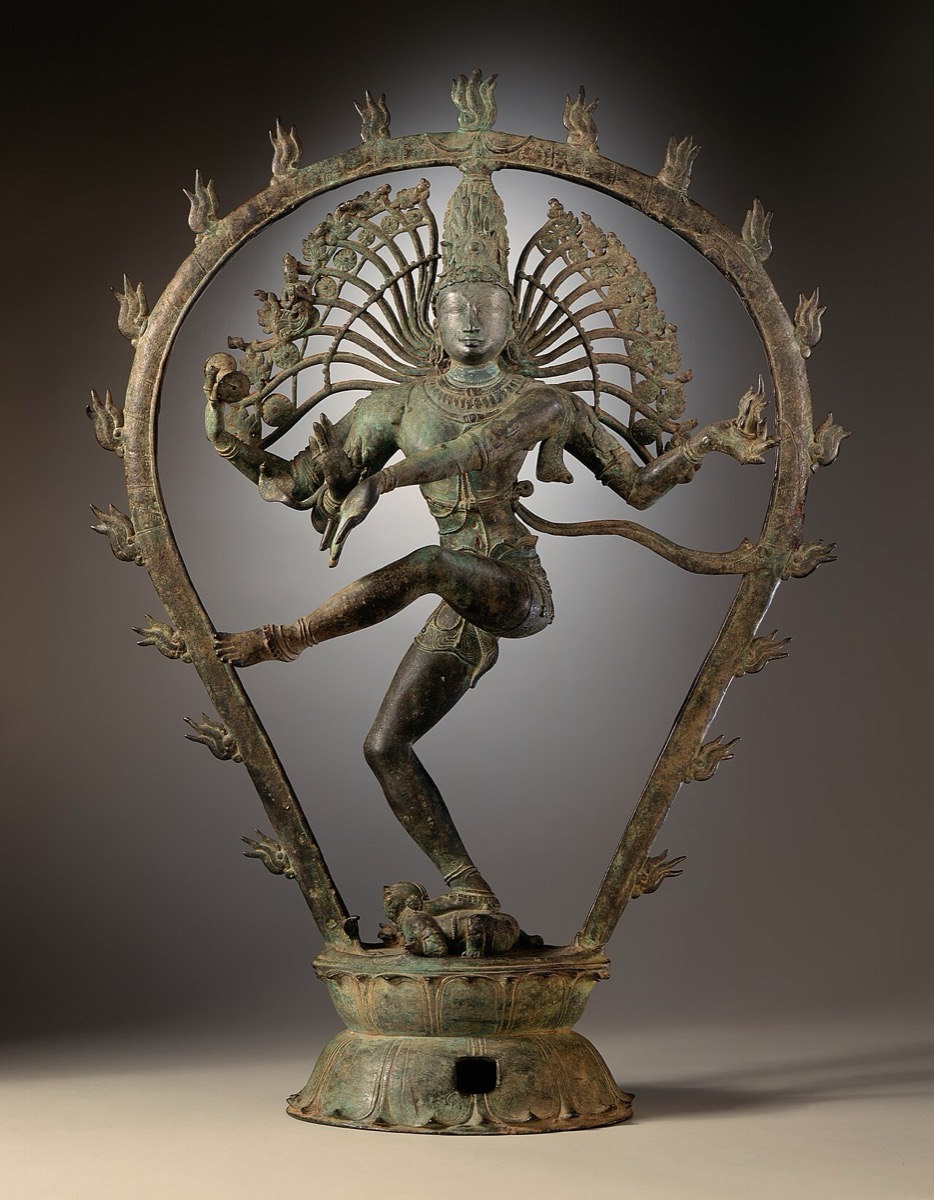
Oṃ Namaḥ Śivāya (ॐ नमः शिवाय) is the most sacred mantra in Śaivism and one of the most widely chanted mantras in all of Hinduism. Known as the Pañcākṣarī (पञ्चाक्षरी) — the “Five-Syllable” mantra — it consists of the five sacred syllables Na-Maḥ-Śi-Vā-Ya, preceded by the primordial Praṇava (Oṃ). This deceptively simple utterance encapsulates the entirety of Śaiva theology, cosmology, and soteriology. For countless millions of devotees across millennia, these five syllables have served as the supreme path to liberation — the direct invocation of Lord Śiva as the Absolute Reality.
The Complete Mantra
ॐ नमः शिवाय
IAST Transliteration: Oṃ Namaḥ Śivāya
Translation: “Oṃ — I bow to Śiva” or “Oṃ — salutations to the Auspicious One”
The word namaḥ (नमः) means “salutation, obeisance, I bow.” The word Śiva (शिव) means “the Auspicious One, the Benevolent, the Pure.” Together, “Namaḥ Śivāya” is a complete act of self-surrender — the individual soul (jīva) offering itself entirely to the Supreme Lord (Paramaśiva).
Origin in the Vedas: Śrī Rudram
The Pañcākṣarī Mantra has its root in the Śrī Rudram (also called the Rudra Praśna or Namakam), found in the Kṛṣṇa Yajurveda (Taittirīya Saṁhitā 4.5). The Śrī Rudram is the oldest and most elaborate Vedic hymn dedicated to Rudra-Śiva, consisting of eleven anuvākas (sections) that systematically praise Rudra in all His forms — as the terrifying destroyer, the gentle healer, the lord of animals, the cosmic archer, and the dweller in all beings.
In the eighth anuvāka (Taittirīya Saṁhitā 4.5.8), the phrase “namaḥ śivāya ca śivatarāya ca” appears: “Salutations to the One who is Auspicious (Śiva) and to the One who is most Auspicious (Śivatara).” This is the Vedic seed from which the Pañcākṣarī Mantra blossoms. The Rudram does not present “namaḥ śivāya” as an isolated mantra but weaves it into a vast litany of 300+ “namaḥ” salutations, each addressing a different aspect of Rudra. It is the later Āgamic and Purāṇic traditions that crystallized these two words into the supreme five-syllable mantra.
The Śatapatha Brāhmaṇa further associates the name “Śiva” with Rudra’s pacified, benevolent aspect — distinguishing it from His fierce (ghora) forms. When a devotee says “Namaḥ Śivāya,” they are invoking Rudra in His most gracious, liberating mode.
The Five Syllables: Esoteric Meaning
The five syllables Na-Ma-Śi-Vā-Ya are not arbitrary sounds but are understood in the Śaiva tradition as cosmic principles. Each syllable corresponds to one of the Pañcabhūtas (five elements), one of the Pañcakṛtya (five cosmic actions of Śiva), and one of the five aspects of the body and spirit.
The Five Elements (Pañcabhūta)
| Syllable | Element | Meaning |
|---|---|---|
| Na | Pṛthivī (Earth) | Solidity, the ground of existence |
| Ma | Āpas (Water) | Fluidity, the flow of life |
| Śi | Agni (Fire) | Transformation, the light of consciousness |
| Vā | Vāyu (Air) | Breath, the vital force |
| Ya | Ākāśa (Space/Ether) | Infinity, the all-pervading |
The Five Cosmic Actions (Pañcakṛtya)
The Śiva Purāṇa (Vidyeśvara Saṁhitā) and the Śaiva Āgamas associate each syllable with one of the five divine functions through which Śiva governs the universe:
| Syllable | Cosmic Action | Deity Form |
|---|---|---|
| Na | Tirobhāva (Concealment) | Śiva veils the true nature of the Self |
| Ma | Mala/Āṇava (The impurity of individuality) | The bondage of the soul |
| Śi | Anugraha (Grace/Liberation) | Śiva bestows saving grace |
| Vā | Sthiti (Preservation) | The sustaining power |
| Ya | Sṛṣṭi (Creation) | The emanation of the universe |
In this reading, the mantra enacts a spiritual journey: the soul begins in concealment (Na) and bondage (Ma), receives the grace of Śiva (Śi), is sustained in that grace (Vā), and is ultimately reborn into divine awareness (Ya). The five syllables thus compress the entire path from ignorance to liberation into a single utterance.
The Three Realities (Tattvatraya)
In Śaiva Siddhānta philosophy, the five syllables are also mapped onto the three fundamental categories of reality:
- Na-Ma = Paśu (the bound soul, the individual self caught in limitation)
- Śi-Vā = Pati (the Lord, Paramaśiva, the Supreme Master)
- Ya = Pāśa (the bond, the fetters of āṇava, karma, and māyā)
The sequence of the mantra is thus understood as the soul (Na-Ma) turning toward the Lord (Śi-Vā), with the final syllable (Ya) representing the dissolution of bondage. When chanted with understanding, the mantra enacts the severing of the three fetters and the union of the soul with Śiva.
Tirumūlar and the Tirumantiram
The Tamil Śaiva saint Tirumūlar (traditionally dated to the pre-Common Era, though scholars place him between the 5th and 8th centuries CE) devoted extensive verses of his masterwork, the Tirumantiram (திருமந்திரம்), to expounding the Pañcākṣara. The Tirumantiram is the foundational text of Śaiva Siddhānta in the Tamil tradition, and its treatment of the five-syllable mantra is unparalleled in devotional literature.
Tirumūlar declares in the Tirumantiram (verse 941):
“The Pañcākṣara is the seed of all the Āgamas. The Pañcākṣara is the root of all mantras. The Pañcākṣara is the support of all the worlds. Those who know the Pañcākṣara attain the feet of Śiva.”
He further teaches that the five syllables are not merely sounds to be spoken but are living realities — each syllable is a gateway to a progressively deeper experience of the Divine. Tirumūlar distinguishes between the Sthūla Pañcākṣara (the gross or external form: “Na-Maḥ-Śi-Vā-Ya”) and the Sūkṣma Pañcākṣara (the subtle or internal form: “Śi-Vā-Ya-Na-Ma”), explaining that when the devotee matures, the syllables rearrange themselves — the name of the Lord (Śi-Vā) moves to the front, signifying the soul’s complete surrender and absorption into Śiva.
This reversal — from Namaḥ Śivāya to Śivāya Namaḥ — is not merely grammatical but ontological. It represents the shift from the devotee seeking God to God claiming the devotee.
Role in Śaiva Siddhānta
Śaiva Siddhānta, the predominant school of Śaiva philosophy in South India, places the Pañcākṣarī Mantra at the absolute centre of its theology and liturgy. The mantra functions at every level of religious life:
Dīkṣā (Initiation): The Pañcākṣara is the primary mantra conferred during Śaiva dīkṣā — the initiation into the Śaiva path. The guru transmits the mantra to the disciple, awakening the disciple’s dormant connection with Śiva. Without this initiation, the mantra remains merely a sequence of sounds; with it, the syllables become a living conduit of divine grace (śaktipāta).
Temple Worship: In Śaiva temples across India, particularly in Tamil Nadu, the Pañcākṣara is chanted during every major ritual: abhiṣeka (ritual bathing of the Liṅga), arcana (worship offering), and dīpārādhana (lamp ceremony). The Mṛgendrāgama (Kriyāpāda) prescribes the mantra as essential for the consecration of Śivaliṅgas and the sanctification of temple spaces.
Daily Worship: Devout Śaivas chant the Pañcākṣara as part of their daily worship (nitya pūjā), typically performing 108 repetitions using a rudrākṣa mālā at the three sandhyā (junction) times — dawn, noon, and dusk.
Methods of Chanting (Japa)
The Śaiva tradition prescribes several methods for the chanting of Oṃ Namaḥ Śivāya, each suited to different levels of spiritual development:
Vācika Japa (Spoken Aloud)
The mantra is chanted audibly. This is the most accessible form and is recommended for beginners. The sound vibrations purify the environment and the practitioner’s subtle body.
Upāṃśu Japa (Whispered)
The lips move but the sound is barely audible — only the practitioner can hear it. This is considered more powerful than spoken japa, as the mantra begins to internalize.
Mānasika Japa (Mental Recitation)
The mantra is repeated silently within the mind, without any movement of the lips. This is the highest form of japa, in which the mantra becomes one with the practitioner’s consciousness. The Liṅga Purāṇa declares that mental japa is a thousand times more efficacious than spoken japa.
Ajapā Japa (Spontaneous Repetition)
The ultimate stage, in which the mantra repeats itself ceaselessly within the practitioner without any conscious effort. The Śaiva yogins describe this as the state in which the mantra has “come alive” — it is no longer something the devotee does but something the devotee is. The breath itself becomes the mantra: “So” on the inhalation (Śiva) and “Ham” on the exhalation (aham, “I”) — “I am Śiva.”
Practical Guidelines
Traditional prescriptions for Pañcākṣarī japa include:
- Mālā: A 108-bead rudrākṣa mālā (rosary of Rudrākṣa seeds sacred to Śiva)
- Āsana: A seated posture, preferably padmāsana or siddhāsana, facing east or north
- Time: The brahma muhūrta (approximately 4:00-6:00 AM), pradoṣa kāla (twilight, sacred to Śiva), or the hours of Mahāśivarātrī
- Number: Minimum 108 repetitions per session; serious practitioners perform 1,008 or even 100,000 (one lakh) as a puraścaraṇa (intensive practice)
Stories of the Mantra’s Power
Sage Vasiṣṭha and the Liberation of Rāvaṇa
The Śiva Purāṇa relates that even the great Rāvaṇa, the demon-king of Laṅkā, was a fervent devotee of Lord Śiva. Despite his fearsome nature and his many transgressions, Rāvaṇa’s continuous chanting of the Pañcākṣarī Mantra is said to have earned him Śiva’s unwavering protection. When Rāvaṇa composed the Śiva Tāṇḍava Stotram (Hymn to Śiva’s Cosmic Dance), he prefaced it with the Pañcākṣara, acknowledging that all praise begins and ends with these five syllables.
The Salvation of the Hunter (Vyādha)
A well-known Purāṇic narrative tells of a hunter who, unknowingly, performed worship of Śiva on the night of Mahāśivarātrī. Perched on a bilva (wood-apple) tree above a Śivaliṅga, he plucked leaves that fell upon the liṅga below while repeating “Namaḥ Śivāya” — not from devotion but from cold and fear. Yet the power of the mantra was so great that even this inadvertent worship liberated the hunter from the cycle of birth and death. The story illustrates a cardinal principle of the Pañcākṣara: it works regardless of the chanter’s intention, for the mantra itself carries the grace of Śiva.
Nandanār and the Opening of the Temple
In the Tamil Śaiva tradition, the saint Nandanār — a devotee from a marginalized community — is celebrated for his unwavering faith in the Pañcākṣara. Barred from entering the temple at Chidambaram, Nandanār stood outside and chanted “Namaḥ Śivāya” ceaselessly. The Śiva Purāṇa tradition records that Lord Śiva Himself intervened, causing the sacred bull Nandi to move aside so that Nandanār could behold the dancing form of Naṭarāja. The story affirms that the mantra transcends all social barriers — whoever chants it with sincerity is Śiva’s own.
Comparison with Other Śiva Mantras
The Pañcākṣarī occupies a unique position among Śiva mantras:
Śrī Rudram (Namakam): The full Vedic hymn from which the Pañcākṣara is drawn. While the Rudram consists of over 300 salutations and requires trained Vedic chanting, the Pañcākṣara distills its essence into five accessible syllables.
Mahāmṛtyuñjaya Mantra: (“Oṃ Tryambakaṃ Yajāmahe…”) — Addressed to Tryambaka (the Three-Eyed Śiva), this mantra is primarily used for healing and protection from death. The Pañcākṣara, by contrast, is not limited to any specific purpose — it is the universal mantra of Śiva, encompassing all goals from worldly well-being to final liberation.
Śiva Gāyatrī: (“Oṃ Tatpuruṣāya Vidmahe Mahādevāya Dhīmahi | Tanno Rudraḥ Pracodayāt”) — A Gāyatrī-metre invocation of Śiva used in specific ritual contexts. The Pañcākṣara is more fundamental and more widely practised.
Oṃ Namaḥ Śivāya stands apart because it requires no ritual qualification, no Vedic initiation, and no elaborate preparation. It is available to all — men and women, young and old, initiated and uninitiated. This radical accessibility is one of the great gifts of the Śaiva tradition.
Philosophical Significance
The Pañcākṣarī Mantra embodies a complete philosophy in miniature:
The Praṇava (Oṃ) represents the Absolute — the undifferentiated, uncaused ground of all existence. It is Paramaśiva before creation, the silence from which all sound emerges.
Namaḥ represents the act of self-surrender — the dissolution of the ego (ahaṅkāra). The word “namaḥ” is traditionally derived from “na” (not) + “mama” (mine): “nothing is mine.” It is the foundational gesture of bhakti — the recognition that the individual self has no independent existence apart from Śiva.
Śivāya represents the goal and the refuge — Śiva Himself, the Auspicious One, the Supreme Consciousness in whom all beings find their origin, sustenance, and dissolution.
Thus, the mantra traces a complete arc: from the Absolute (Oṃ), through surrender (Namaḥ), to union with the Divine (Śivāya). It is simultaneously a prayer, a philosophy, and a practice — a single utterance that contains the whole of Śaiva spirituality.
The Living Tradition
Today, Oṃ Namaḥ Śivāya reverberates through every sphere of Hindu devotional life. It echoes in the sanctum of ancient temples at Chidambaram, Varanasi, Kedarnath, and Rameshwaram. It is the first mantra taught to children in Śaiva families, the last utterance whispered at the hour of death, and the constant companion of millions of practitioners in their daily japa.
From the snow-clad heights of Mount Kailāsa to the granite corridors of Thanjavur’s Bṛhadīśvara Temple, from the ghats of Kāśī to the vibhūti-streaked foreheads of wandering sādhus — the five syllables persist, unchanged and undying, carrying the grace of Śiva to every soul that turns to Him.
In the words of the great Tamil saint Māṇikkavācakar (Tiruvāsagam): “Even if I forget myself, I shall never forget those five sacred syllables.” This is the promise and the power of the Pañcākṣarī — the mantra that, once received, never leaves the heart.