Introduction
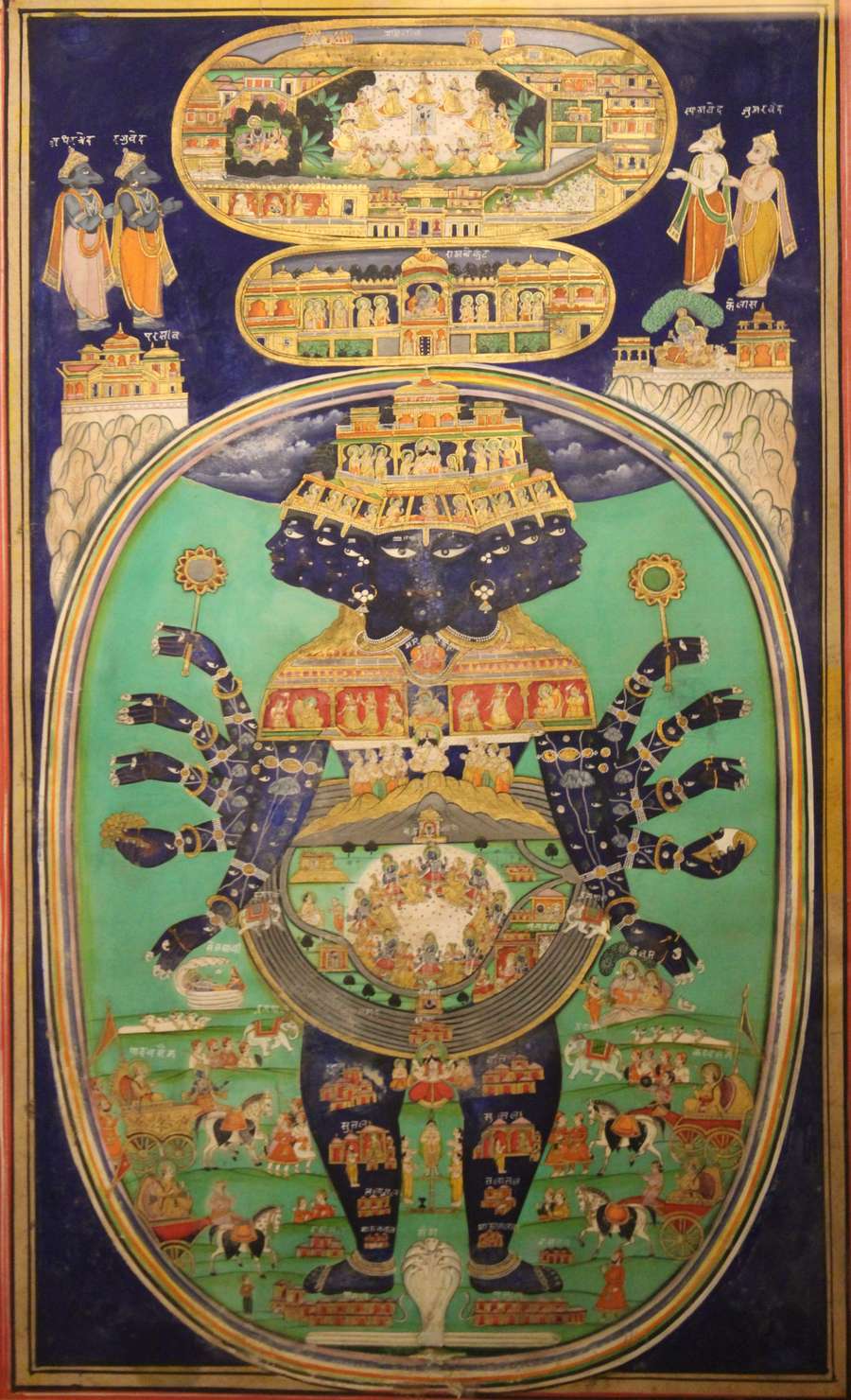
The Puruṣa Sūkta (Sanskrit: पुरुषसूक्तम्, “Hymn of the Cosmic Person”) stands as one of the most philosophically profound and ritually significant hymns in the entire corpus of Vedic literature. Found in the Tenth Maṇḍala (Book 10) of the Ṛgveda as hymn 10.90, it describes the cosmic sacrifice (yajña) of the primordial being, Puruṣa, from whose dismembered body the entire universe — the gods, the elements, the creatures, and the social order of humanity — emerged. Attributed to the ṛṣi (seer) Nārāyaṇa, the hymn is among the latest compositions in the Ṛgveda and marks a watershed moment in the evolution of Hindu cosmological thought.
The Puruṣa Sūkta appears not only in the Ṛgveda but is also found, with variations, in the Śukla Yajurveda (31.1–16), the Kṛṣṇa Yajurveda (Taittirīya Āraṇyaka 3.12–13), the Sāmaveda, and the Atharvaveda (19.6). Its pervasiveness across all four Vedas attests to its extraordinary importance in the Vedic tradition.
Structure and Metre
The standard Ṛgvedic recension of the Puruṣa Sūkta comprises sixteen verses (ṛcas). The first fifteen verses are composed in the anuṣṭubh (eight-syllable) metre, while the sixteenth and final verse employs the triṣṭubh (eleven-syllable) metre. Some later recensions — particularly the Taittirīya and Vājasaneyi versions — extend the hymn to twenty-four verses, with the additional eight verses (sometimes called the Uttara Nārāyaṇa) elaborating on the theological implications of the original sixteen.
The hymn is traditionally divided into three thematic sections:
- Verses 1–5: The transcendent nature and limitless magnitude of Puruṣa
- Verses 6–10: The cosmic sacrifice and the creation of beings
- Verses 11–16: The emergence of the social order, the seasons, the Vedas, and the ritual framework
The Transcendent Puruṣa (Verses 1–5)
The hymn opens with one of the most majestic images in world literature:
sahasraśīrṣā puruṣaḥ sahasrākṣaḥ sahasrapāt sa bhūmiṃ viśvato vṛtvātyatiṣṭhad daśāṅgulam
“The Puruṣa has a thousand heads, a thousand eyes, a thousand feet. He pervaded the earth on all sides and extended beyond it by ten finger-breadths.” (10.90.1)
The word sahasra (“thousand”) is not meant literally but signifies infinity — the Puruṣa is omnipresent and immeasurable. The striking phrase atyatiṣṭhad daśāṅgulam (“he stood beyond by ten fingers”) conveys that while the Puruṣa pervades all of material creation, he also transcends it — an early statement of the theological principle later codified as sarvavyāpitva (all-pervasiveness) and viśvātītatva (transcendence beyond the universe).
Verse 2 declares: puruṣa evedaṃ sarvaṃ yad bhūtaṃ yac ca bhavyam — “Puruṣa alone is all this — whatever has been and whatever shall be.” This establishes the hymn’s radical monism: past, present, and future are all manifestations of this single cosmic entity. He is also amṛtatvasya īśānaḥ — “the lord of immortality” — who grows beyond even the food that sustains mortal life.
Verse 3 introduces a crucial cosmological proportion: only one quarter (pāda) of the Puruṣa constitutes all beings and all of manifest creation; three quarters remain in the immortal realm of heaven (tripād asyāmṛtaṃ divi). This “quarter-to-three-quarters” imagery profoundly influenced later Vaiṣṇava theology, where it became the basis for the doctrine of Bhagavān as simultaneously immanent within creation and transcendent beyond it.
The Cosmic Sacrifice (Verses 6–10)
The central narrative of the hymn unfolds in verses 6–10, where the gods (devāḥ) perform a great sacrifice with Puruṣa himself as the offering (havis):
yat puruṣeṇa haviṣā devā yajñam atanvata vasanto asyāsīd ājyaṃ grīṣma idhmaḥ śarad dhaviḥ
“When the gods spread the sacrifice, using the Puruṣa as the oblation, spring was its ghee, summer its fuel-wood, and autumn the offering.” (10.90.6)
The seasons themselves serve as the ritual materials, establishing a correspondence between the natural order (ṛta) and the sacrificial order (yajña). From this primordial sacrifice arise all the creatures of the world: cattle, horses, goats, and sheep (verse 10). The clarified butter (ājya) that dripped from the sacrifice was gathered and fashioned into the animals of the sky and of the field.
This cosmic yajña is not merely a mythological narrative but encodes a deep philosophical insight: creation is fundamentally an act of self-offering. The universe does not come into being through an external act of a detached creator but through the self-sacrifice of the Absolute. This idea reverberates throughout the later Hindu tradition — in the Bhagavadgītā’s teaching of yajña as the sustaining principle of the cosmos (3.14–15), in the Upaniṣadic identification of the self (ātman) with Brahman, and in the Śrī Vaiṣṇava theology of divine self-offering.
The Social Order and the Vedas (Verses 11–16)
Verse 12 is the most discussed and debated verse of the Puruṣa Sūkta:
brāhmaṇo ‘sya mukham āsīd bāhū rājanyaḥ kṛtaḥ ūrū tad asya yad vaiśyaḥ padbhyāṃ śūdro ajāyata
“The Brāhmaṇa was his mouth, of his two arms was the Rājanya (Kṣatriya) made. His thighs became the Vaiśya; from his feet the Śūdra was born.” (10.90.12)
This verse describes the four varṇas as arising organically from the body of the cosmic Puruṣa, presenting them as interdependent parts of a single whole rather than as a hierarchy. Modern scholarship notes that this verse is unique in the Ṛgveda — the word śūdra appears nowhere else in the text — and likely represents a late addition reflecting the social developments of the later Vedic period.
Verse 13 describes the emergence of the celestial bodies: the moon (candramā) from his mind (manas), the sun (sūrya) from his eye (cakṣuḥ), Indra and Agni from his mouth, and Vāyu (wind) from his breath (prāṇa). Verse 14 adds that the atmosphere (antarikṣa) came from his navel, heaven (dyauḥ) from his head, earth (bhūmiḥ) from his feet, and the quarters of space (diśaḥ) from his ear.
Verse 15 is of particular importance for the history of Vedic ritual, stating that from this sacrifice were born the ṛcaḥ (hymns of the Ṛgveda) and the sāmāni (melodies of the Sāmaveda), the chandāṃsi (metres), and the yajuḥ (sacrificial formulae of the Yajurveda). The Vedas themselves are thus products of the cosmic sacrifice — they are not human compositions but emanations of the primordial act of creation.
Sāyaṇācārya’s Commentary
The great 14th-century commentator Sāyaṇācārya (c. 1315–1387 CE), who served in the Vijayanagara court, provided the most authoritative traditional commentary (bhāṣya) on the Puruṣa Sūkta as part of his monumental commentary on the entire Ṛgveda. Sāyaṇa interprets the hymn through the lens of Advaita-inflected Vedānta, reading the Puruṣa as identical with Brahman, the absolute ground of all being. He carefully explains each verse’s grammatical structure and ritual application, noting how the hymn serves as the philosophical foundation for the entire Vedic sacrificial system.
Sāyaṇa also addresses the “quarter and three-quarters” imagery of verse 3, explaining that the manifest universe is merely a fraction of the divine reality, while the greater part — immortal, unchanging, and self-luminous — remains forever beyond the reach of creation and destruction.
Connection to Nārāyaṇa and Vaiṣṇava Theology
The traditional attribution of the Puruṣa Sūkta to the ṛṣi Nārāyaṇa created a natural bridge between this Vedic hymn and later Vaiṣṇava theology. In the Śrī Vaiṣṇava tradition of Rāmānujācārya (1017–1137 CE), the Puruṣa of the sūkta is explicitly identified with Viṣṇu-Nārāyaṇa, the Supreme Being whose viśvarūpa (cosmic form) encompasses all of creation.
The extended version of the hymn found in the Taittirīya Āraṇyaka includes the verse patiṃ viśvasyātmeśvaram (“the Lord of all, the ruler of the self”), which Vaiṣṇava theologians cite as scriptural evidence for the supremacy of Nārāyaṇa. The Uttara Nārāyaṇa section further elaborates: nārāyaṇaḥ paraṃ brahma tattvaṃ nārāyaṇaḥ paraḥ — “Nārāyaṇa is the supreme Brahman, Nārāyaṇa is the highest reality.”
The concept of viśvarūpa — the cosmic form that encompasses the entire universe — which later appears dramatically in the Bhagavadgītā (Chapter 11) when Kṛṣṇa reveals his universal form to Arjuna, finds its earliest literary expression in the Puruṣa Sūkta’s vision of the thousand-headed, thousand-eyed cosmic being.
Ritual Use in Hindu Temples
The Puruṣa Sūkta occupies a central place in Hindu temple worship and domestic rituals to this day. It is recited during:
- Abhiṣeka (ritual bathing of the deity), particularly in Vaiṣṇava temples where it accompanies the bathing of Viṣṇu or his avatāras
- Pratiṣṭhā ceremonies (consecration of new temple images), where the hymn’s cosmic symbolism sanctifies the installation
- Śrāddha rituals (ancestral rites), especially the mahāśrāddha performed during pitṛpakṣa
- Upanayana (sacred thread ceremony), where it reinforces the cosmic dimension of the initiation
- Daily sandhyāvandana in certain Vaiṣṇava traditions, forming part of the daily liturgical cycle
In South Indian Śrī Vaiṣṇava temples following the Pāñcarātra Āgama, the Puruṣa Sūkta is recited alongside the Viṣṇu Sūkta and the Śrī Sūkta as part of the tirumanjanam (sacred ablution) ceremony. The Nambūdiri Brāhmaṇas of Kerala recite it during the elaborate Śoḍaśa Saṃskāra rituals.
Place in the Tenth Maṇḍala
The Tenth Maṇḍala (Book 10) of the Ṛgveda is widely recognized as the latest stratum of the text, containing some of the most philosophically sophisticated hymns in the collection. Alongside the Puruṣa Sūkta, this book includes the famous Nāsadīya Sūkta (10.129, the “Hymn of Creation”), the Hiraṇyagarbha Sūkta (10.121, “The Golden Embryo”), and the Devī Sūkta (10.125, spoken by the goddess Vāc). Together, these hymns represent a late Vedic flowering of cosmological and metaphysical speculation that would eventually bear fruit in the Upaniṣads.
The Puruṣa Sūkta’s position within this philosophically rich Maṇḍala is significant: it bridges the older sacrificial religion of the earlier Maṇḍalas with the emerging metaphysical inquiry of the late Vedic period. Its vision of the cosmos as originating from the self-sacrifice of a single universal being anticipates the Upaniṣadic doctrine of Brahman as the sole reality underlying all phenomena.
Legacy and Influence
The Puruṣa Sūkta’s influence on Hindu thought is immeasurable. Its imagery of the cosmic person pervades the Purāṇas, the Āgamas, and the devotional literature of every major Hindu tradition. The hymn’s central insight — that the diversity of the manifest world arises from the unity of a single transcendent source — remains the foundational axiom of Hindu theology, whether Advaita, Viśiṣṭādvaita, or Dvaita.
For over three millennia, the Puruṣa Sūkta has been chanted in homes and temples, studied in traditional pāṭhaśālās and modern universities, and contemplated by seekers on the path to mokṣa. Its sixteen verses continue to speak, as they always have, of the infinite vastness of the divine and the intimate connection between the cosmic and the human.