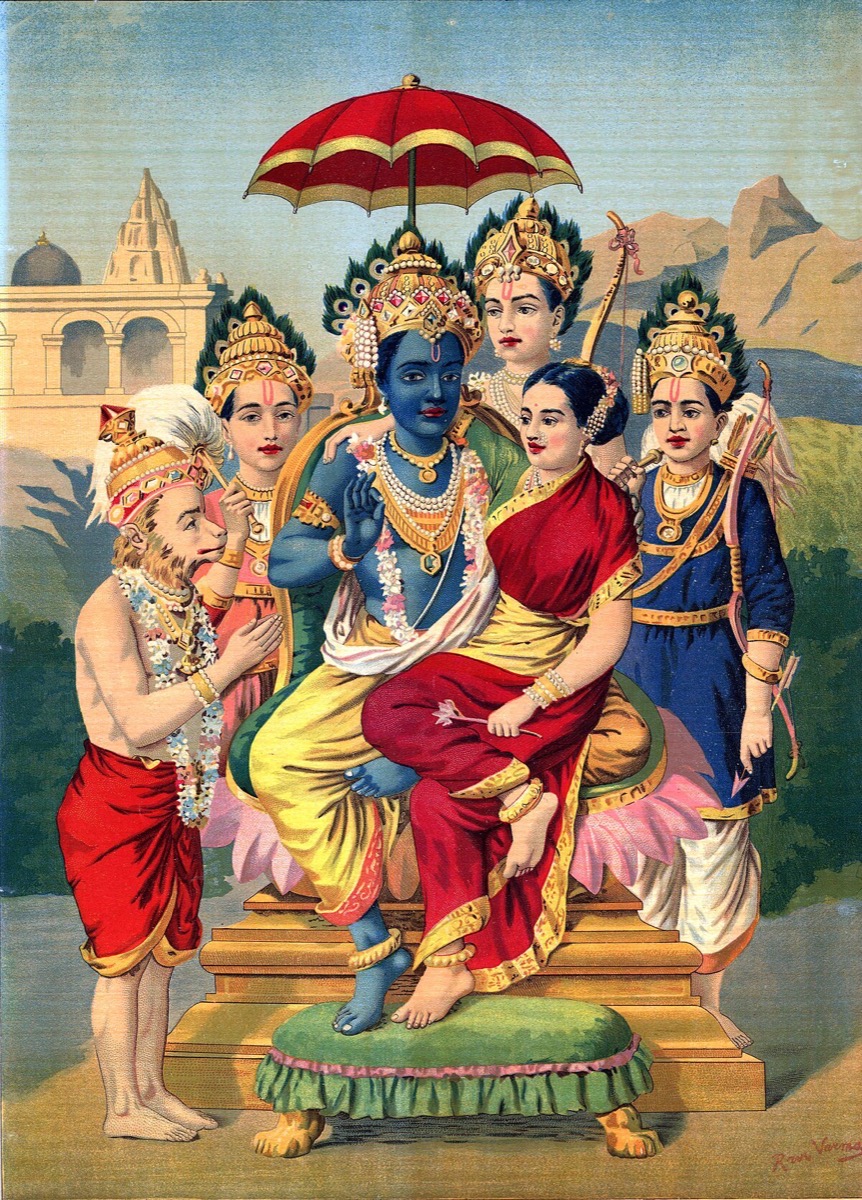
Śrī Rāmacandra Kṛpālu Bhajumana (श्रीरामचन्द्र कृपालु भजु मन) — commonly known as Rāma Stuti or the “Hymn of Praise to Lord Rāma” — is one of the most beloved and widely recited devotional compositions in all of Hinduism. Composed by the great poet-saint Gosvāmī Tulasīdāsa (c. 1532—1623 CE) as part of his magnum opus of devotional supplication, the Vinaya Patrikā, this hymn captures the quintessence of Rāma bhakti in a cascade of luminous imagery. Its opening words — “O mind, worship the compassionate Lord Rāmacandra” — have echoed through temples, homes, and concert halls for over four centuries, inspiring millions of devotees across linguistic and regional boundaries.
Tulasīdāsa and the Vinaya Patrikā
Gosvāmī Tulasīdāsa is principally celebrated as the author of the Śrī Rāmacaritamānasa, the retelling of Lord Rāma’s story in Avadhī that reshaped the devotional landscape of North India. However, his lesser-known but equally sublime collection, the Vinaya Patrikā (“Petition of Humility”), represents the most intimate dimension of his spiritual life. Composed in the Braj Bhāṣā dialect during the final years of his life (c. 1612—1623 CE), the Vinaya Patrikā comprises 279 pads (devotional songs) addressed to various deities — Gaṇeśa, Śiva, Pārvatī, Sūrya, Gaṅgā, and Yamunā — but its central and most impassioned petitions are directed to Lord Rāma and His consort Sītā.
F. R. Allchin, the distinguished scholar who published the first English translation of the Vinaya Patrikā as The Petition to Ram (1966), described the work as being “primarily intended for singing” yet possessing “outstanding poetic beauty” whose “language and contents are unsurpassed in Tulsi Das’s other writings.” Within this garland of 279 hymns, Pad 45 — Śrī Rāmacandra Kṛpālu — stands as perhaps the single most famous and frequently performed composition. It is identified as a Rāma Stuti (praise-hymn to Rāma) and functions as a standalone devotional piece that has transcended its literary origins to become a staple of Hindu worship across India.
Unlike the narrative epic of the Rāmacaritamānasa, which unfolds Rāma’s story in sequential chapters (kāṇḍas), the Vinaya Patrikā is lyrical and personal. Each pad is a self-contained prayer, and Pad 45 is structured as a direct invocation urging the devotee’s own mind (mana) to contemplate the divine form of Lord Rāma. This intimate mode of address — the poet speaking to his own heart — places the composition squarely in the tradition of saguṇa bhakti (devotion to God with form and attributes), where the detailed visualisation of the deity’s beauty becomes a pathway to liberation.
Structure and Complete Text
The Rāma Stuti as commonly recited comprises five principal verses (pads) in the doha-chaupāī metre, followed by a chhanda (metrical passage) and a concluding sorathā (couplet). The five main verses are from the Vinaya Patrikā, while the chhanda and sorathā sections are drawn from the Rāmacaritamānasa, Bālakāṇḍa (the section describing Rāma’s appearance at Sītā’s svayaṁvara). This composite structure — blending two distinct works by Tulasīdāsa — is the form in which the hymn is most widely known and performed.
Verse 1
श्रीरामचन्द्र कृपालु भजु मन हरण भवभय दारुणम्। नवकञ्ज लोचन कञ्ज मुख कर कञ्ज पद कञ्जारुणम्॥
Śrī Rāmacandra kṛpālu bhaju mana haraṇa bhava-bhaya dāruṇam / Nava-kañja-locana kañja-mukha kara-kañja pada-kañjāruṇam //
Meaning: “O mind, worship the compassionate Lord Rāmacandra, who removes the terrible fear of worldly existence. His eyes are like fresh-blooming lotuses, His face is like a lotus, His hands are like lotuses, and His feet glow with the crimson hue of lotuses.”
The opening verse establishes the twin themes that pervade the entire hymn: Rāma as kṛpālu (the compassionate one) and Rāma as the supremely beautiful divine being whose every limb evokes the lotus (kañja). The fourfold repetition of kañja — eyes, face, hands, feet — creates the rhetorical figure of anuprāsa (alliteration), producing a hypnotic musicality that makes the verse unforgettable. The lotus, in Hindu iconography, symbolises purity, beauty, and transcendence — qualities that define the divine form of Rāma.
Verse 2
कन्दर्प अगणित अमित छवि नव नील नीरद सुन्दरम्। पट पीत मानहुँ तड़ित रुचि शुचि नौमि जनक सुतावरम्॥
Kandarpa agaṇita amita chavi nava nīla nīrada sundaram / Paṭa pīta mānahu taḍita ruci śuci naumi Janaka-sutā-varam //
Meaning: “His splendour surpasses that of countless Kāmadevas (gods of love). He is beautiful like a fresh dark rain-cloud. His yellow garments shimmer like lightning upon that cloud. I bow to this pure and radiant bridegroom of Janaka’s daughter (Sītā).”
Here Tulasīdāsa deploys a stunning visual metaphor: Rāma’s dark-complexioned body is likened to a rain-cloud (nīrada), and His golden-yellow silk garments (paṭa pīta) flash across it like lightning (taḍit). The comparison with Kāmadeva (Cupid) is deliberately hyperbolic — not one, but agaṇita (countless) gods of love fall short of Rāma’s beauty. The verse culminates in the epithet Janaka-sutā-varam — “the chosen husband of Sītā” — grounding the cosmic beauty in the specific context of Rāma’s marriage at the court of King Janaka.
Verse 3
भजु दीनबन्धु दिनेश दानव दैत्यवंश निकन्दनम्। रघुनन्द आनन्दकन्द कोसलचन्द दशरथनन्दनम्॥
Bhaju dīna-bandhu dineśa dānava-daitya-vaṁśa nikandanam / Raghunanda ānanda-kanda Kosala-canda Daśaratha-nandanam //
Meaning: “Worship Him who is the friend of the lowly (dīna-bandhu), the sun-god to the demons’ darkness, the destroyer of the lineages of demons and daityas. He is the delight of Raghu’s dynasty, the root of all bliss, the moon of Kosala, and the beloved son of Daśaratha.”
This verse pivots from aesthetic beauty to heroic glory. Rāma is simultaneously the gentle protector of the humble and the fierce annihilator of demonic forces. The cascade of epithets — Raghu-nanda (joy of the Raghu clan), Ānanda-kanda (root of bliss), Kosala-canda (moon of the kingdom of Kosala), Daśaratha-nandana (son of Daśaratha) — weaves together Rāma’s familial, dynastic, and cosmic identities.
Verse 4
शिर मुकुट कुण्डल तिलक चारु उदारु अंग विभूषणम्। आजानुभुज शर चाप धर संग्राम जित खरदूषणम्॥
Śira mukuṭa kuṇḍala tilaka cāru udāra aṅga vibhūṣaṇam / Ājānu-bhuja śara cāpa dhara saṅgrāma jita Khara-Dūṣaṇam //
Meaning: “His head bears a crown, His ears bear earrings, His forehead is adorned with a beautiful tilaka, and His noble limbs are bedecked with ornaments. His arms reach down to His knees; He holds bow and arrow; and in battle He conquered Khara and Dūṣaṇa.”
The fourth verse presents Rāma in His complete iconographic form — the crowned prince adorned with ornaments, yet also the warrior whose long arms (ājānu-bhuja, an ancient marker of a mahāpuruṣa) wield the divine bow. The reference to the defeat of the rākṣasa brothers Khara and Dūṣaṇa (Rāmāyaṇa, Āraṇyakāṇḍa) anchors the hymn in the narrative tradition, reminding the listener of Rāma’s prowess in combat.
Verse 5
इति वदति तुलसीदास शंकर शेष मुनि मनरंजनम्। मम हृदयकंज निवास कुरु कामादि खलदलगंजनम्॥
Iti vadati Tulasīdāsa Śaṅkara Śeṣa muni mana-rañjanam / Mama hṛdaya-kañja nivāsa kuru kāmādi khala-dala-gañjanam //
Meaning: “Thus speaks Tulasīdāsa: He who delights the hearts of Lord Śaṅkara (Śiva), Śeṣanāga, and the sages — O Lord, dwell in the lotus of my heart and destroy the host of wicked passions such as lust and anger.”
The concluding verse carries the poet’s mudrikā (signature), a convention in medieval Indian devotional poetry. Tulasīdāsa invokes the authority of Śiva and Ādiśeṣa — both legendary narrators of Rāma’s story — before making his personal plea: mama hṛdaya-kañja nivāsa kuru — “make Your dwelling in the lotus of my heart.” The final phrase, kāmādi khala-dala-gañjanam, encapsulates the soteriological purpose of the entire hymn: the invocation of Rāma is not merely aesthetic but a means to vanquish the inner enemies — desire (kāma), anger (krodha), greed (lobha) — that bind the soul to saṁsāra.
The Chhanda and Sorathā
In popular recitation, the five Vinaya Patrikā verses are followed by two additional stanzas drawn from the Rāmacaritamānasa, Bālakāṇḍa, describing Goddess Pārvatī’s blessing upon Sītā at the temple of Gaurī before Rāma’s svayaṁvara. These verses, beginning “manu jāhi rāceu milihi so baru sahaja sundara sāṁvaro” (“The bridegroom your heart is set upon — that naturally handsome, dark-complexioned one — you shall obtain”), and the concluding sorathā, “jāni Gauri anukūla siya hiya haraṣu na jāi kahi” (“Knowing Gaurī to be favourable, Sītā’s heart filled with inexpressible joy”), complete the devotional arc by linking the praise of Rāma’s beauty to the narrative moment of His union with Sītā.
Musical Traditions and Rāgas
Hindustānī Tradition
The most iconic rendition of Śrī Rāmacandra Kṛpālu in the Hindustānī classical tradition is the celebrated recording by Lata Mangeshkar, whose 1983 version set an enduring benchmark. Her rendition, set in Rāga Yaman Kalyāṇ with Tāla Rūpaka (a seven-beat rhythmic cycle), combines crystalline vocal purity with deep devotional feeling. The bright, ascending phrases of Yaman Kalyāṇ — with its characteristic tīvra madhyama (sharp fourth) — perfectly complement the luminous imagery of Rāma’s beauty.
Other distinguished Hindustānī renditions include those by Pandit Rajan and Sajan Mishra of the Banaras gharānā, who interpret the hymn with elaborate ālāpa (melodic improvisation) and restrained tāna passages, and Hari Om Sharan, whose bhajan-style performances have introduced the hymn to a wider popular audience. Anuradha Paudwal has recorded multiple versions that have achieved enormous circulation through devotional music channels.
Carnatic Tradition
In the Carnatic classical tradition, the hymn is rendered in Rāga Kalyāṇī (the South Indian equivalent of Yaman Kalyāṇ), typically in Miśra Cāpu tāla. Notable Carnatic renditions include those by T. M. Krishna, whose dynamic vocal modulation and emphasis on bhakti rasa (devotional sentiment) bring a distinctive South Indian flavour to this North Indian composition, and by the duo Ranjani and Gayatri, who have demonstrated the hymn’s remarkable capacity to transcend regional musical boundaries.
The use of Rāga Kalyāṇī / Yaman Kalyāṇ across both traditions is not accidental. This rāga, known for its serene yet luminous character, is associated in both systems with devotional and auspicious contexts. Its ascending-dominant scale creates an atmosphere of aspiration and joy that mirrors the hymn’s portrait of divine beauty.
Digital Reach
In the contemporary era, the T-Series Bhakti Sagar YouTube channel’s rendition has amassed over 124 million views as of 2025, testifying to the hymn’s enormous popularity among younger generations of listeners. The composition continues to be performed at classical music festivals, temple concerts, and household devotions alike.
Devotional Significance
In Temple Worship
Śrī Rāmacandra Kṛpālu holds the status of a standard āratī (ritual hymn of worship) in Rāma temples across India. It is recited during the evening āratī at major Rāma shrines including the Rāma Janmabhūmi Mandir in Ayodhyā, the Rāma Rājā Mandir in Orchhā, and countless smaller temples throughout the Hindi-speaking belt. During the historic prāṇa pratiṣṭhā (consecration ceremony) of the Rāma Janmabhūmi Mandir on 22 January 2024, the hymn was performed by Shankar Mahadevan as Prime Minister Narendra Modi arrived at the temple, underscoring its status as the pre-eminent hymn of Rāma worship in contemporary India.
In Festival Observances
The Rāma Stuti occupies a central place in the celebration of Rāma Navamī (the birthday of Lord Rāma), Vijayadaśamī / Dussehra (the triumph of Rāma over Rāvaṇa), and Dīpāvalī (celebrating Rāma’s return to Ayodhyā). During these festivals, community recitations of the hymn — often accompanied by bhajan mandals (devotional singing groups) — create an atmosphere of collective devotion. In many households, the Rāma Stuti is recited as part of the daily morning or evening prayer (pūjā), alongside the Hanumān Chālīsā.
Theological Dimensions
The hymn exemplifies the principles of saguṇa bhakti — devotion to God in His personal, attributeful form. Tulasīdāsa’s detailed description of Rāma’s physical beauty is not mere poetic ornamentation; it is a form of dhyāna (meditation) in which the devotee constructs the divine image within the mind’s eye. Each verse adds a layer to this inner visualisation: lotus-eyes, rain-cloud complexion, golden garments, crown and earrings, long arms holding the bow. By the fifth verse, when Tulasīdāsa asks Rāma to dwell in the lotus of his heart, the external description has been fully internalised — the deity contemplated without is now installed within.
This movement from outward beauty to inward presence reflects the arca-avatāra theology of Vaiṣṇavism, in which the material image of God is understood as a gateway to direct spiritual communion. The hymn’s concluding plea — kāmādi khala-dala-gañjanam (“destroy the host of wicked passions”) — reveals the ultimate purpose of this beautiful meditation: not aesthetic pleasure but inner purification and liberation from the cycle of birth and death (saṁsāra).
Comparison with Other Rāma Stutis
Tulasīdāsa’s hymn stands alongside several other celebrated compositions in the tradition of Rāma devotion:
-
Rāma Rakṣā Stotra (attributed to Budha Kauśika Ṛṣi): A Sanskrit protective hymn invoking Rāma’s presence on every part of the body. While the Rakṣā Stotra emphasises protection (rakṣā), Tulasīdāsa’s composition emphasises beauty and inner transformation.
-
Rāma Aṣṭakam (attributed to various authors): Eight-verse Sanskrit praise-hymns to Rāma. These tend to be more formal and liturgical, whereas Śrī Rāmacandra Kṛpālu is intensely personal, addressing the poet’s own mind.
-
Ādityahṛdayam (Vālmīki Rāmāyaṇa, Yuddhakāṇḍa): Agastya’s hymn to Sūrya recited before Rāma’s battle with Rāvaṇa. This is a martial invocation, while Tulasīdāsa’s hymn is contemplative and lyrical.
-
Hanumān Chālīsā (Tulasīdāsa): The most widely recited Hindu devotional text, also by Tulasīdāsa but composed in Avadhī and dedicated to Hanumān. The Rāma Stuti shares the same devotional spirit but focuses entirely on the divine beauty and compassion of Lord Rāma Himself.
What distinguishes Śrī Rāmacandra Kṛpālu from all these is its extraordinary musicality. The alliterative cascades (kañja… kañja… kañja… kañjāruṇam), the thundering compounds (dānava-daitya-vaṁśa-nikandanam), and the melodic vowel patterns make it uniquely suited for musical performance — a quality that has ensured its survival and popularity across centuries.
Poetic Devices and Language
The hymn is composed in Braj Bhāṣā, the literary dialect of the Mathurā-Agra region that served as the principal language of North Indian devotional poetry from the 15th to the 18th century. Braj Bhāṣā is characterised by its melodic vowel endings and rich tradition of association with Kṛṣṇa and Rāma bhakti. Tulasīdāsa, though more commonly associated with Avadhī (the language of the Rāmacaritamānasa), wrote his Vinaya Patrikā in Braj — the language favoured by the aṣṭachāpa poets and by the musical traditions of Vṛndāvana.
Key poetic devices include:
- Anuprāsa (alliteration): The fourfold repetition of kañja in Verse 1, the rhythmic pounding of dīna-bandhu dineśa dānava-daitya-vaṁśa in Verse 3.
- Upamā (simile): Rāma compared to a rain-cloud (nīrada), His garments to lightning (taḍit).
- Atiśayokti (hyperbole): His beauty surpasses agaṇita (countless) gods of love.
- Rūpaka (metaphor): The heart as a lotus (hṛdaya-kañja) in which Rāma is asked to dwell.
- Mudrikā (poet’s signature): Iti vadati Tulasīdāsa — “thus speaks Tulasīdāsa.”
Legacy and Living Tradition
Śrī Rāmacandra Kṛpālu Bhajumana has been recognised by scholars as a “pinnacle of saguṇa bhakti,” embodying Tulasīdāsa’s revolutionary approach to devotion that democratised salvation through Rāma-centric surrender. It is not a text confined to manuscripts or academic study — it is a living, breathing prayer that resonates in the voices of millions daily. From the marble halls of the Ayodhyā Mandir to the bamboo shrines of rural Bihar, from the Carnatic concert stages of Chennai to the bhajan sessions of the Indian diaspora in London and New York, this hymn continues to fulfil its opening injunction: bhaju mana — “O mind, worship.”
Its enduring power lies in the paradox at its heart: it describes the indescribable. Through the finite medium of human language, Tulasīdāsa evokes the infinite beauty of the Lord, and in doing so, transforms the very act of listening into an act of worship. As the poet declares in his final verse, Rāma is not merely to be admired from without but to be enthroned within — in the lotus-heart of every devotee who turns to Him with love.