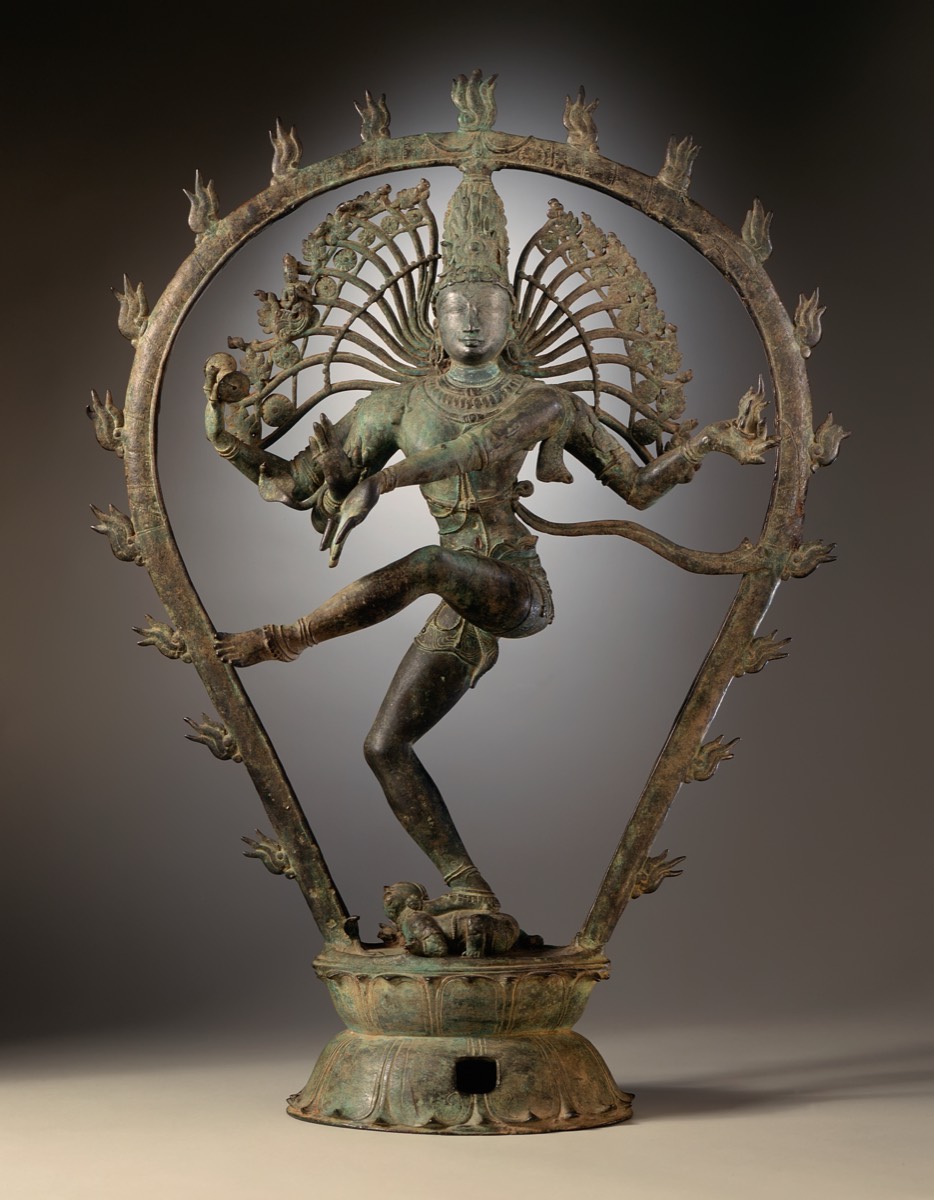
The Śiva Tāṇḍava Stotram is one of the most electrifying and powerful devotional compositions in Sanskrit literature. Traditionally attributed to Rāvaṇa, the mighty ruler of Laṅkā and an ardent devotee of Lord Śiva, this hymn celebrates the awe-inspiring cosmic dance (tāṇḍava) of Mahādeva — the dance through which the universe is created, sustained, and dissolved. Composed in the vigorous aṣṭa-caturaśra-gati (iambic octameter) metre, the stotram’s thundering rhythmic cadence mirrors the very dance it describes.
The Complete Opening Verse
जटाटवीगलज्जलप्रवाहपावितस्थले गलेऽवलम्ब्य लम्बितां भुजङ्गतुङ्गमालिकाम् । डमड्डमड्डमड्डमन्निनादवड्डमर्वयं चकार चण्डताण्डवं तनोतु नः शिवः शिवम् ॥१॥
IAST Transliteration: Jaṭāṭavīgalajjalapravāhapāvitasthale gale’valambya lambitāṃ bhujaṅgatuṅgamālikām | ḍamaḍḍamaḍḍamaḍḍamanninādavaḍḍamarvayaṃ cakāra caṇḍatāṇḍavaṃ tanotu naḥ śivaḥ śivam ||1||
Translation: “From the dense forest of His matted locks, the holy waters of the Gaṅgā stream down, purifying the ground beneath. Around His neck hangs a garland of mighty serpents. To the resounding beat of His ḍamaru drum — ḍamat, ḍamat, ḍamat, ḍamat — He performs the fierce tāṇḍava. May that Śiva bestow auspiciousness upon us.”
Structure and Metre
The Śiva Tāṇḍava Stotram consists of seventeen quatrains (some recensions preserve sixteen), each composed in a metre of sixteen syllables per quarter-verse (pāda). The syllabic pattern strictly alternates between laghu (short) and guru (long) syllables, creating a relentless rhythmic pulse that evokes the beating of Śiva’s ḍamaru drum. In Western prosodic terms, this corresponds to iambic octameter — eight pairs of short-long feet per line.
This rhythmic intensity is not merely ornamental. The metre itself becomes a form of worship: as the reciter chants, the very cadence of the syllables recreates the cosmic rhythm of Śiva’s dance. The compounding of long Sanskritic words — sometimes spanning an entire half-verse — produces an effect of breathless momentum that is unique in devotional literature.
The Legend of Composition
Rāvaṇa as Śiva’s Devotee
The traditional account of this stotram’s composition is found in the Uttara Kāṇḍa of Vālmīki’s Rāmāyaṇa and elaborated in various Purāṇic sources. According to the Śiva Mahāpurāṇa, Rāvaṇa once attempted to uproot Mount Kailāsa, the celestial abode of Lord Śiva, in order to carry it to Laṅkā. When Śiva pressed the mountain down with His toe, Rāvaṇa’s arms were crushed beneath it. In agony and awe, Rāvaṇa composed this hymn, singing it for a thousand years with such devotion that Śiva was pleased and not only released him but also bestowed upon him the invincible sword Candrahāsa.
This narrative illustrates a profound principle of Hindu theology: even a being of immense tāmasic (destructive) power can access divine grace through sincere devotion. Rāvaṇa, despite being the antagonist of the Rāmāyaṇa, is acknowledged as one of the greatest Śiva-bhaktas in the Hindu tradition. His scholarship in the Vedas, his mastery of music (he is credited with inventing the rāvaṇahāṭha, an ancestor of the violin), and his devotion to Śiva make him a complex figure who transcends simple moral categories.
The Significance of Tāṇḍava
The word tāṇḍava derives from Taṇḍu, the name of Śiva’s attendant who first demonstrated this dance form to the sage Bharata, as recorded in the Nāṭya Śāstra (4.263). The tāṇḍava represents the vigorous, dynamic aspect of Śiva’s dance, in contrast to the gentle lāsya performed by Pārvatī. Together, they symbolise the complementary forces of creation: energy and grace, dissolution and renewal.
The Śiva Mahāpurāṇa (Vāyavīya Saṃhitā 30.182-187) describes seven forms of the tāṇḍava, including the ānanda tāṇḍava (dance of bliss), sandhyā tāṇḍava (twilight dance), and kāla tāṇḍava (dance of time/death). The Śiva Tāṇḍava Stotram primarily celebrates the caṇḍa tāṇḍava — the fierce dance that embodies Śiva’s role as the destroyer of ignorance and the liberator of souls.
Key Verses with Translation
Verse 2: The Adorned Destroyer
जटाकटाहसम्भ्रमभ्रमन्निलिम्पनिर्झरी- विलोलवीचिवल्लरीविराजमानमूर्धनि । धगद्धगद्धगज्ज्वलल्ललाटपट्टपावके किशोरचन्द्रशेखरे रतिः प्रतिक्षणं मम ॥२॥
Jaṭākaṭāhasambhramabhramannilimpanirjharī-vilollavīcivallarīvirājamānamūrdhani | dhagaddhagaddhagajjvalallalāṭapaṭṭapāvake kiśoracandraśekhare ratiḥ pratikṣaṇaṃ mama ||2||
Translation: “Upon His crown, the celestial river Gaṅgā whirls and tosses in the bowl of His matted locks, its waves dancing like creepers. Upon His forehead blazes a fire that crackles dhagad, dhagad, dhagad. In that Lord who wears the crescent moon as His crest-jewel — may my love dwell at every moment.”
Verse 7: The Cosmic Fearlessness
निलिम्पनाथनागरीकदम्बमौलिमल्लिका- निगुम्फनिर्भरक्षरन्मधूष्णिकामनोहरः । तनोतु नो मनोमुदं विनोदिनीमहर्निशं परिश्रय परम्पदं तदङ्गजत्विषां चयः ॥७॥
Translation: “The garlands of the celestial women are adorned with kadamba flowers, from which honey drips most enchantingly. May the splendour of His limbs, which is the refuge of the supreme abode, grant us the delight of ceaseless inner joy, day and night.”
Verse 10: Transcendent Power
जयत्वदभ्रविभ्रमभ्रमद्भुजङ्गमश्वस- द्विनिर्गमत्क्रमस्फुरत्करालभालहव्यवाट् । धिमिद्धिमिद्धिमिध्वनन्मृदङ्गतुङ्गमङ्गल- ध्वनिक्रमप्रवर्तित प्रचण्डताण्डवः शिवः ॥१०॥
Translation: “Victorious is He — from the serpents writhing upon His arms, their breath emerges, making the fire on His terrible forehead blaze forth. To the auspicious sound of the mṛdaṅga drum beating dhimid, dhimid, dhimid — Śiva performs the fierce tāṇḍava.”
Verse 13: The Devotee’s Prayer
कदा निलिम्पनिर्झरीनिकुञ्जकोटरे वसन् विमुक्तदुर्मतिः सदा शिरःस्थमञ्जलिं वहन् । विमुक्तलोललोचनो ललामभाललग्नकः शिवेति मन्त्रमुच्चरन् कदा सुखी भवाम्यहम् ॥१३॥
Kadā nilimpanirjharīnikuñjakoṭare vasan vimuktadurmatih sadā śiraḥsthamañjaliṃ vahan | vimuktalolalocano lalāmabhālalagnakah śiveti mantramuccaran kadā sukhī bhavāmyaham ||13||
Translation: “When shall I dwell in a cave by the banks of the celestial river, freed from all impure thoughts, with hands forever folded above my head in salutation, eyes closed in meditation, forehead marked with sacred ash, chanting the mantra ‘Śiva, Śiva’ — when shall I attain that bliss?”
This verse is particularly poignant because it reveals the inner longing of the devotee beneath the stotram’s outward grandeur. Here, the composer — whether Rāvaṇa or a later poet channelling his voice — expresses the universal yearning for liberation through complete surrender to Śiva.
Word Analysis of the Opening Verse
The opening verse is a masterpiece of Sanskrit compound construction:
- Jaṭāṭavī — the forest (aṭavī) of matted locks (jaṭā)
- Galat-jala — streaming (galat) water (jala)
- Pravāha — flow, current
- Pāvita — purified, sanctified
- Sthale — on the ground, at the place
- Gale — on the neck
- Avalambya — hanging, suspended
- Lambitām — dangling
- Bhujaṅga — serpent (literally “arm-mover”)
- Tuṅga — lofty, great
- Mālikām — garland
- Ḍamat — onomatopoeia for the sound of the ḍamaru drum
- Nināda — resonance, sound
- Caṇḍa — fierce, violent
- Tāṇḍavam — the vigorous dance of Śiva
- Tanotu — may He extend, may He grant
- Naḥ — to us
- Śivaḥ — Śiva (the auspicious one)
- Śivam — auspiciousness, welfare
Philosophical Significance
The Dance as Cosmology
The Śiva Tāṇḍava Stotram is not merely devotional poetry but a cosmological statement. Each element of Śiva’s adornment described in the verses carries profound metaphysical meaning:
- The Gaṅgā in His hair represents the descent of divine knowledge into the material world, tempered by Śiva’s grace so that it does not overwhelm creation
- The serpent garland symbolises kuṇḍalinī śakti — the coiled spiritual energy that, when awakened, leads to liberation
- The crescent moon (candraśekhara) represents the cyclical nature of time and Śiva’s mastery over it
- The ḍamaru drum produces the primordial sound (nāda) from which the Sanskrit alphabet and all of creation emerge — the Māheśvara Sūtras are said to have sprung from the fourteen beats of Śiva’s ḍamaru
- The fire on His forehead is the third eye of wisdom that destroys Kāma (desire) and all illusion
Ānanda and Pralaya
The tāṇḍava embodies a paradox central to Śaiva theology: the dance of destruction is simultaneously a dance of bliss (ānanda). As the Śaiva Siddhānta tradition teaches, Śiva’s five cosmic acts (pañcakṛtya) — creation (sṛṣṭi), preservation (sthiti), dissolution (saṃhāra), concealment (tirobhāva), and grace (anugraha) — are all expressions of a single unified divine will. The tāṇḍava encompasses all five: in the destruction of the old, the new is born; in the veiling of truth, the seeker is impelled to search; in the granting of grace, the cycle completes itself.
The philosopher Abhinavagupta (c. 950–1016 CE) of the Kashmir Śaiva tradition interpreted Śiva’s dance as the perpetual vibration (spanda) of consciousness itself. For Abhinavagupta, the universe is not created by a distant God but is the spontaneous self-expression of Śiva’s consciousness — an eternal dance with no beginning and no end.
Naṭarāja: The King of Dance
The iconographic form of Śiva as Naṭarāja — the lord of dance depicted within a circle of flames (prabhāmaṇḍala) — is the visual counterpart to this stotram. The Chola bronze Naṭarājas of Tamil Nadu (10th–12th centuries CE) are among the supreme achievements of Indian art. In this form:
- The upper right hand holds the ḍamaru (creation through sound)
- The upper left hand holds agni — fire (destruction)
- The lower right hand is raised in abhaya mudrā (gesture of fearlessness)
- The lower left hand points to the raised foot (grace, liberation)
- The right foot presses upon Apasmāra — the dwarf of ignorance
- The left foot is raised in the gesture of liberation
The Cidambaram temple in Tamil Nadu, dedicated to Śiva as Naṭarāja, is the premier pilgrimage site associated with the cosmic dance. The temple’s Cit Sabhā (Hall of Consciousness) houses the ākāśa liṅga — the formless space itself worshipped as Śiva.
The Stotram in Practice
Recitation Tradition
The Śiva Tāṇḍava Stotram is traditionally recited during Mahāśivarātri, the great night of Śiva, when devotees observe an all-night vigil of fasting, meditation, and chanting. It is also recited during the pradoṣa (twilight) pūjā and in Śiva temples throughout India.
The stotram’s rhythmic power makes it particularly suited to group chanting, where the building momentum of the iambic metre creates an almost trance-like state in the reciters. Many contemporary musicians have set the stotram to classical rāgas, and its dramatic quality has made it one of the most widely performed Sanskrit hymns in popular culture.
Spiritual Benefits
According to the Śaiva tradition, regular recitation of the Śiva Tāṇḍava Stotram is believed to:
- Invoke Śiva’s protective grace against negative forces
- Develop inner courage and fearlessness (abhaya)
- Purify the mind of tāmasic tendencies
- Awaken devotion (bhakti) and spiritual energy
- Lead ultimately to mokṣa through Śiva’s grace
The Concluding Verse
इमं हि नित्यमेव मुक्तमुत्तमोत्तमं स्तवं पठन्स्मरन्ब्रुवन्नरो विशुद्धिमेतिसन्ततम् । हरे गुरौ सुभक्तिमाशु याति नान्यथा गतिं विमोहनं हि देहिनां सुशङ्करस्य चिन्तनम् ॥
Translation: “Whoever reads, remembers, and recites daily this supreme hymn attains perpetual purity. He quickly gains devotion to Hara (Śiva), the Guru. There is no other path — for the contemplation of the auspicious Śaṅkara is indeed the destroyer of delusion for all embodied beings.”
This phalaśruti (declaration of benefits) encapsulates the stotram’s ultimate purpose: not merely the aesthetic appreciation of Śiva’s dance, but the complete transformation of the devotee through single-pointed devotion to Mahādeva.