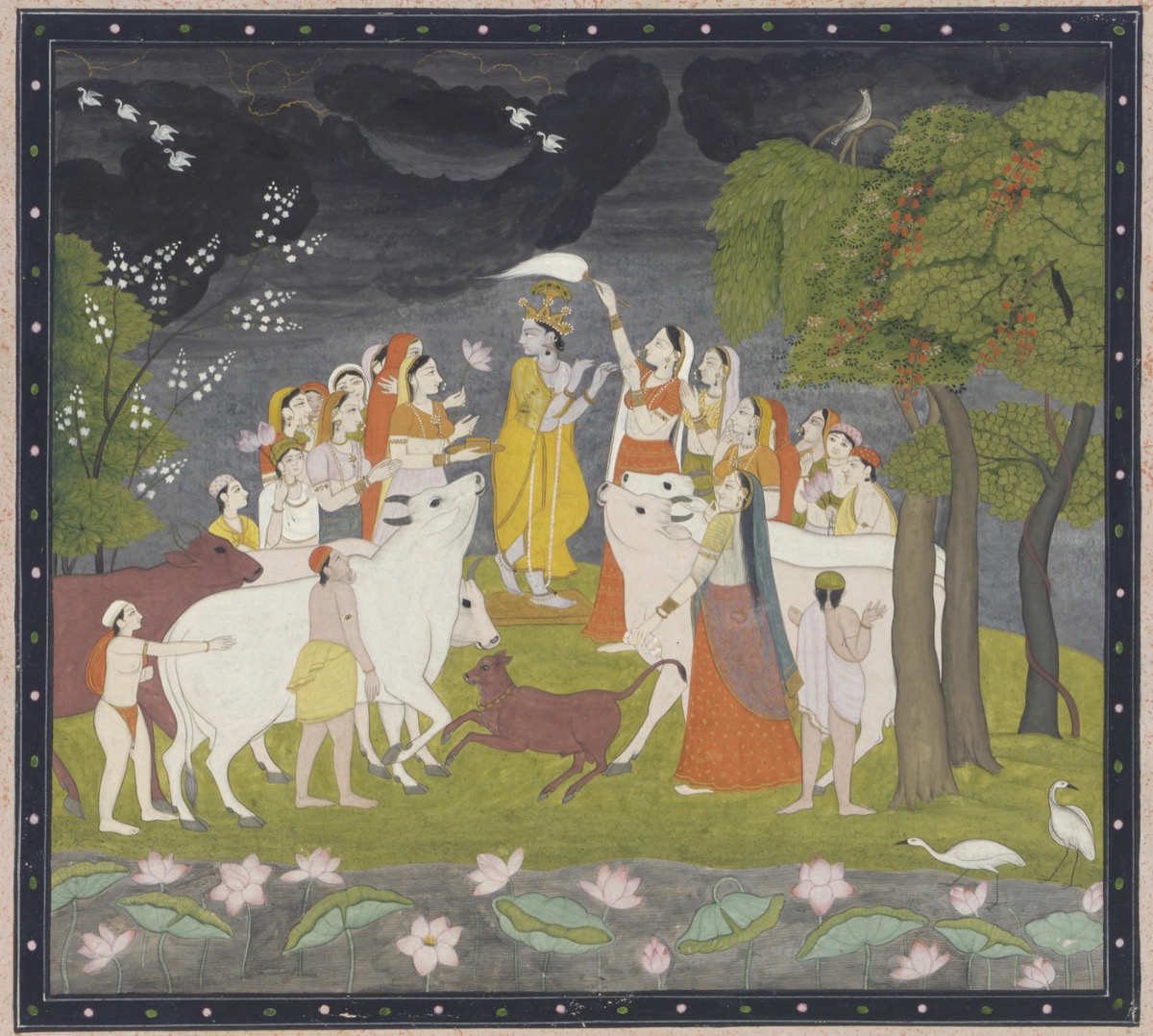
The Śrī Kṛṣṇa Ārtī, universally known by its opening words “Ārtī Kuñj Bihārī Kī” (आरती कुंजबिहारी की, “Ārtī of the One Who Delights in the Groves”), is arguably the most widely performed ārtī in the entire Hindu devotional repertoire. Sung every evening in thousands of temples across India — from the grand shrines of Vṛndāvana and Mathurā to humble neighbourhood mandirs — this prayer encapsulates the essence of Kṛṣṇa devotion in Braj Bhāṣā verse of remarkable beauty and intimacy. It presents Kṛṣṇa not as an abstract cosmic principle but as the enchanting, dark-complexioned youth who plays his flute in the moonlit groves of Vṛndāvana, wearing a garland of forest flowers and earrings that sparkle like stars.
The Ārtī Tradition in Hindu Worship
What Is Ārtī?
Ārtī (also spelled āratī or āratrikā) is one of the sixteen traditional acts of worship (ṣoḍaśa upacāra) in Hindu pūjā. The word derives from the Sanskrit ā-rātrika, meaning “that which removes darkness.” In its essential form, ārtī involves the circular waving of a lighted lamp — traditionally fuelled by ghee (clarified butter) or camphor — before the deity’s image (mūrti), accompanied by devotional singing, the ringing of bells, and the blowing of conch shells.
Ārtī serves multiple liturgical functions:
- Illumination: The lamp reveals the deity’s form to the worshippers in the dim temple sanctum
- Offering of light: Fire is offered as the purest element, symbolizing the devotee’s surrender of the ego
- Communal worship: Ārtī is typically the most participatory element of temple service, with the entire congregation singing together
- Blessing: After the ārtī, devotees pass their hands over the flame and touch them to their foreheads, receiving the sanctified light
The Five-Lamp Ārtī
In formal temple worship, the ārtī is performed with a pañcārtī — a five-wick lamp representing the five elements (pañca-bhūta: earth, water, fire, air, ether). The priest (pujārī) waves the lamp in clockwise circles before the deity, typically three, five, or seven times, while the congregation sings the ārtī hymn. The Śrī Kṛṣṇa Ārtī is the hymn most commonly sung during this evening ritual in Vaiṣṇava temples.
Text and Translation
The full text of the Ārtī Kuñj Bihārī Kī consists of four stanzas, each painting a vivid image of Kṛṣṇa’s divine beauty and his līlā (sacred play):
Stanza 1: The Flute Player in the Grove
आरती कुंजबिहारी की। श्री गिरिधर कृष्णमुरारी की॥ गले में बैजंती माला। बजावै मुरली मधुर बाला॥ श्रवन में कुण्डल झलकाला। नन्द के आनन्द नंदलाला॥ गगन सम अंग कान्ति काली। राधिका चमक रही अम्बर की लाली॥
Ārtī of Kuñjabihārī — Śrī Giridhara Kṛṣṇamurārī. Around his neck hangs the Vaijayantī garland. The sweet child plays the flute. In his ears, earrings sparkle. He is Nandalālā — the bliss of Nanda. His body’s radiance is dark as the sky. Rādhikā shines like the crimson of the heavens.
This opening stanza introduces Kṛṣṇa through a cascade of epithets and visual images:
- Kuñjabihārī: “One who sports in the groves” — Kṛṣṇa as the playful lover who dances among the flowering bowers of Vṛndāvana
- Giridhara: “The Mountain-Lifter” — recalling his feat of lifting Mount Govardhana to protect the cowherds from Indra’s storm (Bhāgavata Purāṇa 10.25)
- Kṛṣṇamurārī: “Kṛṣṇa, the slayer of Mura” — the demon Mura was destroyed by Kṛṣṇa (Bhāgavata Purāṇa 10.59)
- Vaijayantī mālā: The garland of five types of forest flowers that Kṛṣṇa wears, a mark of his identity as the Supreme Being in Vaiṣṇava theology
- Muralī: The bamboo flute whose music enchants all living beings — the most iconic symbol of Kṛṣṇa’s divine attraction
Stanza 2: The Butter Thief and Child God
The second stanza shifts to Kṛṣṇa’s childhood līlās — particularly the beloved episode of the butter theft (mākhana-corī). The child Kṛṣṇa, irresistibly drawn to fresh butter, would sneak into the houses of the gopīs (cowherd women) and steal their carefully stored butter, sharing it with his friends and the monkeys. When caught and scolded, he would flash his innocent smile. This verse celebrates Kṛṣṇa as Mākhana-cora (the Butter Thief) and Navaṇīta-cora (the Cream Thief), names spoken with overwhelming affection rather than reproach.
The theological significance of the butter-theft līlā is profound: Kṛṣṇa “steals” the hearts of his devotees just as he steals the gopīs’ butter. The butter represents the devotee’s accumulated spiritual merit and ego, which the Lord playfully takes for himself, leaving the devotee in a state of blissful surrender.
Stanza 3: The Rāsa Līlā and the Gopīs
The third stanza turns to the Rāsa Līlā — the great circle dance described in the Bhāgavata Purāṇa (10.29—33). On a full-moon night in autumn, Kṛṣṇa played his flute, and its music was so intoxicating that all the gopīs of Vṛndāvana left their homes, their families, and their worldly duties to dance with him on the banks of the Yamunā. Kṛṣṇa multiplied himself so that each gopī felt she was dancing with him alone.
The verse evokes the image of Kṛṣṇa as Rāsa-bihārī (the one who delights in the dance), surrounded by the gopīs, with the Yamunā flowing nearby, the moon bathing the scene in silver light, and the fragrance of night-blooming jasmine filling the air. The Rāsa Līlā is understood in Vaiṣṇava theology not as a romantic encounter but as the supreme expression of mādhurya bhakti — the devotion of divine love, in which the soul (symbolized by the gopī) abandons all worldly attachments to unite with the Beloved.
Stanza 4: The Universal Lord
The final stanza expands the vision from the intimate groves of Vṛndāvana to the cosmic scale. Kṛṣṇa is revealed as the Jagadīśvara — the Lord of the Universe — whose ārtī is performed not only by human devotees but by the entire cosmos. The sun and moon serve as his lamps, the stars as his garland, the fragrant winds as his incense, and the forests as his flower offerings. This verse echoes the famous Ākāśa-dīpa imagery found in Śaṅkara’s works and in the broader Hindu liturgical tradition: all of nature is perpetually performing ārtī to the Supreme Being.
The Braj Bhāṣā Poetic Tradition
The Ārtī Kuñj Bihārī Kī is composed in Braj Bhāṣā (ब्रजभाषा), the literary dialect of the Braj region (Mathurā, Vṛndāvana, and surrounding areas in present-day Uttar Pradesh). Braj Bhāṣā was the pre-eminent language of Kṛṣṇa devotional poetry from the 15th to the 18th centuries, used by an extraordinary lineage of poet-saints:
- Sūrdāsa (c. 1478—1583): The blind poet whose Sūra Sāgara contains thousands of poems celebrating Kṛṣṇa’s childhood and his love for the gopīs
- Mīrābāī (c. 1498—1546): The Rajput princess-saint whose passionate songs of longing for Kṛṣṇa remain among the most beloved in Indian music
- Nandadāsa (c. 1533—1583): Whose Rāsa Pañcādhyāyī is a masterpiece of Braj Kṛṣṇa poetry
- Hita Harivaṃśa (c. 1502—1553): Founder of the Rādhāvallabha sect, whose compositions celebrate the love of Rādhā and Kṛṣṇa
- The Aṣṭachāpa poets: The eight poets of the Puṣṭimārga tradition founded by Vallabhācārya, who composed extensively in Braj Bhāṣā
The Ārtī Kuñj Bihārī Kī belongs to this rich literary heritage. Its language is warm, intimate, and sensuous — qualities that are native to Braj Bhāṣā and that make it the ideal medium for expressing the mādhurya (sweetness) of Kṛṣṇa’s nature.
Krishna as Kuñjabihārī: The Divine Lover
The epithet Kuñjabihārī (कुंजबिहारी, “One who delights in the bowers”) is central to the ārtī’s theology. A kuñja is a secluded bower formed by intertwining trees and creepers — a natural shrine of beauty and intimacy. In Vaiṣṇava bhakti poetry, the kuñja is the site of Kṛṣṇa’s most intimate meetings with Rādhā and the gopīs.
The image of Kṛṣṇa playing his murali (bamboo flute) in the kuñja is one of the most theologically charged images in all of Hinduism:
- The flute represents the hollow reed — the emptied self — through which the divine breath (prāṇa) flows to create irresistible music. The devotee who empties the ego becomes an instrument of divine expression.
- The music symbolizes the call of the Absolute to the individual soul (jīvātman). The gopīs who abandon everything to follow the sound of the flute represent souls who have heard the call of the divine and cannot resist it.
- The darkness of the night in which the flute is played represents the material world (saṃsāra), through which the sound of grace penetrates.
Ritual Performance in Temples
The Evening Ārtī (Sandhyā Ārtī)
In most Kṛṣṇa temples, the Ārtī Kuñj Bihārī Kī is performed during the evening ārtī (sandhyā ārtī or saṃdhyā-kālīna ārtī), typically at sunset. The ritual follows a standard sequence:
- Preparation: The priest arranges the ārtī lamp (usually a brass pañca-ārtī with five wicks), camphor, incense, and flowers before the deity.
- Conch and bell: The ceremony opens with the blowing of the conch (śaṅkha) and the ringing of the temple bell.
- Lamp offering: The priest lights the ghee-soaked wicks and begins waving the lamp in slow, clockwise circles before the mūrti.
- Singing: The congregation sings the Ārtī Kuñj Bihārī Kī in unison, accompanied by bells, karatāla (cymbals), mṛdaṅga (drum), and sometimes harmonium.
- Distribution of light: After the singing concludes, the priest carries the ārtī flame to the devotees, who pass their hands over it and touch them to their eyes and foreheads.
- Prasāda: The ceremony concludes with the distribution of sanctified food (prasāda), typically tulasī leaves, sugar, or miśrī.
Major Temples Where This Ārtī Is Performed
- Bāṅke Bihārī Temple, Vṛndāvana: Perhaps the most famous Kṛṣṇa temple in Braj, where the ārtī attracts thousands daily
- Śrī Kṛṣṇa Janmabhūmi, Mathurā: The traditional birthplace of Kṛṣṇa
- Dvarakādhīśa Temple, Dvārakā: The great Kṛṣṇa temple of Gujarat
- ISKCON temples worldwide: The International Society for Krishna Consciousness performs this ārtī in its temples across the globe
- Jagannātha Temple, Purī: Where a version of this ārtī is performed for Kṛṣṇa in his Jagannātha form
Musical and Cultural Legacy
The Ārtī Kuñj Bihārī Kī has been rendered in countless musical styles — from the classical dhrupad tradition to popular bhajan recordings. Its melody, while varying regionally, typically follows a simple, repetitive structure that enables large congregations to join in easily. The ārtī has been recorded by virtually every major devotional singer in India, ensuring its presence in homes, cars, and public spaces across the subcontinent.
In the modern era, the ārtī’s reach has extended far beyond traditional temple worship. It is performed at Hindu weddings, house-warming ceremonies, corporate events, and community gatherings. Its opening words — Ārtī kuñjabihārī kī — are among the most instantly recognizable phrases in the Hindi-speaking world.
Conclusion
The Ārtī Kuñj Bihārī Kī is a masterpiece of devotional simplicity. In four stanzas of Braj Bhāṣā verse, it conjures the complete vision of Kṛṣṇa as the Hindu tradition knows and loves him — the dark-skinned child, the enchanting flute player, the divine lover, and the Lord of the cosmos. Its words, sung each evening by millions, transform the mundane act of lighting a lamp into a bridge between the human and the divine. For those who sing it with devotion, the ārtī becomes what its name promises: the removal of darkness and the dawning of divine light.