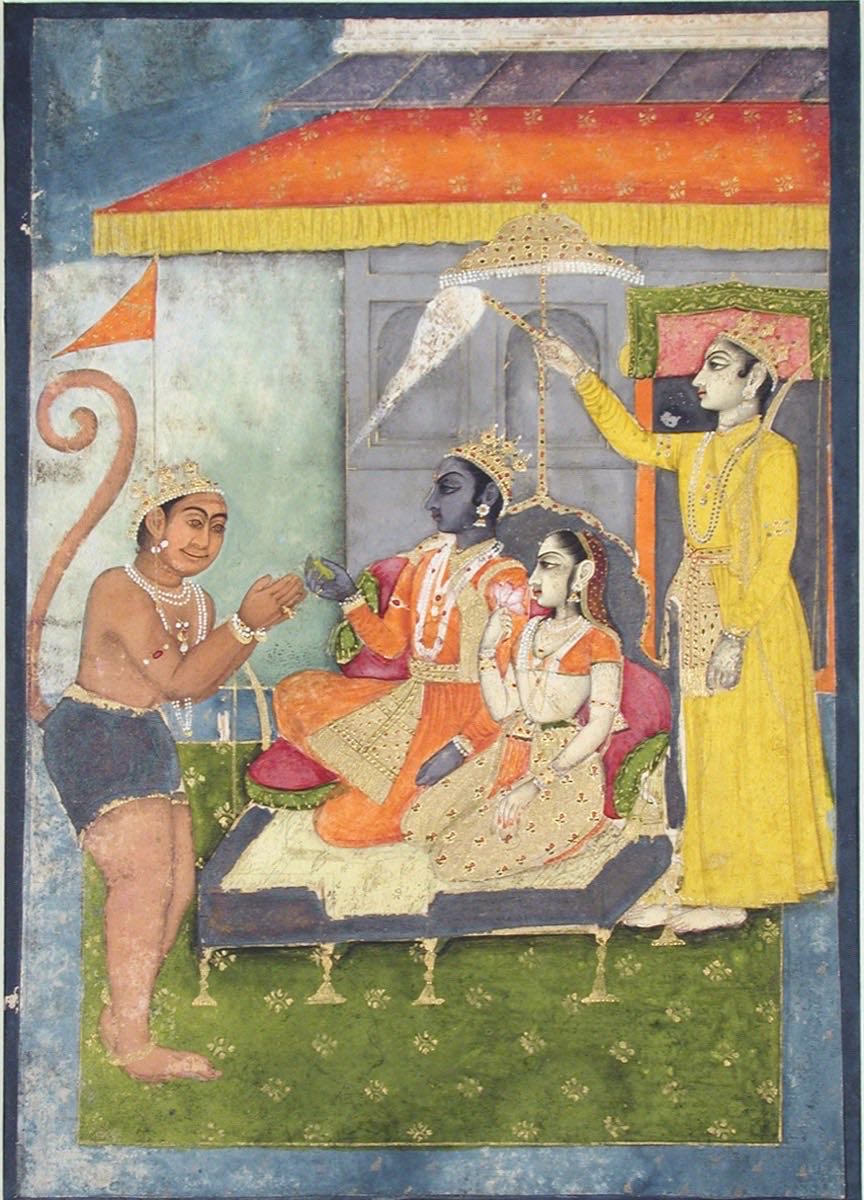
Among the vast treasury of devotional literature that India has produced over millennia, few hymns occupy a place as central and cherished as the Shri Ramchandra Stuti — formally known as Shri Ramchandra Kripalu Bhajman (श्री रामचन्द्र कृपालु भजु मन). Composed by the great poet-saint Gosvami Tulsidas (c. 1532—1623 CE) as part of his monumental devotional collection Vinaya Patrika, this stuti (hymn of praise) addresses the human mind directly, urging it to worship Lord Rama as the supreme refuge from the terrors of worldly existence. Recited daily in countless temples, homes, and ashrams across India, and forming an integral part of Rama aarti ceremonies, the Shri Ramchandra Stuti represents the very essence of Rama bhakti — devotion to the divine through the adoration of the Maryada Purushottama, the ideal man.
The Vinaya Patrika: Context of Composition
The Vinaya Patrika (विनय पत्रिका, literally “Petition of Humility”) is one of Tulsidas’s most important works, second only to the Shri Ramcharitmanas in its influence on North Indian devotional life. Composed between approximately 1609 and 1623 CE, the work consists of 279 devotional poems (pads) framed as humble petitions submitted to Lord Rama’s court, seeking spiritual liberation.
The conceit of the Vinaya Patrika is striking: Tulsidas imagines himself as a plaintiff in the divine court of Lord Rama, with Hanuman serving as the intercessor who carries his petitions. Each poem is a heartfelt appeal — for grace, for the removal of worldly attachment, for the strength to maintain devotion in the face of suffering. The collection is addressed to various deities — Ganesha, Shiva, Surya, Yamuna, Ganga — but the overwhelming majority of petitions are directed to Rama and Sita.
The Shri Ramchandra Kripalu Bhajman is identified as Pad 45 in standard editions of the Vinaya Patrika. Manuscripts show remarkable consistency across major recensions, with only minor orthographic variants (such as kripalu versus kripalu or vatapita versus pitambara) reflecting scribal conventions of 16th—17th century Awadhi manuscripts without altering the meaning. This textual stability speaks to the hymn’s early and widespread popularity, which ensured careful preservation.
Language and Poetic Structure
The Shri Ramchandra Stuti is composed in a distinctive blend of Sanskrit and Awadhi — the vernacular language of the eastern Hindi belt. This linguistic fusion was a hallmark of Tulsidas’s genius: Sanskrit lent the hymn classical gravitas and theological precision, while Awadhi made it accessible to the common devotee who may not have had formal training in the sacred language. This choice reflected the spirit of the broader Bhakti movement, which sought to democratize spiritual knowledge by moving beyond the Brahmanical monopoly on Sanskrit.
The poetic structure of the stuti follows a specific compositional form:
- Five Doha (couplets) at the beginning, setting the devotional tone
- Two Chanda (metrical verses) in the middle, forming the elaborate body of praise
- One Sortha (inverted doha) at the conclusion, serving as Tulsidas’s personal seal and prayer
This tripartite structure creates a natural arc: invocation, elaboration, and surrender — mirroring the devotional journey from initial aspiration through contemplation to complete self-offering.
Verse-by-Verse Analysis
Verse 1: The Call to Worship
श्री रामचन्द्र कृपालु भजु मन हरण भवभय दारुणम्। नवकञ्जलोचन कञ्जमुख करकञ्ज पदकञ्जारुणम्॥
“O mind, worship the compassionate Shri Ramachandra, who removes the terrible fear of worldly existence. His eyes are like fresh lotuses, his face is a lotus, his hands are lotuses, and his feet glow with the rosy hue of lotuses.”
The opening verse establishes the hymn’s fundamental theological claim: Rama is kripalu (compassionate), and through his grace alone can the devotee overcome bhavabhaya — the existential terror of samsara, the cycle of birth, death, and rebirth. The fourfold lotus imagery (kanja repeated four times) invokes the classical Indian aesthetic of divine beauty. In Sanskrit poetics, the lotus (padma or kanja) symbolizes purity, beauty, and transcendence — it grows in muddy water yet remains unstained, much as the divine manifests in the material world without being tainted by it. Each part of Rama’s body compared to a lotus — eyes, face, hands, feet — suggests that divinity pervades his entire being.
Verse 2: Beauty Beyond Measure
कन्दर्प अगणित अमित छवि नवनीलनीरद सुन्दरम्। पटपीत मानहुँ तडित रुचि शुचि नौमि जनकसुतावरम्॥
“His beauty surpasses countless Kamadevas (gods of love), and he is beautiful like a fresh dark-blue rain cloud. Clad in yellow garments that gleam like lightning against the cloud, I bow to the pure Lord, the beloved husband of Janaka’s daughter Sita.”
Here Tulsidas introduces the classical comparison of Rama’s dark complexion to a nila nirada (dark rain cloud) — an image found throughout Vaishnava poetry. The pita ambara (yellow garment) against the dark skin creates the visual metaphor of lightning against a monsoon cloud, an image of breathtaking natural beauty deeply familiar to Indian audiences. The verse concludes by identifying Rama as Janaka-suta-vara — the chosen husband of Sita, daughter of King Janaka. This is significant because in Rama bhakti, Sita and Rama are worshipped together as the divine couple; Rama’s compassion is inseparable from his relationship with Sita.
Verse 3: The Friend of the Afflicted
भजु दीनबन्धु दिनेश दानव दैत्यवंशनिकन्दनम्। रघुनन्द आनन्दकन्द कोसलचन्द दशरथनन्दनम्॥
“Worship the friend of the poor (Dinabandhu), the sun-like one, the destroyer of the lineages of demons and daityas. He is the joy of the Raghu dynasty, the root of bliss, the moon of Kosala, the delight of Dasharatha.”
This verse reveals Rama’s multifaceted identity. He is Dinabandhu (friend of the humble and afflicted) — an epithet central to the Bhakti understanding of God as one who is especially attentive to the prayers of the downtrodden. Simultaneously, he is the fierce destroyer of demonic forces (danava-daitya-vamsha-nikandanam). The verse then traces Rama’s earthly lineage: he is the scion of the Raghu dynasty (Raghunanda), the glory of the kingdom of Kosala (Kosalachandra), and the beloved son of King Dasharatha (Dasharathanandana). By anchoring the divine in specific genealogical and geographical detail, Tulsidas affirms the central Vaishnava doctrine that God truly incarnates in the world — not as an abstract principle, but as a historical person with family, kingdom, and relationships.
Verse 4: The Warrior King
सिर मुकुट कुण्डल तिलक चारु उदार अंग विभूषणम्। आजानुभुज शरचापधर संग्रामजित खरदूषणम्॥
“Adorned with a crown upon his head, earrings, a tilak mark, and beautiful, generous ornaments on his limbs. His arms extend to his knees, bearing bow and arrow, victorious in battle over Khara and Dushana.”
The fourth verse shifts to Rama’s royal and martial aspects. The description of ornaments — mukuta (crown), kundala (earrings), tilak (sacred forehead mark) — presents Rama as the resplendent king. The phrase ajanubhuja (arms reaching to the knees) is a traditional mark of the mahapurusha (great being) in Indian iconography, found in descriptions of both Rama and Vishnu. The reference to victory over Khara and Dushana — the powerful rakshasa (demon) commanders slain by Rama in the Aranyakanda of the Ramayana — establishes his credentials as a warrior. This is not merely physical prowess but the triumph of dharma over adharma, of cosmic order over chaos.
Verse 5: The Culminating Prayer
इति वदति तुलसीदास शंकर शेष मुनि मनरञ्जनम्। मम हृदयकञ्ज निवास कुरु कामादि खलदल गञ्जनम्॥
“Thus speaks Tulsidas: O Lord who delights the hearts of Shankara (Shiva), Shesha (the cosmic serpent), and the sages — reside in the lotus of my heart and destroy the wicked army of desire and other vices.”
The concluding verse is Tulsidas’s personal signature and the emotional climax of the stuti. By naming himself (iti vadati Tulsidas), the poet-saint follows the classical Indian convention of the bhanita — the poet’s seal that authenticates the composition. He invokes three great devotees of Rama: Shankara (Lord Shiva, who eternally chants Rama’s name), Shesha (Adishesha, the cosmic serpent upon whom Vishnu reclines), and the munis (sages). If even these exalted beings find delight in Rama, how much more should ordinary mortals seek refuge in him? The final prayer — mama hridaya-kanja nivasa kuru (“make your abode in the lotus of my heart”) — is the quintessential Bhakti plea: not for wealth, power, or even liberation, but simply for the Lord’s presence within.
Rama as Maryada Purushottama
The Shri Ramchandra Stuti celebrates Rama as the Maryada Purushottama — the supreme being who embodies perfect adherence to maryada (ethical boundaries, righteous conduct). This title, deeply rooted in the Ramayana tradition, captures what distinguishes Rama from other avatars of Vishnu. Where Krishna operates through divine play (lila) and transcends conventional morality, Rama demonstrates that the highest divinity can be expressed through perfect obedience to dharma.
The Ramayana of Valmiki (Ayodhyakanda 109.10) records the famous enumeration of Rama’s sixteen qualities — gunavana, viryavan, dharmajnah, kritajnah, satyavakyah, dridha-vratah — qualities that the stuti evokes through its imagery. When Tulsidas calls Rama kripalu (compassionate) and dinabandhu (friend of the poor), he draws on the Valmiki tradition while filtering it through the Bhakti lens that emphasizes God’s accessibility and love.
The Maryada Purushottama concept holds that Rama’s divinity is revealed not through supernatural displays alone but through his adherence to truth even at devastating personal cost: accepting fourteen years of exile to uphold his father’s word, treating every being with dignity regardless of caste or status, and governing Ayodhya with such justice that Rama Rajya became the Indian synonym for the ideal state.
The Devotional Tradition of Rama Worship
The Shri Ramchandra Stuti sits at the heart of the Rama bhakti tradition, one of the two great streams of Vaishnava devotion in India (the other being Krishna bhakti). The organized worship of Rama received its most powerful institutional expression through the Ramanandi Sampradaya, founded by the 14th-century saint Ramananda in Varanasi.
Ramananda shifted emphasis from the elaborate ritualism and Sanskrit-centric practices of southern Sri Vaishnavism toward an accessible, Rama-focused bhakti expressed in vernacular languages. His revolutionary approach — welcoming disciples regardless of caste, including Kabir, Ravidas, and others from marginalized communities — transformed the landscape of North Indian spirituality. The Ramanandi Sampradaya grew to become the largest Vaishnava sect in India, with 36 of the 52 sub-branches of Vaishnavism falling under its umbrella.
Tulsidas emerged from this tradition and gave it its most enduring literary expression. The Shri Ramchandra Stuti is recited as part of the standard Rama aarti in temples across North India. In major Rama temples — including the Ram Janmabhoomi Mandir in Ayodhya, the Kanak Bhawan, and the Hanuman Garhi — this stuti forms an integral part of daily worship. During Ram Navami (the celebration of Rama’s birth, falling on the ninth day of Chaitra Shukla), the recitation of this stuti reaches its annual crescendo, with thousands of devotees singing it collectively in temples and processions.
Relationship to Other Rama Stutis in Hindu Literature
The Hindu literary tradition contains numerous hymns of praise to Rama, and the Shri Ramchandra Stuti occupies a distinctive position among them:
Valmiki’s Rama Stuti (Yuddha Kanda, Sarga 117)
In the Valmiki Ramayana, after Rama’s victory over Ravana, Brahma himself reveals Rama’s true divine identity and praises him in a celebrated stuti. This hymn declares that those devoted to Rama “will never be unsuccessful on this earth” and “will forever attain their desired objects here as well as hereafter” (Valmiki Ramayana 6.117). Tulsidas’s stuti echoes this theme of Rama as the granter of all boons, but transforms it from a celestial pronouncement into a personal, intimate prayer.
Ram Raksha Stotra
The Ram Raksha Stotra, attributed to the sage Budha Kaushika and found in several Puranic traditions, is a protective hymn invoking Rama’s name for spiritual and physical safety. While the Ram Raksha Stotra emphasizes Rama’s protective power, Tulsidas’s stuti focuses more on Rama’s beauty, compassion, and the devotee’s longing for inner communion.
Rama Stutis in the Adhyatma Ramayana
The Adhyatma Ramayana (a text embedded within the Brahmanda Purana) contains several philosophically rich stutis that identify Rama with the formless Brahman of Advaita Vedanta. Tulsidas, while aware of this tradition, chose a different path: his stuti celebrates Rama’s saguna (with attributes) form, insisting that the beautiful, adorned, bow-wielding prince of Ayodhya is the highest expression of divinity.
Tulsidas’s Own Ramcharitmanas
Within the Ramcharitmanas itself, Tulsidas includes numerous passages of praise to Rama, particularly in the Balkanda and Uttarakanda. The Shri Ramchandra Stuti from the Vinaya Patrika differs in tone: while the Manas presents a narrative epic, the stuti is a concentrated, lyrical outpouring of adoration meant for repeated recitation and meditation.
Recitation Traditions and Spiritual Benefits
The Shri Ramchandra Stuti is traditionally recited in several devotional contexts:
- Daily Aarti: The stuti is sung as part of the evening aarti in temples dedicated to Rama, typically accompanied by bells, lamps, and incense.
- Ram Navami: On this most sacred day of the Rama calendar, the stuti is recited as part of elaborate worship ceremonies marking the birth of Lord Rama in Ayodhya.
- Ekadashi Observance: Many devotees include this stuti in their Ekadashi prayers, combining it with Vishnu Sahasranama or other Vaishnava texts.
- Personal Sadhana: Devotees who undertake a niyama (spiritual discipline) of reciting this stuti a fixed number of times (traditionally 11 times over 11 days) believe it brings Rama’s grace in abundance.
The tradition holds that regular recitation of the stuti purifies the mind of the six enemies (shadripu) — kama (desire), krodha (anger), lobha (greed), moha (delusion), mada (pride), and matsarya (jealousy) — the very “wicked army” (khala-dala) that Tulsidas asks Rama to vanquish in the final verse.
The Ayodhya Connection
Ayodhya — the birthplace of Lord Rama on the banks of the Sarayu River in present-day Uttar Pradesh — is inextricably linked with the devotional ecosystem in which the Shri Ramchandra Stuti thrives. The city has been a pilgrimage centre for Rama devotees for millennia, and the stuti resonates with particular power when chanted within its sacred precincts.
The description of Rama as Kosalachandra (“moon of Kosala”) in the third verse is a direct geographical anchor: Kosala was the ancient kingdom whose capital was Ayodhya. Tulsidas, who spent significant periods of his life in both Varanasi and Ayodhya, composed poetry that breathes the air of these sacred cities. The Vinaya Patrika’s conceit of petitioning Rama’s court would have had immediate resonance for devotees familiar with Ayodhya as the site of Rama’s earthly kingdom.
With the consecration of the Ram Janmabhoomi Mandir in Ayodhya in 2024, the Shri Ramchandra Stuti has gained renewed prominence in national devotional life, being featured in the temple’s regular worship schedule and broadcast during major ceremonies.
Musical and Performance Traditions
The Shri Ramchandra Stuti has been set to music in numerous ragas and performance styles. Classical musicians have rendered it in ragas such as Yaman, Bhairavi, and Des, each bringing a different emotional texture. The hymn’s rhythmic structure — with its internal rhymes and alliterative patterns (kanja-lochana kanja-mukha kara-kanja pada-kanjarunam) — lends itself naturally to melodic treatment.
The stuti has been recorded and popularized by legendary performers including Lata Mangeshkar, Hari Om Sharan, and Anuradha Paudwal, among many others. These recordings have carried the hymn beyond the temple into millions of homes, ensuring its transmission to new generations.
Theological Significance
At its deepest level, the Shri Ramchandra Stuti articulates a theology of grace (kripa). The very first word after “Shri Ramchandra” is kripalu — compassionate, gracious. This is not incidental; it is the theological key to the entire hymn. Tulsidas does not begin by praising Rama’s power, his kingship, or even his beauty. He begins with compassion, because in the Bhakti worldview, it is God’s grace alone that bridges the infinite gap between the finite human soul and the infinite divine.
The hymn’s repeated address to the mind (mana) is equally significant. In the Indian philosophical tradition, the mind is the instrument of both bondage and liberation. By directing the mind to worship Rama — to fill its attention with the beauty, compassion, and righteousness of the divine — the devotee transforms the very faculty that generates suffering into the vehicle of salvation. This is the essence of bhakti yoga as Tulsidas understood it: not the renunciation of the world, but the redirection of the heart toward God.
The Shri Ramchandra Stuti thus stands as one of the most perfect expressions of devotional Hinduism — a hymn that is at once theologically profound and emotionally immediate, scholarly and popular, ancient in its roots and eternally fresh in its appeal. For over four centuries, it has helped millions of devotees turn their minds toward the lotus feet of Sri Rama, finding in his compassionate gaze the courage to face the terrors of existence and the hope of ultimate liberation.