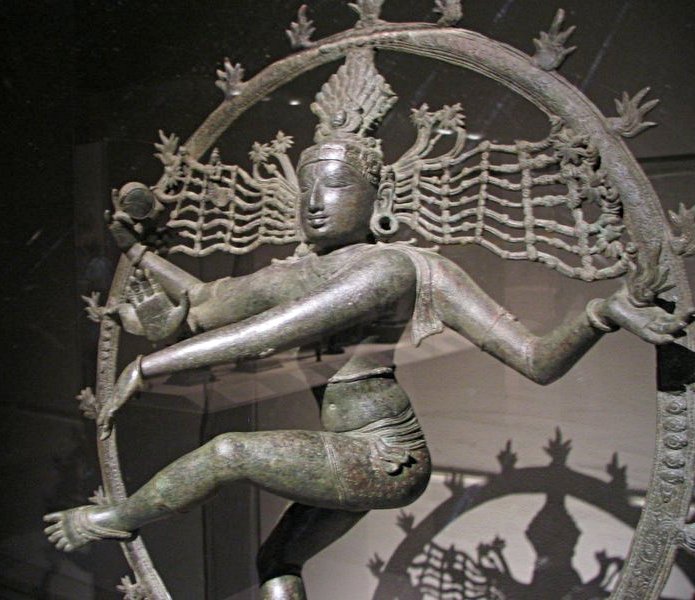
The Shrī Rudram, also known as Rudrapraśna or Śatarudrīya, stands as the most revered and powerful Vedic hymn dedicated to Lord Rudra-Shiva. Found in the fourth kāṇḍa (book) of the Taittirīya Saṃhitā of the Krishna Yajurveda (TS 4.5 and 4.7), this sacred text comprises two complementary sections — the Namakam and the Chamakam — each containing eleven anuvakas (hymns). Together, they form a comprehensive liturgical composition that simultaneously praises Rudra’s cosmic omnipresence and petitions for divine blessings across all dimensions of existence.
The Two Parts: Namakam and Chamakam
Namakam (TS 4.5): Salutations to Rudra
The first part of the Shrī Rudram derives its name from the repeated use of the word “namaḥ” (salutation, “I bow”). The Namakam is found in the fifth prapāṭhaka (chapter) of the fourth kāṇḍa of the Taittirīya Saṃhitā. Its eleven anuvakas systematically address Rudra’s multifaceted nature — from his terrifying, destructive aspects to his supremely compassionate and healing manifestations.
The opening invocation sets the tone for the entire composition:
oṃ namo bhagavate rudrāya namaste rudra manyava utota iṣave namaḥ namaste astu dhanvane bāhubhyāmuta te namaḥ
“Om, salutations to the blessed Lord Rudra. Salutations to your wrath, and also to your arrow. Salutations to your bow, and to your arms.”
This opening acknowledges Rudra’s fierce nature while seeking his benevolence — a theological pattern that pervades the entire Namakam.
Chamakam (TS 4.7): Petitions for Blessings
The second part takes its name from the repeated phrase “cha me” (“and for me”), found in the seventh prapāṭhaka of the same kāṇḍa. While the Namakam offers reverence, the Chamakam makes explicit requests. The devotee, having acknowledged Rudra’s supreme sovereignty in the Namakam, now asks for blessings spanning material prosperity, physical health, spiritual wisdom, and cosmic harmony.
The Eleven Anuvakas of the Namakam
Each anuvaka of the Namakam addresses a distinct dimension of Rudra’s cosmic presence:
Anuvaka 1: The foundational invocation addressing Rudra’s wrath, arrows, bow, and arms. Contains fifteen mantras that transition from acknowledging Rudra’s terrifying weaponry to requesting that those same weapons become instruments of protection. Sāyaṇa notes that Rudra’s anger and arrows should be “active in destroying enemies, but not in me.”
Anuvaka 2: Identifies Rudra in his benevolent form as the blue-throated (Nīlagrīva) and red-bodied one. Describes Rudra as the lord of forests, fields, pathways, and rivers.
Anuvaka 3: Recognizes Rudra’s presence in all social roles — as the lord of thieves, robbers, and those who dwell in darkness. This anuvaka reveals the radical theology of Rudra’s omnipresence in even the most marginal figures of society.
Anuvaka 4: Addresses Rudra as present in artisans, craftsmen, hunters, and chariot-makers. The hymn sees divine manifestation in every occupation and profession.
Anuvaka 5: Salutes Rudra as present in natural phenomena — trees, plants, leaves, and herbs. The ecological dimension of Rudra’s cosmic presence is fully elaborated here.
Anuvaka 6: Identifies Rudra in water, rain, clouds, lightning, and storms. The connection between Rudra and the cosmic forces of nature reaches its fullest expression.
Anuvaka 7: Addresses Rudra as the lord of birds, cattle, and all living creatures. Every animal form is recognized as a manifestation of the divine.
Anuvaka 8: Contains the celebrated Pañchākṣarī Mantra — “namaḥ śivāya” — which appears at TS 4.5.8. This is the origin of the most widely recited Shaiva mantra, Oṃ Namaḥ Śivāya, though in the Vedic source it appears without the syllable Oṃ.
Anuvaka 9: Praises Rudra as Bhava, Śarva, Paśupati, and Nīlagrīva, listing his most celebrated epithets and establishing his identity with the later Purāṇic Shiva.
Anuvaka 10: Contains the famous Mṛtyuñjaya Mantra (the death-conquering mantra) and invocations for protection from disease, suffering, and untimely death.
Anuvaka 11: The concluding section offers comprehensive salutations requesting Rudra’s grace and asks him to reveal his most auspicious form, turning away his fierce manifestations.
The Eleven Anuvakas of the Chamakam
The Chamakam’s eleven anuvakas systematically request blessings across every domain of existence:
Anuvaka 1: Fundamental blessings — strength (balam), longevity (āyuḥ), vitality (ojas), knowledge (vidyā), skill, protection, and physical well-being.
Anuvaka 2: Leadership qualities, brilliance, growth, truth (satyam), faith (śraddhā), prosperity, and wisdom.
Anuvaka 3: Peace (śānti), desire-fulfillment, wealth, health, longevity, knowledge, comfort, and fearlessness.
Anuvaka 4: Nourishment, agricultural abundance — grains, milk, honey, ghee, and vital food resources.
Anuvaka 5: Natural resources — metals, fire, water, medicinal plants, and animal wealth, connecting material prosperity with spiritual abundance.
Anuvaka 6: Blessings from specific deities — Agni, Soma, Sarasvatī, Viṣṇu, and Indra — invoked alongside Rudra.
Anuvaka 7: Ritual vessels for Soma sacrifices, representing the offering of self to the divine.
Anuvaka 8: Components for Vedic rituals — sacred materials and purification elements ensuring the sanctity of sacrificial rites.
Anuvaka 9: Cosmic elements — fire, sun, life force (prāṇa), earth, seasons, and the sacred Vedic texts themselves.
Anuvaka 10: Fertility, livestock, life energy, and blessings obtained through sacrificial rituals.
Anuvaka 11: The celebrated numerical sequence — blessings invoked through odd numbers (1, 3, 5, 7… up to 33) representing divine numbers and even numbers (4, 8, 12, 16… up to 48) representing human completeness. This mathematical mysticism is unique in Vedic literature.
Rudra as Cosmic Principle
The Shrī Rudram’s theology transcends simple devotional praise. Rudra is presented not merely as a deity but as an all-pervading cosmic principle. The Namakam systematically identifies Rudra with every aspect of creation — from the mightiest storm to the humblest blade of grass, from the most exalted king to the lowliest thief.
This radical inclusiveness reflects the Upaniṣadic insight that the divine permeates all reality without exception. The hymn recognizes that Rudra dwells equally in the beautiful and the terrifying, in creation and destruction, in life and death. As commentator Sāyaṇa explains, Rudra is identified with the sun (Āditya) in his visible form, making him accessible to all beings.
The dual nature of Rudra — simultaneously ugra (fierce) and śiva (auspicious) — serves as the theological foundation for the entire Namakam. The devotee does not deny or ignore the destructive power of the divine but instead seeks to transform that power into benevolence through devoted worship.
Significance in Shaiva and Smārta Traditions
The Shrī Rudram holds a position of supreme importance in both the Shaiva and Smārta traditions of Hinduism:
In the Shaiva tradition, the Shrī Rudram is considered the highest Vedic authority for Shiva worship. The Shaiva Siddhānta and Vīraśaiva traditions regard it as the foundational scriptural testimony (śruti pramāṇa) establishing Shiva’s supremacy. The derivation of the Pañchākṣarī Mantra from the eighth anuvaka gives the Shrī Rudram a unique liturgical authority.
In the Smārta tradition, established by Ādi Śaṅkarācārya, the Shrī Rudram occupies a central role in the worship of Shiva as one of the five principal deities (Pañchāyatana Pūjā). Smārta Brāhmaṇas recite the Rudram as part of their daily Vedic duties (nitya karma).
The hymn is also referenced extensively in the Mahābhārata, various Purāṇas, and the Āgamas, all of which amplify its spiritual significance and prescribe its recitation for specific benefits.
Rudrābhiṣekam: The Sacred Ritual
The most prominent ritual application of the Shrī Rudram is the Rudrābhiṣekam (Rudra Abhiṣeka), a ceremonial bathing of the Shiva Liṅga performed while chanting the Namakam and Chamakam. During this ritual:
- The Namakam is chanted while the Liṅga is bathed with various sacred substances — milk, yogurt, honey, ghee, sugarcane juice, and water
- The Chamakam follows, with each anuvaka’s petitions consecrated through the ritual bathing
- Ekādasha Rudrābhiṣekam involves eleven repetitions of the complete text by eleven priests simultaneously
- Mahā Rudrābhiṣekam involves 121 repetitions (11 x 11), and the grand Ati Rudram involves 14,641 repetitions (11^4)
This ritual is considered one of the most powerful Vedic ceremonies for removing obstacles, healing diseases, destroying negative karma, and attaining spiritual liberation (mokṣa).
Sāyaṇa’s Commentary
Sāyaṇācārya (14th century CE), the great Vedic commentator from the Vijayanagara Empire, provided the most authoritative traditional commentary on the Shrī Rudram. His bhāṣya (commentary) on the Taittirīya Saṃhitā includes detailed word-by-word analysis of both the Namakam and Chamakam.
Sāyaṇa’s key interpretive contributions include:
- Identifying Rudra’s weapons (bow, arrows) with cosmic forces such as sun rays and rain
- Explaining that Rudra’s “peaceful form” (śivā tanū) is the one “free from ignorance” (avidyā-rahita)
- Connecting the hymn’s imagery with the Upaniṣadic philosophy of Brahman
- Providing ritual context (viniyoga) for each anuvaka, specifying which mantras are used in particular Vedic ceremonies
His commentary remains indispensable for serious study of the Shrī Rudram and continues to inform both traditional recitation and academic scholarship.
Place in the Krishna Yajurveda
The Shrī Rudram’s location within the Taittirīya Saṃhitā of the Krishna Yajurveda is significant. Unlike the Shukla (White) Yajurveda, which separates mantras from their ritual instructions, the Krishna (Black) Yajurveda interweaves both. This means the Shrī Rudram exists not as an isolated hymn but as an integral part of the sacrificial liturgy.
The text occupies chapters 4.5 (Namakam) and 4.7 (Chamakam) of the Taittirīya Saṃhitā, with chapter 4.6 containing prose explanations (brāhmaṇa) that provide ritual context. This tripartite structure — praise, explanation, petition — mirrors the broader Vedic pattern of relating mantra, meaning, and application.
The Taittirīya recension is the most widely followed tradition for Shrī Rudram chanting, particularly in South India, where the unbroken tradition of Vedic recitation has preserved the exact intonation (svara) patterns that date back millennia.
Recitation and Spiritual Practice
Traditional recitation of the Shrī Rudram follows strict Vedic phonetic rules including proper svara (pitch accent), mātrā (syllable length), and saṃdhi (euphonic combinations). The three tonal accents — udātta (raised), anudātta (lowered), and svarita (circumflex) — are meticulously preserved in the oral tradition.
The Shrī Rudram is recited on various occasions:
- Daily practice (nitya karma) by Vedic Brāhmaṇas
- Pradoṣa Kāla (the auspicious twilight period sacred to Shiva)
- Mahā Śivarātri, the great night of Shiva
- Mondays (Somavāra), the day sacred to Shiva
- During Rudrābhiṣekam ceremonies at temples and homes
- For healing, protection, and spiritual purification
The cumulative effect of regular recitation is described in traditional texts as purifying the mind, removing the accumulated effects of negative karma, and ultimately leading to the direct realization of Rudra-Shiva as the supreme, all-pervading reality.