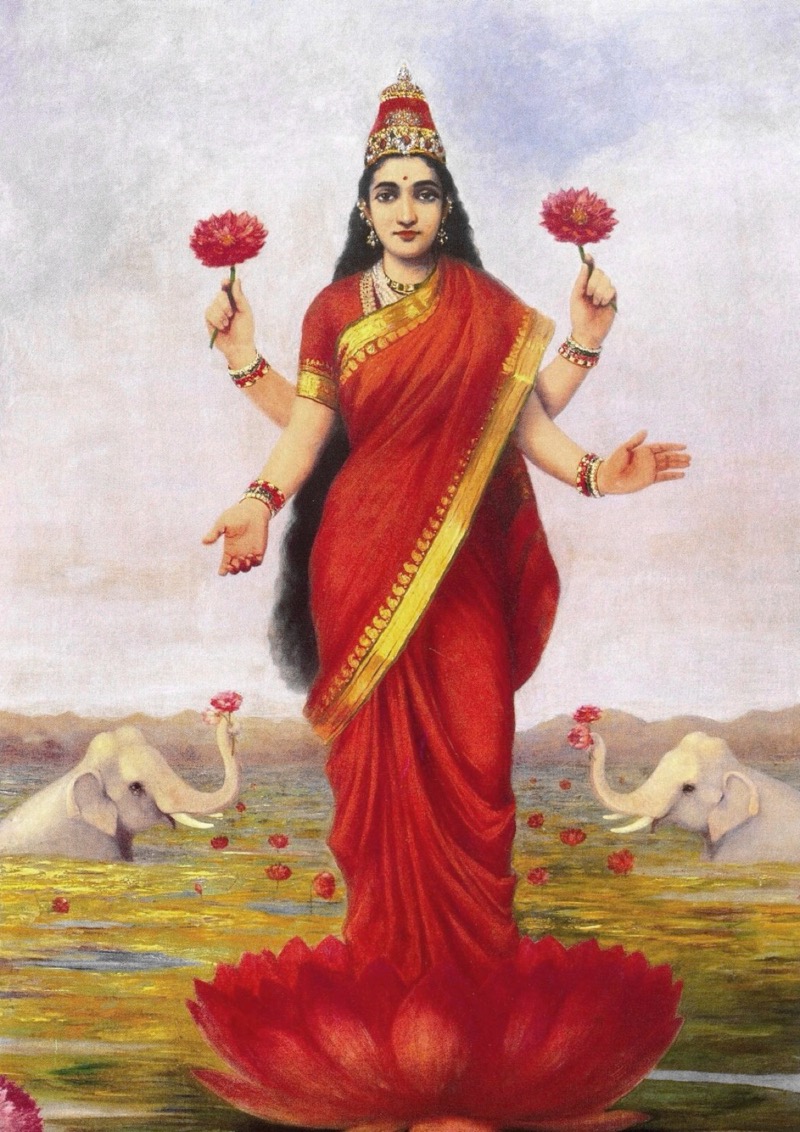
The Śrī Sūktam is one of the most ancient and revered Vedic hymns dedicated to Goddess Lakṣmī, the divine embodiment of prosperity, beauty, grace, and sovereign power. Found in the Khilāni (supplement) of the Ṛgveda, this sixteen-verse hymn has been chanted for millennia in homes, temples, and fire rituals across the subcontinent, invoking the blessings of Śrī — the luminous goddess who bestows both material abundance and spiritual fulfilment.
The Complete Opening Verse
हिरण्यवर्णां हरिणीं सुवर्णरजतस्रजाम्। चन्द्रां हिरण्मयीं लक्ष्मीं जातवेदो म आवह॥
IAST Transliteration: Hiraṇyavarṇāṃ Hariṇīṃ Suvarṇarajatasrajām | Candrāṃ Hiraṇmayīṃ Lakṣmīṃ Jātavedo Ma Āvaha ||
Translation: “O Jātavedas (Agni, the all-knowing Fire), bring to me Lakṣmī — she who is golden-hued, deer-like in grace, adorned with garlands of gold and silver, radiant as the moon, and resplendent with golden lustre.”
Source and Antiquity
The Śrī Sūktam belongs to the Khilāni — a collection of supplementary hymns appended to the Ṛgveda. While some scholars classify these khila sūktas as later additions to the Vedic corpus, the linguistic and metrical analysis places the Śrī Sūktam in the late Vedic period (circa 800-600 BCE), making it contemporaneous with the early Upaniṣads.
The hymn is traditionally attributed to multiple ṛṣis, with the Anukramaṇī (Vedic index) listing several seers. The verses employ the Anuṣṭubh and Triṣṭubh metres, characteristic of mature Vedic poetry. The Śrī Sūktam is preserved in both the Bāṣkala and Śāṅkhāyana recensions of the Ṛgveda, attesting to its wide acceptance across Vedic schools.
The Sixteen Verses: A Thematic Overview
Verses 1-4: Invocation through Agni
The hymn opens with a remarkable invocation addressed not directly to Lakṣmī but to Jātavedas (Agni, the sacred fire), requesting him to bring the goddess to the devotee. This establishes the Śrī Sūktam firmly within the Vedic yajña (fire sacrifice) tradition, where Agni serves as the intermediary between humans and devas.
The first four verses describe Lakṣmī’s resplendent physical form: she is hiraṇyavarṇā (golden-complexioned), hariṇī (graceful as a deer), adorned with suvarṇa-rajata-srajā (garlands of gold and silver), and radiant as the moon (candrā). These verses invoke Agni to bring her and to drive away her sister Alakṣmī (misfortune), establishing the fundamental duality of fortune and misfortune.
तां म आवह जातवेदो लक्ष्मीमनपगामिनीम्। यस्यां हिरण्यं विन्देयं गामश्वं पुरुषानहम्॥
“O Jātavedas, bring to me that Lakṣmī who does not depart — she through whom I may obtain gold, cattle, horses, and descendants.”
Verses 5-8: Lakṣmī’s Cosmic Attributes
The middle portion of the hymn expands Lakṣmī’s identity beyond mere wealth. She is called ārdrā (moist, compassionate), associated with the fertility of rain-bearing clouds. She is puṣkarīṇī (she of the lotuses), linking her to the cosmic lotus that symbolises creation itself. The famous verse declares:
पद्मप्रिये पद्मिनि पद्महस्ते पद्मालये पद्मदलायताक्षि। विश्वप्रिये विष्णुमनोऽनुकूले त्वत्पादपद्मं मयि सन्निधत्स्व॥
“O lover of lotuses, O lotus-dwelling one, lotus-handed, lotus-abode, lotus-petal-eyed, beloved of the universe, dear to Viṣṇu’s heart — place your lotus feet upon me.”
This verse establishes the profound connection between Lakṣmī and the lotus (padma), which in Vedic symbolism represents purity, creation emerging from primordial waters, and the unfolding of consciousness.
Verses 9-12: The Cosmic Sovereignty of Śrī
These verses elevate Lakṣmī from a goddess of household prosperity to the cosmic sovereign. She is identified with kīrti (fame), ṛddhi (growth), and samṛddhi (complete prosperity). The hymn declares that Śrī pervades all of existence:
The concept of Śrī in Vedic thought extends far beyond material wealth. The Śatapatha Brāhmaṇa (11.4.3.1) identifies Śrī with royal glory, priestly power, and the splendour of the natural world. The Śrī Sūktam inherits this expansive understanding, presenting Lakṣmī as the vital force that sustains all forms of abundance — from agricultural fertility to intellectual brilliance.
Verses 13-16: Invocation of Permanent Blessing
The concluding verses are prayers for Lakṣmī’s permanent residence in the devotee’s life. The hymn pleads that she should not depart (anapagāminī), distinguishing the stable, meritorious form of Śrī from the fickle fortune that comes and goes. The final verse returns to the fire-ritual context, offering oblations to ensure Lakṣmī’s continued presence.
Significance in Vedic Fire Rituals
The Śrī Sūktam holds a unique position among Vedic hymns because of its integral connection to yajña (fire sacrifice). The repeated address to Jātavedas (Agni) is not merely poetic convention but reflects the actual ritual practice of chanting these verses during homa (fire offerings).
In the Āpastamba Gṛhya Sūtra and the Āśvalāyana Gṛhya Sūtra, the Śrī Sūktam is prescribed for specific domestic fire rituals aimed at prosperity. The hymn is chanted while offering ghee (clarified butter), lotus flowers, and bilva (wood apple) leaves into the sacred fire, each offering corresponding to specific verses.
The Lakṣmī Homa — a fire ritual dedicated exclusively to Lakṣmī — uses the Śrī Sūktam as its primary liturgical text. In this ritual, the sixteen verses are chanted in sequence with specific offerings at each verse, creating a systematic invocation of all aspects of Lakṣmī’s grace.
Role in Lakṣmī Pūjā and Dīvālī
The Śrī Sūktam is the most important liturgical text in the annual Lakṣmī Pūjā, which is the central ritual of Dīvālī (Dīpāvali) — the festival of lights celebrated across India in the month of Kārtika (October-November).
During Dīvālī Lakṣmī Pūjā, the Śrī Sūktam is chanted in its entirety while the priest or householder performs ṣoḍaśopacāra pūjā (sixteen-fold worship) before an image or mūrti of Lakṣmī. The sixteen verses of the Śrī Sūktam are often correlated with the sixteen offerings (āvāhana, āsana, pādya, arghya, ācamanīya, snāna, vastra, yajñopavīta, gandha, puṣpa, dhūpa, dīpa, naivedya, tāmbūla, dakṣiṇā, and pradakṣiṇā).
In South Indian temples, particularly those following the Pāñcarātra Āgama, the Śrī Sūktam is chanted daily during the Abhiṣeka (ritual bathing) of the Lakṣmī image. The Tirumala Tirupati Devasthānam includes the Śrī Sūktam in its regular worship of Padmāvatī (Lakṣmī) at the temple in Tiruchanur.
Lakṣmī’s Attributes as Described in the Hymn
The Śrī Sūktam presents a remarkably detailed portrait of Lakṣmī through a series of vivid epithets:
- Hiraṇyavarṇā — Golden-complexioned, symbolising the warmth and radiance of prosperity
- Hariṇī — Graceful as a deer; also interpreted as “remover of sins” (from hṛ, to take away)
- Candrā — Luminous as the moon, embodying cool, soothing beauty
- Ārdrā — Moist, compassionate; associated with life-giving rain
- Padmapriyā — Lover of lotuses, symbolising purity amid worldly existence
- Padmahastā — Lotus-handed, the gesture of bestowing blessings
- Padmālayā — Lotus-dwelling, her divine abode
- Viṣṇumanānukūlā — She whose mind is ever in accord with Viṣṇu
This last epithet is theologically significant. The Viṣṇu Purāṇa (1.8.15) declares that as Viṣṇu pervades the universe, so does Śrī: “As Viṣṇu is all-pervading, so is Śrī. He is meaning; she is speech. He is conduct; she is policy. Viṣṇu is the creator; Śrī is creation.” The Śrī Sūktam’s reference to Lakṣmī as “dear to Viṣṇu’s heart” establishes the inseparable divine couple that later Vaiṣṇava theology would elaborate extensively.
Philosophical Dimensions
The Duality of Śrī and Alakṣmī
A distinctive feature of the Śrī Sūktam is its explicit mention of Alakṣmī — the goddess of misfortune, poverty, and inauspiciousness. The hymn prays to Agni to drive away Alakṣmī while bringing Śrī. This is not merely a prayer for material gain but a profound philosophical statement about the paired nature of fortune and misfortune in the phenomenal world.
The Taittirīya Āraṇyaka commentary tradition explains this duality through the concept of karma — positive karma attracts Śrī, while negative karma draws Alakṣmī. The Śrī Sūktam’s invocation is thus simultaneously a prayer for divine grace and a commitment to righteous action.
Śrī as the Creative Power of Brahman
In the Śrī Vaiṣṇava theological tradition, particularly as articulated by Rāmānujācārya in his Vedārthasaṅgraha, the Śrī Sūktam is a foundational text for understanding Lakṣmī as the śakti (power) of Nārāyaṇa. Śrī is not merely a consort but the dynamic creative energy through which the Lord sustains the cosmos. Rāmānuja’s concept of Śrī as puruṣakāra (mediatrix) — she who mediates between the erring soul and the Lord — draws directly from the Śrī Sūktam’s imagery of Lakṣmī as the compassionate (ārdrā) goddess who turns Viṣṇu’s justice toward mercy.
Daily Recitation and Spiritual Practice
Beyond the grand rituals, the Śrī Sūktam is widely chanted as a daily practice (nitya pārāyaṇa) for spiritual and material well-being. Traditional prescriptions recommend chanting the hymn:
- On Fridays — the day sacred to Lakṣmī
- During Navarātri — especially the last three nights dedicated to Lakṣmī
- At dawn and dusk — as part of daily worship
- During business openings — invoking Lakṣmī’s blessings for new ventures
The Nārāyaṇīyam by Melpathur Nārāyaṇa Bhaṭṭatiri mentions that the regular chanting of the Śrī Sūktam with faith and devotion removes poverty, sickness, and sorrow, and brings the devotee into alignment with the divine will.
The Living Tradition
The Śrī Sūktam remains one of the most widely chanted Vedic hymns in contemporary Hinduism. From the grand Kanakadhārā festivals of Kerala to the simple household pūjā during Dīvālī, from the ornate temple rituals of Tirupati to the meditative chanting in ashrams, this ancient hymn continues to serve as a living bridge between the Vedic fire altar and the modern devotee’s heart. In its luminous verses, the eternal Śrī — golden, compassionate, and ever-gracious — continues to answer the prayer of those who call upon her through the sacred fire of devotion.