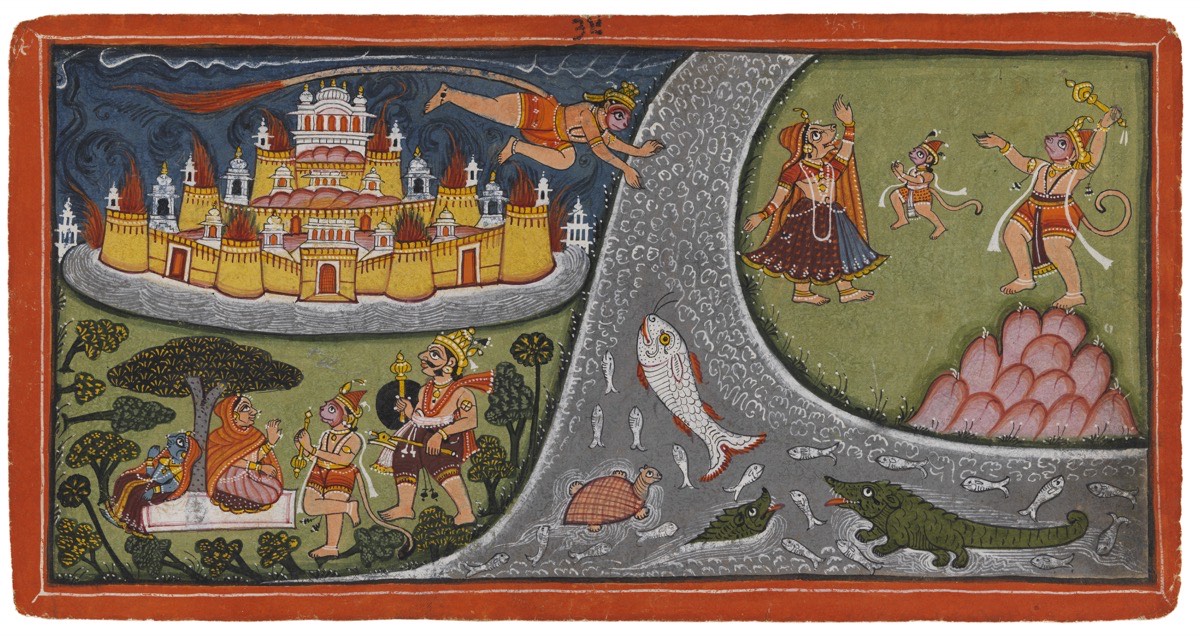
The Sundarakāṇḍa (Sanskrit: सुन्दरकाण्ड, “The Beautiful Chapter”) is the fifth of seven books (kāṇḍas) in the Vālmīki Rāmāyaṇa, and the fifth of seven chapters (sopānas) in Tulasīdāsa’s Rāmacaritamānasa. It holds a singular distinction in the entire epic: it is the only section where the central hero is not Śrī Rāma but Hanumān, the devoted vānara warrior who crosses the ocean to find Sītā in the island fortress of Laṅkā. With its narrative of courage, devotion, ingenuity, and divine grace, the Sundarakāṇḍa has become the most independently recited portion of the Rāmāyaṇa across Hindu households and temples worldwide.
Why Is It Called “Sundara” (Beautiful)?
The word sundara means “beautiful” in Sanskrit, and several traditional and scholarly explanations exist for why Vālmīki chose this title:
-
Poetic beauty of description: The text contains exquisite descriptions of beautiful objects, places, and beings — Laṅkā’s golden citadel, the Puṣpaka Vimāna, the Aśoka grove, Sītā’s radiance, Hanumān’s luminous form, and even Rāvaṇa’s imposing grandeur (Vālmīki Rāmāyaṇa, Sundara Kāṇḍa 2.5—19).
-
Hanumān’s epithet: Hanumān himself bears the name “Sundara” (the handsome one). Vālmīki describes him as kāñcana-parvata-ābhāsam — “shining like a golden mountain” (Sundara Kāṇḍa 1.198).
-
Auspiciousness of every act: Every event described in this book — from the ocean crossing to Sītā’s consolation to the burning of Laṅkā — culminates in spiritual victory. The commentator Tilaka wrote: “Beautiful is Laṅkā, beautiful is the narrative, beautiful is Sītā — what in this section is not beautiful?”
-
The triumph of dharma: This is the turning point of the epic where despair gives way to hope. Sītā receives the assurance that rescue is coming, and the invincible facade of Rāvaṇa’s empire is shattered for the first time.
The word sundara appears over forty times in the original text, and Śrī Rāma’s name is mentioned more than thirty times, reinforcing both the aesthetic and devotional beauty of the chapter.
Two Great Versions: Vālmīki and Tulasīdāsa
Vālmīki’s Sundara Kāṇḍa (Sanskrit)
The original Sundara Kāṇḍa in the Vālmīki Rāmāyaṇa consists of 68 sargas (chapters) containing approximately 2,885 ślokas (verses) in classical Sanskrit. It is the most meticulously composed section of the epic, with elaborate alaṃkāra (poetic ornamentation) and vivid rasa (aesthetic sentiment). The predominant rasa is vīra (heroic), interwoven with karuṇa (compassion) during the Sītā episodes and adbhuta (wonder) during Hanumān’s supernatural feats.
Vālmīki’s version is recited in Vedic pāṭhaśālās and forms the basis for Sundara Kāṇḍa parayana in South Indian traditions, particularly in Andhra Pradesh, Tamil Nadu, and Karnataka.
Tulasīdāsa’s Sundarakāṇḍa (Awadhī)
Gosvāmī Tulasīdāsa (c. 1532—1623 CE) retold the Rāmāyaṇa in the Awadhī vernacular as the Śrīrāmacaritamānasa (c. 1574 CE). His Sundarakāṇḍa, while following the same narrative arc, is distinctly devotional (bhakti) in tone. It opens with invocations to Gaṇeśa, Sarasvatī, Śiva-Pārvatī, Vālmīki, Hanumān, Sītā, and Rāma, and is narrated within the frame story of Śiva explaining the Rāma-kathā to Pārvatī.
Tulasīdāsa’s version is the one most commonly recited in North Indian households, and when devotees refer to “Sundarkāṇḍ Pāṭh,” they typically mean this Awadhī text.
Narrative Summary: The Journey of Hanumān
The Great Leap Across the Ocean (Sargas 1—3)
The Sundarakāṇḍa begins where the Kiṣkindhā Kāṇḍa leaves off. The vānara search parties have reached the southern shore of the ocean, and only Hanumān possesses the strength to cross the hundred-yojana expanse to Laṅkā. Jāmbavān reminds Hanumān of his forgotten powers, and the mighty vānara ascends Mount Mahendra, assumes a colossal form, and leaps into the sky.
Vālmīki’s description of the leap is among the most celebrated passages in Sanskrit poetry. The ocean churns beneath Hanumān’s shadow, celestial beings watch in awe, and flowers rain from the heavens.
Encounter with Mainākā (Sarga 1)
The mountain Mainākā, submerged in the ocean, rises from the waters to offer Hanumān a resting place. This episode symbolizes the support that nature and the divine offer to those on a righteous mission. Hanumān graciously touches the mountain but declines rest, pressing on with single-minded focus.
The Test of Surasā (Sarga 1)
The Devas send Surasā, mother of the Nāgas, to test Hanumān’s wisdom. She appears as a gargantuan sea-creature and declares that none may pass without entering her mouth. Hanumān expands his form; she expands hers further. In a brilliant tactical move, Hanumān shrinks to the size of a thumb, enters and exits her mouth in an instant, fulfilling the condition without delay. Surasā blesses him, confirming his mission will succeed.
Defeating Siṃhikā (Sarga 1)
The rākṣasī Siṃhikā (also called Chāyāgrahī, “shadow-seizer”) lurks in the ocean and catches Hanumān by grasping his shadow. This is a test of raw power. Hanumān expands his body, tears open her jaws, and slays her. The celestial onlookers shower praise: “One who has wisdom, courage, intellect, and skill will never fail” (Sundara Kāṇḍa 1.199).
Arrival in Laṅkā and the Laṅkinī Encounter (Sargas 2—4)
Hanumān arrives at Laṅkā at night, shrinking to the size of a cat to enter the fortified city undetected. At the gate, the guardian goddess Laṅkinī challenges him. Hanumān strikes her with his left fist, and she realizes the prophecy: “When a vānara defeats me, the end of the rākṣasas is near.” She grants him entry.
Searching Laṅkā (Sargas 5—11)
Hanumān searches every palace, garden, and chamber of the magnificent city. Vālmīki lavishes description on Laṅkā’s architecture — its crystal walls, golden towers, and gem-studded terraces. Hanumān enters Rāvaṇa’s inner apartments and even the Puṣpaka Vimāna, but does not find Sītā. He briefly despairs but steels himself with the resolve of a true devotee.
The Aśoka Vāṭikā: Finding Sītā (Sargas 12—18)
At last, Hanumān discovers Sītā in the Aśoka Vāṭikā (grove of Aśoka trees), gaunt, sorrowful, surrounded by rākṣasī guards, clinging to life only through faith in Rāma. Rāvaṇa arrives and makes his daily attempt to persuade her with threats and blandishments. She refuses with unwavering dignity. After Rāvaṇa departs, Sītā considers ending her life, but auspicious omens stay her hand.
Hanumān Reveals Himself (Sargas 31—37)
Hanumān descends from the tree where he has been hiding and, in a gentle voice, sings the glories of Rāma. He presents Rāma’s signet ring (mudrā-aṅguṭhīya) as proof of his identity (Sundara Kāṇḍa 36.2—4). Sītā is overwhelmed with joy and gives Hanumān her cūḍāmaṇi (jewel ornament) to carry back to Rāma as a token of recognition.
This meeting is one of the most emotionally profound episodes in all of Indian literature — the moment when Sītā’s isolation ends and hope is restored.
Destruction of the Aśoka Vāṭikā (Sargas 38—43)
To test Rāvaṇa’s military strength, Hanumān deliberately destroys the Aśoka grove, uprooting trees and shattering pavilions. Rāvaṇa sends waves of warriors, including his son Akṣa Kumāra, whom Hanumān slays. Finally, Indrajit (Meghanāda) uses the Brahmāstra to bind Hanumān and brings him before Rāvaṇa’s court.
Hanumān Before Rāvaṇa (Sargas 49—53)
Bound but fearless, Hanumān delivers a bold message to Rāvaṇa: return Sītā, seek Rāma’s forgiveness, or face total destruction. This is the dūta-vākya (ambassador’s speech), one of the finest examples of diplomatic eloquence in Sanskrit literature. Rāvaṇa, enraged, orders Hanumān’s tail set on fire.
Laṅkā Dāhana: The Burning of Laṅkā (Sargas 54—55)
With his tail wrapped in oil-soaked cloth and set ablaze, Hanumān breaks free from his bonds, shrinks his body, and leaps from rooftop to rooftop, setting fire to the golden city of Laṅkā. The conflagration reduces palaces, armories, and gardens to ashes — all except the Aśoka Vāṭikā where Sītā resides, protected by Agni, the fire god, out of reverence for her purity.
Hanumān then douses his burning tail in the ocean and makes the great leap back across the sea.
The Triumphant Return (Sargas 56—68)
Hanumān returns to the waiting vānara army with joyful news. The monkeys celebrate by plundering the honey grove of Madhuvana, and Hanumān presents Sītā’s cūḍāmaṇi to Rāma. Rāma embraces Hanumān with deep gratitude — a moment that encapsulates the bond between God and devotee.
Spiritual Significance
Why the Sundarakāṇḍa Is Recited Independently
Among the seven kāṇḍas, the Sundarakāṇḍa holds a unique position as a self-contained narrative of spiritual victory:
-
It contains no tragedy: Unlike the Araṇya Kāṇḍa (Sītā’s abduction) or Yuddha Kāṇḍa (war and death), the Sundarakāṇḍa moves from challenge to triumph without permanent loss.
-
Hanumān as the ideal devotee: Hanumān embodies niṣkāma bhakti (selfless devotion), vīrya (heroic courage), prajñā (wisdom), and vinaya (humility). He is the dāsa (servant) par excellence.
-
The central role of faith: Every obstacle Hanumān faces — the ocean, Surasā, Siṃhikā, the rākṣasa armies — is overcome not by brute force alone but by faith in Rāma’s name and mission.
-
Hope in darkness: For devotees facing difficulties, the Sundarakāṇḍa is a reminder that even in the darkest circumstances (Sītā’s captivity), divine help arrives through devoted agency.
Theological Themes
The Sundarakāṇḍa illuminates several core Hindu theological concepts:
- Śaraṇāgati (surrender): Sītā’s complete trust in Rāma despite her suffering.
- Sevā (service): Hanumān’s every action is for Rāma’s sake, never his own.
- Nāma-māhātmya (glory of the divine name): Hanumān chants Rāma’s name before each feat, and it is this chanting that sustains him.
- Daiva-sāhāyya (divine assistance): Mainākā, Surasā, and even the fire god Agni assist Hanumān at critical junctures.
Pārāyaṇa: The Tradition of Ritualistic Recitation
When to Recite
The Sundarakāṇḍa is traditionally recited on Tuesdays (Maṅgalavāra) and Saturdays (Śanivāra), both days sacred to Hanumān. Other auspicious occasions include:
- Hanumān Jayantī (Hanumān’s birthday)
- Rāma Navamī (Rāma’s birthday)
- The month of Caitra (March—April)
- During personal crises, illness, or major life transitions
Method of Recitation
According to the Pārāyaṇa Vidhāna (rules of recitation):
-
Preparation: Bathe, wear clean clothes, and sit before an image of Hanumān or Rāma-Sītā-Hanumān. Light a ghee lamp and offer flowers (lotus and tulasī are preferred).
-
Invocation: Begin with the saṅkalpa (vow of purpose) and chant the opening dohā and invocatory verses.
-
Continuous recitation: The entire text should be recited in one sitting without interruption. In Tulasīdāsa’s version, this takes approximately 90 minutes to 2 hours.
-
Concluding worship: End with the āratī and offer naivedya (typically boiled milk with sugar, fruits, or lāḍḍū).
-
Multi-day schedules: For extended pārāyaṇa, the text may be recited over 7, 11, 21, or 41 consecutive days for specific spiritual purposes.
Group Recitation
In many communities, Sundarkāṇḍ Pāṭh is organized as a group event, especially on Saturday evenings. A lead reciter (pāṭhī) chants and the congregation follows or listens. These gatherings often conclude with a communal prasāda meal.
Benefits Attributed to Sundarkāṇḍ Recitation
Hindu tradition attributes numerous benefits to regular recitation, as described in the phala-śruti (verses on the fruits of recitation):
- Removal of obstacles (vighna-nāśana): As Hanumān overcame every barrier, devotees believe the recitation dissolves personal and professional impediments.
- Freedom from fear: The text instills courage, drawing on Hanumān’s fearlessness in Rāvaṇa’s court.
- Harmony in the household: Regular recitation is believed to bring peace, prosperity, and protection to the home.
- Healing and protection from negativity: Many families recite it during illness or when facing malicious forces.
- Spiritual liberation: According to the frame story of the Rāmacaritamānasa, Śiva tells Pārvatī that hearing or reciting the Rāma-kathā (of which Sundarakāṇḍa is the heart) leads to mokṣa (liberation from the cycle of birth and death).
The Sundarakāṇḍa in Hindu Households
For millions of Hindu families, particularly in North India, the Sundarakāṇḍa is not merely a text to be studied but a living presence in daily worship:
- Saturday evening recitations are a weekly ritual in countless homes, often accompanied by the fragrance of incense and the light of oil lamps.
- Tulasīdāsa’s text is published in small, portable booklets found in virtually every Hindu bookshop and temple shop.
- Audio and digital recitations by famous singers (Mukesh, Hari Om Sharan, Anup Jalota) have made the text accessible to those who cannot read.
- Wedding ceremonies: In some traditions, a Sundarkāṇḍ Pāṭh is performed before the wedding to invoke blessings and remove obstacles.
- During adversity: When a family faces a crisis — illness, financial difficulty, legal problems — organizing a Sundarkāṇḍ Pāṭh is often the first spiritual response.
The Literary and Cultural Legacy
The Sundarakāṇḍa has inspired an extraordinary range of artistic expression:
- Classical dance: Bharatanatyam, Kuchipudi, and Odissi performances regularly depict Hanumān’s ocean leap and the Aśoka Vāṭikā scene.
- Rāmlīlā theatre: The Sundarkāṇḍ episodes are among the most dramatic and popular in the annual Rāmlīlā performances across North India.
- Miniature painting: The Mewar, Basohli, and Pahari schools produced stunning visual narratives of Hanumān’s journey.
- Television and film: The Sundarakāṇḍa episodes were the highest-rated segments of Ramanand Sagar’s Ramayan television serial (1987—88).
Conclusion
The Sundarakāṇḍa stands as the luminous heart of the Rāmāyaṇa — a testament to what devotion, courage, and faith can accomplish against seemingly insurmountable odds. In Hanumān’s leap across the ocean, devotees see a metaphor for the soul’s journey across the ocean of saṃsāra (worldly existence), sustained by the name and grace of the Divine. Whether recited in the sonorous Sanskrit of Vālmīki or the lyrical Awadhī of Tulasīdāsa, the Sundarakāṇḍa continues to illuminate millions of hearts, fulfilling the promise embedded in its very name: sundara — unfailingly, transcendently beautiful.