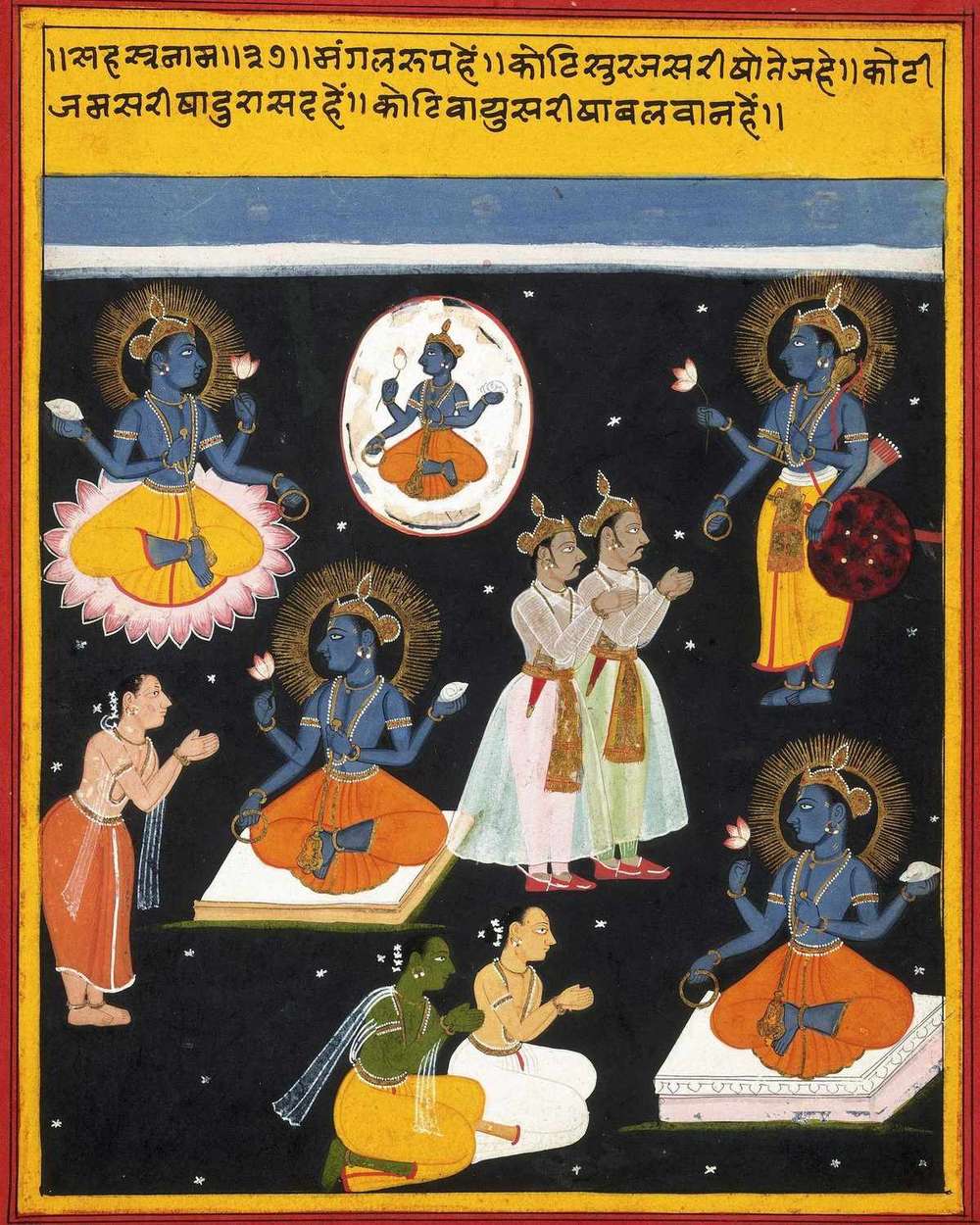
The Vishnu Sahasranāma (विष्णु सहस्रनाम, “The Thousand Names of Vishnu”) is one of the most sacred and widely recited hymns in Hinduism. Enshrined within the Anushāsana Parva (Book 13, Chapter 149) of the Mahābhārata, this stotra consists of 1,000 names (nāmas) of Lord Vishnu, the Supreme Preserver of the universe. Chanted daily by millions of devotees across all Hindu traditions, it occupies a uniquely unifying position in Indian spiritual life.
The Narrative Setting: Bhīshma’s Final Teaching
The Vishnu Sahasranāma arises in one of the most poignant episodes of the Mahābhārata. After the devastating Kurukshetra war, Bhīshma Pitāmaha lies on a bed of arrows (śaratalpa), awaiting the arrival of the auspicious Uttarāyaṇa (the northward journey of the sun) to depart his mortal body. During this interlude, Yudhishthira, the eldest Pāṇḍava and newly victorious king, approaches Bhīshma with profound spiritual questions.
Yudhishthira asks six fundamental questions (Mahābhārata 13.149.10-13):
- Kim ekam daivatam loke? — Who is the one Supreme Deity in the world?
- Kim vāpyekam parāyaṇam? — Who is the one ultimate refuge?
- Stuvantaḥ kam — Praising whom can human beings attain auspiciousness?
- Arcantaḥ kam — Worshipping whom can they reach what is beneficial?
- Ko dharmaḥ sarvadharmāṇām — What is the greatest dharma among all dharmas?
- Kim japan mucyate jantuḥ — By chanting whose name are beings freed from bondage?
To all six questions, Bhīshma responds with a single answer: Lord Vishnu, the Supreme Being, and proceeds to reveal the thousand names as the path to liberation.
Structure and Organisation of the Stotra
The complete Vishnu Sahasranāma is structured as follows:
Pūrvabhāga (Introductory Section)
- Dhyāna Shlokas: Meditative verses invoking Lord Vishnu in his cosmic form — four-armed, bearing the conch (śaṅkha), discus (cakra), mace (gadā), and lotus (padma)
- The six questions of Yudhishthira
- Bhīshma’s invocation before commencing the names
The Thousand Names
The 1,000 names are arranged in 107 stanzas (shlokas) in the anuṣṭubh metre, making them rhythmically suited for chanting. Many names appear in compound forms, where a single shloka may contain multiple names strung together. The traditional count reaches exactly 1,000 when these compounds are parsed according to the commentarial traditions.
Uttarabhāga (Concluding Section)
- Phala Shruti: The section describing the fruits (phala) and benefits of recitation
- Closing prayers and dedication
Key Names and Their Significance
Among the thousand names, several carry particular theological weight:
- Viśvam (विश्वम्) — “The Universe Itself”; the first name, declaring Vishnu as identical with all of creation
- Vishṇuḥ (विष्णुः) — “The All-Pervading One”; from the root viṣ (to pervade)
- Vāsudevaḥ (वासुदेवः) — “Son of Vasudeva” and “The Indweller of all beings” (vāsu = dwelling)
- Nārāyaṇaḥ (नारायणः) — “The Refuge of All Beings” or “One who lies on the waters”; the supreme name in Shrī Vaishnava theology
- Achyutaḥ (अच्युतः) — “The Infallible One”; one who never falls from his supreme state
- Anantaḥ (अनन्तः) — “The Infinite”; without end or limit
- Govindaḥ (गोविन्दः) — “The Protector of Cows” and “Knower of All Speech and Beings”
- Mādhavaḥ (माधवः) — “Consort of Lakshmi” (Mā = Lakshmi) and “Born in the Madhu clan”
- Hṛṣīkeśaḥ (हृषीकेशः) — “Lord of the Senses”
- Padmanābhaḥ (पद्मनाभः) — “He from whose navel the lotus of creation springs”
Each name reveals a facet of Vishnu’s limitless nature — his cosmological role, ethical perfections, ontological supremacy, and compassionate accessibility to devotees.
The Dhyāna Shlokas: Meditation Verses
Before reciting the thousand names, the tradition prescribes a set of dhyāna shlokas (meditation verses) that prepare the mind through visualization of the divine form. The most famous opening verse is:
śuklāmbaradharaṁ viṣṇuṁ śaśivarṇaṁ caturbhujam | prasannavadanaṁ dhyāyet sarvavighnopaśāntaye ||
“One should meditate upon Vishnu, who wears white garments, who is all-pervading, who is moon-coloured and four-armed, who has a serene face — for the removal of all obstacles.”
This is followed by invocations to Vyāsa (the narrator of the Mahābhārata), to Vishvaksena (Vishnu’s commander), and to Lakshmi (the divine consort). The dhyāna shlokas establish the mental setting — bhāvana — essential for the chanting to bear full fruit.
Phala Shruti: The Fruits of Recitation
The concluding Phala Shruti section, narrated by Bhīshma, describes the manifold benefits of reciting or hearing the Sahasranāma. Among the promises stated in the Mahābhārata text (13.149.120-135):
- Freedom from fear (bhayāt pramucyate): The reciter is liberated from all fears
- Freedom from sorrow: All grief and affliction are dissolved
- Attainment of wealth and progeny: Material blessings for householders
- Victory over enemies: Both external adversaries and internal weaknesses
- Supreme liberation (mokṣa): The ultimate fruit — release from the cycle of birth and death
The Phala Shruti emphasizes that even those unable to perform elaborate rituals or penances can attain the highest spiritual goal simply through nāma-saṅkīrtana (the chanting of divine names). This teaching makes the Vishnu Sahasranāma uniquely democratic in its spiritual promise.
The Great Commentaries
Two monumental commentaries have shaped the interpretation of every name:
Ādi Shankarāchārya’s Bhāshya (8th century CE)
The Advaita master Shankarāchārya wrote a comprehensive commentary interpreting each name through the lens of non-dualistic Vedānta. In his reading, the names ultimately point to Brahman — the formless, attributeless Absolute. For example, he explains “Viśvam” not merely as “the universe” but as the very being of Brahman that is identical with all that exists. Shankarāchārya’s commentary is remarkable for its grammatical precision and philosophical depth, deriving meanings through etymology (nirukti), Sanskrit grammar (vyākaraṇa), and Upanishadic references.
Parāshara Bhattar’s Bhagavad Guṇa Darpaṇam (12th century CE)
The Shrī Vaishnava āchārya Parāshara Bhattar, son of Kūrattāzhwān and spiritual descendant of Rāmānujāchārya, composed this commentary interpreting each name through Vishishtādvaita theology. He organizes the 1,000 names thematically, identifying groups of names that correspond to Vishnu’s:
- Para form (transcendent, in Vaikuṇṭha)
- Vyūha forms (Vāsudeva, Saṅkarshana, Pradyumna, Aniruddha)
- Vibhava forms (avatāras such as Rāma, Krishna, Narasimha)
- Antaryāmī form (the indwelling Self)
- Archā form (the deity in the temple)
This structural reading reveals an entire systematic theology embedded within the hymn.
Significance Across Traditions
In Vaishnava Practice
For Shrī Vaishnavas, the Vishnu Sahasranāma holds near-scriptural authority. It is recited daily in temples and homes, especially during Ekādashī observances. The text is considered a direct verbal manifestation (shabda-brahman) of the Lord’s nature. The great āchāryas — Rāmānuja, Vedānta Deshika, and Maṇavāḷa Māmuni — all emphasized its recitation as a primary spiritual practice.
In Smārta Practice
Smārta Hindus, following Shankarāchārya’s tradition, recite the Vishnu Sahasranāma as part of Pañchāyatana Pūjā — the worship of five deities. Here, Vishnu is honored as one of five equally valid expressions of Brahman, alongside Shiva, Shakti, Gaṇesha, and Sūrya.
In Temple Worship
Across South India, the Vishnu Sahasranāma is chanted daily in temples dedicated to Vishnu, particularly the 108 Divya Desams revered by the Āḻvārs. In the Tirumala Tirupati temple, it forms a core part of the daily liturgical cycle.
In Domestic Devotion
The hymn is widely recited during sandhyā vandana (daily prayers), at satyānārāyaṇa pūjā, during Vaikuṇṭha Ekādashī, and on auspicious occasions. Many families maintain a tradition of daily recitation, often in the early morning or at twilight.
Method of Recitation
Traditional practice prescribes the following sequence for a complete recitation:
- Āchamana (ritual sipping of water for purification)
- Prāṇāyāma (breathing exercises)
- Saṅkalpa (statement of intention)
- Dhyāna Shlokas (meditation verses)
- The Thousand Names (107 stanzas)
- Phala Shruti (the concluding benefits section)
- Closing prayers to Lakshmi and Vishnu
A single complete recitation takes approximately 25 to 30 minutes. The anuṣṭubh metre provides a natural, steady rhythm that supports both concentration and devotion.
Theological Essence
The Vishnu Sahasranāma is far more than a list of epithets. It is a verbal icon (nāma-rūpa) of the divine, a sonic embodiment of Vishnu’s infinite nature. Each name is considered a mantra in its own right, carrying the power to purify the mind, dissolve karmic obstacles, and draw the devotee closer to the Supreme.
As Bhīshma declares to Yudhishthira (Mahābhārata 13.149.14):
“Anantaḥ, the Infinite One, the Lord of the Devas — by glorifying Him with these thousand names, a mortal being attains the highest good.”
In a world of complexity and suffering, the Sahasranāma offers a luminous path: through the repetition of divine names, the ordinary human voice becomes an instrument of liberation.