Introduction: A Sacred Site Shared by Two Great Traditions
In the dusty plains of southern Bihar, along the western bank of the Nirañjanā (Phalgu) river, lies one of the most spiritually charged sites on earth: Bodh Gayā. Here, beneath a pīpal tree (Ficus religiosa) some 2,500 years ago, a young ascetic named Siddhārtha Gautama sat in meditation and attained sambodhi — perfect enlightenment — becoming the Buddha, “the Awakened One.” The spot where he sat, marked today by the magnificent Mahābodhi Temple and a descendant of the original Bodhi Tree, is the most sacred place in Buddhism.
But Bodh Gayā is not solely a Buddhist site. It exists within the larger sacred geography of Gayā, one of the oldest and most important Hindu tīrthas (pilgrimage centres) in India, renowned since Vedic times as the supreme location for performing piṇḍa dāna — the ritual offering to deceased ancestors that liberates their souls from the cycle of rebirth. For Hindus, the Buddha himself is honoured as an avatāra (incarnation) of Lord Viṣṇu, weaving the Buddhist and Hindu narratives of this place into a single, layered tapestry of sanctity.
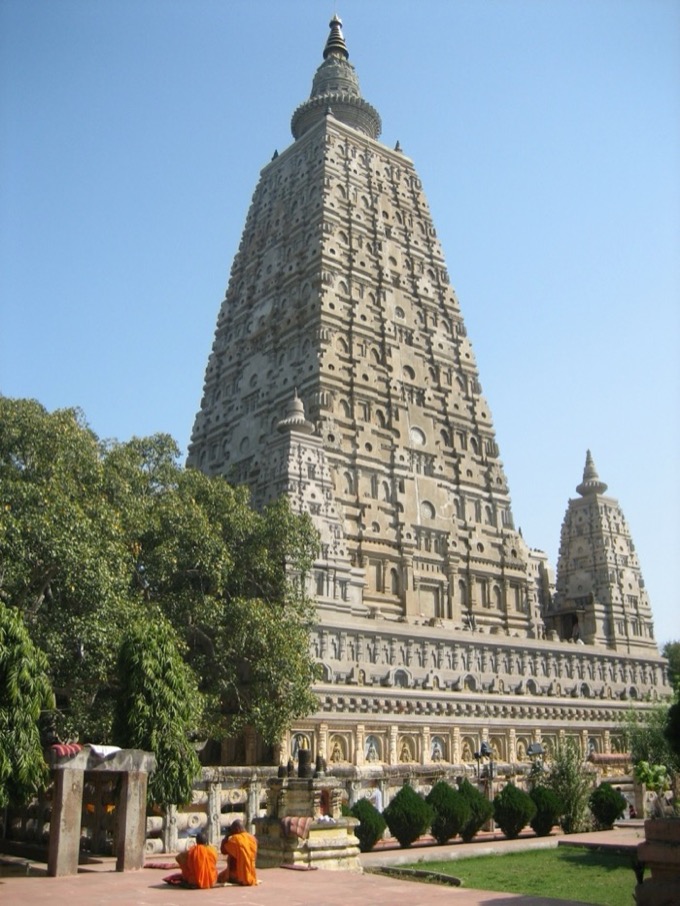
The Mahābodhi Temple Complex was inscribed as a UNESCO World Heritage Site in 2002, recognized as “one of the earliest and most imposing temple structures built entirely in brick, from the late Gupta period.”
Gayā as Hindu Tīrtha: The Land of Ancestral Liberation
The Gayā Māhātmya
Long before the Buddha’s birth, Gayā was established in Hindu scripture as a uniquely powerful tīrtha for piṇḍa dāna (offerings to the dead). The Gayā Māhātmya — a section found in the Vāyu Purāṇa (chapters 105-112) and the Agni Purāṇa — declares that performing śrāddha (ancestral rites) at Gayā liberates not just the immediate ancestors but seven generations of forebears from the cycle of saṃsāra. The Vāyu Purāṇa (108.1-4) states: “There is no tīrtha on earth equal to Gayā for the liberation of the ancestors. He who offers piṇḍa at Gayā frees his ancestors unto the seventh generation.”
The Legend of Gayāsura
The mythology of Gayā centres on a powerful demon (asura) named Gayāsura, whose body was so pure from austerities that anyone who touched it was immediately liberated from all sins. The gods, alarmed that this automatic liberation would render dharmic effort meaningless, requested Lord Viṣṇu to intervene. Viṣṇu placed his foot on Gayāsura’s body, pressing the demon into the earth. Gayāsura agreed to remain underground on the condition that the land above his body would forever be a tīrtha where the dead could achieve salvation (Vāyu Purāṇa 105.12-28).
The Viṣṇu Pada (“Footprint of Viṣṇu”) temple in Gayā, approximately 15 kilometres from Bodh Gayā, preserves what is venerated as the literal footprint of Lord Viṣṇu upon a basalt rock. This footprint, set within a silver basin, remains one of the most sacred objects in Hindu pilgrimage. The Viṣṇu Pada temple is mentioned in the Mahābhārata (Vana Parva 87.10-15) and has been a site of continuous worship for at least two millennia.
Piṇḍa Dāna Rituals
The piṇḍa dāna rituals at Gayā follow a prescribed circuit (the Gayā Kṣetra Parikramā) covering multiple sacred sites along the Phalgu river, including:
- Viṣṇu Pada Temple: The principal site, where piṇḍas are offered on the stone footprint
- Phalgu River Ghats: Where ancestral offerings are made into the sacred waters
- Akṣayavaṭa (Immortal Banyan Tree): An ancient tree mentioned in the Mahābhārata under which piṇḍas are offered
- Pretaśilā Hill: Where souls of the departed are believed to gather
- Rāma Śilā and Sītā Kuṇḍ: Associated with Lord Rāma, who according to the Rāmāyaṇa performed śrāddha for his father Daśaratha at Gayā
The ritual significance of Gayā in Hindu tradition cannot be overstated. The Garuda Purāṇa (Pretakhaṇḍa, Chapter 10) prescribes Gayā śrāddha as the most efficacious of all ancestral rites, and millions of Hindus continue to visit Gayā specifically for this purpose.
The Bodhi Tree: Axis Mundi of Enlightenment
The Original Tree and Its Descendants
The Bodhi Tree (Skt: bodhivṛkṣa or aśvattha) under which the Buddha attained enlightenment is a pīpal tree (Ficus religiosa), a species sacred in both Hindu and Buddhist traditions. The pīpal is identified in the Bhagavad Gītā (15.1) as the cosmic tree: “With roots above and branches below, the aśvattha tree is said to be imperishable.”
The original tree was reportedly destroyed several times over the centuries — by Aśoka before his conversion (according to some traditions), by the Śuṅga king Puṣyamitra, and by the Bengal king Śaśāṅka in the 7th century CE. Each time, a new tree was planted from a cutting or seed of the previous one. The Chinese pilgrim Xuánzàng, who visited in 637 CE, recorded the tree’s destruction and regrowth. The current tree, the fifth or sixth in the lineage, is believed to be a descendant of the original, propagated through the celebrated Sri Lankan sapling sent by Emperor Aśoka’s daughter Saṅghamittā to Anurādhapura in the 3rd century BCE. A cutting from that Anurādhapura tree was replanted at Bodh Gayā in the 19th century.
The Vajrāsana: Diamond Throne
Directly beneath the Bodhi Tree lies the Vajrāsana (“Diamond Throne” or “Indestructible Seat”), a red sandstone platform believed to mark the exact spot where the Buddha sat during his enlightenment meditation. The Nidānakathā (the Jātaka commentary) describes the Vajrāsana as “the navel of the earth,” the one place that can bear the weight of a Bodhisattva’s final meditation. Emperor Aśoka is credited with identifying and marking this spot in the 3rd century BCE.
The Mahābodhi Temple: Architecture and History
Aśokan Origins
The first shrine at the Bodhi Tree site was established by Emperor Aśoka (r. 268-232 BCE) following his conversion to Buddhism after the Kaliṅga War. Aśoka erected a shrine, a railing (vedikā) around the tree, and a canopy over the Vajrāsana. Archaeological evidence confirms Aśokan-period remains at the site, including fragments of the original stone railing with medallion carvings that are among the earliest examples of Indian narrative sculpture.
The Present Temple: Gupta-Period Masterpiece
The towering temple structure visible today dates primarily to the 5th-6th century CE (late Gupta period), though it incorporates elements from earlier constructions and was extensively restored in the 19th century. The temple’s key architectural features include:
- The Main Śikhara (Tower): A pyramidal brick tower rising approximately 55 metres (180 feet), one of the tallest ancient brick structures in India. The tower’s profile — a series of receding tiers topped by an āmalaka (fluted disc) and finial — became the prototype for Buddhist temple architecture across Asia, influencing buildings from Bagan (Myanmar) to Borobudur (Java).
- The Sanctum: Houses a gilded image of the Buddha in the earth-touching gesture (bhūmisparśa mudrā), commemorating the moment of enlightenment when Siddhārtha called the earth to witness his realization.
- The Stone Railing (Vedikā): Surrounding the temple are stone railings from two periods — the Śuṅga period (2nd century BCE, in granite) and the Gupta period (5th century CE, in sandstone). The earlier railings bear lotus medallions and Jātaka tales in relief; the later ones display more elaborate Buddhist and Hindu iconographic themes.
- The Seven Sacred Sites: Within the temple complex, seven sites mark locations where the Buddha spent each of the seven weeks following his enlightenment, including the Animēśa Locana (where he gazed at the Bodhi Tree without blinking), the Ratanāghara (Jewel House), and the Rājāyatana Tree.
The Walking Meditation Path (Caṅkamana)
Adjacent to the temple is the Caṅkamana — a raised stone platform with carved lotus flowers marking the Buddha’s walking meditation path during the third week after enlightenment. The lotuses are said to represent the flowers that bloomed under his feet as he walked.
The Hindu-Buddhist Nexus at Bodh Gayā
The Buddha as Avatāra of Viṣṇu
Hindu tradition, particularly from the medieval period onward, incorporated the Buddha into the Vaishnava framework as the ninth avatāra (incarnation) of Lord Viṣṇu. The Bhāgavata Purāṇa (1.3.24) lists “Buddha, the son of Añjanā” among the incarnations of Viṣṇu. The Gītagovinda of Jayadeva (12th century CE) celebrates the Buddha avatāra in its opening invocation: “O Keśava! O Lord of the universe! O Lord Hari, who have assumed the form of Buddha! All glories to You! O Buddha of compassionate heart, You denounce the slaughtering of animals performed according to the rules of Vedic sacrifice” (Gītagovinda 1.9).
This identification meant that for many Hindus, the Bodhi Tree site was not outside their religious geography but part of it — a place where Viṣṇu himself had manifested in human form. This theological framework facilitated centuries of Hindu-Buddhist coexistence at Bodh Gayā, even as institutional boundaries between the two religions shifted.
Historical Coexistence and Contestation
The history of Bodh Gayā reflects a complex interplay of Hindu and Buddhist stewardship:
- Aśokan Period (3rd century BCE): Bodh Gayā was a Buddhist pilgrimage centre under imperial patronage.
- Gupta Period (4th-6th century CE): The Gupta emperors, though Vaishnavite, patronized the Mahābodhi Temple alongside Hindu temples, reflecting the syncretic spirit of the age.
- Medieval Decline: As Buddhism declined in India between the 8th and 12th centuries, the Mahābodhi Temple gradually came under Hindu (Śaiva) control. A Śaiva maṭha (monastery) was established adjacent to the temple, and the site was managed by a Śaiva mahant (head priest) for several centuries.
- British Period: In the 19th century, the Burmese king Mindon and later the British archaeologist Alexander Cunningham undertook major restoration of the temple, which had fallen into severe disrepair.
- The Bodh Gaya Temple Act (1949): After Indian independence, the Bihar government passed the Bodh Gaya Temple Act, establishing a management committee with both Hindu and Buddhist members. The Act, still in force, reflects the site’s shared heritage — a rare legislative acknowledgment of dual religious claims to a single sacred site.
Viṣṇu Pada and the Gayā Connection
The continuity between the Hindu tīrtha of Gayā and the Buddhist sacred site of Bodh Gayā is geographical, mythological, and ritual. The Viṣṇu Pada temple, the Phalgu river ghats, and the piṇḍa dāna rituals constitute an unbroken Hindu pilgrimage tradition that predates, envelops, and continues alongside the Buddhist veneration of the Bodhi Tree. Many Hindu pilgrims visiting Gayā for ancestral rites also visit the Mahābodhi Temple, praying before the Buddha image as a form of Viṣṇu.
Aśoka’s Legacy: From Emperor to Pilgrim
Emperor Aśoka’s patronage of Bodh Gayā was transformative. After his conversion following the carnage of the Kaliṅga War (c. 261 BCE), Aśoka visited Bodh Gayā, erected pillars and shrines, and dispatched missionaries to spread the Buddha’s message. His daughter Saṅghamittā carried a branch of the Bodhi Tree to Sri Lanka, where it was planted at Anurādhapura and still survives — one of the oldest documented trees in the world.
Aśoka’s rock edicts and pillar inscriptions at various sites across India constitute the earliest datable historical records of Bodh Gayā’s significance. His patronage model — royal support for a site of spiritual transformation — influenced Buddhist statecraft across Asia for millennia.
The Mahābodhi Temple as World Heritage
UNESCO inscribed the Mahābodhi Temple Complex as a World Heritage Site in 2002, citing four criteria:
- It marks one of the most important events in the history of world religion
- The 5th-6th century temple is an outstanding example of early brick architecture in India
- The site has been a centre of pilgrimage for nearly two millennia
- It had a profound influence on temple architecture across East and Southeast Asia
The inscription noted the “remarkable continuity of worship at the site” and its role as a “place of international pilgrimage.” The Complex includes the main temple, the Bodhi Tree, the Vajrāsana, the Caṅkamana, and the surrounding monasteries and votive stūpas.
Modern Bodh Gayā: A Global Pilgrimage Centre
Today, Bodh Gayā is a vibrant international pilgrimage town. Monasteries built by Buddhist communities from Thailand, Japan, Myanmar, Tibet, China, Bhutan, Sri Lanka, Vietnam, and many other countries surround the Mahābodhi Temple, creating a remarkable multicultural spiritual neighbourhood. The 80-foot Great Buddha Statue (completed in 1989), built by the Daijōkyō sect of Japan, overlooks the town.
For Hindu pilgrims, the city of Gayā (15 km away) continues to be one of the most important destinations for piṇḍa dāna, especially during the annual Pitṛ Pakṣa period (the fortnight of ancestral rites in the Hindu month of Āśvina). During Pitṛ Pakṣa, hundreds of thousands of Hindu pilgrims converge on Gayā from across India, performing rituals at the Viṣṇu Pada temple, the Phalgu river ghats, and the Akṣayavaṭa tree.
Conclusion: Where Two Rivers of Faith Converge
Bodh Gayā is, in many ways, a mirror of the Indian spiritual experience itself — layered, pluralistic, and defiant of neat categorization. The same earth that Hindu mythology says was sanctified by Viṣṇu’s footprint is the earth that the Buddha touched at the moment of his awakening. The same river along whose banks Hindus offer piṇḍa dāna to liberate their ancestors flows past the tree under which the Buddha liberated all sentient beings from suffering. These are not competing narratives but complementary ones, each enriching the other across the millennia. As the Gayā Māhātmya declares: “Gayā is the supreme tīrtha. What is done here, no power in the universe can undo” (Vāyu Purāṇa 108.73).