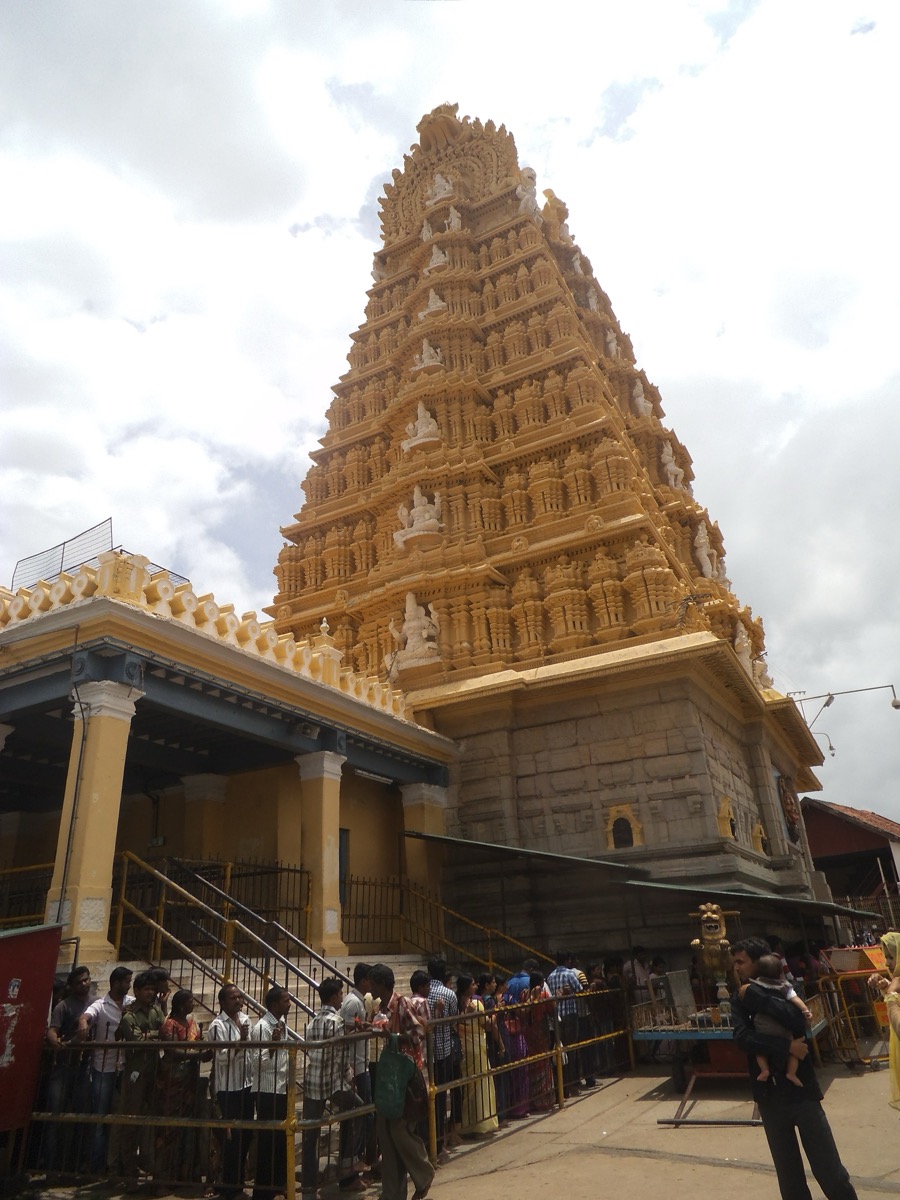
Chamundeshwari Temple (ಶ್ರೀ ಚಾಮುಂಡೇಶ್ವರಿ ದೇವಾಲಯ) stands resplendent atop Chamundi Hills, rising 1,063 metres (3,489 feet) above sea level on the eastern outskirts of Mysuru (Mysore), Karnataka. For over a millennium, this sacred summit has served as the spiritual sentinel of the city below — home to the fierce form of the Goddess who slew the buffalo demon Mahishāsura and thereby gave Mysuru its very name. As the kuladevī (tutelary deity) of the Wodeyar dynasty that ruled the Kingdom of Mysore for over five centuries, Chamundeshwari is not merely a temple deity but the living soul of a city, a dynasty, and a civilisation that venerates the triumph of divine feminine power over demonic tyranny.
The temple is counted among the 18 Mahā Shakti Pīṭhas enumerated by Ādi Śaṅkarācārya, believed to be the site where the hair (keśa) of Goddess Satī fell during Lord Śiva’s grief-stricken dance across the cosmos. This sanctity, combined with the mythological destruction of Mahishāsura, makes Chamundi Hills one of the most revered pilgrimage destinations in southern India. Each year, during the ten-day Mysuru Dasara (Navarātri), the temple and the city below come alive with what is widely considered India’s grandest royal festival, drawing millions of devotees and visitors from around the world.
The Legend of Mahishāsura and the Etymology of Mysuru
The mythology of Chamundeshwari is rooted in the Devī Māhātmya (also known as Durgā Saptaśatī or Caṇḍī Pāṭha), chapters 81–93 of the Mārkaṇḍeya Purāṇa, composed between 400–600 CE. This seminal Śākta text narrates the cosmic battle between the Goddess and the forces of demonic evil across three great episodes.
The central episode (chapters 2–4) describes the menace of Mahishāsura, the buffalo demon whose very name derives from the Sanskrit mahiṣa (buffalo) and asura (demon). Having obtained a boon from Lord Brahmā that he could not be killed by any god or man, Mahishāsura wrought havoc across the three worlds. He dethroned Indra, enslaved the Devas, and usurped the governance of the cosmos. In their desperation, the gods pooled their divine energies (tejas), and from this blazing convergence arose the supreme Goddess — resplendent with eighteen arms, each bearing the weapons of a different deity. Mounted upon a lion, she waged a ferocious battle against the shape-shifting demon. After a prolonged combat in which Mahishāsura assumed the forms of a lion, an elephant, and finally his true buffalo shape, the Goddess pierced his chest with her trident and beheaded him with her sword. The Devī Māhātmya (3.37–38) exults: “The Goddess, having slain that great Asura Mahisha, was praised by the hosts of gods with joy and devotion.”
Local tradition holds that this cosmic battle took place upon the very hill that now bears the name Chamundi. The place where Mahishāsura was slain came to be called Mahishūru (the place of Mahisha), which evolved into Mahiṣa-ūru in Kannada and was anglicised by the British as “Mysore.” The modern Kannada name Mysūru retains this ancient etymology. A magnificent statue of Mahishāsura — depicted holding a cobra in his left hand and a sword in his right, standing in a warrior’s posture — was erected near the 700th step of the hill during the reign of Dodda Dēvarāja Woḍeyar in the 17th century. This statue has become an iconic symbol of the city itself.
The Name Chāmuṇḍā: Slayer of Caṇḍa and Muṇḍa
The name “Chamundeshwari” (Chāmuṇḍā-Īśvarī, “the sovereign Chāmuṇḍā”) derives from a separate episode in the Devī Māhātmya. In Canto LXXXVII (chapter 7) of the Mārkaṇḍeya Purāṇa, the narrative describes the Goddess’s battle against the demon generals Caṇḍa and Muṇḍa, commanders in the army of the great demons Śumbha and Niśumbha. From the wrathful brow of the Goddess Ambikā emerged the terrifying form of Kālī, dark as a thundercloud, garlanded with severed heads, who annihilated the demonic armies and beheaded both Caṇḍa and Muṇḍa. Presenting their severed heads to Ambikā as trophies, Kālī received the honorific: “Because thou hast seized both Caṇḍa and Muṇḍa… thou shalt therefore be famed in the world by the name Chāmuṇḍā!” (Mārkaṇḍeya Purāṇa 87.27).
Thus, Chamundeshwari represents the composite divine power that vanquishes all forms of evil — both the tactical commanders (Caṇḍa and Muṇḍa) and the supreme adversary (Mahishāsura). In the temple, the Goddess is worshipped as a fierce yet benevolent mother who protects her devotees from all adversity.
Historical Evolution: From Ancient Shrine to Royal Temple
Early Origins and the Hoysala Period
Archaeological and literary evidence suggests that the hill was a sacred site long before the present temple structure. The Chamundi Hills were originally known as Mahābaladri (the hill of great power), a name honouring Lord Śiva, indicating that Śaiva worship preceded the Śākta tradition at this site. The earliest structural remains of the temple are attributed to the Hoysala dynasty (11th–14th century CE), who built the original shrine in the Dravidian architectural style characteristic of southern Indian temple building.
The Wodeyar Dynasty and the Rise to Prominence
The transformative chapter in the temple’s history began with the founding of the Woḍeyar dynasty in 1399 CE. According to dynastic tradition, Yadurāya, the progenitor of the Woḍeyar line, received a divine vision of Goddess Chamundeshwari that guided him to establish his kingdom at the foot of her sacred hill. The Woḍeyars adopted Chamundeshwari as their kuladevī (family deity), and her blessings were invoked at every royal coronation, military campaign, and state ceremony. She was also known as Nāḍa Devī (“State Goddess”), reflecting her role as the spiritual sovereign of the entire kingdom.
Rāja Woḍeyar I (r. 1578–1617), who defeated the Vijayanagara viceroy Tirumalarāja and established Mysore as an independent kingdom, inaugurated the grand Dasara celebrations in 1610 CE. He modelled this festival after the Vijayanagara Navarātri traditions but centred it entirely on the worship of Chamundeshwari, thus weaving the Goddess into the political and cultural identity of the state.
The Thousand Steps and the Nandi Monolith
In 1659 CE (some sources cite 1664), Dodda Dēvarāja Woḍeyar (also known as Dodda Kempa Dēvarāja), the thirteenth Mahārāja of Mysore, commissioned the construction of the celebrated 1,008 stone steps leading from the base of the hill to its summit. Before this, reaching the temple required a difficult trek through dense forest. The steps transformed the pilgrimage into an accessible devotional practice that persists to this day, with thousands of devotees climbing them daily — many barefoot, chanting the Goddess’s names.
Approximately midway along the ascent, at around the 700th step, stands one of Karnataka’s most iconic sculptures: a massive Nandi (the sacred bull and vāhana of Lord Śiva) carved from a single block of black granite. This monolith stands approximately 4.9 metres (16 feet) tall and is 7.6 metres (25 feet) long, adorned with intricately carved bells and ornamental chains around its neck. It is one of the largest monolithic Nandi statues in India and was commissioned during the same era as the steps. The Nandi sits serenely facing the summit, as if perpetually guarding the path to the divine.
Krishnarāja Woḍeyar III and the Great Gopuram
The temple assumed its present grandeur largely through the patronage of Mahārāja Krishnarāja Woḍeyar III (r. 1799–1868), one of the most cultured and devout rulers of the dynasty. In 1827 CE, he commissioned the construction of the magnificent seven-tiered gopuram (pyramidal entrance tower) in the classical Dravidian style, rising approximately 40 metres above the temple entrance. This gopuram, crowned with seven golden kalaśas (sacred urns), is visible from great distances across the Mysuru plain and has become the defining architectural symbol of the temple. Krishnarāja III also donated the Siṃha Vāhana (lion chariot), processional vehicles, and jewellery that are still used in ritual processions during Dasara. So deep was his devotion that he adopted the pen name (mudra) “Chamundi” in his literary compositions.
Temple Architecture and Sacred Spaces
The Chamundeshwari Temple is a fine example of Dravidian temple architecture, characterised by its quadrangular layout, towering gopuram, and ornate sculptural programme. The key architectural elements include:
The Gopuram: The seven-storey entrance tower, built in 1827, features elaborate stucco figures of gods, goddesses, celestial beings, and mythological narratives arranged in ascending tiers. The tower narrows progressively toward its apex, where the seven golden kalaśas gleam in the sunlight.
The Garbhagṛha (Sanctum Sanctorum): The innermost chamber houses the primary deity — a magnificent image of Goddess Chamundeshwari depicted in her fierce yet gracious form, adorned with gold ornaments and flower garlands. Silver gates, donated by the Mysore Mahārājas, guard the entrance to the sanctum.
The Vimāna: A smaller tower (śikhara) rises directly above the sanctum, marking the divine axis connecting earth to the heavens. The vimāna is adorned with sculptural panels depicting episodes from the Devī Māhātmya.
The Navaraṅga Maṇḍapa: The pillared hall before the sanctum features carved columns and ceiling panels, serving as the space for ritual assemblies and devotional singing.
Subsidiary Shrines: The temple complex includes shrines dedicated to Lord Gaṇeśa, Hanumān, and other deities, reflecting the inclusive devotional landscape of Hindu temple worship.
The Mysuru Dasara: India’s Grandest Royal Festival
The Mysuru Dasara (also spelled Dussehra) is a ten-day festival coinciding with Navarātri (the nine nights of the Goddess) and culminating on Vijayādaśamī (the tenth day of victory). It is the Nāḍahabba (State Festival) of Karnataka and is widely regarded as one of the most spectacular religious and cultural celebrations in all of India. Its origins trace to 1610 CE, when Rāja Woḍeyar I initiated the celebrations at Śrīraṅgapaṭṭana, drawing upon the grand Navarātri traditions of the Vijayanagara Empire.
The Nine Nights of Worship
During Navarātri, the Goddess is worshipped in her nine forms across nine nights. Special pūjās, abhiṣekas (ritual bathing of the deity), and alaṅkāras (decorations) are performed daily at the Chamundeshwari Temple. The Mysore Palace, at the foot of Chamundi Hills, is illuminated with nearly 100,000 light bulbs, transforming it into a vision of celestial splendour. Cultural programmes, classical music concerts, dance performances, wrestling tournaments, and processions fill the city for the entire duration.
Jamboo Savārī: The Golden Howdah Procession
The climax of the Dasara celebrations is the Jamboo Savārī on Vijayādaśamī, a grand procession in which the idol of Goddess Chamundeshwari is placed upon a golden mantapa (pavilion) mounted on the back of a magnificently decorated elephant. The golden ambārī (howdah) weighs approximately 750 kilograms and is one of the most treasured possessions of the Mysore royal family. The procession moves along a prescribed route through the streets of Mysuru, accompanied by caparisoned elephants, horse-drawn chariots, silver chariots, folk art troupes representing Karnataka’s diverse districts, musical bands, and thousands of participants.
The procession commences at the Mysore Palace and proceeds along Sayyājī Rao Road to the Bannī Mantapa grounds, a distance of approximately four to five kilometres. At Bannī Mantapa, the traditional Bannī tree worship (banni pūje) takes place — a ritual recalling the Pāṇḍava prince Arjuna’s retrieval of his weapons from a śamī (Bannī) tree after his year of disguise, symbolising the victory of dharma.
The Torchlight Parade
Following the Jamboo Savārī, an evening torchlight parade (Panjina Kavaayathu) provides a spectacular finale, with military bands, floats, and illuminated displays passing through the city streets. This tradition, introduced during the British Residency period, has become an integral part of the Dasara celebrations.
Shakti Pīṭha Status and the Satī Legend
The Chamundeshwari Temple is venerated as one of the 18 Mahā Shakti Pīṭhas in the enumeration attributed to Ādi Śaṅkarācārya. According to this tradition, when Lord Śiva carried the immolated body of his consort Satī across the cosmos in his grief-stricken tāṇḍava dance, Lord Viṣṇu released his Sudarśana Cakra to dismember her body and halt the destruction. Satī’s hair (keśa) is believed to have fallen upon this hill, consecrating it as the Krauñca Pīṭha. The ancient name of the region, Krauñca Purī, derives from this tradition. This Shakti Pīṭha status elevates the temple beyond a mere royal shrine to a site of pan-Indian pilgrimage significance, drawing Śākta devotees from across the subcontinent.
The Sacred Geography of Chamundi Hills
Chamundi Hills is not merely a religious site but a distinct ecological and geographical landmark. Rising abruptly from the flat Mysuru plateau to an elevation of 1,063 metres above sea level (approximately 300 metres above the surrounding plain), the hill is home to a rich diversity of tropical dry deciduous forest. The Chamundi Hills Reserved Forest harbours species of sandalwood, teak, and numerous medicinal plants, while the rocky outcrops support populations of langurs, peafowl, and various raptors.
The panoramic view from the summit encompasses the entire city of Mysuru spread below, with the magnificent Mysore Palace clearly visible, framed by the distant Western Ghats. This visual relationship — the Goddess gazing down protectively upon her city from above — is central to the spiritual geography of Mysuru. Devotees ascending the hill experience a gradual transition from the mundane world of the city below to the sacred realm of the Goddess above, a physical enactment of the spiritual journey from the worldly to the divine.
The hill is accessible by a well-maintained road that winds up in a series of hairpin bends, or by the traditional 1,008 stone steps that provide the pilgrim’s path. Many devotees choose to climb the steps on auspicious occasions — particularly on Fridays (sacred to the Goddess), during Navarātri, and on Ashāḍha Śukravāra (Fridays during the monsoon month of Ashāḍha) — as an act of physical devotion and penance.
Rituals and Worship
The temple follows a daily ritual calendar that reflects both Āgamic tradition and the specific customs established under Woḍeyar patronage:
- Prātaḥkāla Pūjā (morning worship): The temple opens at 5:30 AM with the awakening ceremony (suprabhāta) of the Goddess, followed by abhiṣeka (ritual bathing) between 6:00 and 7:30 AM.
- Regular Darśana: Devotees may have darśana (sacred viewing) of the deity from 7:30 AM to 1:30 PM and again from 3:30 to 5:30 PM.
- Sāyaṃkāla Pūjā (evening worship): The evening abhiṣeka takes place from 6:00 to 7:30 PM, followed by the āratī ceremony.
- Special Fridays: Friday is considered especially sacred to Chamundeshwari, with extended worship hours and special abhiṣekas beginning at 5:00 AM.
Major festivals beyond Dasara include Āṣāḍha Śukravāra (monsoon Fridays), Navarātri (nine nights), and the annual Rathotsava (chariot festival).
The Connection to Karnataka’s Cultural Identity
Chamundeshwari’s influence extends far beyond the temple walls. She is the State Goddess of Karnataka, and her image appears on the official state emblem. The Dasara celebrations she inspires have shaped Mysuru’s identity as a cultural capital, supporting traditions of classical Carnatic music, Bharatanāṭyam dance, Mysore painting, sandalwood carving, and silk weaving that have flourished under the patronage associated with her festival.
The Mysore painting style, characterised by its gold leaf work and jewel-like colours, developed largely as a devotional art form depicting Chamundeshwari and the other deities of the Woḍeyar court. The Mysore silk sāṛī, woven with gold zari threads, is traditionally associated with festival wear during Dasara. These artistic traditions, born from devotion to the Goddess, have achieved recognition as Geographical Indications and continue to sustain communities of artisans and craftspeople.
Pilgrimage Significance Today
The Chamundeshwari Temple receives an estimated two to three million visitors annually, with numbers swelling dramatically during the Dasara season. The temple is managed by the Muzrai Department of the Government of Karnataka, which oversees Hindu religious institutions in the state, while the Mysuru royal family continues to play a ceremonial role in the Dasara festivities.
For the pilgrim, the journey to Chamundi Hills is an encounter with multiple layers of sacred history: the primordial myth of the Goddess’s triumph over the buffalo demon, the Purāṇic sanctity of the Shakti Pīṭha, the medieval devotion of the Woḍeyar kings, and the living festival tradition that makes the Goddess present in the streets and homes of Mysuru year after year. Whether one climbs the ancient steps counting each as a prayer, stands before the massive Nandi contemplating the stillness of devotion, or watches the golden howdah glide through illuminated streets on Vijayādaśamī evening, the experience of Chamundi Hills is an immersion in the enduring power of Śākta faith — the conviction that the Divine Mother, fierce and compassionate, watches over her children from the sacred heights above.