Introduction: Where the Earth’s Ear Meets the Sea
On a narrow promontory jutting into the Arabian Sea along the coast of Uttara Kannada district in Karnataka, where the Western Ghats descend to meet the ocean in a landscape of coconut palms, laterite cliffs, and crescent beaches, lies the ancient sacred town of Gokarna. The name itself carries a profound geographical and mythological meaning: Go-karṇa, “the ear of the cow” — a reference to the shape of the land between two rivers that resembles a cow’s ear, or, according to another tradition, to the legend that Lord Śiva emerged from the ear (karṇa) of a cow (go), which was the form taken by the earth (Pṛthvī) when Śiva chose this spot for his manifestation.
At the heart of Gokarna stands the Mahābaleshwar Temple, one of the most sacred Śiva temples in India, housing the Ātmaliṅga — the “liṅga of the Self” or “liṅga of the soul” — a form of the Śiva Liṅga so powerful that it is said to grant liberation to all who behold it. The story of how this Ātmaliṅga came to Gokarna is one of the most dramatic and theologically rich legends in Hindu mythology, involving the demon-king Rāvaṇa, Lord Gaṇeśa, Lord Viṣṇu, and the cosmic power of Śiva himself.
Gokarna is counted among the seven Mukti-sthalas (liberation-granting sacred sites) of Karnataka — alongside Uḍupi, Subrahmaṇya, Kumbhāsi, Koṭeśvara, Śaṅkara Nārāyaṇa, and Kollūr — and its temple has been a major pilgrimage centre for Śaiva devotees for well over a thousand years.
The Legend of the Ātmaliṅga
Rāvaṇa’s Penance to Śiva
The central legend of Gokarna, narrated in the Śiva Purāṇa (Koṭi Rudra Saṃhitā) and the Skanda Purāṇa (Sahyādri Khaṇḍa), begins with Rāvaṇa, the mighty ten-headed king of Laṅkā. Despite being a rākṣasa (demon), Rāvaṇa was an exceptionally learned Brahmin, a master of the Vedas, and an intensely devoted worshipper of Lord Śiva. Seeking to make Laṅkā invincible, Rāvaṇa performed severe austerities on Mount Kailāsa, Śiva’s celestial abode. According to the Śiva Purāṇa, Rāvaṇa offered one of his ten heads to Śiva each day for ten days, and each time a new head grew back. Pleased with this extraordinary devotion, Śiva appeared before Rāvaṇa and offered him a boon.
Rāvaṇa asked for the Ātmaliṅga itself — the Prāṇaliṅga or “living liṅga” that represents Śiva’s own essence, his very soul. This was the most powerful form of the Śiva Liṅga, possessing the ability to grant absolute invincibility to whoever possessed it and mokṣa to whoever worshipped it. Śiva, bound by his own promise, granted the boon but imposed a critical condition: the Ātmaliṅga must not be placed on the ground before reaching Laṅkā. If it were set down at any point, it would become permanently fixed at that spot and could never be moved again.
The Stratagem of the Gods
The gods were alarmed. If Rāvaṇa reached Laṅkā with the Ātmaliṅga, he would become utterly invincible, and the cosmic order would be permanently disrupted. Lord Viṣṇu devised a plan. As Rāvaṇa journeyed southward along the western coast of India carrying the precious Ātmaliṅga, Viṣṇu used his māyā to cause the sun to set prematurely, creating the illusion of evening. Rāvaṇa, who was meticulous in his observance of sandhyāvandana (the twilight prayers that every Brahmin must perform), desperately needed to set down the liṅga to perform his evening rituals, but he could not place it on the ground.
Gaṇeśa’s Intervention
At this crucial moment, Lord Gaṇeśa appeared in the form of a young Brahmin boy (a cowherd, in some versions). Rāvaṇa asked the boy to hold the Ātmaliṅga while he performed sandhyāvandana, instructing him not to place it on the ground. Gaṇeśa agreed but imposed his own condition: he would call out to Rāvaṇa three times, and if Rāvaṇa did not return by the third call, he would set the liṅga down.
As Rāvaṇa hurried through his prayers, Gaṇeśa called out three times in rapid succession and then placed the Ātmaliṅga on the ground. The liṅga immediately became rooted to the earth with immense force. When Rāvaṇa returned and tried to pull it out, he could not — even with all ten pairs of arms and all his colossal strength. He squeezed the liṅga so hard that it assumed a distorted shape (which is the form in which it is worshipped today — the liṅga in the sanctum is described as having a slightly deformed or pressed appearance). In his rage, Rāvaṇa threw fragments of the liṅga’s covering in different directions; these fragments are said to have become the Śiva liṅgas at four other sacred sites in the region: Dhareshwar, Guṇavaṃteshwar, Muruḍeshwar, and Śejjeshwar.
The name Mahābaleshwar — “the Lord of Great Strength” — refers either to the immense strength with which the liṅga fixed itself to the earth or to the great strength of Rāvaṇa who tried and failed to uproot it.
The Mahābaleshwar Temple
Architecture
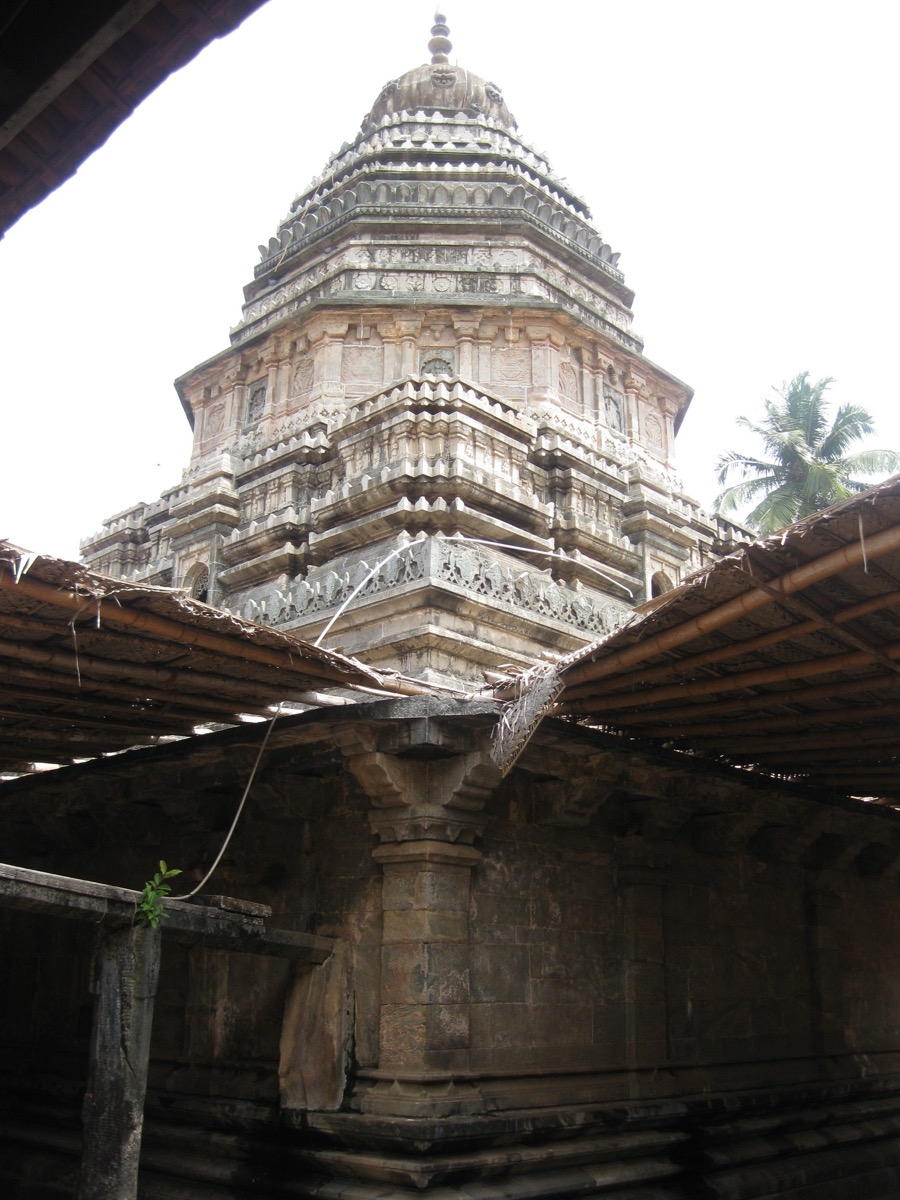
The Mahābaleshwar Temple, dating in its present form primarily to the 4th century CE with subsequent renovations over the centuries, is built in the classical Dravidian architectural style. The temple features a towering gopura (entrance tower) characteristic of South Indian temples, a maṇḍapa (pillared hall), and a garbhagṛha (sanctum sanctorum) housing the Ātmaliṅga. The temple is constructed from granite, and its weathered stone surfaces bear testimony to its great antiquity.
The temple faces the Gokarna beach on the Arabian Sea, and its proximity to the ocean — the salt air, the sound of waves, the sight of the vast western horizon from the temple entrance — gives the worship experience a distinctive maritime character found in few inland Śiva temples.
The Ātmaliṅga
The Ātmaliṅga in the sanctum is a svayambhū liṅga (self-manifested, not carved by human hands). It is worshipped as the Prāṇaliṅga — the “liṅga of life” or “liṅga of consciousness” — the most sacred form of the Śiva Liṅga in Vīraśaiva theology. The Ātmaliṅga is relatively small and is said to have an irregular shape due to Rāvaṇa’s violent attempt to uproot it. Only the head priest (bhaṭṭa) of the temple is permitted to touch the liṅga during the daily abhiṣeka (ritual bathing), and even he does so with his eyes closed, following a tradition said to have been maintained for centuries.
Temple Rituals
The daily worship at the Mahābaleshwar Temple follows a Śaiva Āgamic ritual sequence, with six daily pūjās from the pre-dawn abhiṣeka to the night-time śayana (sleep) ceremony. Special worship is performed on Mondays (Śiva’s sacred day), on the thirteenth day of each lunar fortnight (Pradoṣa), and on Mahāśivarātri, when the temple remains open throughout the night for continuous worship. The abhiṣeka of the Ātmaliṅga with milk, water, sandalwood paste, and vibhūti (sacred ash) is considered an act of supreme devotion.
Om Beach and the Sacred Geography
The Shape of the Sacred Syllable
South of the Mahābaleshwar Temple, the coastline of Gokarna features a remarkable natural formation: Om Beach, a stretch of coastline where two semi-circular bays meet to form a shape resembling the sacred syllable Om (ॐ). While this resemblance is visible most clearly from elevated viewpoints or aerial photographs, it has given the beach a sacred significance beyond its natural beauty. The Oṃkāra (the syllable Om) is the primordial sound from which all creation emerged, according to the Māṇḍūkya Upaniṣad: “Om is this imperishable word. Om is the universe” (Māṇḍūkya Upaniṣad 1.1).
The Five Beaches
Gokarna’s coastline features five principal beaches, each with its own character: Gokarna Beach (the town beach), Kudle Beach, Om Beach, Half Moon Beach, and Paradise Beach. These beaches, set between laterite cliffs and coconut groves, have made Gokarna a destination that combines spiritual pilgrimage with natural beauty. For many pilgrims, the contemplation of the vast ocean from the site where the Ātmaliṅga is enshrined creates a powerful sense of Śiva’s infinite nature.
The Seven Mukti-Sthalas
Gokarna is one of the seven Mukti-sthalas (liberation-granting sites) of Karnataka, a classification that appears in the Skanda Purāṇa’s Sahyādri Khaṇḍa and in the traditions of the Smārta and Vīraśaiva communities. The seven sites are:
- Gokarna (Mahābaleshwar — Śiva)
- Uḍupi (Śrī Kṛṣṇa Maṭha — Kṛṣṇa)
- Subrahmaṇya (Kukke — Lord Subrahmaṇya/Kārtikeya)
- Kumbhāsi (Abhayeśvara — Śiva)
- Koṭeśvara (Koṭīśvara — Śiva)
- Śaṅkara Nārāyaṇa (Harideva — Śiva and Viṣṇu combined)
- Kollūr (Mūkāmbikā — the Goddess)
This circuit, spanning the coastal and interior districts of Karnataka, is a traditional pilgrimage route that devout Hindus of the region endeavour to complete in their lifetime. Gokarna, with the Ātmaliṅga, is considered the most powerful of the seven for granting mokṣa.
Scriptural Foundations
The Skanda Purāṇa
The Sahyādri Khaṇḍa of the Skanda Purāṇa contains the most extensive account of Gokarna’s sacredness, including the full narrative of the Ātmaliṅga, a description of the sacred geography of the town, and the enumeration of the spiritual benefits of pilgrimage. The Skanda Purāṇa declares: “He who dies at Gokarna attains immediate liberation. He who performs śrāddha at Gokarna liberates seven generations of ancestors. He who bathes in the sea at Gokarna is freed from all sins” (Skanda Purāṇa, Sahyādri Khaṇḍa).
The Śiva Purāṇa
The Śiva Purāṇa’s account of the Ātmaliṅga legend is found primarily in the Koṭi Rudra Saṃhitā. The text emphasises the theological significance of the Ātmaliṅga: it is not merely a stone symbol but the actual presence of Śiva’s consciousness (ātman) in material form. The Śiva Purāṇa states: “This liṅga is Śiva himself, not a representation but the reality. He who worships the Ātmaliṅga worships Śiva in his essential nature” (Śiva Purāṇa, Koṭi Rudra Saṃhitā).
Vīraśaiva Theology
In the Vīraśaiva (Liṅgāyata) tradition, which originated in Karnataka in the 12th century under the leadership of Basavēśvara, the concept of the Prāṇaliṅga — the liṅga as a living embodiment of divine consciousness — is central. The Ātmaliṅga of Gokarna is venerated by Vīraśaivas as the supreme example of what they carry on their bodies as the iṣṭaliṅga (personal liṅga): a direct, unmediated connection to Śiva’s consciousness. Allama Prabhu, one of the great Vīraśaiva mystics, speaks of realizing the “liṅga within” as the highest spiritual attainment.
Other Sacred Sites in Gokarna
The Gaṇeśa Temple (Mahāgaṇapati)
Near the Mahābaleshwar Temple, the Mahāgaṇapati Temple is dedicated to Lord Gaṇeśa in his form as the young Brahmin boy who tricked Rāvaṇa. The temple honours Gaṇeśa’s crucial role in the Ātmaliṅga legend and is an essential stop on the Gokarna pilgrimage circuit.
The Tamaraparni Tīrtha
A sacred water tank near the Mahābaleshwar Temple, the Tamaraparni (also called Koṭi Tīrtha) is used for ritual bathing before temple darśana. The tank is believed to contain water from all the sacred rivers of India and is used for the preparation of holy water for the temple’s abhiṣeka ceremonies.
The Mṛtyuñjaya Temple
Dedicated to Śiva in his form as Mṛtyuñjaya (the conqueror of death), this temple is visited by devotees seeking relief from illness, fear of death, and ancestral afflictions. The Mahāmṛtyuñjaya Mantra is recited here with particular fervour.
Festivals
Mahāśivarātri
The great night of Śiva (the fourteenth night of the dark half of Phālguna/Māgha) is celebrated with extraordinary intensity at Gokarna. The temple remains open throughout the night, with continuous abhiṣeka and worship of the Ātmaliṅga. Tens of thousands of devotees gather for the four-prahar (four-watch) vigil, and the sound of “Oṃ Namaḥ Śivāya” fills the coastal air.
Gokarna Saptāha
An annual seven-day event involving the recitation of the Bhāgavata Purāṇa (the Saptāha), this festival draws scholars and devotees from across Karnataka and Goa. The recitation takes place in the temple premises and is accompanied by discourses on Śaiva philosophy.
Ratha Yātrā
The annual chariot festival of the Mahābaleshwar Temple, when the processional image of Lord Śiva is taken in a grand procession through the streets of Gokarna on a decorated ratha (chariot), draws pilgrims from across the Konkan and Deccan regions.
The Pilgrim Experience: Between Mountain and Sea
What distinguishes Gokarna from most other Śiva pilgrimage sites is its coastal setting. While temples like Kāśī Viśvanātha, Kedārnātha, and Trimbakeshwar are situated on river banks or in the mountains, Gokarna faces the open ocean. The experience of worshipping the Ātmaliṅga and then walking to the beach to watch the sun set over the Arabian Sea — the limitless horizon mirroring the boundless nature of Śiva — creates a pilgrimage experience of unique power. The ancient and the natural, the temple and the sea, the carved stone and the living wave converge at Gokarna in a way that few sacred sites in India can match.
Conclusion: The Soul of Śiva in Stone
Gokarna’s Ātmaliṅga stands as one of the most theologically profound sacred objects in Hinduism — not a symbol of the divine but, according to tradition, the divine itself made tangible. The legend of its journey from Kailāsa to the Karnataka coast, the interplay of Rāvaṇa’s devotion and ambition, Gaṇeśa’s playful wisdom, and Viṣṇu’s cosmic strategy, encapsulates the Hindu understanding that the sacred is established on earth not by human design alone but through the complex interplay of divine wills. As the Skanda Purāṇa declares: “Gokarna is Kailāsa on earth, and the Ātmaliṅga is Śiva’s very self. He who reaches this shore has reached the farthest shore” (Sahyādri Khaṇḍa). In the sound of the waves, in the darkness of the ancient sanctum, in the touch of the salt air, the pilgrim at Gokarna encounters what the Upaniṣads call the “real of the real” — the Ātman that is Śiva.