Introduction: Where the Cosmos Dances
In the heart of the ancient town of Chidambaram in Tamil Nadu stands one of Hinduism’s most philosophically profound temples — the Thillai Naṭarāja Temple. Unlike most Śiva temples where the deity is worshipped in the aniconic form of a liṅga, here the supreme lord is enshrined as Naṭarāja, the “King of Dance,” captured in the eternal moment of his Ānanda Tāṇḍava — the Blissful Cosmic Dance that simultaneously creates, sustains, and dissolves the universe.
The temple’s name itself encodes a theological statement. “Chidambaram” derives from the Tamil “chitrambalam” (சிற்றம்பலம்), meaning “small hall” or “hall of consciousness,” from the Sanskrit “cit” (consciousness) and “ambaram” (space/sky). This etymological synthesis points to the temple’s central teaching: the infinite consciousness of Śiva manifests within the finite space of the heart. The Tirumantiram of Tirumūlar (verse 2722) declares: “Where the cosmic dance takes place, there Consciousness stands revealed.”
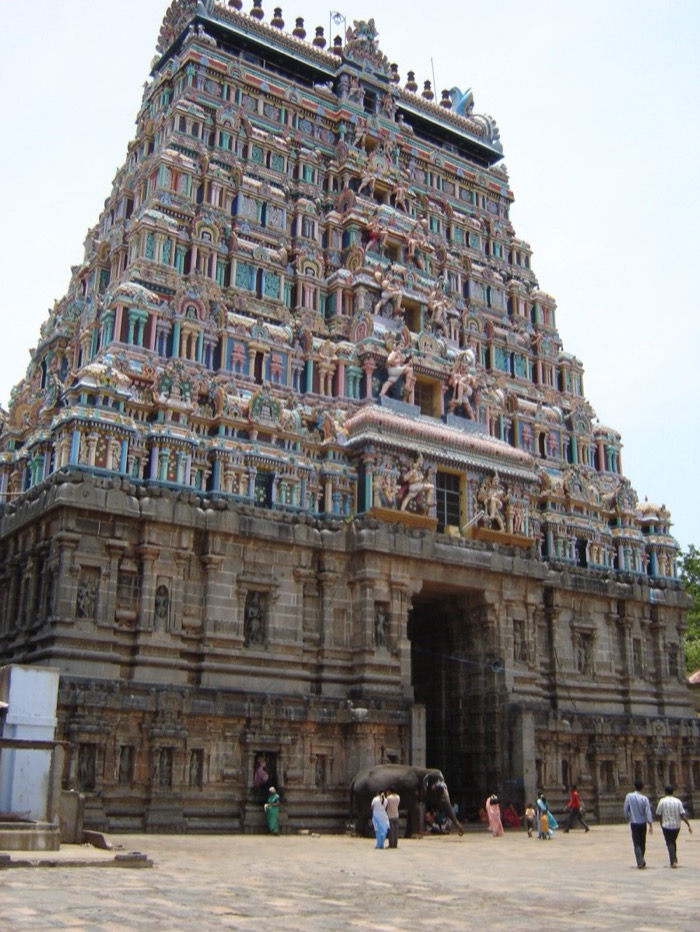
The temple complex, sprawling over 40 acres, is one of the largest in India. Its four towering gopurams (gateway towers), each rising to approximately 40-50 metres, are adorned with the 108 karaṇas — classical dance poses codified in Bharata Muni’s Nāṭyaśāstra (2nd century BCE to 2nd century CE). This makes Chidambaram not merely a place of worship but a living encyclopaedia of Indian performing arts inscribed in stone.
Mythological Origins: The Dance Contest at Thillai
The Thillai Forest and the Sages
According to the Chidambara Māhātmya (a section of the Skanda Purāṇa), the site of Chidambaram was once a dense forest of thillai trees (Excoecaria agallocha, a species of mangrove). In this forest dwelt a group of ṛṣis (sages) who practised ritual worship according to the Karma Kāṇḍa section of the Vedas, believing that ritual action alone was sufficient for salvation. They had grown proud of their austerities and had forgotten the supremacy of divine grace.
Lord Śiva, wishing to humble these sages and reveal the path of devotion, entered the thillai forest in the guise of a beautiful mendicant (Bhikṣāṭana), accompanied by Lord Viṣṇu in the enchanting form of Mohinī. The sages’ wives were captivated by the wandering ascetic, and the sages, consumed by jealousy and rage, attempted to destroy Śiva through ritual magic. They sent a ferocious tiger, which Śiva slew and wore as a garment around his waist. They conjured a venomous serpent, which Śiva draped around his neck as an ornament. Finally, they sent the malevolent dwarf Muyalakan (Apasmāra), the embodiment of ignorance and spiritual forgetfulness.
The Ānanda Tāṇḍava
It was at this moment that Śiva began his cosmic dance. Crushing Muyalakan beneath his right foot, he launched into the Ānanda Tāṇḍava — the Dance of Bliss. The Tirumantiram (verse 2786) describes this supreme moment: the gods gathered to witness the spectacle; Brahmā took up the cymbals, Viṣṇu played the mṛdaṅga drum, Sarasvatī played the vīṇā, and Indra played the flute. The sages, witnessing the overwhelming beauty and power of the dance, fell prostrate and surrendered their pride, realising that liberation comes not through mere ritual but through the grace of the Lord.
The Kanda Purāṇam (Tamil version of the Skanda Purāṇa) adds that Goddess Pārvatī, known here as Śivakāmasundarī (“the beautiful one who desires Śiva”), challenged Naṭarāja to a dance competition. In this contest of divine grace and cosmic power, Śiva performed the Ūrdhva Tāṇḍava — lifting his left foot above his head — a posture that Pārvatī, out of modesty, could not replicate. She thus acknowledged his supremacy in dance, and the two became united as the inseparable halves of the cosmic whole.
The Chit Sabhā: The Hall of Consciousness
Architecture of the Innermost Sanctum
The spiritual heart of the Chidambaram temple is the Chit Sabhā (Hall of Consciousness), a small wooden-roofed structure within the innermost precinct. This sanctum is deliberately modest in scale — a “small hall” (chitrambalam) — to embody the teaching that the infinite manifests within the intimate space of the heart.
Within the Chit Sabhā, three sacred entities are enshrined side by side:
-
Naṭarāja: The bronze mūrti of Śiva performing the Ānanda Tāṇḍava, approximately three feet in height, is considered among the most sacred images in all of Hinduism. The iconography is precise: the upper right hand holds the ḍamaru (drum of creation), the upper left holds agni (fire of dissolution), the lower right is raised in abhaya mudrā (gesture of fearlessness), the lower left points to the raised left foot indicating refuge (anugraha, divine grace), and the right foot crushes Apasmāra (ignorance). The entire figure is encircled by the prabhāvali (arch of flames) representing the cosmic cycle of saṃsāra.
-
The Chidambara Rahasyam: Adjacent to the Naṭarāja image is a curtain concealing what is known as the “Chidambara Rahasyam” — the “Secret of Chidambaram.” Behind this curtain is empty space, adorned only with golden bilva leaves. This void represents the Ākāśa Liṅga — Śiva as formless, infinite space (ākāśa). The secret teaches that ultimate reality is formless, and that the space within the heart and the space of the cosmos are one and the same.
-
The Crystal Liṅga (Spaṭika Liṅga): A small crystal liṅga representing Śiva in his subtle form sits near the Naṭarāja, bridging the iconic (Naṭarāja) and the aniconic (Ākāśa Liṅga) representations.
The Five Sabhās
The temple contains five sabhās (halls), each with distinct ritual and philosophical significance:
- Chit Sabhā (Hall of Consciousness): The innermost sanctum housing Naṭarāja
- Kanaka Sabhā (Golden Hall): The hall immediately before the Chit Sabhā, with a gold-plated roof, where major rituals are performed
- Nṛtta Sabhā (Dance Hall): A separate hall depicting Śiva’s Ūrdhva Tāṇḍava posture, with exquisite stone carvings
- Deva Sabhā (Hall of the Gods): Used for festival processions
- Rāja Sabhā (Hall of the King): The thousand-pillared hall (though actually containing 999 pillars, with the devotee completing the count as the thousandth), used for grand ceremonies
The Pañca Bhūta Sthala: Temple of Space
Chidambaram in the Elemental Cosmology
Chidambaram holds a unique position in Śaiva sacred geography as the Ākāśa Kṣetra — the temple representing ākāśa (space/ether), the subtlest of the five great elements (pañca bhūtas). The five Pañca Bhūta Sthalas are:
| Element | Temple | Location |
|---|---|---|
| Pṛthvī (Earth) | Ekāmbaranāthar | Kanchipuram |
| Ap (Water) | Jambukēśvarar | Thiruvanaikaval |
| Agni (Fire) | Aruṇācalēśvarar | Tiruvannamalai |
| Vāyu (Air) | Kālahastīśvarar | Srikalahasti |
| Ākāśa (Space) | Naṭarāja | Chidambaram |
That Chidambaram represents ākāśa — the most subtle, all-pervading, and formless of the elements — is profoundly appropriate. Space is the element that contains all others; it is the medium in which creation unfolds. The Chāndogya Upaniṣad (1.9.1) declares: “Ākāśa is the origin of all beings; ākāśa is their final resting place. Ākāśa is greater than all.” The Chidambara Rahasyam — the empty space behind the curtain — is the architectural expression of this Upanishadic truth.
The Dīkṣitar Priests: Guardians of an Ancient Tradition
Origins and Lineage
The Chidambaram temple is unique among major Hindu temples in being administered not by a state-appointed board but by a hereditary community of priests known as the Dīkṣitars (also spelled Dīkṣitars or Thillai Vāzhum Antanār — “Brahmins who live in Thillai”). According to temple tradition, 3,000 Dīkṣitars were originally appointed by Lord Naṭarāja himself, corresponding to the 3,000 celestial gaṇas who serve Śiva in heaven.
The Dīkṣitars follow a unique set of ritual practices that distinguish them from other Śaiva priests:
- They wear their hair in a distinctive top-knot (kuḍumi) at the front of the head rather than the back
- They follow the Vedic Śrauta tradition combined with Āgamic worship
- All adult male Dīkṣitars have equal rights to perform worship — there is no hierarchy among them
- The administration follows a democratic rotation system where families take turns performing daily worship
Ritual Tradition
The daily worship at Chidambaram follows both Vedic and Āgamic protocols, a rare synthesis in temple practice. The six daily pūjās (worship services) include elaborate rituals with Vedic chanting, the performance of special abhiṣekas (ritual bathing) of the Naṭarāja image, and the dramatic unveiling of the Chidambara Rahasyam. During the Rahasyam darśan, the curtain is drawn back to reveal the empty space adorned with golden bilva leaves — a moment of intense devotion for the assembled worshippers, who experience the formless divine reality directly.
The Cosmic Symbolism of Naṭarāja
Ananda Coomaraswamy’s Interpretation
The iconography of Naṭarāja has been the subject of profound philosophical commentary. Ananda K. Coomaraswamy, in his seminal work The Dance of Shiva (1918), provided the definitive interpretation that has since become widely accepted:
-
The Drum (Ḍamaru): Symbolises creation through sound (nāda), the primordial vibration from which the universe emanates. The Śiva Sūtras (1.1-2) state: “Consciousness is the Self. Knowledge is bondage” — it is through the cosmic sound that consciousness differentiates into the multiplicity of creation.
-
The Fire (Agni): Represents dissolution (saṃhāra) and transformation. The flame in Śiva’s left hand balances the creative drum in his right, establishing the eternal rhythm of creation and destruction.
-
The Abhaya Mudrā: The raised palm of the lower right hand offers protection and fearlessness, representing Śiva’s role as sustainer (sthiti).
-
The Raised Left Foot: Points upward, representing divine grace (anugraha) and liberation (mokṣa). The Tirumantiram (verse 2790) explains: “The raised foot is the abode of grace.”
-
The Crushed Dwarf (Apasmāra): Represents ignorance (avidyā) and spiritual forgetfulness. Śiva’s dance upon ignorance is the triumph of knowledge over delusion.
-
The Ring of Fire (Prabhāvali): Represents saṃsāra, the cycle of birth and death, within which the cosmic dance unfolds. Śiva dances within this cycle yet remains its transcendent lord.
Fritjof Capra, in The Tao of Physics (1975), later drew a celebrated parallel between the dance of Naṭarāja and the cosmic dance of subatomic particles, noting that “modern physics has thus revealed that every subatomic particle not only performs an energy dance, but also is an energy dance.” A two-metre statue of Naṭarāja now stands at CERN, the European Organisation for Nuclear Research in Geneva, as a symbol of the cosmic dance of creation and destruction that particle physics explores.
Natyanjali Festival: Dance Offering to the Lord of Dance
The Natyanjali Dance Festival, held annually during the Mahāśivarātri period (February-March), is one of India’s most important classical dance celebrations. “Natyanjali” means “offering of dance” — an apt name for a festival held at the temple of the Lord of Dance himself.
Established in 1980, the festival brings together hundreds of classical dancers from across India and the world, performing all major Indian classical dance forms — Bharatanāṭyam, Kuchipuḍi, Odissi, Kathak, Mohiniyāṭṭam, and others — before the Naṭarāja sanctum. Performances take place in the temple’s Nṛtta Sabhā and in the open spaces before the gopurams, transforming the entire temple precinct into a stage for sacred art.
The festival embodies a profound theological principle: dance, in the Śaiva tradition, is not mere entertainment but a form of worship (upāsanā). The Nāṭyaśāstra of Bharata Muni (chapter 36, verse 34) declares that dance performed with devotion yields the same spiritual merit as a Vedic sacrifice. At Chidambaram, where the supreme deity is himself the Cosmic Dancer, this belief finds its fullest expression.
The Gopurams: Encyclopaedia in Stone
The four main gopurams of the Chidambaram temple, facing the cardinal directions, are architectural masterpieces of the Chola period (10th-13th centuries CE). Each gopuram displays a significant portion of the 108 karaṇas — the fundamental dance units described in the Nāṭyaśāstra’s fourth chapter (4.30-100).
These stone sculptures are among the oldest surviving visual records of classical Indian dance technique. Scholars of Bharatanāṭyam have used the Chidambaram karaṇas as primary sources for reconstructing dance postures described in Bharata Muni’s text. The eastern gopuram, the most elaborate, contains 108 sculptural panels that have been systematically studied and documented.
The gopurams also feature extensive narrative sculpture depicting episodes from Śaiva mythology, including the 63 Nāyaṉmār (the Tamil Śaiva saints), scenes from the Periya Purāṇam, and manifestations of Śiva’s 25 līlās (divine plays) described in the Koyil Purāṇam.
Chidambaram in Tamil Devotional Literature
The Tēvāram — the collection of hymns by the three great Śaiva poets Tiruñāṇacampantar, Tirunāvukkaracar (Appar), and Cuntarar (7th-8th centuries CE) — contains numerous hymns glorifying Chidambaram. Tiruñāṇacampantar’s Paṇ Kolli describes the lord of Thillai as one “whose dance fills the cosmos with bliss.” Appar’s famous verse declares: “Even if they give me the jewelled crown of Indra, I want nothing but to see the dance at Thillai.”
Māṇikkavācakar’s Tiruvācakam (9th century), regarded as the pinnacle of Tamil devotional poetry, contains the celebrated Tiruvempāvai and Tiruppalliyezhucchi, both intimately connected to Chidambaram. His verse (Tiruvācakam 6.1) cries out: “O Lord who dances in the golden hall of Thillai, when will you melt my stony heart?”
The Tirumantiram of Tirumūlar (possibly 7th century), a foundational text of the Tamil Śaiva Siddhānta tradition, devotes extensive passages to the philosophical significance of the dance at Chidambaram. Tirumūlar’s famous verse (2775) states: “Where the Lord dances, there the world dances. Where the Lord is still, there the world is still.”
Conclusion: The Stillness at the Heart of the Dance
Chidambaram is not merely a temple; it is a three-dimensional philosophical text. The juxtaposition of the dancing Naṭarāja and the empty Ākāśa Liṅga within the same sanctum encodes the central paradox of Śaiva theology: the Absolute is simultaneously dynamic and static, formed and formless, active and still. The Ānanda Tāṇḍava is the activity of consciousness itself — the eternal pulse by which the One becomes the many and the many return to the One.
As the Chidambara Māhātmya declares: “He who beholds the dance at Chidambaram, beholds the dance at the heart of all things. For the hall of consciousness is not in Chidambaram alone — it is within every being.” The temple, with its soaring gopurams, its democratic priesthood, its living dance tradition, and its secret of empty space, stands as one of the most complete expressions of Hindu sacred architecture and theology anywhere in the world.