Introduction: A Capital Born of Conquest
In the flat, fertile plains of the Kaveri delta, roughly 70 kilometres northeast of Thanjavur, stands a temple that once anchored the mightiest empire in South and Southeast Asia. The Bṛhadīśvara Temple at Gangaikonda Cholapuram — “the city of the Chola who conquered the Ganges” — was built around 1025-1035 CE by Rājendra Chola I to commemorate his extraordinary military triumphs and to serve as the centrepiece of his new imperial capital. For the next 250 years, this city would remain the beating heart of the Chola realm, commanding trade routes that stretched from China to the Arabian Sea.
UNESCO inscribed the temple as part of the “Great Living Chola Temples” World Heritage Site in 2004 (extending the original 1987 designation of the Thanjavur Bṛhadīśvara), recognizing that together these monuments “testify to the brilliant achievements of the Chola in architecture, sculpture, painting, and bronze casting.” Yet while Thanjavur’s colossal Big Temple draws millions of visitors annually, Gangaikonda Cholapuram remains comparatively quiet — a circumstance that makes a pilgrimage here all the more rewarding, for one encounters the temple in something close to the contemplative silence for which it was conceived.
Rājendra Chola I: The Emperor Who Reached the Ganges
To understand this temple, one must understand the man who built it. Rājendra I (r. 1014-1044 CE) was the son and successor of Rājarāja I, the emperor who had already transformed the Chola state into a subcontinental power and raised the legendary Bṛhadīśvara Temple at Thanjavur. Rājendra inherited his father’s ambitions and exceeded them.
The Northern Expedition (c. 1019-1021 CE)
The campaign that gave Rājendra his immortal epithet was a sweeping northward march across the subcontinent. Chola-era inscriptions, particularly the Tiruvalangāḍu copper plates, record how his armies advanced through Veṅgi (coastal Andhra), defeated Indrarātha of the Somavaṃśī dynasty in Kaliṅga (Odisha), pushed through Dakṣiṇa Kōsala, and penetrated deep into the territories of the Pāla dynasty of Bengal. The culmination came when Chola forces reached the sacred Ganges itself, defeating Mahīpāla I of the Pāla kingdom and Govindachandra of the Chandra dynasty in eastern Bengal.
Rājendra did not seek to hold territory in the distant north. Instead, the campaign was conceived as a digvijaya — a ceremonial conquest of the four directions modelled on the ideal of a cakravartin (“universal sovereign”) described in the Arthaśāstra and the Purāṇas. The symbolic crown of the expedition was the demand that defeated kings carry holy water from the Ganges back to Tamil country, where it was poured into a massive artificial lake — the Cholagaṅgam — dug near the new capital. The Tiruvalangāḍu plates describe this reservoir as a “gaṅgā-jalamayam jayastambham” — a “liquid pillar of victory.”
Maritime Conquests
Rājendra’s reach extended across the seas as well. His naval expeditions targeted the Śrīvijaya empire in Southeast Asia (modern Sumatra, Malay Peninsula, and parts of Java), securing Chola dominance over the maritime trade routes of the Indian Ocean. These combined land-and-sea conquests made the Chola empire one of the largest and most powerful states of the medieval world.
After these triumphs, Rājendra assumed the title Gaṅgaikoṇḍa Choḻan — “the Chola who captured the Ganges” — and founded Gangaikonda Cholapuram as his new capital, replacing the ancestral seat at Thanjavur.
The Temple: Architecture of Imperial Ambition
The Curvilinear Vimāna
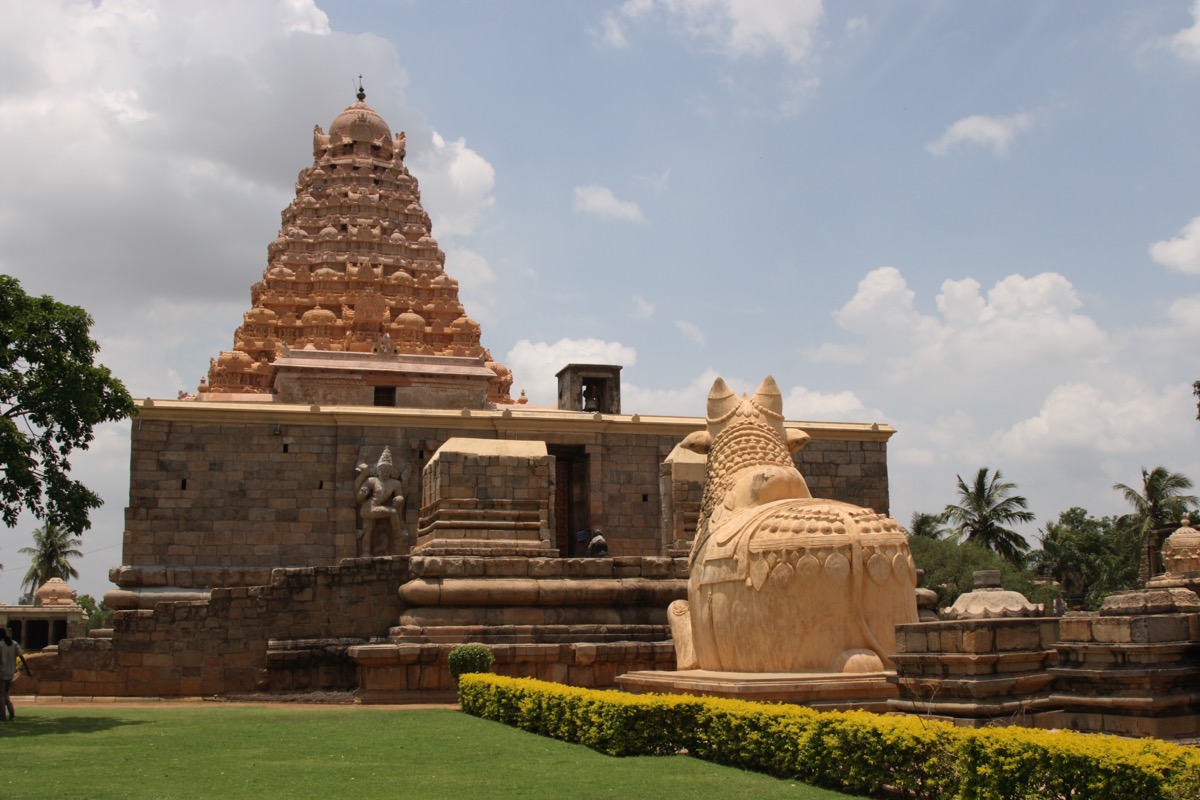
The most immediately striking feature of the Gangaikonda Cholapuram temple is its vimāna — the towering superstructure above the sanctum sanctorum. Rising to approximately 53 metres (about 174 feet), it is among the tallest temple towers in India, though slightly shorter than Thanjavur’s 66-metre (216-foot) vimāna. But what it yields in raw height, it more than compensates in sculptural refinement.
Where the Thanjavur vimāna ascends in straight, austere lines through thirteen diminishing storeys, Gangaikonda Cholapuram’s vimāna rises through nine receding tiers (talas) with gently recessed corners that create a graceful, curvilinear profile. This subtle concavity gives the tower an almost parabolic silhouette — a flowing, upward-surging movement that art historians have long regarded as one of the most elegant compositions in all of Dravidian architecture. The renowned art historian C. Sivaramamurti observed that the Gangaikonda Cholapuram temple possesses a “very masculine” power compared to the “more feminine” proportions of Thanjavur, though scholars continue to debate the exact meaning of his characterization. The śikhara (finial dome) crowning the vimāna is an octagonal monolith estimated to weigh over 80 tonnes, placed atop the structure using a system of ramps and earthen inclines — the same engineering feat that astonished observers at Thanjavur a generation earlier.
The Sanctum and the Great Liṅga
The garbhagṛha (sanctum) houses a massive Śivaliṅga approximately 4 metres (13 feet) tall, with a base circumference of about 18 metres (59 feet), believed to be among the largest in South India. This is a double-walled structure (sandhāra prasāda) standing on a high terrace, a design that allows ritual circumambulation (pradakṣiṇa) in the space between the inner and outer walls. The sanctum is entered through a sequence of halls: the ardhamaṇḍapa (antechamber), mahāmaṇḍapa (great hall), and mukhamaṇḍapa (entrance pavilion), creating a dramatic progression of expanding and contracting spaces as the devotee approaches the deity.
The Temple Courtyard
The entire temple complex is enclosed within a vast courtyard measuring approximately 170 metres by 98 metres (560 feet by 320 feet). Unlike Thanjavur, where a massive Nandi pavilion (Nandi maṇḍapa) sits directly before the temple entrance, the Nandi at Gangaikonda Cholapuram — a monolithic limestone sculpture — is placed in the open, roughly 200 metres from the sanctum on the axial alignment. Though it lacks its own shelter today, its colossal scale and open-air setting create a powerful visual dialogue with the vimāna across a vast expanse of cleared ground.
Sculptural Masterworks
The outer walls of the sanctum and maṇḍapas carry an extraordinary programme of stone sculptures that are widely considered the finest examples of mature Chola art. There are approximately fifty figural panels on the garbhagṛha walls alone, with additional sculptures on the maṇḍapa walls and subsidiary shrines.
Chaṇḍeśānugrahamūrti: Śiva Blessing His Devotee
The most celebrated relief on the outer wall depicts Chaṇḍeśānugrahamūrti — Śiva in the act of bestowing grace upon his devotee Chaṇḍeśa. In Hindu legend, the young Brāhmaṇa boy Chaṇḍeśa was so devoted to Śiva that he performed abhiṣeka (ritual bathing) of a liṅga with milk diverted from his father’s cows. When his enraged father kicked the offering, Chaṇḍeśa struck him with an axe. Śiva, moved by this fierce devotion, appeared in person to bless the boy and grant him the status of gaṇapati (leader of Śiva’s attendants). In the Gangaikonda Cholapuram panel, the tenderness of Śiva’s gesture — one arm encircling Pārvatī, the other reaching down to place a garland on the kneeling Chaṇḍeśa — is rendered with a fluidity and emotional depth that art historians consider among the supreme expressions of the Chola sculptural idiom.
Naṭarāja: The Cosmic Dancer
On the south wall of the sanctum, a splendid relief of Naṭarāja — Śiva as the Lord of Dance — occupies a prominent niche. The four-armed figure holds the ḍamaru (kettle-drum) in his upper right hand and agni (fire) in his upper left, while the lower right hand extends in the abhaya mudrā (gesture of fearlessness) and the lower left sweeps across the body in the gajahasta pose. To his left stands Pārvatī, leaning gracefully against the bull Nandi and holding a lotus. To his right, subsidiary panels depict Kārttikeya and Gaṇeśa on their respective vāhanas, with a four-armed Nandīkeśvara seated below, playing a vertical drum. The composition as a whole captures the rhythmic movement and cosmic energy that define Chola Naṭarāja iconography.
Ardhanārīśvara and Other Masterpieces
The south wall of the mukhamaṇḍapa carries a deeply carved Ardhanārīśvara — the androgynous form showing Śiva and Pārvatī united in a single body, leaning against the bull. Other notable panels include Dakṣiṇāmūrti (Śiva as the supreme teacher), Liṅgodbhava (Śiva emerging from the cosmic liṅga of fire), Bhikṣāṭana (Śiva as the wandering mendicant), and various Bhairava manifestations. The upper sculptural band on the vimāna depicts the eleven Rudra forms of Śiva alongside the Aṣṭadikpālakas — the eight guardian deities of the cardinal directions — each shown with four arms, the upper pair holding the paraśu (axe) and mṛga (deer), the lower pair in the abhaya and varada mudrās.
Six pairs of colossal monolithic dvārapālas (guardian figures) stand at the entrances to the various maṇḍapas, their towering presence enforcing the sacred boundary between the profane and the divine.
Chola Bronzes: Metallurgical Masterpieces
The Bṛhadīśvara Temple was not only a house of stone but a treasury of metal icons created through the lost-wax (cire perdue) technique that the Chola workshops had perfected over centuries. Among the bronzes recovered from the temple, two stand out as acknowledged masterpieces of Indian metal sculpture:
- Bhogaśakti (the goddess of prosperity in her sensuous aspect), a gracefully poised figure whose swaying tribhaṅga stance and delicate ornamentation epitomize Chola bronze aesthetics.
- Subraḥmaṇya (Lord Murugan), depicted in a youthful form with exquisite detailing of jewellery, crown, and hand gestures.
Other significant bronzes include representations of Somāskanda (Śiva, Pārvatī, and the infant Skanda as a divine family group), Durgā, Adhikaraṇandī, and Vṛṣabhavāhana (Śiva on his bull mount). These bronzes, created during the reign of Rājendra I, reflect the peak of Chola metallurgical artistry and are now preserved partly in the temple and partly in the collections of major museums.
The Siṃhakeṇi: The Lion Well
One of the most unusual features of the temple complex is the Siṃhakeṇi — a well whose entrance is carved in the form of a colossal lion, through whose body a staircase descends to a circular well below. According to tradition, the holy water brought back from the Ganges during Rājendra’s northern expedition was poured into this well, sanctifying it as a surrogate tīrtha. Devotees performed ritual ablutions here, and the Ganges water was used for the daily abhiṣeka (ceremonial bathing) of the main deity. The lion — a symbol of royal power and valour ubiquitous in Chola art — turns what might have been a mere utilitarian structure into a striking piece of architectural sculpture and a potent emblem of imperial triumph.
Gangaikonda Cholapuram vs. Thanjavur: Father and Son in Stone
The two Bṛhadīśvara temples are inevitably compared, for they were built by father and son within a single generation and share the same name, the same deity, and the same fundamental architectural grammar. Yet the differences are as instructive as the similarities:
| Feature | Thanjavur (Rājarāja I, c. 1010) | Gangaikonda Cholapuram (Rājendra I, c. 1035) |
|---|---|---|
| Vimāna height | ~66 m (216 ft), 13 storeys | ~53 m (174 ft), 9 storeys |
| Vimāna profile | Straight, severe, pyramidal | Curvilinear, recessed corners, parabolic |
| Nandi | Housed in a large maṇḍapa | Open-air, 200 m from sanctum |
| Sculptural programme | Rich but somewhat formal | More fluid, emotionally expressive |
| Bronzes | Outstanding collection | Equally outstanding; Bhogaśakti and Subraḥmaṇya are among the finest ever found |
| Courtyard | ~240 m x 120 m | ~170 m x 98 m |
| UNESCO inscription | 1987 | 2004 (extension) |
Where Thanjavur overwhelms through sheer scale and vertical thrust, Gangaikonda Cholapuram captivates through its refinement of line and depth of sculptural feeling. Many art historians regard the later temple as the more mature artistic statement — the product of a dynasty that had fully absorbed the lessons of its first great building campaign and now sought elegance and nuance over raw monumentality.
UNESCO World Heritage Inscription
The Bṛhadīśvara Temple at Gangaikonda Cholapuram was inscribed on the UNESCO World Heritage List in 2004 as an extension of the “Great Living Chola Temples” site (originally inscribed in 1987 for the Thanjavur Bṛhadīśvara alone). The extension also included the Airāvateśvara Temple at Dārāsuram, completed by Rājarāja II around 1167 CE.
The inscription criteria highlight:
- Criterion (i): The three Chola temples represent an outstanding creative achievement in the architectural conception of the pure form of the Dravidian temple.
- Criterion (ii): The Thanjavur temple influenced temple architecture across South and Southeast Asia.
- Criterion (iii): The Chola temples bear exceptional testimony to the cultural achievements of the Chola dynasty.
- Criterion (iv): The three temples are outstanding examples of Chola architecture and art, and their continued use as living places of worship over nearly a millennium underscores their enduring significance.
The Archaeological Survey of India (ASI) maintains the temple complex and oversees ongoing conservation work, while daily pūjā continues under the administration of the Hindu Religious and Charitable Endowments Department of Tamil Nadu.
Visiting the Temple Today
Gangaikonda Cholapuram lies in Ariyalur District, approximately 35 kilometres from Kumbakonam and 70 kilometres from Thanjavur. The temple is open daily from 6:00 AM to 12:00 PM and 4:00 PM to 8:30 PM. There is no entry fee, as with most ASI-maintained monuments.
The relative quietness of the site — compared to the bustling streets of Thanjavur — allows for an unusually contemplative experience. Visitors can circumambulate the outer walls at leisure, studying the sculptural panels that unfold like a textbook of Chola iconography. The Siṃhakeṇi, the open-air Nandi, and the subsidiary shrines all reward close attention.
The best time to visit is between October and March, when the weather is cooler. The temple is often combined with visits to the Thanjavur Bṛhadīśvara and the Airāvateśvara at Dārāsuram in a single “Chola temple circuit” — a journey through three masterpieces separated by roughly 70 kilometres and 150 years of artistic evolution.
The Legacy: A Civilization Remembered in Stone
Gangaikonda Cholapuram endured as the Chola capital for approximately 250 years, until the dynasty’s power waned in the late thirteenth century. The city gradually declined; its palaces, markets, and residences crumbled into the alluvial soil of the Kaveri delta. Only the temple survived — its granite bones too massive and too sacred to be dismantled.
What remains is a monument of extraordinary power and beauty. The Bṛhadīśvara at Gangaikonda Cholapuram testifies not only to the military and economic might of the Chola empire but also to the depth of its spiritual culture — a civilization that channelled the wealth of subcontinental conquest and oceanic trade into the creation of sacred spaces of breathtaking artistry. In the quiet light of a Tamil morning, standing before the curving tower and the stone Naṭarāja, one senses what Rājendra Chola I intended: that the temple should endure long after the empire that built it, carrying the devotion of a thousand years into an unknown future.