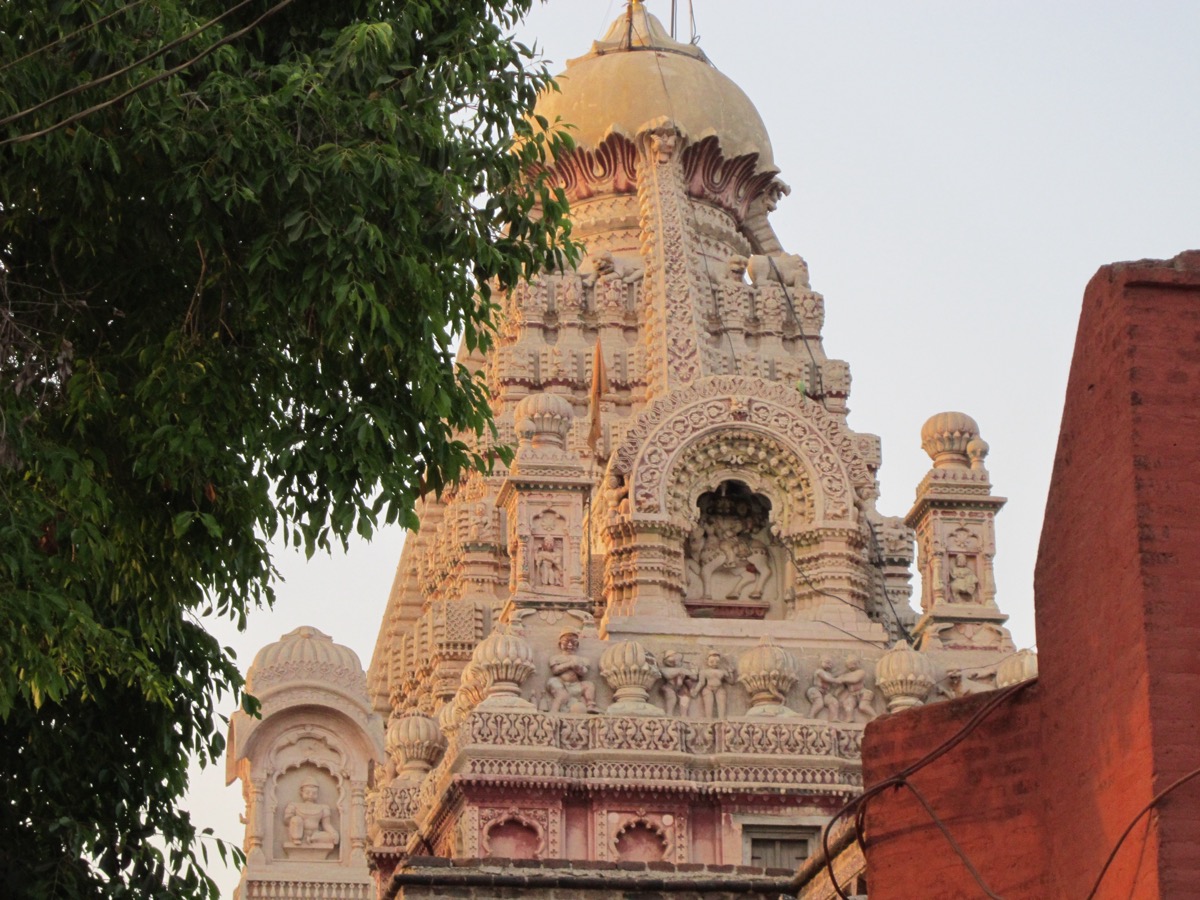
The Ghṛṣṇeśvara Temple (also written Grishneshwar or Ghushmeshwar), nestled in the village of Verul in Maharashtra’s Chhatrapati Sambhajinagar district, enshrines the twelfth and final Jyotirliṅga of Lord Śiva. Situated barely one and a half kilometres from the UNESCO World Heritage Ellora Caves and approximately thirty kilometres northwest of the city of Chhatrapati Sambhajinagar (formerly Aurangabad), this ancient shrine completes the sacred circuit of the Dvādaśa Jyotirliṅga — the twelve self-manifested pillars of infinite light through which Mahādeva reveals himself across the subcontinent.
The name Ghṛṣṇeśvara derives from Sanskrit roots meaning “Lord of Compassion” (ghṛṇā = compassion; īśvara = lord), a fitting epithet for a deity who manifested here in response to the unwavering devotion and forgiveness of a grieving mother. Despite being the smallest of the twelve Jyotirliṅga temples, Ghṛṣṇeśvara holds an immense spiritual gravity — it is where the cosmic enumeration of Śiva’s luminous abodes reaches its sacred completion.
The Dvādaśa Jyotirliṅga: Completing the Sacred Circuit
The celebrated verse enumerating the twelve Jyotirliṅgas, recited by millions of Śaiva devotees, concludes with the name of this very shrine:
Saurāṣṭre Somanāthaṁ ca Śrīśaile Mallikārjunam Ujjayinyāṁ Mahākālaṁ Oṁkāram Amaleśvaram Paraly Vaidyanāthaṁ ca Ḍākinīṁ Bhīmaśaṅkaram Setubandhe tu Rāmeśaṁ Nāgeśaṁ Dārukāvane Vārāṇasyāṁ tu Viśveśaṁ Tryambakaṁ Gautamītaṭe Himālaye tu Kedāraṁ Ghṛṣṇeśaṁ ca Śivālaye
Beginning with Somnātha in Saurashtra and ending with Ghṛṣṇeśvara, this sacred enumeration traces a spiritual geography across the entire breadth of Bhārata. Pilgrims who complete the Dvādaśa Jyotirliṅga Yātrā consider the darśana at Ghṛṣṇeśvara to be the culminating moment — the point at which the full radiance of Śiva’s twelve-fold manifestation is received.
The Legend of Ghushmā: Devotion Beyond Grief
The origin story of the Ghṛṣṇeśvara Jyotirliṅga is narrated in the Śiva Purāṇa (Koṭi Rudra Saṁhitā, Chapters 32-33) and is among the most poignant of the twelve Jyotirliṅga legends, for it speaks not only of devotion but of extraordinary compassion and forgiveness.
The Household on Devagiri
In the region of the Devagiri mountain (the ancient name for the area around modern-day Daulatabad), there lived a learned Vedic brāhmaṇa named Brahmavettā Sudharma with his wife Sudeha. The couple lived a pious life devoted to Śiva, yet one sorrow weighed heavily upon them — they were childless. Despite years of prayers and rituals, Sudeha could not conceive.
Eventually, tortured by societal pressure and her own longing, Sudeha persuaded her husband to marry her younger sister, Ghushmā (also called Kusumā), hoping that a child through her sister would bring fulfilment to the household. Sudharma reluctantly agreed, and Ghushmā entered the household as a co-wife.
The 101 Liṅgas and the Blessing of a Son
Ghushmā was a woman of extraordinary devotion. Each day, she would fashion one hundred and one Śiva liṅgas from clay, worship each one with full Vedic rites — offering flowers, bilva leaves, incense, and sacred water — and then reverently immerse them in the nearby sacred lake called Śivālaya. She performed this rigorous practice day after day, year after year, with total sincerity and without expectation of reward.
Pleased by her unwavering devotion, Lord Śiva blessed Ghushmā with a son. The boy grew to be handsome and learned, and joy filled the household. Ghushmā’s son married and the family prospered.
The Terrible Crime of Jealousy
However, where there had once been sympathy in Sudeha’s heart, a terrible jealousy now took root. Seeing her sister blessed with a son — the very blessing that had eluded her — Sudeha’s mind became poisoned with envy. One night, consumed by this dark impulse, Sudeha crept into the sleeping quarters, murdered Ghushmā’s son, dismembered his body, and cast the remains into the very lake where Ghushmā daily immersed her liṅgas.
When morning came, Ghushmā’s daughter-in-law discovered the bloodstained bed and raised an anguished cry that shook the entire household. The young wife told Ghushmā that Sudeha was surely behind the atrocity. Yet Ghushmā, though she was a mother who had just lost her only child, did something that astonished all who witnessed it.
Forgiveness and Divine Manifestation
Rather than collapsing in grief or seeking vengeance, Ghushmā composed herself and proceeded to the lake to perform her daily worship exactly as she had done every day for years. She fashioned her one hundred and one liṅgas, completed the pūjā with steady hands and an unwavering heart, and went to immerse them in the sacred water.
As the liṅgas sank into the lake, the water began to glow. And there, walking toward her from the shimmering surface, was her son — alive, whole, and radiant, as though waking from a peaceful sleep. In that same moment, Lord Śiva himself appeared in a blaze of divine light before Ghushmā. He revealed to her the full truth of Sudeha’s heinous crime and declared that he would destroy the wicked sister.
But Ghushmā — in an act of compassion that moved even the gods — fell at Śiva’s feet and begged him to forgive Sudeha. She said that vengeance would only multiply suffering, and that she desired only the Lord’s grace, not retribution. Deeply pleased by this extraordinary display of kṣamā (forgiveness), Śiva asked Ghushmā to name any boon.
Ghushmā replied: “O Lord, if you are truly pleased with me, then stay at this place forever in my name and protect the world.”
Lord Śiva granted her wish and manifested at that spot as a self-born Jyotirliṅga. The shrine became known as Ghushmeshwar — “the Lord of Ghushmā” — which over centuries evolved into the name Ghṛṣṇeśvara. The sacred lake where the miracle occurred came to be called Śivālaya Tīrtha, and the region itself became one of the most hallowed pilgrimage sites in all of Bhārata.
Temple History: Destruction and Rebuilding
Like many sacred Hindu sites, the Ghṛṣṇeśvara temple endured cycles of destruction and reconstruction spanning nearly a millennium.
Ancient Origins
The original temple is believed to be of great antiquity, with references in the Śiva Purāṇa placing its establishment in a mythological past. Archaeological evidence suggests that a temple structure existed at this site from at least the early centuries of the Common Era, likely contemporaneous with the earliest phases of rock-cut activity at nearby Ellora.
Medieval Destructions
The temple suffered devastating destruction during the invasions of the Delhi Sultanate in the 13th and 14th centuries CE. The region around Devagiri (later renamed Daulatabad) was a primary target of the Sultanate’s southward expansion, and Hindu temples in the area bore the brunt of iconoclastic campaigns. The Ghṛṣṇeśvara temple was demolished and its sanctum desecrated during this period.
Restoration by the Bhosale Family
The first major restoration was undertaken in the 16th century by Mālojī Rāje Bhosale, the grandfather of the legendary Maratha warrior king Chatrapati Śivājī Mahārāj. Mālojī Bhosale, who held a jāgīr (feudal estate) in the Verul-Daulatabad region, recognized the spiritual importance of the site and devoted resources to rebuilding the temple. This act of restoration connected the Bhosale dynasty’s identity to the revival of Hindu sacred geography in the Deccan — a cause that his grandson Śivājī would later champion on an epochal scale.
The Mughal-Maratha Conflict
During the prolonged Mughal-Maratha conflict of the 17th and early 18th centuries, the temple suffered further damage. The region changed hands multiple times, and religious structures were periodically targeted during periods of Mughal control.
Ahilyābāī Holkar’s Definitive Reconstruction
The temple as it stands today owes its form to the extraordinary patronage of Rānī Ahilyābāī Holkar (1725-1795 CE), the legendary queen of the Holkar dynasty of Indore. The reconstruction, completed around 1729 CE (some sources attribute the completion to Gautamābāī Holkar, Ahilyābāī’s predecessor, with Ahilyābāī funding subsequent renovations and embellishments), gave the temple its present Hemādpanthi form in red volcanic basalt.
Ahilyābāī Holkar: The Temple Builder of India
Ahilyābāī Holkar’s contribution to Ghṛṣṇeśvara is inseparable from her larger, unparalleled mission of Hindu temple restoration across the subcontinent. Born in a small village in Maharashtra, she rose to become one of the most remarkable rulers in Indian history — a woman who combined administrative genius with deep personal devotion.
After the deaths of her husband, father-in-law, and son, Ahilyābāī assumed the governance of Indore and devoted the kingdom’s resources to an extraordinary programme of temple construction and restoration. Her achievements include:
- Kāśī Viśvanātha Temple in Vārāṇasī — rebuilt after its destruction by Aurangzeb in 1669
- Somnātha Temple in Gujarat — the “old temple” adjacent to the modern reconstruction
- Viṣṇupada Temple in Gayā
- Temples and ghāṭs at Haridwār, Kedārnāth, Badrīnāth, Ṛṣikesh, Prayāga, Nāsik, Oṁkāreśvar, Śrīśailam, and Gokarṇa
- Dharmaśālās (rest houses), wells, tanks, and roads for pilgrims across North and South India
Her reconstruction of Ghṛṣṇeśvara was part of this larger vision — a systematic effort to restore the sacred geography of Hinduism after centuries of destruction. At Ghṛṣṇeśvara, she funded not only the temple itself but the surrounding infrastructure for pilgrims, ensuring that the twelfth Jyotirliṅga would once again serve as a living centre of worship.
Architecture: Red Basalt and the Hemādpanthi Style
The Ghṛṣṇeśvara temple is built in the Hemādpanthi style of architecture, named after the 13th-century Yādava prime minister Hemāḍpant (Hemādri Paṇḍit), who codified a distinctive Deccan temple-building tradition. The temple is constructed entirely from red volcanic basalt (locally called Deccan trap stone), which gives it a warm, russet-toned appearance that glows especially at dawn and dusk.
Key Architectural Features
- Dimensions: The temple complex measures approximately 240 by 185 feet, making it the smallest of the twelve Jyotirliṅga temples — yet its proportions are exquisite
- Śikhara (Spire): A five-tiered spire rises above the sanctum, adorned with intricately carved figures of the Daśāvatāra (ten incarnations of Lord Viṣṇu) rendered in the red volcanic stone
- Sabhā Maṇḍapa (Assembly Hall): A spacious hall supported by twenty-four pillars, each carved with scenes from Hindu mythology — episodes from the Rāmāyaṇa, the Mahābhārata, and the legends of Śiva
- Garbhagṛha (Sanctum Sanctorum): Houses the self-manifested Jyotirliṅga, which faces east. The liṅga is set in a shallow pit below floor level, as is characteristic of several Jyotirliṅga shrines
- Nandī Maṇḍapa: A separate pavilion facing the sanctum houses a large stone statue of Nandī, the sacred bull and vehicle of Śiva
- Outer Walls: The exterior is richly decorated with sculptural panels depicting deities, celestial musicians (gandharvas and apsarās), mythological narratives, and intricate floral and geometric patterns
- Lattice Work: Delicate stone latticework (jālī) screens filter light into the interior spaces, creating an atmosphere of diffused radiance
The Hemādpanthi style is notable for its use of interlocking stones fitted without mortar — a technique that gives the structure remarkable seismic resilience and has contributed to its survival across centuries.
The Ellora Connection: Where Art and Faith Converge
The proximity of Ghṛṣṇeśvara to the Ellora Caves — a UNESCO World Heritage Site comprising 34 rock-cut caves spanning Buddhist, Hindu, and Jain traditions — creates a unique pilgrimage landscape where monumental art and living worship exist side by side.
The Ellora caves, carved between the 6th and 10th centuries CE, include the celebrated Kailāsa Temple (Cave 16), a monolithic structure carved from a single basalt cliff to represent Mount Kailāsa, the celestial abode of Śiva. It is the largest monolithic excavation in the world. The fact that this extraordinary sculptural achievement dedicated to Śiva stands within walking distance of a living Jyotirliṅga creates a powerful convergence — the eternal Śiva worshipped in a rock-hewn mountain of art and in a consecrated liṅga of living ritual, separated by less than two kilometres.
Pilgrims and visitors today typically combine darśana at Ghṛṣṇeśvara with exploration of the Ellora Caves, making this one of the rare sites in India where archaeological heritage and active religious devotion are experienced in a single journey.
Daulatabad Fort: The Citadel Above
Approximately eleven kilometres southeast of the temple stands Daulatabad Fort (originally Devagiri Fort), one of the most formidable medieval fortifications in India. Devagiri — literally “Hill of the Gods” — is the very mountain referenced in the Śiva Purāṇa’s account of the Ghṛṣṇeśvara legend, where Brahmavettā Sudharma and his family lived.
The fort’s history intersects with the temple’s fate: it was the capture of Devagiri by Alauddin Khalji in 1296 CE that brought the region under Sultanate control and initiated the period of temple destructions. Later, Muhammad bin Tughluq briefly made it his capital (renaming it Daulatabad, “City of Fortune”), and the Mughal emperors maintained it as a military stronghold in the Deccan.
Today, the dramatic conical hill of Daulatabad, with its concentric rings of fortifications, moats, and secret passages, forms part of the broader pilgrimage and cultural circuit that includes Ghṛṣṇeśvara and Ellora.
Worship Practices and Darśana
Daily Rituals
The temple follows a structured daily worship schedule:
- Maṅgala Āratī: The auspicious dawn āratī, performed at approximately 5:30 AM
- Abhiṣeka: The Jyotirliṅga is bathed with water, milk, curds, honey, and ghee throughout the morning
- Madhyāhna Pūjā: Midday worship with offerings of bilva leaves, flowers, and dhūpa (incense)
- Sandhyā Āratī: The evening āratī at dusk, accompanied by the ringing of bells and the chanting of the Rudra Sūkta
- Śayana Āratī: The final night āratī before the temple closes at approximately 9:30 PM
A distinctive tradition at Ghṛṣṇeśvara requires male devotees to enter the sanctum bare-chested — wearing only a dhoti or lower garment — as a mark of humility before the deity. This practice is observed strictly by the temple administration.
Festivals
- Mahāśivarātri: The grandest celebration, drawing lakhs of devotees for an all-night vigil of worship, abhiṣeka, and chanting. The Jyotirliṅga is specially adorned, and the temple remains open throughout the night
- Śrāvaṇa (July-August): The holy month sacred to Śiva, when devotees undertake the Kāṅvaḍ Yātrā and offer Gaṅgā jal to the liṅga
- Kārtika Pūrṇimā: A significant occasion for pilgrimage, with ritual bathing in the sacred lake
- Navarātri: Although primarily a Devī festival, the temple sees increased activity as devotees honour the śakti dimension of Śiva’s consort
The Sacred Lake
The Śivālaya Tīrtha — the lake into which Ghushmā immersed her daily liṅgas and where her son was miraculously restored — remains an integral part of the temple complex. Devotees take a ritual dip in this lake before proceeding to the main temple for darśana, echoing the purificatory tradition prescribed in the Śiva Purāṇa.
Pilgrimage Guide: The Ghṛṣṇeśvara-Ellora Circuit
The temple’s location makes it a natural anchor for a richly rewarding pilgrimage and cultural circuit:
- Ghṛṣṇeśvara Temple: Begin with an early morning darśana at the Jyotirliṅga
- Ellora Caves (1.5 km): Explore the 34 rock-cut caves, with special attention to the Kailāsa Temple (Cave 16) and the Śaiva caves (Caves 14-29)
- Daulatabad Fort (11 km): Visit the historic Devagiri citadel referenced in the temple’s mythology
- Khuldabad (4 km from Ellora): The “Valley of Saints,” home to Sufi dargāhs and the tomb of Aurangzeb
- Ajanta Caves (100 km): The renowned Buddhist cave paintings, for those extending their journey
Best time to visit: October to March, when the Deccan plateau enjoys cool, dry weather. The monsoon months (July-September) bring lush greenery but also heavy rainfall.
Temple timings: Approximately 5:30 AM to 9:30 PM, with no entry fee.
Spiritual Significance: The Lord of Compassion
The Ghṛṣṇeśvara Jyotirliṅga carries a spiritual message distinct from the other eleven. While each Jyotirliṅga embodies a particular facet of Śiva’s nature — Somnātha his mercy toward the repentant, Mahākāla his mastery over Time, Kedārnātha his presence in the high Himālayan solitudes — Ghṛṣṇeśvara embodies divine compassion born from human compassion. It was Ghushmā’s forgiveness of her sister, even more than her daily worship, that moved Śiva to manifest at this place.
This teaching resonates with the broader Śaiva philosophical tradition, which holds that true devotion is not merely ritual performance but the cultivation of divine qualities within oneself. The Śiva Purāṇa uses Ghushmā’s story to illustrate that kṣamā (forgiveness) is the highest offering one can make to Śiva — greater than a thousand yajñas, more purifying than a thousand pilgrimages.
As the twelfth and final Jyotirliṅga, Ghṛṣṇeśvara also carries the symbolism of completion — the moment at which the full circle of Śiva’s luminous self-manifestation on earth is made whole. For pilgrims who complete the Dvādaśa Jyotirliṅga circuit, arriving at Ghṛṣṇeśvara is both an ending and a transcendence — the point at which the journey through Śiva’s twelve-fold light becomes a single, unified experience of the divine.
Oṁ Namaḥ Śivāya — May the compassionate light of Ghṛṣṇeśvara bless all who seek refuge in the Lord of Compassion.