Introduction: The Temple That Survived an Empire’s Fall
On the southern bank of the Tuṅgabhadrā River, amid the boulder-strewn landscape of what was once the world’s second-largest medieval city, stands the Virupākṣa Temple — the only fully intact and continuously worshipped temple in the vast ruins of Hampi. While hundreds of temples, palaces, and civic structures of the Vijayanagara Empire were destroyed when the Deccan Sultanates sacked the capital in 1565 CE, the Virupākṣa Temple endured. For over thirteen centuries, without a single break, the sound of temple bells, the chanting of Vedic mantras, and the fragrance of camphor and flowers have filled this sacred space dedicated to Lord Śiva in his form as Virupākṣa — “the one with oblique eyes” — the benevolent destroyer who gazes upon the world with compassionate asymmetry.
The temple is part of the “Group of Monuments at Hampi,” designated a UNESCO World Heritage Site in 1986. UNESCO recognizes Hampi’s 4,187-hectare heritage zone as “an outstanding example of the last great Hindu kingdom of Vijayanagara,” and the Virupākṣa Temple stands at its spiritual centre — the sacred anchor around which the entire city was planned and built.
Mythological Origins: Śiva and Pampā Devī
The Legend of Pampā’s Penance
The name “Hampi” derives from “Pampā,” the local river goddess identified with Pārvatī, whose mythology is woven into the landscape of this region. According to local tradition rooted in Śaiva Purāṇic narratives, the goddess Pampā (an aspect of Pārvatī) performed severe tapas (austerities) on the banks of the Tuṅgabhadrā River to win Lord Śiva as her husband. Pleased by her devotion, Śiva appeared and married her at this very site. In honour of this divine marriage, Śiva is worshipped here as Pampāpati (“Lord of Pampā”) and Virupākṣa, while the goddess is venerated as Pampā Devī.
The temple thus enshrines not merely a deity but a divine love story — the eternal union of Śiva and Śakti that sustains the cosmos. The annual wedding festival of Virupākṣa and Pampā Devī, celebrated in December, re-enacts this sacred marriage and remains the most important religious event in the Hampi region.
Rāmāyaṇa Connections
The Hampi region is closely associated with the Kiṣkindhā of the Rāmāyaṇa — the monkey kingdom ruled by the brothers Vāli and Sugrīva. The Viṣṇu Purāṇa and the Vālmīki Rāmāyaṇa (Kiṣkindhā Kāṇḍa) describe this region as the land where Lord Rāma forged his alliance with Hanumān and Sugrīva to rescue Sītā. Numerous sites around Hampi are identified with events from the Rāmāyaṇa: Añjanādrī Hill is revered as the birthplace of Hanumān, and Ṛṣyamūka Hill as the place where Rāma and Sugrīva first met. This Rāmāyaṇa association made Hampi a doubly sacred landscape — a tīrtha of both Śiva and Viṣṇu — and powerfully influenced the Vijayanagara rulers, who styled themselves as protectors of dharma in the tradition of Lord Rāma.
Historical Evolution: From Chalukyan Shrine to Imperial Capital
Early History (7th-14th Century)
The origins of the Virupākṣa Temple predate the Vijayanagara Empire by several centuries. Archaeological and inscriptional evidence indicates the existence of a Śiva shrine at this location as early as the 7th century CE, during the reign of the Bādāmi Chalukyas. Inscriptions from the 9th and 10th centuries document additions and renovations during the later Chalukya and Hoysala periods.
The temple’s transformation from a regional shrine to a site of imperial significance began with the founding of the Vijayanagara Empire in 1336 CE by Harihara I and Bukka Rāya I, who chose the area around Hampi as their capital specifically because of the presence of the Virupākṣa Temple. The temple’s tutelary deity, Virupākṣa, became the kuladaivam (family deity) of the Vijayanagara kings, and royal coronations and state ceremonies were conducted under the sanction of the temple.
The Age of Kṛṣṇadēvarāya (1509-1529 CE)
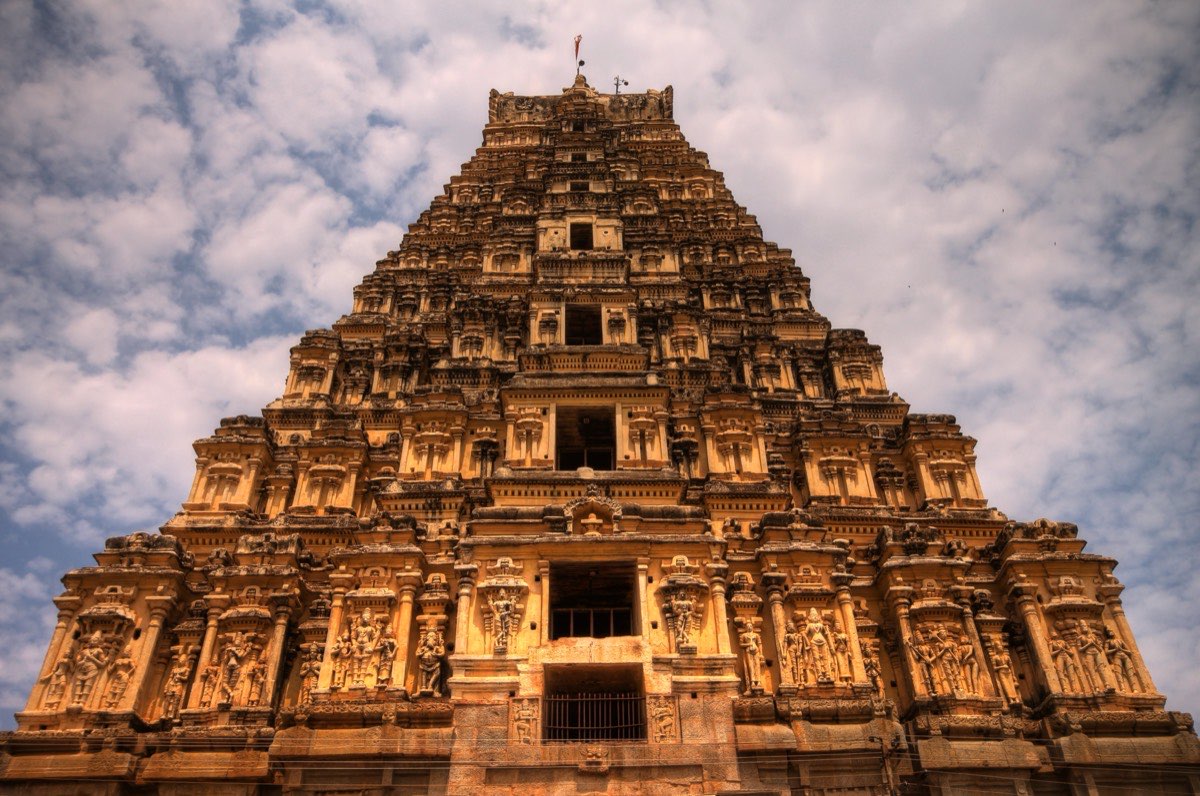
The temple reached its architectural zenith under Emperor Kṛṣṇadēvarāya (r. 1509-1529 CE), the most celebrated ruler of the Vijayanagara Empire and a legendary patron of arts, literature, and temple-building. Kṛṣṇadēvarāya commissioned the most ornate addition to the temple complex — the central pillared hall (raṅga maṇḍapa) — in 1510 CE to celebrate his accession to the throne. The emperor also renovated and expanded the eastern gopuram (tower gateway) to its present imposing height of approximately 160 feet (49 metres) with nine storeys.
Inscriptions record that Kṛṣṇadēvarāya visited the Virupākṣa Temple to offer worship before and after his military campaigns, donating lavish quantities of gold, jewels, and landed endowments. His court poet Allasāni Peddana composed the celebrated Telugu mahākāvya “Manu Caritramu” under his patronage, and the literary and artistic flowering of the Kṛṣṇadēvarāya period represents one of the high points of South Indian civilization.
Expansion by Lakkan Daṇḍeśa
Another major phase of expansion occurred under Lakkan Daṇḍeśa, a nāyaka (military chieftain) serving under Emperor Dēva Rāya II (r. 1424-1446 CE), also known as Prauḍha Dēva Rāya. Lakkan Daṇḍeśa commissioned significant structural additions to the temple complex, including the expansion of the outer prākāra (enclosure wall) and the construction of several subsidiary shrines.
Architecture: A City Within a City
The Gopurams: Gateways to the Divine
The Virupākṣa Temple complex is entered through two imposing gopurams (tower gateways):
-
The Eastern Gopuram (Rāya Gopuram): The taller of the two, rising to approximately 160 feet (49 metres) in nine storeys. Renovated by Kṛṣṇadēvarāya, it dominates the eastern approach to the temple and serves as the visual anchor of Hampi Bazaar, the long colonnaded street that stretches eastward from the temple entrance. The gopuram is decorated with elaborate stucco figures depicting scenes from Hindu mythology.
-
The Inner Gopuram: A smaller but richly carved gateway that leads into the inner prākāra containing the main shrine.
The Three Enclosures
The temple complex is organized into three concentric enclosures (prākāras), following the traditional South Indian temple plan that represents progressively deeper levels of sanctity as one moves inward:
-
The Outer Enclosure: Contains subsidiary shrines, including a temple dedicated to Goddess Bhuvaneśvarī and various maṇḍapas (pillared halls) used for festivals and community gatherings.
-
The Second Enclosure: Houses the raṅga maṇḍapa (the ornate pillared hall commissioned by Kṛṣṇadēvarāya), characterized by richly sculpted pillars depicting Vijayanagara court scenes, mythological narratives, and rearing animals.
-
The Inner Enclosure: Contains the garbhagṛha (sanctum sanctorum) with the Virupākṣa Liṅga, the shrine of Pampā Devī, and the Vidyāśaṅkara shrine.
The Pinhole Camera Effect
One of the temple’s most remarkable features is an optical phenomenon in the Raṅga Maṇṭapa. A small aperture in the western wall of the hall projects an inverted image of the eastern gopuram onto the opposite interior wall. This natural pinhole camera (camera obscura) effect demonstrates that the ancient architects possessed sophisticated understanding of optical principles — specifically, that light travels in straight lines and that an image passing through a small aperture will appear inverted on the opposite surface. This phenomenon, created centuries before the formal documentation of camera obscura principles in Western science, continues to astonish visitors today.
The Fall of Vijayanagara and the Temple’s Survival
The Battle of Tālikōṭa (1565 CE)
The Vijayanagara Empire met its catastrophic end at the Battle of Tālikōṭa (also known as the Battle of Rakkasa-Taṅgaḍi) on January 26, 1565, when the combined forces of the Deccan Sultanates — Bijapur, Ahmadnagar, Golkonda, and Bidar — defeated the Vijayanagara army and captured Emperor Rāma Rāya. The victorious armies then descended upon Hampi, systematically looting and destroying the capital over a period of several months. The Portuguese chronicler Diogo do Couto recorded that the destruction continued for six months, reducing the magnificent city to ruins.
Why the Virupākṣa Temple Survived
While hundreds of temples across Hampi were destroyed — their sculptures defaced, their structures dismantled — the Virupākṣa Temple emerged largely intact. Scholars have proposed several explanations: the temple’s location on the far western edge of the city, near the river, may have afforded it some protection; the invading forces may have concentrated their destruction on the royal and civic centres rather than the riverside temple precinct; and the continuing presence of a Śaiva community of devotees may have provided informal guardianship. Whatever the cause, the survival of the Virupākṣa Temple is remarkable and has allowed the unbroken continuity of worship that distinguishes it from every other structure in Hampi.
Living Traditions and Festivals
The Pampā-Virupākṣa Wedding Festival (Phalapūjā)
The most important annual festival at the Virupākṣa Temple celebrates the divine marriage (kalyāṇotsava) of Virupākṣa and Pampā Devī. Held in December, this multi-day event re-enacts the mythological marriage of Śiva and the river goddess, complete with elaborate ritual processions, Vedic chanting, classical music, and the participation of thousands of devotees. The festival begins with the betrothal ceremony and culminates in the wedding ritual, during which the processional images (utsava mūrtis) of Virupākṣa and Pampā Devī are ceremonially united.
The Annual Chariot Festival (Rathotsava)
Celebrated in February, the chariot festival involves the processional deities being placed on a large decorated wooden chariot (ratha) and pulled through the streets of Hampi by hundreds of devotees. The festival is accompanied by music, dance, and cultural performances, and draws pilgrims from across Karnataka and neighbouring states.
Mahāśivarātri
The Great Night of Śiva is observed with special fervour at the Virupākṣa Temple. The Liṅga in the sanctum receives continuous abhiṣeka (ritual bathing) through the four watches of the night, and devotees maintain an all-night vigil of prayer and chanting.
Daily Worship
The temple maintains a rigorous schedule of daily worship (nityapūjā) that has continued without interruption for over thirteen centuries. Six daily pūjā ceremonies are conducted, beginning before dawn and concluding after nightfall, following the prescriptions of the Śaiva Āgamas. The temple elephant, a beloved feature of the Virupākṣa Temple, blesses visitors at the entrance as part of the daily temple routine.
The Hampi Landscape: A Sacred Geography
The Virupākṣa Temple does not exist in isolation; it is the spiritual nucleus of a vast sacred landscape that the Vijayanagara rulers deliberately shaped to embody their religious vision. Key elements of this sacred geography include:
-
Hemakūṭa Hill: Rising directly behind the Virupākṣa Temple, this hill is covered with Jain and Śaiva temples from the pre-Vijayanagara period and offers a commanding view of the temple complex and the Tuṅgabhadrā valley.
-
The Tuṅgabhadrā River: The sacred river that flows along the northern edge of the temple complex is identified with Pampā, the goddess-consort of Virupākṣa. Ritual bathing in the river remains an integral part of pilgrimage to the temple.
-
Hampi Bazaar (Virupākṣa Bazaar): The long colonnaded street extending eastward from the temple gopuram was once the commercial heart of the Vijayanagara capital, lined with shops that served both pilgrims and the general public.
-
The Maṅgaḍēvī Temple and Other Shrines: Numerous smaller shrines dedicated to various deities surround the Virupākṣa Temple, creating a densely sacred precinct that amplifies the spiritual potency of the site.
Cultural and Artistic Significance
The Virupākṣa Temple complex is a repository of Vijayanagara-era art, encompassing architectural sculpture, painted ceilings, and inscriptional records. The pillars of the Raṅga Maṇṭapa are carved with scenes from the Rāmāyaṇa, the Mahābhārata, and the Śiva Purāṇas, as well as depictions of Vijayanagara court life — dancers, musicians, warriors, and royal processions. The ceiling paintings in several maṇḍapas depict themes from Śaiva mythology, including the marriage of Śiva and Pārvatī, the destruction of Tripura, and the dance of Naṭarāja.
For the Kannaḍa-speaking people of Karnataka, the Virupākṣa Temple and the ruins of Hampi occupy a position of profound cultural significance. Hampi represents the golden age of Kannaḍa and Telugu literature, music, and the arts, and the temple is a living link to that heritage. The Vijayanagara period produced masterworks of Kannaḍa literature, including the writings of Kumāra Vyāsa (whose Kannaḍa Mahābhārata was composed during this era) and the musical compositions of the Haridāsa saints Purandaradāsa and Kanakadāsa.
Conclusion: The Eternal Gaze
In a landscape of magnificent ruins — broken columns, headless statues, walls without roofs — the Virupākṣa Temple alone continues to fulfil the purpose for which it was built. Its bells still ring. Its lamps still burn. Its priests still chant the same mantras that Chalukya kings heard in the 7th century, that Vijayanagara emperors heard in the 15th, and that pilgrims hear today. The oblique-eyed Lord — Virupākṣa — still gazes from his sanctum across the Tuṅgabhadrā, across the broken stones of his imperial city, with the same asymmetric compassion that has sustained this place through the rise and fall of dynasties, the violence of conquest, and the slow erosion of centuries. Empires fall; the temple endures.