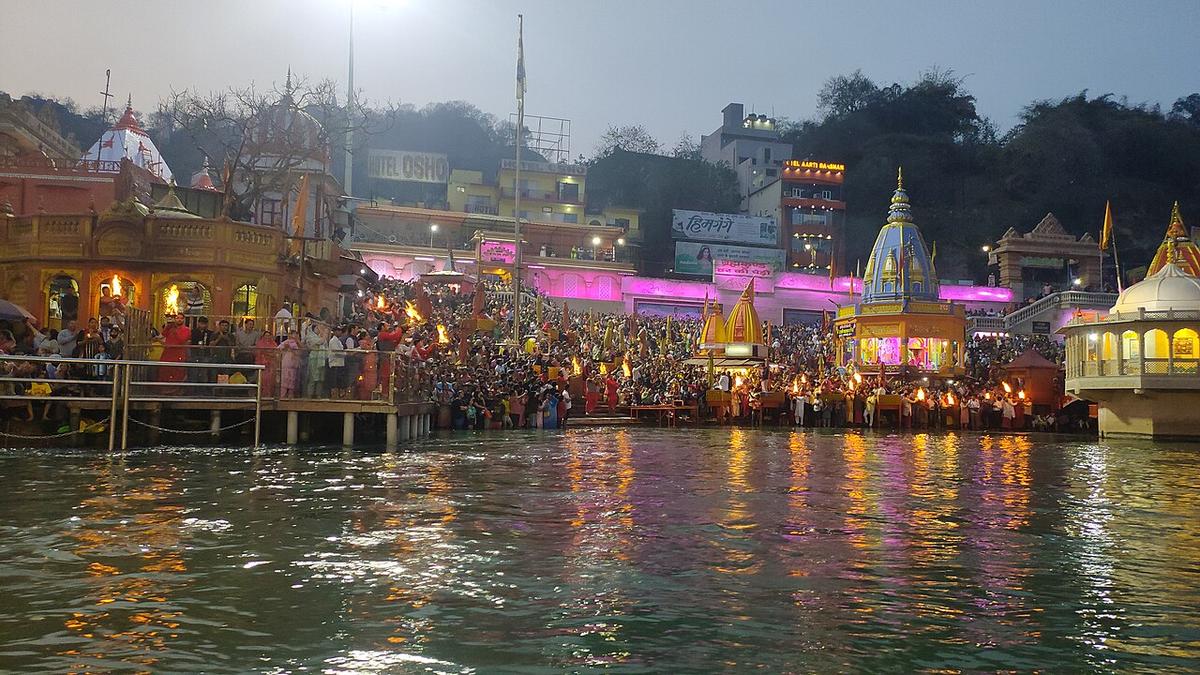
Haridwar (Sanskrit: हरिद्वार, Haridvāra) stands at the precise point where the sacred river Ganga leaves the Shivalik foothills and flows onto the vast Indo-Gangetic plains. One of the seven holiest cities (Sapta Puri) in Hinduism, it is a place where the boundary between the earthly and the divine is believed to dissolve entirely. For millennia, pilgrims have journeyed here to bathe in the Ganga’s purifying waters, perform rites for departed ancestors, and seek liberation (moksha).
Etymology: The Door of Hari
The name “Haridwar” carries a dual spiritual meaning rooted in its Sanskrit etymology. As Hari-dvāra (“Gate of Vishnu”), it signifies the entrance to Lord Vishnu’s abode. Alternatively read as Hara-dvāra (“Gate of Shiva”), it marks the threshold to Lord Shiva’s Himalayan realm. This linguistic duality reflects the city’s unique position as a pilgrimage centre sacred to both Vaishnavites and Shaivites alike.
The Vishnu Purāna (Book II, Chapter 8) describes Haridwar as a tīrtha of supreme merit, declaring that one who bathes at the confluence where the Ganga meets the plains gains the fruit of performing a thousand ashvamedha yajnas (horse sacrifices). The Skanda Purāna (Kedāra Khanda) further extols Haridwar as a place where even the gods descend to bathe during auspicious alignments of the planets.
Har Ki Pauri: The Footprint of God
The spiritual heart of Haridwar is Har Ki Pauri (literally “Footstep of the Lord”), a ghāt on the western bank of the Ganga believed to be the exact spot where the divine nectar (amrita) fell from the celestial pot (kumbha) during the mythological churning of the ocean (Samudra Manthana). According to tradition, Lord Vishnu himself left his footprint (pada) on a stone here, which is still venerated by devotees beneath the waters.
The ghāt was originally built by King Vikramāditya in memory of his brother Bhartrihari, who is said to have meditated and attained samādhi at this very spot. Over the centuries, Har Ki Pauri has been expanded and renovated multiple times, with the present structure dating largely to the British colonial period. The Brahmakunda, the most sacred bathing tank at Har Ki Pauri, is the point where pilgrims immerse themselves for spiritual purification, particularly during eclipses, Amāvasyā (new moon), and other astronomically significant days.
A bath at Har Ki Pauri is considered especially meritorious on Mahā Shivratri, during the month of Vaisākha (April-May), and on the day of Ganga Dussehra (the anniversary of the Ganga’s descent to earth). The Skanda Purāna declares that those who die at Haridwar are released from the cycle of rebirth.
The Kumbh Mela: Largest Gathering on Earth
Haridwar is one of the four cities that host the Kumbh Mela, the world’s largest religious gathering, which rotates among Haridwar, Prayāgraj (Allahabad), Ujjain, and Nāsik on a twelve-year cycle. The Kumbh at Haridwar occurs when Jupiter (Brihaspati) enters Aquarius (Kumbha rāshi) and the Sun enters Aries (Mesha rāshi).
The mythological origin of the Kumbh Mela traces back to the Samudra Manthana narrated in the Bhāgavata Purāna (Canto 8, Chapters 5-10) and the Vishnu Purāna. When the devas and asuras churned the cosmic ocean to obtain the nectar of immortality, the divine physician Dhanvantari emerged carrying the kumbha (pot) of amrita. During a fierce struggle for the pot, four drops of nectar fell at four locations on earth — Haridwar, Prayāgraj, Ujjain, and Nāsik.
During the Kumbh Mela, tens of millions of pilgrims converge on Haridwar for the Shāhi Snāna (Royal Bath), the most auspicious bathing ritual. The akharas (monastic orders) of sādhus and nāgas (warrior ascetics) lead processions to the river in a spectacular display of devotion. UNESCO inscribed the Kumbh Mela on its Representative List of the Intangible Cultural Heritage of Humanity in 2017, recognizing it as a living expression of faith that has endured for millennia.
The most recent Mahā Kumbh Mela at Haridwar occurred in 2021, drawing an estimated 25 million pilgrims over the course of the festival despite pandemic-related restrictions.
The Ganga Aarti: A Symphony of Fire and Devotion
Every evening at sunset, the ghāts of Haridwar come alive with the Ganga Aarti, a grand ritual of worship performed at Har Ki Pauri. Priests (purohitas) hold massive multi-tiered brass lamps (dīpas) blazing with camphor and ghee-soaked wicks, moving them in elaborate circular motions as they chant Vedic hymns and sing devotional songs to Mā Ganga.
The ceremony begins with the blowing of conch shells (shankha) and the ringing of temple bells, followed by the recitation of mantras including the Ganga Stotra and the Āratī:
Om Jai Gange Māta, Jai Gange Māta Tumako Nīpata Karata, Mahādhīpa Dhīpata
Thousands of small leaf boats (dīpa-dānī) carrying flowers and flickering oil lamps are set afloat on the river’s surface, creating a breathtaking tableau of light that drifts downstream into the gathering darkness. The Ganga Aarti at Haridwar is not merely a ceremony but a living expression of the Hindu belief that the Ganga is a goddess — Gangā Devī — who descended from heaven to purify humanity.
Sacred Temples of Haridwar
Daksha Mahādeva Temple
One of the oldest and most historically significant temples in Haridwar is the Daksha Mahādeva Temple, dedicated to Lord Shiva. It stands at the site where, according to the Shiva Purāna and the Vāyu Purāna, King Daksha Prajāpati performed a great yajna (fire sacrifice) to which he deliberately did not invite his son-in-law, Lord Shiva. When Daksha’s daughter Satī arrived uninvited and was humiliated, she immolated herself in the sacrificial fire. Enraged, Shiva sent his fierce manifestation Vīrabhadra, who destroyed the yajna and beheaded Daksha. Later, Shiva relented and restored Daksha to life with a goat’s head.
The temple is located in the Kankhal area of Haridwar and is considered one of the most important Shiva temples in northern India.
Mansa Devi Temple
Perched atop Bilwa Parvat (Bilwa Hill), the Mansa Devi Temple is dedicated to Goddess Mansa Devi, a form of Shakti who is believed to fulfill the wishes (manas) of her devotees. The temple is one of the Siddha Pīthas (seats of spiritual power) and can be reached by a ropeway or a steep trek. Pilgrims tie sacred threads on the temple’s holy tree while making a wish, returning to untie them when the wish is fulfilled.
Chandi Devi Temple
On the summit of Neel Parvat (Neel Hill), the Chandi Devi Temple houses a deity installed by Ādi Shankarāchārya in the 8th century CE. According to local tradition, Goddess Chandī (a fierce form of Durgā) slew the demon generals Shumbha and Nishumbha at this location, as narrated in the Devī Māhātmya (Mārkandeya Purāna, Chapters 81-93). Together with Mansa Devi, the Chandi Devi temple forms part of the Panch Tīrtha (Five Pilgrimages) of Haridwar.
Gateway to the Char Dham
Haridwar has served for centuries as the traditional starting point for the Char Dhām Yātrā, the pilgrimage to the four sacred shrines of the Himalayas: Badrīnāth (dedicated to Vishnu), Kedārnāth (dedicated to Shiva), Gangotri (source of the Ganga), and Yamunotri (source of the Yamunā). Pilgrims have historically gathered in Haridwar to organize caravans for the arduous journey into the mountains, receiving blessings at Har Ki Pauri before departing.
The Skanda Purāna (Kedāra Khanda) describes the Char Dhām as the four divine abodes established to anchor spiritual energy in the Himalayan landscape. Even today, the vast majority of Char Dhām pilgrims begin their journey from Haridwar, making the city an indispensable hub of Hindu pilgrimage infrastructure.
Scriptural References and Spiritual Significance
Haridwar appears across numerous Hindu scriptures under various names. The Mahābhārata (Vana Parva) refers to the region as Gangādvāra (“Door of the Ganga”), while the Vishnu Purāna uses the name Māyāpurī. The Vāmana Purāna describes Haridwar as one of the sites where Lord Vishnu’s divine energy is perpetually manifest.
The spiritual significance of Haridwar rests on several pillars:
- Purification: Bathing in the Ganga at Haridwar is believed to wash away accumulated pāpa (sin) from multiple lifetimes
- Ancestral rites: The city is one of the premier locations for performing shraddhā and pinda-dāna (offerings to departed ancestors)
- Liberation: The Garuda Purāna states that those who leave their mortal body at Haridwar attain moksha without further rebirth
- Divine presence: As a tīrtha where amrita fell, Haridwar is considered a place where the veil between the material and spiritual worlds is thinnest
The Living Tradition
Today, Haridwar remains a vibrant, living centre of Hindu religious life. The city is home to numerous āshramas (spiritual retreats), gurukulas (traditional schools), and dharmaśālās (pilgrims’ rest houses). Organizations such as the Shantikunj ashram of the Gayatri Parivar, the Parmarth Niketan ashram, and the Bharat Mata Mandir continue to draw spiritual seekers from across the world.
The rhythms of Haridwar are governed by the sacred calendar — from the daily Ganga Aarti to the annual Kāvad Yātrā (when millions of Shiva devotees carry Ganga water to their home temples during Shrāvana) to the grand Kumbh Mela that transforms the city into the spiritual capital of the world.
For the devout Hindu, Haridwar is not merely a geographical location but a tīrtha in the deepest sense — a crossing point where the human soul, carried by faith and purified by the sacred waters, can ford the river of samsāra and step through the gateway of the gods toward liberation.