Introduction: The Golden City of the Gods
Kāñcīpuram — known variously as Kāñcī, Conjeevaram, and the “City of Thousand Temples” — is one of the oldest and most sacred cities of India, situated approximately 72 kilometres southwest of Chennai on the banks of the Vegavatī (Pālār) river in Tamil Nadu. Revered as one of the seven Mokṣa-purī cities (Sapta Purī) where liberation from the cycle of rebirth is attainable, Kāñcīpuram holds the rare distinction of being supremely sacred to both major traditions of Hinduism: Śaivism and Vaiṣṇavism.
The city’s very name carries spiritual weight. Traditional etymology derives “Kāñcī” from the Sanskrit kā (Brahmā) + añci (worship), meaning “where Brahmā worshipped” — a reference to the myth of Brahmā performing penance here to obtain Śiva’s grace. The Skanda Purāṇa’s Kāñcī Māhātmya declares: “Among all sacred places on earth, Kāñcīpuram shines supreme. The very dust of this city liberates the soul” (Skanda Purāṇa, Kāñcī Khaṇḍa 1.4-5).
For over two thousand years, Kāñcīpuram has served as a capital of the Pallava dynasty (3rd-9th century CE), a centre of Buddhist and Jain learning, and a hub of silk weaving. But its primary identity remains that of a vast, living temple-city where every street, tank, and grove carries the memory of divine presence.
The Seven Mokṣa-purī Cities
Hindu tradition identifies seven cities where mokṣa (liberation) is assured for the devoted soul:
ayodhyā mathurā māyā kāśī kāñcī avantikā | purī dvāravatī caiva saptaitā mokṣadāyikāḥ ||
“Ayodhyā, Mathurā, Māyā (Haridvāra), Kāśī, Kāñcī, Avantikā (Ujjain), and Dvārakā — these seven are the givers of liberation.”
Kāñcīpuram’s inclusion in this list underscores its pan-Indian significance. While the other Mokṣa-purī cities are primarily associated with a single deity — Kāśī with Śiva, Dvārakā with Kṛṣṇa, Ayodhyā with Rāma — Kāñcīpuram embraces both the Śaiva and Vaiṣṇava traditions with equal fervour, reflected in the geographical division of the city into Śiva Kāñcī (the western quarter) and Viṣṇu Kāñcī (the eastern quarter).
Kāmākṣī Amman Temple: The Śakti Pīṭha
The Goddess Who Conquered Desire
At the spiritual heart of Kāñcīpuram stands the Kāmākṣī Amman Temple, dedicated to the supreme Goddess in her form as Kāmākṣī — “She whose eyes radiate desire (kāma) and grace (akṣī).” The temple is regarded as one of the 51 (or 108) Śakti Pīṭhas, sites where portions of the body of Goddess Satī fell during Śiva’s cosmic dance of grief (as narrated in the Devī Bhāgavata Purāṇa, 7.30).
According to tradition, it is at Kāñcī that the navel (nābhi) of the Goddess fell, making Kāmākṣī the Nābhisthāna Śakti — the “navel centre” of divine feminine power. The Lalitā Sahasranāma (verse 59) praises her as “Kāñcīnagara-nilayā” — “She who resides in the city of Kāñcī.”
The mūrti of Kāmākṣī in the sanctum is depicted seated in padmāsana (lotus posture) on the Śrī Cakra — the geometric representation of cosmic creative energy central to Śrī Vidyā Tantra. In her four hands she holds a sugarcane bow (representing the mind), flower arrows (the five sense-objects), a noose (attachment), and a goad (repulsion), symbolising her mastery over the forces of desire. Unlike the fierce forms of the Goddess seen at many Śakti Pīṭhas, Kāmākṣī is worshipped here in her supremely benevolent aspect (śānta svarūpa), radiating grace and compassion.
Ādi Śaṅkarācārya and the Śrī Cakra
The Kāmākṣī temple is intimately linked with Ādi Śaṅkarācārya (8th century CE), the great philosopher-saint who unified diverse Hindu traditions. According to tradition, when Śaṅkara arrived in Kāñcīpuram, the Goddess Kāmākṣī was in her ugra (fierce) aspect, causing disturbances in the cosmic order. Śaṅkara installed the Śrī Cakra (Śrī Yantra) before the Goddess, channelling her fierce energy into a state of eternal tranquility.
It was at Kāñcīpuram that Śaṅkara is believed to have established the Kāñcī Kāmakōṭi Pīṭham, one of the most prominent monastic seats (maṭha) of the Advaita Vedānta tradition. The Pīṭham’s unbroken succession of Śaṅkarācāryas has guided the spiritual and cultural life of South India for over twelve centuries, and the current pontiff continues to serve as one of Hinduism’s most revered living authorities.
Ekāmbaranātha Temple: The Earth Liṅga
The Pañca Bhūta Sthala
Ekāmbaranātha (Ekāmbareśvara) Temple, located in Śiva Kāñcī, is one of the five Pañca Bhūta Sthalas — temples representing the five primordial elements (earth, water, fire, air, and space) through which Śiva manifests. Ekāmbaranātha represents pṛthivī (earth), complementing Jambukēśvara (water, Tiruchirapalli), Aruṇācaleśvara (fire, Tiruvannamalai), Śrī Kālahastīśvara (air, Kalahasti), and Cidambara Naṭarāja (space, Chidambaram).
The liṅga in the sanctum is made of sand (mṛttikā liṅga), naturally formed from the earth itself, embodying the pṛthivī tattva. The Tēvāram hymns of the Nāyanār saints — particularly those of Tiruñāṇacampantar and Appar (7th century CE) — celebrate this liṅga as a direct manifestation of Śiva in earthly form:
maṉṟu āṭi maṇi āṭi vaṇṭu āṭum poḻilkaḷ cūḻ kaṉṟu āṭiya kaḻal kāmam ceyta kampan
“The Lord who dances in the hall, adorned with jewels, surrounded by groves where bees dance — He who performed the cosmic play at Kāñcī.”
The Ancient Mango Tree
One of Ekāmbaranātha Temple’s most celebrated features is the sacred mango tree (Ekāmra Vṛkṣa) in the temple courtyard, said to be over 3,500 years old. The name “Ekāmbaranātha” itself derives from “Eka-āmra-nātha” — “Lord of the Single Mango Tree.” According to temple tradition, Goddess Pārvatī performed penance under this mango tree, fashioning a liṅga from the earth (hence the earthen liṅga), and Śiva appeared before her, pleased with her devotion. The ancient tree, though partially damaged by natural forces over the centuries, still stands and bears fruit — and remarkably, its four main branches are said to produce four different varieties of mango, one for each Veda.
The temple complex, expanded significantly during the Vijayanagara period (14th-17th century CE), covers approximately 25 acres. Its towering rājagopuram (main gateway tower) rises to 59 metres, making it one of the tallest temple towers in India. The thousand-pillared maṇḍapa, with its intricately carved granite columns, is a masterpiece of Vijayanagara temple architecture.
Varadarāja Perumāḷ Temple: The Vaiṣṇava Crown Jewel
Viṣṇu Kāñcī
In the eastern quarter of Kāñcīpuram, Viṣṇu Kāñcī, stands the magnificent Varadarāja Perumāḷ Temple, dedicated to Lord Viṣṇu in his form as Varadarāja — “the King who grants boons.” This temple is one of the 108 Divya Desams (sacred sites celebrated by the Āḻvār saints) and is considered among the most important Vaiṣṇava temples in India.
The Āḻvār saints — the twelve Tamil poet-mystics of the Bhakti movement (6th-9th century CE) — poured their devotion into hymns praising Varadarāja. Tirumangai Āḻvār dedicated numerous paśurams (verses) to the deity:
kaṇṇan kaḻal iṇai nandāk kaṉṟu āya kāvalanaip paṇṇil paḻam tēṉoḍu pāl amudāy niṉṟāṉ
“He who stood as the calf that never ages, the guardian of cattle — whose melody is like ancient honey mixed with milk and nectar.”
The temple’s most extraordinary feature is the Aththi Varadar — a sacred image of Viṣṇu carved from fig wood (atti maram), which is kept submerged in the temple’s sacred tank (Anantasaras) and brought out for public viewing only once every 40 years. The last such event, in 2019, drew over 10 million devotees in a 48-day period. The next darśana is expected around 2059.
The 100-Pillared Hall and Lizard Carvings
Varadarāja Perumāḷ Temple is famous for its exquisite 100-pillared maṇḍapa, a Vijayanagara-era addition featuring stone chains carved from single blocks of granite — a testament to the extraordinary skill of medieval Indian sculptors. The hall also contains remarkable lizard carvings (one gold, one silver) on the ceiling, which have become iconic symbols of the temple. Touching these lizards is believed by devotees to absolve the effects of sarpa-doṣa and bring good fortune.
Kailāsanātha Temple: The Pallava Masterpiece
The Oldest Standing Temple in Kāñcīpuram
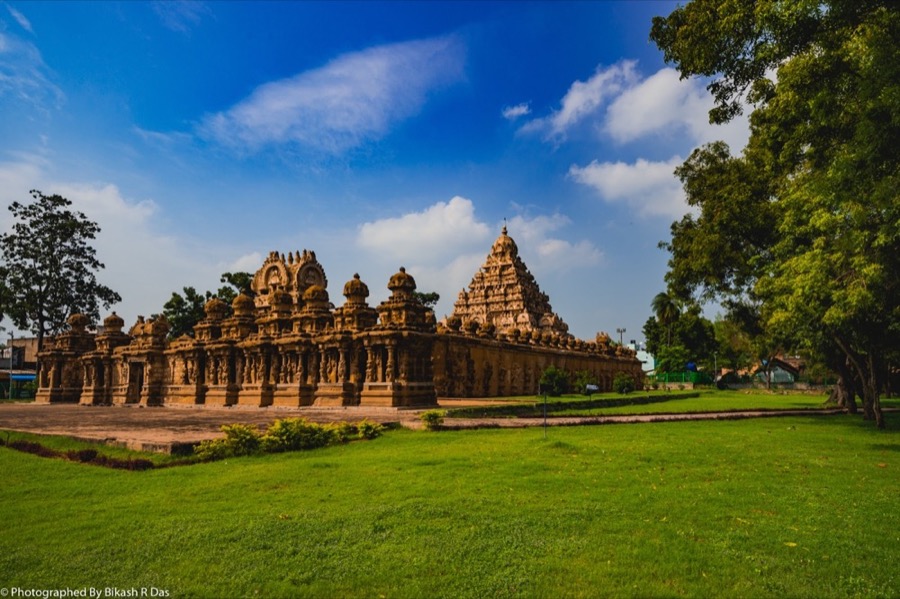
The Kailāsanātha Temple, built by Pallava king Narasimhavarman II (Rājasiṃha) around 700 CE, is the oldest surviving structural temple in Kāñcīpuram and one of the finest examples of early Dravidian architecture. Unlike the later temples, which were expanded over centuries by multiple dynasties, Kailāsanātha preserves the pure Pallava aesthetic — graceful proportions, delicate sculptural detail, and an intimate scale that invites contemplation rather than awe.
The temple’s pyramidal vimāna (tower over the sanctum) rises in a series of diminishing tiers, each adorned with miniature shrines (kūṭas) and barrel-vaulted pavilions (śālās). The exterior walls bear extraordinary panels of Śiva in his various cosmic aspects — as Naṭarāja (the cosmic dancer), Tripurāntaka (the destroyer of the three cities), Gaṅgādhara (bearer of the Gaṅgā), and Ardhanārīśvara (the half-male, half-female form).
A remarkable feature is the circumambulatory passage (prākāra) lined with 58 small subsidiary shrines, each housing a distinct liṅga and once painted with vibrant frescoes. Traces of the original Pallava-era paintings survive in several shrines, making this one of the oldest sites of Hindu mural painting in South India.
Architectural Significance
Art historian Percy Brown described the Kailāsanātha as “the most perfect example of Hindu temple architecture.” The Archaeological Survey of India, which now maintains the temple, considers it a monument of national importance. Its influence extended far beyond Kāñcīpuram — the Pallava architectural principles developed here spread to Southeast Asia through maritime trade, inspiring the temples of Angkor, Prambanan, and Borobudur.
The Kāñcī Kāmakōṭi Pīṭham
The Kāñcī Kāmakōṭi Pīṭham, traditionally associated with Ādi Śaṅkarācārya, is one of the foremost monastic institutions of Hinduism. The Pīṭham’s Śaṅkarācāryas have played a vital role in preserving Vedic learning, Sanskrit scholarship, temple renovation, and inter-religious harmony in South India.
The 68th Śaṅkarācārya, Śrī Chandraśekharendra Sarasvatī (1894-1994), known reverentially as the “Mahāperiyava” (“Great Elder”), is regarded as one of the greatest saints of modern India. His seven decades of spiritual leadership, his encyclopedic knowledge of the Śāstras, and his emphasis on preserving traditional Hindu practices transformed the Pīṭham into a major institution of Hindu renewal in the modern age. His discourses, published as “Deivathin Kural” (“Voice of God”), remain among the most widely read spiritual texts in Tamil.
Silk Weaving: Sacred Art of Kāñcī
Kāñcīpuram is inseparable from its silk weaving tradition, which dates back to the Pallava period. The Kāñcīpuram silk sāṛī — woven with pure mulberry silk thread and real gold or silver zari — is considered the finest handloom silk in India and is an essential element of South Indian weddings, temple rituals, and festival celebrations.
The weaving community traces its origins to the sage Mārkandēya, who is said to have woven fabric for the gods themselves. Many weaving families maintain the tradition of beginning their work day with a prayer to Kāmākṣī and using specific auspicious designs — the temple border (kōpuram design), the mango motif (paislēy), and the mythical parrot — that carry religious symbolism.
The connection between temple and loom is not merely symbolic. Historically, the temples of Kāñcīpuram were the primary patrons and consumers of silk fabric, requiring vast quantities for deity adornment (alaṅkāra), festival decorations, and gifts to devotees. This sacred economy sustained the weaving tradition through the centuries and continues today.
Festivals and Celebrations
Brahmōtsavam
Each major temple in Kāñcīpuram celebrates an annual Brahmōtsavam (grand festival), typically lasting nine to ten days. The deity is taken in procession on various vāhanas (mounts) — Garuḍa, the horse, the elephant, the chariot — through the streets, accompanied by traditional nādasvaram (temple music), Vedic chanting, and the participation of thousands of devotees. The Ekāmbaranātha Brahmōtsavam in the Tamil month of Panguni (March-April) and the Varadarāja Perumāḷ Brahmōtsavam in Vaikāsi (May-June) are the most celebrated.
Thai Poosam and Navarathiri
Thai Poosam (dedicated to Lord Murugan/Skanda) and the nine-night Navarathiri festival (dedicated to the Goddess in her three forms — Durgā, Lakṣmī, and Sarasvatī) are observed with particular grandeur in Kāñcīpuram, drawing pilgrims from across Tamil Nadu.
Conclusion: The Eternal City of Grace
Kāñcīpuram stands as a living testament to the depth and diversity of Hindu temple culture. From the intimate grace of the Pallava-era Kailāsanātha to the towering splendour of Ekāmbaranātha’s rājagopuram, from the serene Goddess Kāmākṣī seated on the Śrī Cakra to the majestic Varadarāja emerging from the sacred waters once in a generation — the city weaves together two millennia of devotion into a seamless tapestry of stone, silk, and spirit. As the Skanda Purāṇa proclaims: “All tīrthas, all sacrifices, all austerities — their combined merit is gained by simply residing in Kāñcī for a single day” (Kāñcī Māhātmya 2.15).