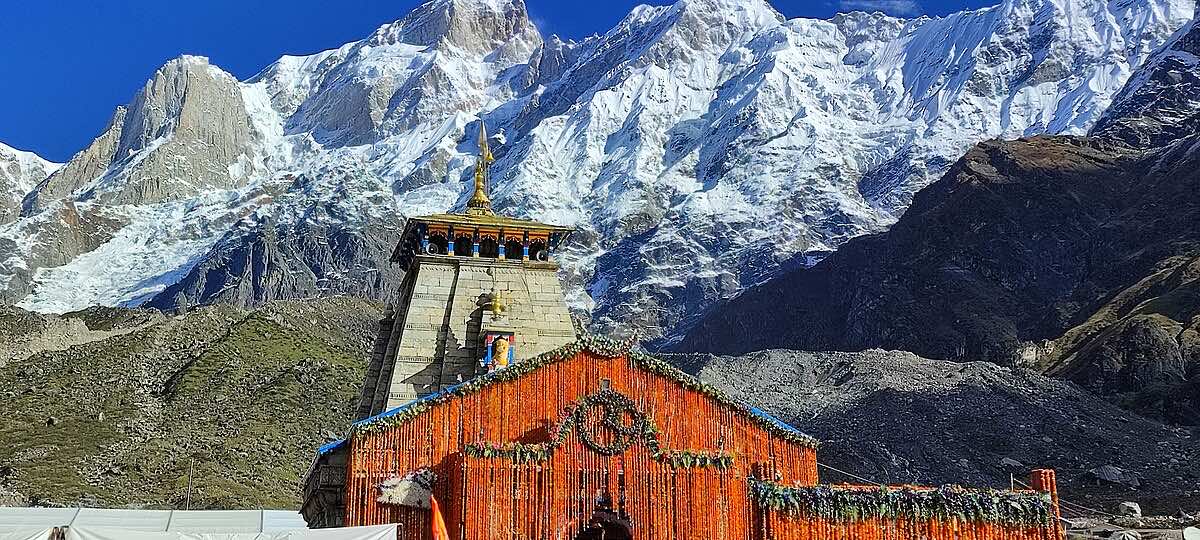
Perched at an altitude of 3,583 metres (11,755 feet) near the head of the Mandākinī river in the Garhwal Himalayas, Kedāranātha (केदारनाथ) is one of the most revered pilgrimage sites in all of Hinduism. The temple enshrines one of the twelve Jyotirlingas — self-manifested pillars of light representing the supreme, formless reality of Lord Śiva. It is also the foremost of the Panch Kedar shrines and an integral stop on the Char Dhām Yātrā, the four-shrine circuit that every devout Hindu aspires to complete at least once in a lifetime.
The Legend of the Pāṇḍavas and Śiva’s Buffalo Form
The most widely recounted origin story of Kedāranātha is tied to the Mahābhārata and the Pāṇḍavas’ quest for absolution after the devastating Kurukṣetra war. According to the Skanda Purāṇa (Kedārakhaṇḍa) and popular oral tradition, the five Pāṇḍava brothers — Yudhiṣṭhira, Bhīma, Arjuna, Nakula, and Sahadeva — sought Lord Śiva’s forgiveness for the sin of killing their own kinsmen in battle.
Śiva, however, wished to avoid the Pāṇḍavas and disguised himself as a Nandī (bull/buffalo). He hid among a herd of cattle in the Garhwal highlands. Bhīma recognised the divine bull and attempted to seize it. As Bhīma grabbed the buffalo by its hump, Śiva began to sink into the earth. His body fragmented and appeared at five separate locations in the Garhwal region, giving rise to the Panch Kedar:
- Kedāranātha — the hump (pṛṣṭha)
- Tunganātha — the arms and face (bāhu)
- Rudranātha — the face (mukha)
- Madhyamaheśvara — the navel (nābhi)
- Kalpēśvara — the matted locks (jaṭā)
The Śiva Purāṇa (Koṭirudra Saṃhitā, chapters 21-22) further elaborates that Śiva was moved by the Pāṇḍavas’ sincere penance and granted them mokṣa (liberation) at this very spot. The triangular, hump-shaped rock worshipped inside the garbhagṛha (sanctum sanctorum) of Kedāranātha is believed to be the very form in which Śiva submerged into the earth.
Jyotirlinga Significance
The concept of the twelve Jyotirlingas is rooted in the Śiva Purāṇa, which describes how Śiva manifested as an infinite column of light (jyotistambha) to settle a dispute between Brahmā and Viṣṇu about supremacy. The twelve sites where this light pierced the earth became the Jyotirlingas — among them, Kedāranātha holds a special place as the highest in elevation and one of the most difficult to reach.
The Śiva Purāṇa (Koṭirudra Saṃhitā 1.21-22) declares:
Kedāraṁ nāma tat kṣetraṁ siddhi-kṣetraṁ pracakṣate | tatrārcanam ca dānaṁ ca tapaḥ homaṁ surārcanam ||
“The land called Kedāra is proclaimed as the field of spiritual attainment; worship, charity, austerity, fire-offerings, and reverence to the gods performed there yield immeasurable merit.”
Pilgrims believe that a single darśana (sacred viewing) of the Kedāranātha Jyotirlinga absolves accumulated sin from multiple lifetimes and accelerates the soul’s journey toward mokṣa.
Temple Architecture and Antiquity
The present temple is a massive stone edifice built from large, evenly cut grey stone slabs. It measures approximately 25 metres (85 feet) in height and rests on a rectangular platform of enormous stone blocks. The architectural style is classified as North Indian Nāgara with a curvilinear śikhara (tower) rising above the garbhagṛha.
Construction and reconstruction
The temple’s exact date of original construction remains debated among historians. Local tradition and several medieval texts attribute the construction — or more precisely, the reconstruction — to Ādi Śaṅkarācārya (8th century CE), the great Advaita Vedānta philosopher who is credited with reviving Hindu pilgrimage circuits across India. Śaṅkarācārya is said to have discovered the ancient ruins of the shrine and rebuilt it as part of his effort to establish places of worship in all four cardinal directions of the subcontinent.
Archaeological evidence, however, suggests that the site was sacred long before Śaṅkarācārya’s intervention. Some scholars date certain structural elements of the foundation to the Gupta period (4th-6th century CE) or even earlier. Inscriptions from the medieval Katyūrī dynasty (7th-11th century) reference endowments to the Kedāranātha shrine, confirming its importance well over a millennium ago.
Key architectural features
- Garbhagṛha: Houses the conical, naturally formed rock representing Śiva’s hump. The liṅga is not a sculpted icon but an irregular, triangular stone formation.
- Maṇḍapa (assembly hall): A large pillared hall where devotees gather for prayers and bhajans.
- Śaṅkarācārya samādhi: Behind the main temple stands a small shrine marking the traditional site of Ādi Śaṅkarācārya’s final resting place (samādhi), though the historical authenticity of this claim is debated.
- Nandī statue: A massive stone bull faces the main entrance, as is customary for Śiva temples.
The Char Dhām Yātrā
Kedāranātha is one of the four sacred sites comprising the Char Dhām (four abodes) of Uttarakhand:
- Yamunōtrī — source of the Yamunā river, dedicated to the goddess Yamunā
- Gaṅgōtrī — source of the Gaṅgā river, dedicated to the goddess Gaṅgā
- Kedāranātha — dedicated to Lord Śiva as Jyotirlinga
- Badrīnātha — dedicated to Lord Viṣṇu
This circuit, collectively known as the Choṭā Char Dhām (to distinguish it from the pan-India Char Dhām established by Śaṅkarācārya), draws hundreds of thousands of pilgrims each season. The yātrā traditionally proceeds from west to east: Yamunōtrī, Gaṅgōtrī, Kedāranātha, and finally Badrīnātha.
The journey to Kedāranātha involves a 16-kilometre trek on foot (or by pony/palanquin) from Gaurikuṇḍ, the last road-accessible point. The trail ascends along the banks of the Mandākinī river through steep, rocky terrain flanked by snow-capped peaks. Helicopter services are also available from Phāṭā and other helipad locations.
The 2013 Floods and the Temple’s Miraculous Survival
On 16-17 June 2013, the Kedāranātha valley experienced a catastrophic cloudburst and glacial lake outburst flood (GLOF) that unleashed devastating flash floods and landslides across the Mandākinī valley. The disaster — widely described as the worst natural calamity in Uttarakhand’s recorded history — killed thousands of pilgrims and local residents, destroyed the town surrounding the temple almost entirely, and wiped out roads and bridges for kilometres.
Yet, remarkably, the main temple structure survived virtually intact. A massive boulder, estimated to weigh several hundred tonnes, lodged itself directly behind the temple and acted as a natural breakwater, diverting the floodwaters around the shrine. Devotees and many observers interpreted this as divine intervention — Śiva protecting his own abode. The boulder, now known locally as “Bhīm Śilā” (Bhīma’s Rock), has itself become an object of veneration.
The temple did sustain some damage to its outer walls and the surrounding paved area, and the adjacent structures (including the Śaṅkarācārya samādhi enclosure) were badly damaged. A comprehensive multi-year reconstruction effort, overseen by the government and the Badrinath-Kedarnath Temple Committee (BKTC), has since restored the site and built new infrastructure, including a retaining wall and improved drainage systems.
Seasonal Opening and Closing
Due to its extreme altitude, Kedāranātha is accessible only during the summer months. The temple follows a strict seasonal calendar:
- Opening (Akṣaya Tṛtīyā): The temple doors are ceremonially opened on the auspicious day of Akṣaya Tṛtīyā, typically in late April or early May. The exact date is determined by the head priest (Rāwal) based on the Hindu calendar.
- Closing (Bhāī Dūj): The temple closes on the day after Dīwālī — the festival of Bhāī Dūj — usually in late October or November. The deity is then symbolically moved to Ūkhīmaṭh (a village at a lower altitude), where worship continues through the winter months.
During the six-month winter closure, the temple is buried under several metres of snow. Despite this, the dīpa (lamp) inside the sanctum is traditionally said to remain lit throughout the winter — a claim that adds to the site’s mystical reputation.
Scriptural References
The sacred stature of Kedāranātha is affirmed across multiple Purāṇic texts:
- Śiva Purāṇa (Koṭirudra Saṃhitā): Describes the Jyotirlinga manifestation and the merit of worship at Kedāra kṣetra.
- Skanda Purāṇa (Kedārakhaṇḍa): Contains the most detailed narration of the Pāṇḍava legend and the establishment of the Panch Kedar shrines.
- Liṅga Purāṇa: Lists Kedāranātha among the foremost Jyotirlingas.
- Mahābhārata (Vana Parva): While the epic does not name Kedāranātha explicitly, it narrates the Pāṇḍavas’ journey through the Himalayas and their encounters with Śiva.
The Kedāra Māhātmya, a sub-text found within certain recensions of the Skanda Purāṇa, elaborates on the specific rituals, vows, and spiritual benefits associated with pilgrimage to Kedāranātha. It prescribes that the yātrā should ideally be undertaken after a period of fasting and mental purification, and that the pilgrim should approach the shrine with humility, chanting the Pañcākṣarī mantra (Om Namaḥ Śivāya).
Spiritual Significance for Devotees
For millions of Śaiva devotees, Kedāranātha represents the ultimate intersection of the earthly and the divine. The harsh, remote landscape — surrounded by glaciers, fed by the Mandākinī, and overshadowed by the Kedāranātha peak (6,940 metres) — reinforces the sense that one has truly left the mundane world behind. The physical difficulty of the pilgrimage is itself regarded as a form of tapas (austerity) that purifies the pilgrim.
The darśana of the sacred hump-shaped liṅga inside the garbhagṛha is considered among the most potent spiritual experiences available in Śaiva tradition. Pilgrims offer bilva (wood-apple) leaves, ghee, milk, and water from the Mandākinī to the liṅga while chanting Vedic hymns such as the Rudram (from the Kṛṣṇa Yajurveda) and the Mahāmṛtyuñjaya mantra.
Whether approached as a test of physical endurance, a fulfilment of scriptural injunction, or simply an act of profound devotion, the journey to Kedāranātha remains one of the most transformative experiences in Hindu pilgrimage tradition — a place where, as the Skanda Purāṇa declares, “even the gods come to worship.”