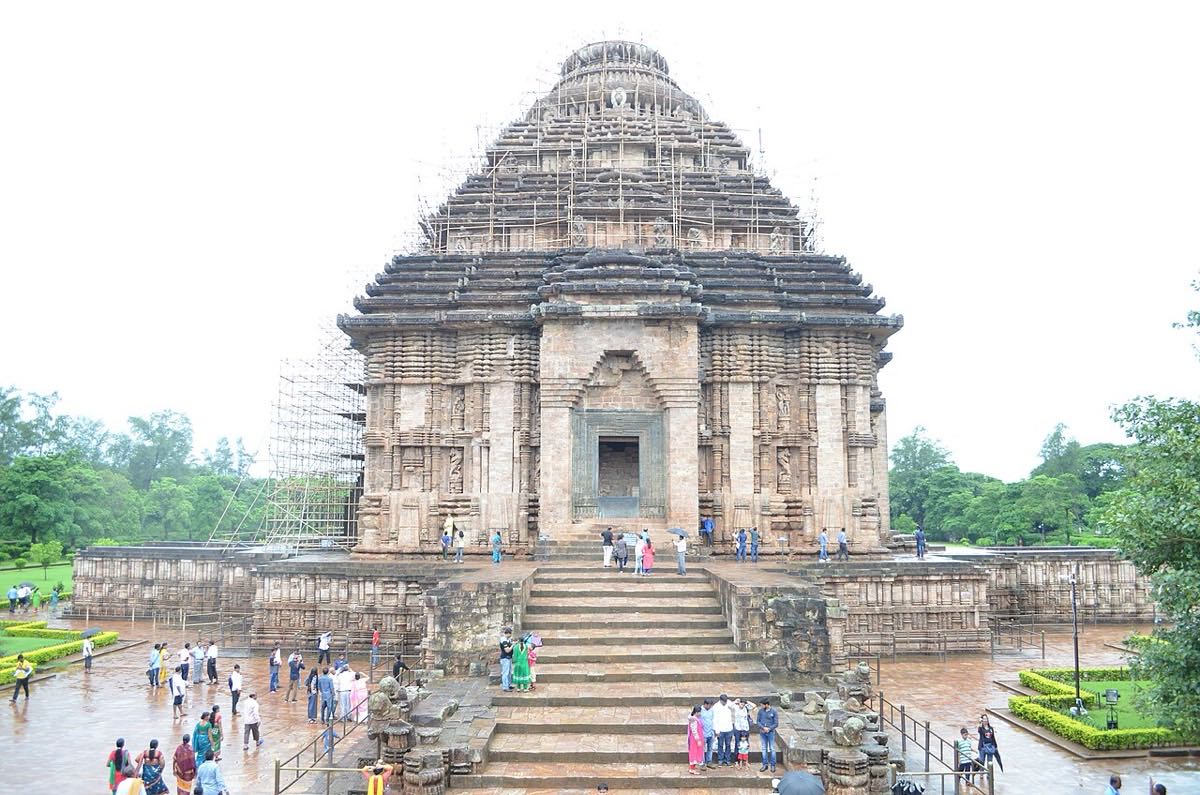
Konark Sun Temple (କୋଣାର୍କ ସୂର୍ଯ୍ୟ ମନ୍ଦିର / कोणार्क सूर्य मंदिर) stands on the shores of the Bay of Bengal in Odisha’s Puri district, approximately 35 kilometers northeast of Puri town. Built in the 13th century CE by King Narasiṃhadeva I of the Eastern Gaṅga dynasty, this extraordinary temple is conceived as a monumental stone chariot of the Sun God Sūrya — complete with twelve pairs of intricately carved wheels, seven galloping horses, and a soaring deul (tower) that once rose to an estimated height of 70 meters. Designated a UNESCO World Heritage Site in 1984, the Konark Sun Temple represents the pinnacle of Kalinga architecture and one of the most ambitious feats of temple construction in the entire history of Indian civilization.
The Name and Legend of Konark
The name Konark derives from the Sanskrit compound koṇa (“corner” or “angle”) and arka (“sun”), meaning “the sun of the corner” — referring to the temple’s location at the northeastern corner of the sacred Puri-Konark-Bhubaneswar triangle, the three most revered pilgrimage destinations in Odisha. European sailors who encountered the temple from the sea in later centuries called it the “Black Pagoda” (kālā pagoda) because its dark granite mass served as a landmark for navigation — and in contrast to the whitewashed “White Pagoda” of the Jagannātha Temple at Puri.
The Sāmba Purāṇa and the Bhaviṣya Purāṇa contain the foundational myth of Sūrya worship at Konark. According to the legend, Sāmba, the son of Lord Kṛṣṇa, was cursed with leprosy by his father for an inadvertent transgression. Following the sage Kaṭaka’s advice, Sāmba performed twelve years of intense penance (tapasyā) to Sūrya at the confluence of the rivers Candrabhāgā and the sea — the very site where the temple now stands. Pleased with his devotion, Sūrya cured his leprosy, and Sāmba established a temple to the Sun God at this spot. The Bhaviṣya Purāṇa (1.130–131) states: “Where the Candrabhāgā meets the great ocean, there Sūrya manifests his healing power, and there his devotees find liberation from all afflictions.”
Historical Context: The Eastern Gaṅga Dynasty
The Konark Sun Temple was constructed between approximately 1244 and 1265 CE during the reign of King Narasiṃhadeva I (r. 1238–1264 CE) of the Eastern Gaṅga dynasty. This was a period of extraordinary political confidence and cultural efflorescence in Odisha. Narasiṃhadeva had recently repelled a major invasion by the Tughlaq forces of the Delhi Sultanate at the Battle of Puri, and the construction of the Sun Temple was, in part, a celebration of this military triumph and an assertion of Hindu sovereignty.
The Mādalā Pāñjī (the temple chronicle of Jagannātha Temple at Puri) records that Narasiṃhadeva employed 1,200 artisans under the supervision of the master architect Biśu Mahārāṇā (also known as Sadāśiva Sāmantarāya Mahāpātra) for this project. The construction reportedly consumed twelve years of labor and vast resources from the royal treasury. Some historical accounts suggest that the project cost the equivalent of twelve years of the kingdom’s revenue — an investment so enormous that it strained the Gaṅga dynasty’s finances.
Architecture: The Cosmic Chariot of Sūrya
The temple’s most remarkable conceptual achievement is its design as a complete ratha (chariot) of the Sun God traversing the heavens. Every architectural element serves this metaphor:
The Wheels
Twenty-four magnificently carved stone wheels, each approximately 3 meters (10 feet) in diameter, line the base platform on both the northern and southern sides. These are not merely decorative — they function as sundials. Each wheel has eight major spokes and eight minor spokes, and the shadow cast by the spokes accurately indicates the time of day to within a few minutes. The twelve pairs of wheels are commonly interpreted as representing the twelve months of the Hindu solar calendar, while the eight spokes of each wheel symbolize the aṣṭa-prahara (eight divisions of the day in ancient Indian timekeeping).
The wheels themselves are masterpieces of sculptural art. Each spoke is carved with intricate medallions depicting scenes from courtly life, mythological narratives, erotic art (mithuna), flora, and fauna. The rims bear geometric and floral patterns of breathtaking precision, and the hubs feature elaborate lotus medallions. No two wheels are identical.
The Horses
Seven colossal war horses, each carved from a single block of chlorite stone and standing approximately 3 meters tall, are positioned at the front (eastern end) of the temple platform, depicted in full gallop as though drawing the chariot of the Sun across the sky. These seven horses represent the seven days of the week and are named in Vedic tradition as the seven rays of the Sun: Gāyatrī, Bṛhatī, Uṣṇik, Jagatī, Triṣṭubh, Anuṣṭubh, and Paṅkti — each corresponding to a Vedic meter. The charioteer Aruṇa (the personification of dawn) was originally positioned at the front of this ensemble.
The Main Temple Structure
The original temple complex consisted of three principal structures aligned on an east-west axis:
-
Deul (Vimāna): The main sanctum tower, which once rose to an estimated 70 meters (230 feet) — making it among the tallest temple towers in India. This massive structure collapsed at an uncertain date, likely between the 16th and 17th centuries. Only the foundation and lower portions survive today. The garbhagṛha (sanctum sanctorum) originally housed a large Sūrya image.
-
Jaganmohana (Maṇḍapa): The audience hall, which survives substantially intact at a height of approximately 39 meters (128 feet). This pyramidal structure, with its ascending tiers of carved horizontal moldings, is the most prominent surviving element of the temple and the iconic image seen in photographs. The British sealed its interior with stone and sand in the early 20th century to prevent structural collapse.
-
Naṭa Maṇḍira (Dance Hall): A separate open pavilion positioned on an elevated platform in front of the jaganmohana, once used for ritual dance performances dedicated to Sūrya. This structure, notable for its intricately carved pillars and raised platform, is one of the finest examples of the naṭa maṇḍira tradition in Odishan temple architecture.
The Sculptural Program
The Konark Sun Temple contains what is arguably the most extensive and sophisticated program of stone sculpture on any single monument in India. Thousands of carved figures populate every surface of the temple, organized in distinct horizontal registers (pīḍhā) and thematic zones.
The Sūrya Images
Three monumental images of Sūrya were originally positioned on the three remaining walls of the deul (south, west, and north), each representing the sun at a different time of day:
- Eastern face (destroyed with the deul): Morning sun (Uday Sūrya)
- Southern face: Midday sun (Mādhyāhnika Sūrya), depicted standing with lotus flowers in both hands, wearing elaborate boots characteristic of Central Asian solar iconography
- Western face: Setting sun (Sāyam Sūrya), shown in a more subdued posture
- Northern face: Now housed in the National Museum, New Delhi
These Sūrya images display a distinctive iconographic feature: the Sun God wears high boots (ūrdhva-pāda-trāṇa), a feature borrowed from the Iranian/Central Asian solar cult and reflecting the historical connections between Indian and Persian sun worship.
Erotic Sculptures (Mithuna)
The temple is celebrated for its elaborate erotic sculptures, which occupy prominent positions on the outer walls, particularly at the junctions between the major structural elements. These mithuna (amorous couple) figures are rendered with remarkable anatomical precision, emotional expressiveness, and artistic grace. Far from being merely ornamental or provocative, these sculptures carry deep symbolic significance within the tantric and Śaiva philosophical traditions — representing the union of opposites (dvandva-yoga), the creative power of desire (kāma), and the realization that the divine manifests through the embrace of all aspects of existence.
Animals, Mythical Creatures, and Daily Life
The temple’s sculptural program also includes hundreds of depictions of elephants, lions, horses, mythical beasts (vyāla, sardūla), musicians, dancers, warriors, courtly scenes, and domestic life — providing an invaluable visual record of 13th-century Odishan society, costume, military equipment, musical instruments, and social customs.
Astronomical Precision
The temple is oriented precisely on an east-west axis, so that the first rays of the rising sun would strike the main entrance and illuminate the Sūrya image in the sanctum during the equinoxes. Modern surveys have confirmed that the temple’s alignment is accurate to within a fraction of a degree of true east.
The twenty-four sundial wheels allow the calculation of time throughout the day, and researchers have demonstrated that the temple’s overall design encodes knowledge of the solstices, equinoxes, and the precession of the equatorial cycle. The temple thus functions not merely as a place of worship but as a monumental astronomical instrument — a testament to the sophisticated mathematical and observational knowledge of medieval Indian astronomers.
Decline and Preservation
The collapse of the main deul remains a subject of scholarly debate. Various theories attribute it to structural failure due to the removal of the central iron beam (dhāraṇī-patra) that held the massive capstone, damage from natural disasters including cyclones and earthquakes, and deliberate destruction during the invasions of Kālapāhāḍ (c. 1568) or other military campaigns.
By the 17th century, the deul had substantially collapsed, and the temple fell into disuse as a place of active worship. The surviving jaganmohana was filled with stone and sand by the Archaeological Survey of India (ASI) between 1903 and 1910 to prevent further collapse — a preservation measure that remains in place today.
The site received UNESCO World Heritage status in 1984, with the citation praising it as “a masterpiece of creative genius.” The ASI continues to manage the site, and extensive conservation work is ongoing.
Sūrya Worship in the Vedic and Purāṇic Traditions
The Konark temple represents the grandest physical expression of Saura (solar) worship — one of the oldest strands of Hindu devotion. The Ṛg Veda (1.50, 1.115, 10.37) contains some of the most sublime hymns to Sūrya, praising him as the eye of Mitra and Varuṇa, the soul of all that moves and is stationary, and the dispeller of darkness and disease. The Gāyatrī Mantra (Ṛg Veda 3.62.10), the most sacred verse in Hinduism, is a direct invocation of the solar deity Savitṛ.
The Sūrya Siddhānta, one of the earliest astronomical texts of India, and the Āditya Hṛdaya Stotra (from the Rāmāyaṇa, Yuddha Kāṇḍa 107) further attest to the centrality of solar worship. The sage Agastya teaches Lord Rāma this stotra before the final battle with Rāvaṇa, declaring: “This is the supreme secret, O Rāma; by this you shall conquer all enemies. This eternal hymn destroys all sins, removes all anxiety, and bestows the highest blessing.”
Living Legacy
Though the Konark Sun Temple is no longer an active place of regular temple worship, it remains a profoundly sacred site for Hindus and a cultural monument of extraordinary importance. The annual Konark Dance Festival, held each December against the backdrop of the illuminated temple, features performances of classical Odissi dance — an art form whose sculptural inspiration is carved into the very walls of the temple.
For visitors and devotees alike, the Konark Sun Temple stands as an enduring testament to the creative genius, spiritual vision, and astronomical knowledge of medieval India — a stone chariot frozen in its eternal journey across the heavens, carrying the radiance of the Sun God to all who approach with wonder and reverence.