Introduction: Where the Serpent King Found Sanctuary
Deep within the emerald folds of Karnataka’s Western Ghats, where mist-laden hills plunge into tropical valleys and the sacred Kumāradhārā River carves its path through ancient rock, stands one of Hinduism’s most extraordinary temples — Kukke Śrī Subrahmanya Swāmī Temple. Unlike any other shrine in India, this temple weaves together two of the tradition’s most powerful mythological currents: the worship of Lord Subrahmanya (Kārtikeya), the divine commander of the celestial armies, and the veneration of Nāgas (serpent deities), particularly the great serpent king Vāsuki.
Situated in the village of Subrahmanya in Sullia Taluk of Dakshina Kannada district, Kukke Subrahmanya draws millions of pilgrims annually who seek liberation from Sarpa Doṣa — astrological afflictions linked to serpent curses — through rituals found nowhere else with such potency. The temple’s mythology, rooted in the Sahyādri Khaṇḍa of the Skanda Purāṇa, tells of how this verdant hillside became the eternal refuge of serpent-kind under the protection of the warrior-god-turned-serpent-lord.
Mythological Origins: Vāsuki’s Flight and Subrahmanya’s Grace
The Sarpa Satra and the Serpents’ Peril
The mythology of Kukke Subrahmanya is inseparable from one of the Mahābhārata’s most dramatic episodes — the Sarpa Satra (Snake Sacrifice) of King Janamejaya. When King Parikṣit, grandson of Arjuna, was killed by the venomous bite of the Nāga king Takṣaka, his son Janamejaya vowed to annihilate the entire serpent race. He initiated the fearsome Sarpa Satra, a grand yajña designed to summon and consume every serpent in existence through sacrificial fire. Thousands of serpents were drawn into the flames by the power of Vedic mantras, and the Nāga race faced extinction.
The great serpent king Vāsuki, who had once served as the churning rope during the Samudra Manthana (Churning of the Ocean) and was among Lord Śiva’s most devoted bhaktas, desperately sought a means of survival. As the sacrificial fire raged and serpents perished by the thousands, Vāsuki fled southward through the dense forests of the Sahyādri mountains, seeking a sanctuary where even the power of the Sarpa Satra could not reach.
Refuge Under Subrahmanya
According to the Sahyādri Khaṇḍa (chapters 113-118) of the Sanatkumāra Saṁhitā within the Skanda Purāṇa, Vāsuki arrived at the banks of the river Dhārā (identified with the modern Kumāradhārā) in the Western Ghats. Here, on the slopes of what came to be known as Śeṣa Parvata — a mountain whose very contours resemble a coiled serpent — Lord Subrahmanya appeared before the trembling Nāga king. The warrior deity, fresh from his victory over the demon Tārakāsura, granted Vāsuki his divine protection. He declared that this sacred ground would forever be the sanctuary of all serpents, and that he himself would preside as the lord and protector of the Nāga race.
The sage Kaśyapa Muni, progenitor of both the Devas and the Nāgas, is said to have intervened on a cosmic level — directing Garuḍa, Viṣṇu’s mighty eagle-mount and the eternal nemesis of serpents, away from this region. Thus Kukke Subrahmanya became a place where the ancient enmity between Garuḍa and the Nāgas is held in divine equilibrium. The silver-plated Garuḍa Stambha (Garuḍa pillar) that stands between the sanctum and the entrance is traditionally believed to neutralize Vāsuki’s poisonous vapours — a symbolic reminder of this cosmic truce.
Subrahmanya’s Own Serpent Form
A lesser-known strand of the mythology explains why Subrahmanya himself took serpent form at this kṣetra. According to certain Purāṇic accounts, the young deity committed a transgression by imprisoning Brahmā. To atone, Subrahmanya transformed himself into a serpent and performed penance on a rock at Daṇḍakāraṇya, eventually settling at this site on the banks of the Kumāradhārā. This dual identity — divine warrior and penitent serpent — gives Kukke Subrahmanya its unique theological character, distinguishing it from other Murugan temples where the deity is worshipped purely as a martial figure.
The Three Subrahmanya Shrines
The Kukke Subrahmanya kṣetra is traditionally understood as comprising three distinct but interconnected sacred sites:
-
Ādi Subrahmanya (Kukke) — The primary temple, housing the main sanctum where the swayambhū (self-manifested) deity resides in serpent form. This is the principal pilgrimage destination and the site of all major rituals.
-
Madhya Subrahmanya (Ghāṭī) — Located approximately 14 kilometres from Kukke, this middle shrine marks a point on the ancient pilgrimage route. Devotees traditionally visit this site as part of the complete kṣetra darśana.
-
Antya Subrahmanya (Nāgalamadaka) — The final shrine in the triad, completing the sacred geography of the Subrahmanya pilgrimage circuit.
Together, these three sites form a unified sacred landscape that encompasses the entire mythological narrative of Subrahmanya’s arrival, his protection of Vāsuki, and the establishment of the Nāga sanctuary.
Temple Architecture and Sacred Spaces
The Main Sanctum
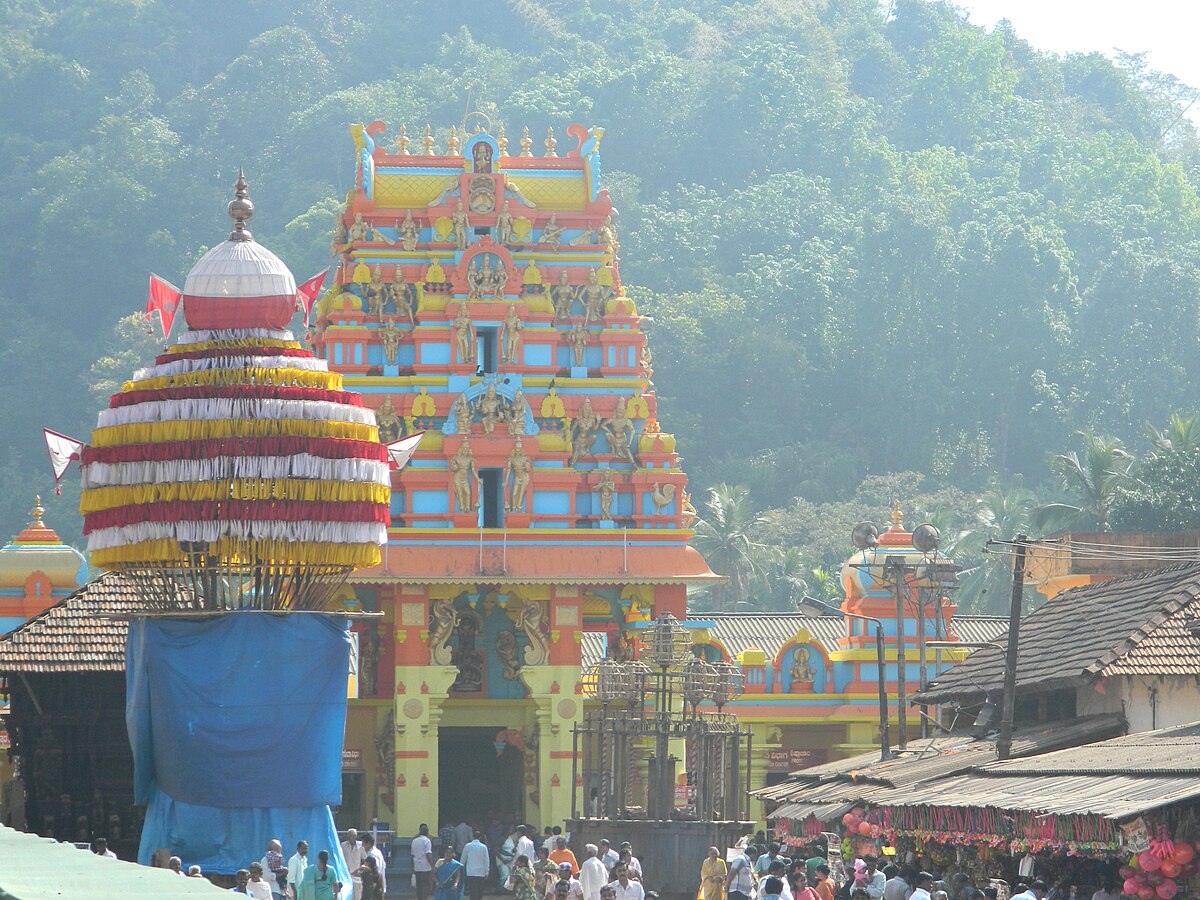
The Kukke Subrahmanya Temple displays a blend of South Indian Dravidian architecture with elements drawn from the Kerala and Tulu temple traditions, reflecting its position at the cultural crossroads of coastal Karnataka. The gopura (entrance tower) rises in vivid polychrome tiers adorned with stucco figures of deities and mythological scenes, set dramatically against the deep green backdrop of the Western Ghats.
The garbhagṛha (sanctum sanctorum) houses the remarkable swayambhū idol of Lord Subrahmanya depicted in the form of a seven-hooded serpent, seated upon Vāsuki. This idol rests on a silver pīṭha (pedestal) and is flanked by silver-faced images of attendant Nāgas, creating an atmosphere of concentrated serpent sanctity found nowhere else in India. The walls of the sanctum are constructed from massive wooden logs, topped with traditional Mangalore tile roofing — a nod to the indigenous architectural vocabulary of coastal Karnataka.
A distinctive feature of the temple is its dual-aspect sanctum: the eastern face reveals Lord Subrahmanya in his serpent form, while on the western side, through an ingeniously positioned mirror, devotees can glimpse the image of Lakṣmī Nārasiṃha. This architectural device allows two distinct theological visions to coexist within a single sacred enclosure.
The Garuḍa Stambha
Between the sanctum and the mukha-maṇḍapa (front hall) stands the celebrated silver-plated Garuḍa Stambha. This pillar, surmounted by the figure of Garuḍa, serves both an architectural and a mythological function. Architecturally, it anchors the visual axis of the temple. Mythologically, it represents the cosmic balance between the serpent-protector deity within the sanctum and the eagle-deity who stands guard outside — the eternal adversary rendered peaceful through divine ordinance.
Biladwāra: The Serpent’s Cave
Approximately 300 metres from the main temple lies Biladwāra, one of the most mysterious and sacred features of the Kukke Subrahmanya complex. The name literally means “entrance to the burrow” (bila = hole, dvāra = door), and it marks the site of an ancient natural cave and anthill formation where, according to tradition, Vāsuki himself lay hiding from Garuḍa during his flight to the Western Ghats.
The site is surrounded by lush gardens, and devotees visit it as part of the comprehensive temple darśana. The Biladwāra is considered a living Nāga dwelling — an actual physical link to the mythological past. The temple distributes Mṛttikā Prasāda (sacred anthill soil) from this site, which devotees revere for its reputed healing properties, particularly for skin ailments. This practice connects to the broader South Indian tradition of venerating anthills as Nāga habitations, elevating a natural phenomenon to the status of divine manifestation.
Rituals: The Science of Serpent Appeasement
Sarpa Saṁskāra
The most elaborate ritual performed at Kukke Subrahmanya is the Sarpa Saṁskāra — a two-day ceremony designed to absolve devotees of sins committed against serpents (knowingly or unknowingly) and to remedy the karmic consequences attributed to such transgressions. On the first day (8:30 AM to 12 PM), the officiating priests perform preliminary homas, mantrajapa, and invocations to the Nāga devatās. On the second day (6 AM to 8 AM), the concluding rituals are performed, including the symbolic release of the serpent curse.
Sarpa Saṁskāra is sought by those who believe they suffer from Nāga Doṣa — manifesting as chronic skin diseases, infertility, obstacles in marriage, or persistent misfortune. The ritual is unique to this kṣetra and draws on the authority of the temple’s direct mythological connection to Vāsuki and the Nāga race.
Aśleṣā Bali
The Aśleṣā Bali pūjā is performed specifically during Aśleṣā Nakṣatra — the lunar mansion associated with serpents in Vedic astrology. This ritual is conducted in two sessions each day (7:00 AM and 9:15 AM) and is considered the most potent remedy for Kāla Sarpa Doṣa, Kuja Doṣa, and other serpent-related astrological afflictions. Devotees arrive with their horoscopes and are guided by temple purohitas through the elaborate ceremony, which involves fire offerings, serpent mantras, and the invocation of Lord Subrahmanya as the supreme protector from all Nāga-related suffering.
The theological logic underlying the Aśleṣā Bali is profound: since Subrahmanya himself became the lord and refuge of all serpents, he alone possesses the authority to intercede on behalf of those whom the serpents have afflicted. The ritual thus enacts a kind of divine arbitration, with the deity mediating between the devotee and the offended Nāga spirits.
Nāga Pratiṣṭhā
Devotees also commission the installation of stone Nāga idols (Nāgakalaśas) within the temple precincts as a form of permanent offering. These carved serpent stones, consecrated through Vedic rites, serve as perpetual acts of devotion to the Nāga deities and are believed to generate ongoing spiritual merit for the donor and their family.
Festivals and Celebrations
Champa Ṣaṣṭhī (Subrahmanya Ṣaṣṭhī)
The grandest festival at Kukke Subrahmanya is Champa Ṣaṣṭhī, celebrated on the sixth day (ṣaṣṭhī) of the bright fortnight in the month of Mārgaśīrṣa (November-December). This festival commemorates Lord Subrahmanya’s victory over the demon Tārakāsura and his subsequent protection of the serpent race. The celebrations span fifteen days and include:
- Lakṣa Dīpotsava: The spectacular lighting of one lakh (100,000) oil lamps, transforming the temple and its surroundings into a sea of flickering golden light — a visual metaphor for the triumph of divine radiance over demonic darkness.
- Champa Ṣaṣṭhī Mahā Rathotsava: The grand chariot procession, in which the processional deities are mounted on the massive Brahma Ratha — a centuries-old wooden chariot — and pulled through the streets by thousands of devotees. The ratha has been in service for over 400 years and is itself an object of veneration.
- Noukā Vihāra: A unique boat festival on the Kumāradhārā River, where the processional deities are taken on a ceremonial ride across the sacred waters — a tradition distinctive to Kukke that combines riverine worship with Subrahmanya devotion.
Throughout the festival period, the processional deities are carried on different vāhanas (divine mounts) each day, recreating the mythological narratives associated with Subrahmanya’s triumphs.
Nāga Pañcamī
On Nāga Pañcamī (the fifth day of the bright fortnight in Śrāvaṇa, July-August), the temple witnesses an enormous influx of pilgrims who come to worship the Nāga deities. Special pūjās are performed at the main sanctum, at Biladwāra, and at the various Nāga shrines throughout the complex. Live serpents are sometimes venerated with offerings of milk, turmeric, and flowers — a practice that connects this specific kṣetra to the pan-Indian tradition of serpent worship while amplifying it through the unique mythological authority of Kukke Subrahmanya.
Other Festivals
Additional celebrations include Makara Saṅkrānti, Kārttika Dīpotsava (lamp festival in the month of Kārttika), and special observances on every ṣaṣṭhī (sixth day) of the lunar fortnight throughout the year, when the temple conducts enhanced worship to Subrahmanya.
The Sacred Kumāradhārā River
The Kumāradhārā River, on whose banks the temple stands, is itself a major object of pilgrimage. According to the Skanda Purāṇa, after his victory over Tārakāsura, Lord Subrahmanya cleansed his divine weapon (Śakti) in the waters of this river, imbuing it with purifying power. The river is also associated with the legend of Sāmba, son of Lord Kṛṣṇa, who was cursed with leprosy and cured by bathing in the Kumāradhārā — a tradition that has led generations of pilgrims with skin ailments to seek healing in its waters.
The Kumāratīrtha Puṣkariṇī, a sacred bathing tank within the temple complex, draws its waters from the river. Pilgrims are expected to bathe here before entering the main sanctum, a practice that combines physical purification with the spiritual potency attributed to the river’s mythological origins.
The Western Ghats Setting and Pilgrimage Route
Kukke Subrahmanya’s location in the Western Ghats is not merely scenic but theologically significant. The Sahyādri mountains are traditionally regarded as the body of the great sage Sahya, and in the Skanda Purāṇa, this range is described as a divinely ordained sanctuary. The dense tropical forests, the mist-shrouded peaks, the abundance of actual serpent species in the region — all these natural features reinforce the mythological narrative of a landscape chosen by the Nāga race as their eternal refuge.
The pilgrimage to Kukke Subrahmanya is traditionally combined with a visit to Dharmasthala, the renowned Jain-Hindu pilgrimage centre located approximately 50 kilometres to the northwest. Dharmasthala, presided over by the Heggade family, is famous for its Dharma worship, its Bahubali statue, and its massive Annadāna (free meals) programme. Pilgrims who undertake the Kukke-Dharmasthala circuit experience two contrasting but complementary expressions of South Indian devotional culture: the ancient Nāga mysticism of Kukke and the syncretic hospitality of Dharmasthala.
The temple is accessible from Mangaluru (about 105 km) and can be reached via the scenic Ghats roads that wind through some of India’s most spectacular Western Ghats landscapes. The nearest railway station is Subrahmanya Road on the Hassan-Mangaluru line.
Historical Patronage and Paraśurāma Connection
Kukke Subrahmanya is traditionally counted among the seven sacred sites established by the sage Paraśurāma along the western coast of India. According to the Sahyādri Khaṇḍa, Paraśurāma — the sixth avatāra of Lord Viṣṇu — reclaimed the coastal strip of Kerala and Karnataka from the sea and consecrated a series of temples to sanctify the new land. Kukke Subrahmanya’s inclusion in this Paraśurāma kṣetra tradition anchors it within the broader sacred geography of India’s western coast.
Historically, the temple received patronage from the Ballāḷarāya dynasty and later from the Mysore kings, who contributed to its architectural expansion and ritual endowments. The great Ādi Śaṅkarācārya is believed to have visited the temple during his legendary tour of India in the 8th century CE, further cementing its pan-Indian spiritual authority. The Vijayanagara period saw significant architectural additions in the Dravidian style that define the temple’s current appearance.
The temple bears the honorific title “Annadāna Subbappa” — a testament to its longstanding tradition of feeding thousands of pilgrims daily, echoing the broader South Indian ethic of temple-based hospitality that finds its most celebrated expression at nearby Dharmasthala.
Daily Worship and Practical Information
The temple follows a rigorous daily worship schedule rooted in Āgamic tradition. The day begins with Suprabhatam (early morning awakening) and proceeds through multiple pūjā sessions, with the main abhiṣeka (ritual bathing of the deity) conducted with elaborate ceremony. The evening Dīpārādhana (lamp worship) is considered particularly auspicious, as the sanctum glows with the light of oil lamps reflecting off the silver surfaces of the Nāga images.
The temple administration has modernized booking systems for Sarpa Saṁskāra and Aśleṣā Bali rituals, allowing devotees to reserve their pūjā slots in advance. The temple complex includes facilities for accommodation, dining, and the purchase of pūjā materials, making it a self-contained pilgrimage destination despite its remote forest setting.
Spiritual Significance: The Theology of Nāga Protection
Kukke Subrahmanya occupies a unique position in Hindu theology. While serpent worship is widespread across India — from the Nāga stones of South Indian villages to the great serpent temples of Kerala — Kukke alone combines the authority of a major Purāṇic kṣetra with the specific mythology of divine serpent protection. The temple’s central teaching is one of cosmic reconciliation: the same deity who commands the armies of the gods also shelters the serpent race; the same sacred precinct that honours Garuḍa through his pillar also serves as the inviolable sanctuary of Garuḍa’s eternal prey.
For the millions who visit each year — whether to seek relief from Sarpa Doṣa, to perform ancestral rites related to serpent karma, or simply to experience the numinous atmosphere of a temple set in one of India’s most pristine natural landscapes — Kukke Subrahmanya offers something that transcends the merely ritualistic. It offers a vision of a universe in which even the most ancient of enmities can be dissolved through divine grace, and in which every creature, from the mightiest god to the humblest serpent, finds its rightful place under the canopy of the sacred.