Introduction: The City That Grew Around a Temple
Madurai, the ancient capital of the Pāṇḍya dynasty, is often called the “Temple City” — and for good reason. At its heart stands the Mīnākṣī Sundareśvara Temple, a sprawling 65,000-square-metre complex that is not merely a place of worship but the living nucleus around which the entire city was built. The concentric rectangular streets of Madurai radiate outward from the temple like the petals of a lotus, preserving to this day the urban plan described in the Śilpaśāstra tradition.
The temple is dedicated to Goddess Mīnākṣī (“the fish-eyed one”), a form of Pārvatī, and her consort Lord Sundareśvara (“the beautiful lord”), a form of Śiva. What makes this temple theologically extraordinary is that it represents a confluence of Śaivism, Śāktism, and Vaiṣṇavism — for according to tradition, Lord Viṣṇu himself came to Madurai to give his sister Mīnākṣī in marriage to Śiva, making the divine wedding the central event of the temple’s mythology and its grandest annual celebration.
The earliest references to Madurai as a sacred centre appear in Tamil Saṅgam literature (c. 3rd century BCE — 3rd century CE), and the temple is believed to have existed in some form for over 2,000 years. Today, it draws an estimated 15,000 visitors daily and remains one of the most important pilgrimage sites in South India.
The Mythology of Mīnākṣī: The Goddess Born from Sacred Fire
The Three-Breasted Princess
The mythological origins of Mīnākṣī are narrated in the Tamil text Tiruviḷaiyāṭal Purāṇam (“The Sacred Games of Śiva”), a 13th-century work by Perumpaṟṟapuliyūr Nampi, later versified by Parañcōti Muṉivar. According to this text, King Malayadhvaja Pāṇḍya and Queen Kāñcanamalā performed a great yāga (fire sacrifice) to beget an heir. From the sacred flames emerged a radiant girl-child of extraordinary beauty — but with three breasts.
The royal parents were alarmed, but a divine voice (asarīrī) declared: “Raise this child as you would a son. Crown her queen. When she meets her destined husband, the third breast will disappear.” The king named her Tāṭātakai and trained her in all the martial arts and sciences befitting a sovereign. She grew into a fierce warrior-queen who conquered the eight directions (aṣṭadikku) and even marched upon Mount Kailāsa, Śiva’s celestial abode.
The Divine Marriage
When Tāṭātakai confronted Śiva on Kailāsa, the prophecy was fulfilled: her third breast vanished instantly, and she stood transformed — no longer the conquering warrior but the shy, devoted bride. She recognized Śiva as Sundareśvara, the Lord of Beauty, and he recognized her as his eternal consort Pārvatī, reborn as the Pāṇḍya princess.
The divine wedding — the Mīnākṣī Tirukkalyāṇam — took place in Madurai with cosmic grandeur. Lord Viṣṇu, identified in the Tamil tradition as Mīnākṣī’s brother Aḻagar (the Beautiful One), journeyed from his hill shrine at Aḻagar Kōvil to give away the bride. This wedding, the Tirukkalyāṇam, is the theological centre of the temple and the basis of the annual Cittirai (Chithirai) festival, one of the grandest temple celebrations in all of India.
The Name “Mīnākṣī”
The name Mīnākṣī literally means “she whose eyes are shaped like fish” (mīn = fish; akṣī = eyes). In Tamil poetic convention, the fish-shaped eye is the supreme standard of feminine beauty. But the name also carries deeper symbolism: just as the fish’s eyes never close, Mīnākṣī’s compassionate gaze upon her devotees is unceasing and unwavering. The Goddess is also known as Aṅgayarkaṇṇi (Tamil: “she of the beautiful fish-eyes”).
Temple Architecture: A Universe in Stone
The Fourteen Gopurams
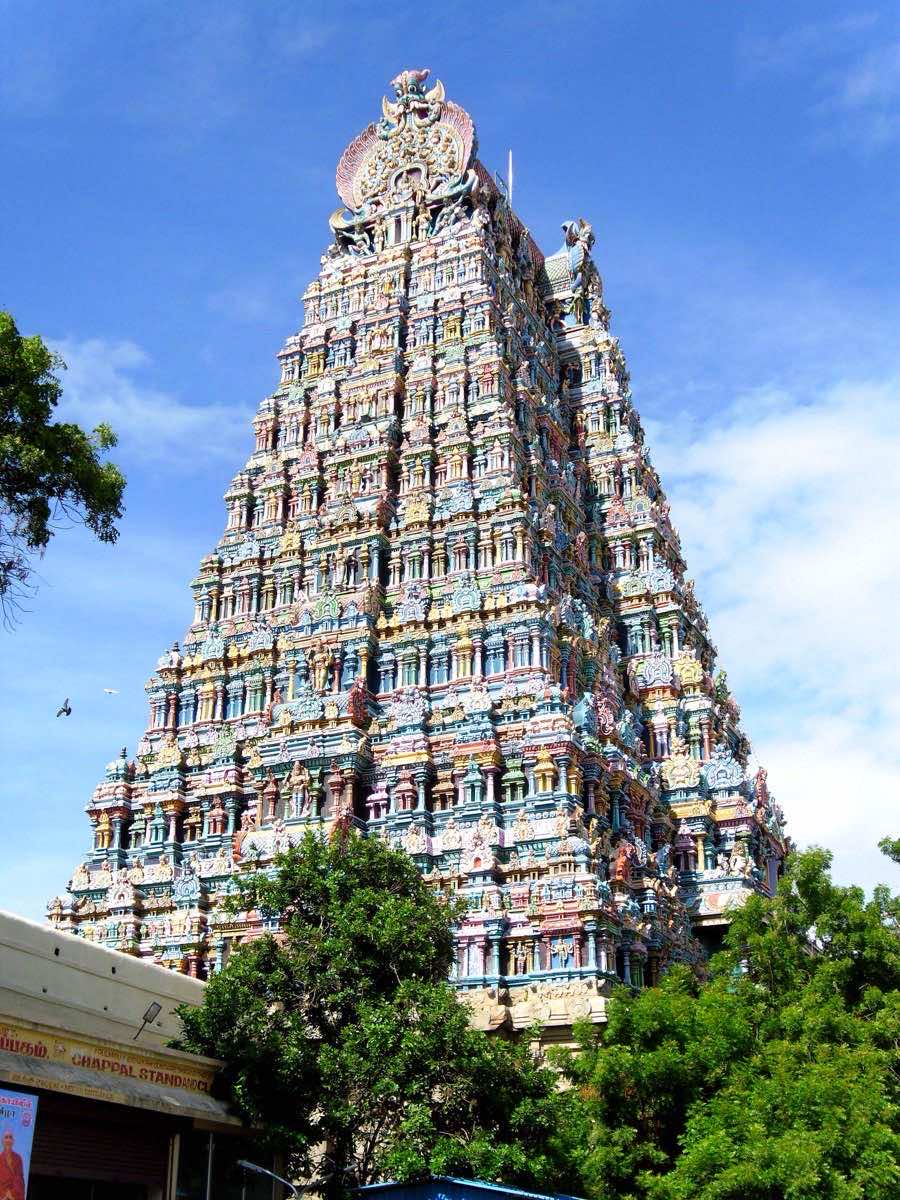
The Mīnākṣī Temple is renowned for its fourteen gopurams — the monumental gateway towers that are the hallmark of Dravidian temple architecture. These tapering, multi-storeyed structures are densely covered with thousands of brilliantly painted stucco figures depicting gods, goddesses, mythological scenes, and celestial beings. The figures are repainted every twelve years during the Kumbabishekam (temple consecration ceremony).
The tallest is the southern gopuram, rising to approximately 52 metres (170 feet), and serving as a landmark visible from across the city. The temple’s four outermost gopurams (north, south, east, and west) are taller than the inner ones, following the theological principle that the outer structures should draw devotees inward toward the sanctum. In total, the fourteen towers contain an estimated 33,000 individual sculptural figures.
Āyiram Kāl Maṇḍapam: The Hall of a Thousand Pillars
The Āyiram Kāl Maṇḍapam (“Hall of a Thousand Pillars”), though technically containing 985 pillars, is one of the most celebrated structures in South Indian temple architecture. Built during the Nāyaka period (16th—17th century), each pillar is a masterwork of granite carving, depicting deities, mythological figures, yāḻi (composite lion-dragon creatures), and celestial dancers. The sculptural detail is so precise that the figures appear lifelike from every angle.
Today, the hall houses a temple museum containing bronzes, stone sculptures, and paintings spanning several centuries of Tamil artistic tradition.
The Musical Pillars
Among the most remarkable features of the temple are the musical pillars in the outer corridors near the Āyiram Kāl Maṇḍapam. Each cluster of pillars, carved from single blocks of granite, produces distinct musical notes of the sapta svara (seven notes of Indian classical music) when tapped. This demonstrates the extraordinary understanding of acoustics, stone density, and harmonic resonance achieved by Dravidian temple architects. The pillars produce tones corresponding to the notes sa, ri, ga, ma, pa, da, ni — and have been studied by musicologists and acoustics researchers alike.
Pottramarai Kuḷam: The Golden Lotus Tank
At the heart of the temple complex lies the Pottramarai Kuḷam (“Golden Lotus Tank”), a sacred bathing tank measuring approximately 165 feet by 120 feet, surrounded by a colonnaded corridor. Pilgrims bathe in its waters before entering the inner sanctums.
According to Tamil literary tradition, the tank served as a divine literary critic: manuscripts placed on its waters would float if their literary merit was genuine and sink if they were unworthy. The great Tamil Saṅgam poets are said to have submitted their works to this test. The tank is also associated with the Sthala Purāṇa legend that the golden lotuses in it bloomed at the command of Śiva himself.
Historical Development: From the Pāṇḍyas to the Nāyakas
Ancient Origins
The temple’s history is deeply intertwined with that of Madurai itself. Tamil Saṅgam literature (c. 3rd century BCE — 3rd century CE) references Madurai as a great urban centre and mentions temples dedicated to both Śiva and the goddess. The Pāṇḍya kings, who claimed descent from the daughter of Śiva and Mīnākṣī, were the earliest patrons of the temple.
The original temple was destroyed by the forces of Malik Kafur, the general of Alauddin Khilji, during a raid on Madurai in 1311 CE. The devastation was catastrophic — the temple’s wealth was plundered and its structures severely damaged.
The Nāyaka Renaissance
The temple as it stands today is largely the creation of the Madurai Nāyaka dynasty (1529—1736 CE), particularly the great builder-king Tirumalai Nāyaka (r. 1623—1659 CE). Under the Nāyakas, the temple was not merely rebuilt but expanded into the colossal complex that exists today. Tirumalai Nāyaka constructed the vast Vasanta Maṇḍapam (Spring Hall), the Kiḷikūṭṭu Maṇḍapam (Parrot Cage Hall), and substantially expanded the pillared corridors. The Nāyaka architects perfected the Dravidian gopuram form, creating the soaring, multi-coloured towers that have become the temple’s most recognizable feature.
Ariyaṉātha Mudaliyār, a commander under Viśvanātha Nāyaka (r. 1529—1564), is credited with overseeing the initial reconstruction and building the Āyiram Kāl Maṇḍapam. Successive Nāyaka rulers continued to embellish the complex, each adding new maṇḍapams, gopurams, and sculptural programmes.
Worship and Daily Rituals
The Mīnākṣī Sundareśvara Temple is a living centre of worship, with an elaborate daily ritual cycle that has continued for centuries. The temple follows the Śaiva Āgama tradition and observes six daily pūjā services:
- Tiruppaḷḷi Eḻucci (5:00 AM) — the awakening ceremony, when the deities are roused with sacred hymns
- Kālasanti Pūjā (7:30 AM) — the morning worship
- Uccikkāla Pūjā (12:00 PM) — the noon worship
- Sāyaratchai Pūjā (6:00 PM) — the evening worship
- Irāṇṭām Kāla Pūjā (8:00 PM) — the second evening worship
- Arttajāma Pūjā (9:30 PM) — the night ceremony
The most beloved daily ritual is the Palliarai Seva (bedtime ceremony), performed each night at approximately 9:30 PM. During this intimate ritual, the processional image (utsavar) of Lord Sundareśvara is carried in a palanquin from his shrine to the shrine of Goddess Mīnākṣī, symbolizing the nightly reunion of husband and wife. The deity is accompanied by musicians and the chanting of Tēvāram hymns. This ritual beautifully expresses the temple’s central theology: Mīnākṣī is not a secondary consort but the sovereign of Madurai, and Sundareśvara comes to her.
The Cittirai Festival: The Divine Wedding
The Cittirai Tiruviḻā (Chithirai Festival), celebrated over approximately 15 days during the Tamil month of Cittirai (April—May), is the temple’s grandest annual celebration and one of the largest religious festivals in South India. The festival re-enacts the mythology of Mīnākṣī’s coronation and her marriage to Sundareśvara.
Key events of the festival include:
- Mīnākṣī Paṭṭābhiṣēkam (Day 8): The coronation of Mīnākṣī as sovereign queen of Madurai, affirming her status as both goddess and ruler
- Mīnākṣī Tik Vijayam (Day 9): Mīnākṣī’s conquest of the eight directions, re-enacting her warrior campaign
- Mīnākṣī Tirukkalyāṇam (Day 10): The divine wedding itself, attended by hundreds of thousands of devotees who gather to witness the deities being ceremonially united in marriage
- Aḻagar’s Entry: Lord Viṣṇu, in his form as Kaḷḷaḻagar, arrives from his hilltop temple to give away his sister in marriage, crossing the Vaigai River. This moment, when Viṣṇu enters Madurai, is theologically significant as it unites Vaiṣṇava and Śaiva traditions in a single narrative of divine kinship
- Ther Tiruviḻā: The grand chariot procession through the streets of Madurai
The Cittirai festival draws an estimated one million devotees and visitors to Madurai annually, and the Tirukkalyāṇam day itself has been described as one of the most attended single-day religious events in India.
The Golden Lotus Tank and Tamil Literary Heritage
The Pottramarai Kuḷam is not merely a ritual bathing tank but a symbol of Madurai’s identity as a centre of Tamil literary culture. According to tradition, the Saṅgam — the legendary academy of Tamil poets — met under the patronage of the Pāṇḍya kings in Madurai. The tank is associated with the story of the Caṅkam (Sangam), where poets would place their compositions on the sacred waters. Works of genuine merit would float; inferior compositions would sink. This legend, though mythological, reflects the historical reality that Madurai was the foremost centre of Tamil literary production for centuries.
The great Tamil poet-saint Tirujñānasambandhar (7th century CE) sang of the temple in his Tēvāram hymns, establishing it as one of the 274 Paadal Petra Sthalams — the Śiva temples celebrated in the canon of Tamil Śaiva devotional poetry.
UNESCO Recognition and Contemporary Significance
The Mīnākṣī Sundareśvara Temple has been on India’s tentative list for UNESCO World Heritage Site designation, recognizing its outstanding universal value as a masterpiece of Dravidian architecture and a living centre of cultural tradition. The temple continues to function as the spiritual heart of Madurai, administered by the Tamil Nadu Hindu Religious and Charitable Endowments Department.
The temple receives approximately 15,000 visitors daily, with numbers swelling to hundreds of thousands during major festivals. It remains one of the few ancient temples where the architectural complex, ritual tradition, and devotional culture have continued in an unbroken line from antiquity to the present.
Conclusion: Where the Goddess Reigns
The Mīnākṣī Sundareśvara Temple stands as a testament to an extraordinary theological vision: that the feminine divine is sovereign, that the goddess is not merely Śiva’s consort but the reigning queen of her own kingdom. In Madurai, it is Sundareśvara who comes to Mīnākṣī, not the reverse. Every evening, when the processional image of the Lord is carried to the Goddess’s shrine, this ancient truth is enacted anew. The fourteen gopurams rise over the city like stone hymns, their 33,000 painted figures declaring in silence what the Cittirai festival proclaims each year with drums and flowers: that the fish-eyed Goddess, born from the sacred fire, reigns eternal in her city of Madurai.