Introduction: Where Stone Meets the Sea
On the Coromandel Coast of Tamil Nadu, roughly sixty kilometres south of Chennai, a collection of rock-cut caves, monolithic temples, and sculptured boulders stands as one of India’s most extraordinary artistic achievements. This is Mahabalipuram — known historically as Māmallapuram, the “City of Māmalla” — the port city and artistic laboratory of the Pallava dynasty, where master sculptors transformed living granite into some of the finest expressions of Hindu sacred art between the 7th and 8th centuries CE.
Designated a UNESCO World Heritage Site in 1984, the Group of Monuments at Mahabalipuram represents a pivotal moment in the evolution of South Indian temple architecture. Here, the transition from rock-cut cave temples to freestanding structural temples can be traced in stone — a process that would culminate in the towering gopurams of Chola, Pandya, and Vijayanagara temple complexes. As the UNESCO citation notes, these monuments are “an outstanding creative achievement” that influenced temple building across Southeast Asia.
But Mahabalipuram is far more than an architectural museum. Each sculpture, each temple, each carved narrative panel is a devotional act — a rendering of sacred mythology in stone intended to invoke the presence of the divine. For the Hindu pilgrim, walking among these monuments is to enter a frozen moment of Pallava devotion, where Śiva, Viṣṇu, and Devī still preside in their granite sanctuaries overlooking the Bay of Bengal.
The Pallava Dynasty: Builders of a Sacred Vision
Narasimhavarman I (Māmalla)
The primary patron of Mahabalipuram’s monuments was Narasimhavarman I (r. c. 630-668 CE), who bore the title Māmalla (“Great Wrestler”), from which the city derives its historical name. A warrior-king who defeated the Cāḷukya ruler Pulakeśin II and briefly captured the western Deccan capital of Bādāmi, Narasimhavarman I channelled the wealth and prestige of his conquests into an unprecedented programme of monumental art.
Under Māmalla’s patronage, the rock-cut cave temples and the monolithic rathas (chariot-temples) were carved from the natural granite outcrops along the coast. His court attracted the finest sculptors of the age, who developed what art historians now call the “Māmalla style” — characterized by slender, dynamic figures; complex multi-figure narrative compositions; and a joyful naturalism rare in Indian temple sculpture.
Narasimhavarman II (Rājasimha)
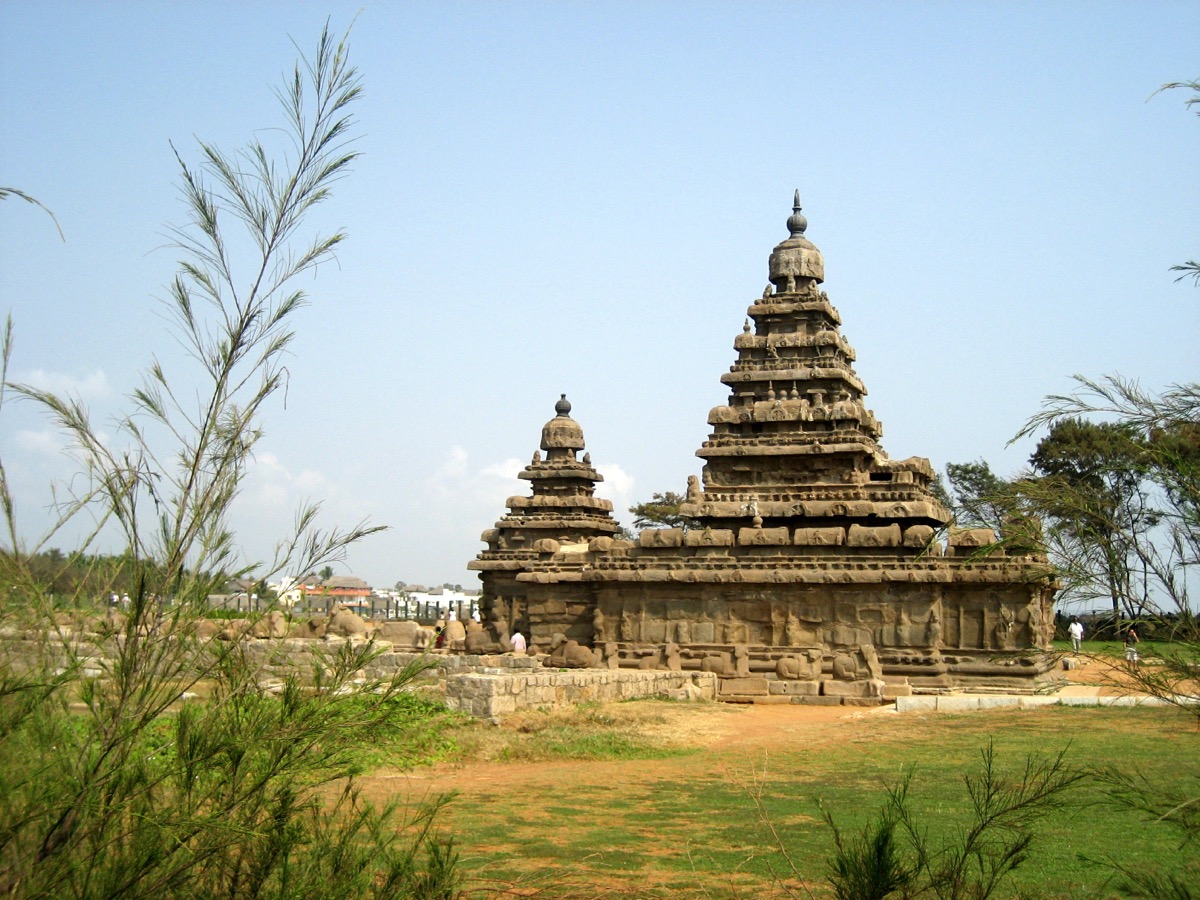
The Shore Temple, the most iconic structure at Mahabalipuram, was built a generation later by Narasimhavarman II, also known as Rājasimha (r. c. 700-728 CE). Rājasimha was also the builder of the Kailāsanātha Temple at Kāñcīpuram, and his reign represents the transition from rock-cut to fully structural temple architecture in the Pallava tradition. The Shore Temple, constructed of dressed granite blocks rather than carved from living rock, is one of the earliest surviving structural stone temples in South India.
The Shore Temple: Śiva Watching Over the Waves
Architecture and Design
The Shore Temple (Jalasayana Perumal Temple complex) stands directly on the beach, its silhouette visible from far out at sea — a deliberate choice that served both devotional and navigational purposes for the Pallava maritime fleet. The complex actually comprises three shrines: two dedicated to Śiva (facing east and west respectively) and a smaller central shrine dedicated to Viṣṇu in his reclining (Anantaśayana) form.
The main eastern shrine houses a Śiva Liṅga that catches the first rays of the rising sun — an architectural alignment that transforms the daily sunrise into a divine abhiṣeka of light upon the liṅga. The western shrine, smaller but exquisitely proportioned, faces the setting sun over the Bay of Bengal. Between them, the Viṣṇu shrine represents the sectarian inclusiveness characteristic of Pallava religion, which honoured both Śaiva and Vaiṣṇava traditions.
The temple’s vimāna (tower) rises in a pyramidal tier of diminishing storeys, establishing the prototype for the later Dravidian temple tower. The outer walls were once covered with elaborate sculptural panels, though centuries of salt spray and coastal erosion have worn many to smooth abstraction — giving the temple its haunting, time-worn beauty.
The Submerged Temples
Local legend has long held that the Shore Temple was originally one of seven pagodas (temples) visible from the sea, six of which were submerged by the ocean. This legend gained dramatic confirmation in the aftermath of the 2004 Indian Ocean tsunami, when the retreating waters briefly exposed previously unknown structural remains on the seabed near the Shore Temple. Subsequent underwater archaeological surveys by the Archaeological Survey of India (ASI) and the National Institute of Oceanography confirmed the existence of submerged temple foundations, structural walls, and stone sculptures dating to the Pallava period — evidence that the coastline has indeed receded significantly since the 8th century.
The Five Rathas (Pañca Pāṇḍava Rathas)
Monoliths Carved from Living Rock
South of the Shore Temple, five monolithic temple structures — each carved from a single boulder of granite — stand in a sandy compound. Popularly known as the Pañca Pāṇḍava Rathas (“Five Chariots of the Pāṇḍavas”), these monuments are named after the five Pāṇḍava brothers and their shared wife Draupadī from the Mahābhārata, though the association is traditional rather than historical.
Each ratha is a complete architectural prototype in miniature, representing a different style of temple design:
-
Draupadī Ratha: The smallest, a simple square shrine with a curved thatched-roof style (kuṭina) vimāna. Dedicated to Durgā (Mahiṣāsuramardinī), it reproduces in stone the form of a village hut — demonstrating the organic origin of temple architecture from vernacular building forms.
-
Arjuna Ratha: A two-storeyed miniature temple in the Dravidian style, with a square base and an octagonal dome (vṛttāyata śikhara). The walls feature sculptures of Śiva, including Śiva as Ardhanārīśvara (the half-male, half-female form) and dvarapālas (door guardians).
-
Bhīma Ratha: The largest ratha, rectangular in plan with a barrel-vaulted (śālā) roof reminiscent of Buddhist chaitya halls. This form would evolve into the distinctive gopuram (entrance tower) of later Dravidian temples.
-
Dharmarāja Ratha: The tallest and most elaborate, a three-storeyed pyramidal structure with a square plan. Its walls bear portrait sculptures, including what is believed to be a depiction of King Narasimhavarman I himself — one of the earliest royal portrait sculptures in South India.
-
Nakula-Sahadeva Ratha: An apsidal (curved-end) structure with an elephant-back roof form (gajapṛṣṭha). A magnificent life-size elephant sculpture stands beside it.
Remarkably, none of the five rathas were ever consecrated or used for worship — they appear to have been architectural models, perhaps intended as prototypes for structural temples that would be built in dressed stone.
Arjuna’s Penance: The World’s Largest Bas-Relief
The Great Cliff Sculpture
The most celebrated sculpture at Mahabalipuram — and one of the most remarkable works of art in the ancient world — is the massive open-air bas-relief known variously as “Arjuna’s Penance” or “Descent of the Gaṅgā” (Gaṅgāvataraṇa). Carved on the face of two enormous boulders, the composition measures approximately 27 metres wide and 9 metres high, making it the largest open-air rock relief in the world.
The central feature is a natural cleft between the two boulders, which once channelled water from a cistern above — creating a cascading waterfall down the rock face during festivals. This water-flow represents either the descent of the Gaṅgā from heaven to earth or the flow of divine grace responding to ascetic penance.
Interpretive Debate
Scholars have long debated whether the scene depicts Arjuna’s penance for the divine weapon Pāśupatāstra (as described in the Mahābhārata, Vana Parva 3.39-41) or the cosmic event of the Gaṅgā’s descent to earth through the matted locks of Śiva (as described in the Rāmāyaṇa, Bāla Kāṇḍa 42-44 and the Bhāgavata Purāṇa 9.9).
The relief includes over one hundred figures — gods, celestial beings, nāgas (serpent deities), humans, and animals — all converging toward the central cleft. A magnificent panel of elephants, rendered with extraordinary naturalism, leads a procession of life-size animals. Emaciated ascetics perform tapas, a four-armed figure of Śiva (or possibly Arjuna in ascetic guise) stands in meditation, and celestial Apsaras and Gandharvas fly through the heavens. A delightful detail is a cat standing on one leg in imitation of the ascetic, surrounded by mice — a visual parable about hypocrisy that reveals the Pallava sculptors’ sense of humour.
Varāha Cave Temple and Other Cave Shrines
The Varāha Maṇḍapa
The Varāha Cave Temple is among the finest cave shrines at Mahabalipuram, dedicated to Lord Viṣṇu in his Varāha (cosmic boar) incarnation. The main panel depicts Varāha lifting Bhūdevī (the Earth Goddess) from the cosmic ocean after rescuing her from the demon Hiraṇyākṣa — a scene carved with remarkable grace, where the goddess sits delicately on the boar-god’s shoulder while celestial beings shower flowers from above.
Adjacent panels show Viṣṇu as Trivikrama (the cosmic strider who measured the three worlds in three steps) and Gajalakṣmī (Goddess Lakṣmī bathed by elephants). The Varāha Maṇḍapa’s sculptural quality represents the pinnacle of Pallava rock-cut art.
Mahiṣāsuramardinī Cave
This cave temple features one of the most dynamic compositions in Indian sculpture: Goddess Durgā (Mahiṣāsuramardinī) in battle with the buffalo-demon Mahiṣāsura. The eight-armed goddess rides her lion mount, her weapons fanning out in an arc of divine energy, while the demon’s army retreats in disarray. On the opposite wall, Viṣṇu reclines on the cosmic serpent Ananta, attended by Lakṣmī — a scene of supreme tranquillity deliberately juxtaposed with the fierce battle opposite.
Krishna Maṇḍapa
This cave shrine contains a celebrated panel of Lord Kṛṣṇa lifting Govardhana hill to shelter the cowherds of Vṛndāvana from Indra’s storm — a scene from the Bhāgavata Purāṇa (10.25). The naturalistic depiction of village life — cows being milked, children playing, flute music — reflects the Pallava sculptors’ gift for combining the divine and the everyday.
Maritime Legacy and Cultural Exchange
Mahabalipuram was not merely a temple city but a thriving port that connected the Pallava kingdom to the maritime trade networks of Southeast Asia. Pallava merchants and missionaries carried Hindu culture, Sanskrit learning, and architectural knowledge to the kingdoms of the Malay Archipelago, Cambodia, and Champa (Vietnam).
The architectural forms pioneered at Mahabalipuram — the pyramidal vimāna, the maṇḍapa (pillared hall), the monolithic shrine — can be traced in the temples of Angkor Wat in Cambodia, the Prambanan complex in Java, and the Mỹ Sơn sanctuary in Vietnam. The Pallava script, adapted by Southeast Asian kingdoms, evolved into the writing systems of Thai, Khmer, and several Indonesian languages. In this sense, Mahabalipuram’s influence extends far beyond the Coromandel Coast — it is one of the fountainheads of the broader Hindu artistic tradition across maritime Asia.
Festivals and Living Worship
Mahabalipuram Dance Festival
Every year in January-February, the Mahabalipuram Dance Festival brings classical Indian dance forms — Bharatanāṭyam, Kuchipuḍi, Odissi, Kathak — to an open-air stage set against the illuminated backdrop of Arjuna’s Penance. This festival, inaugurated in 1966, has become one of India’s premier cultural events and continues the ancient Pallava tradition of integrating performing arts with sacred architecture.
Temple Worship
The Shore Temple remains an active place of worship. Daily pūjā is performed to Lord Śiva in the main shrine, and the temple draws particular crowds during Mahāśivarātri, Thai Pongal (the Tamil harvest festival in January), and the Māsi Magham festival (February-March), when devotees bathe in the sea at the temple and offer worship at the ancient liṅga that has faced the sunrise for thirteen centuries.
Conclusion: Architecture as Devotion
Mahabalipuram is a place where the boundaries between art, architecture, and worship dissolve entirely. The Pallava sculptors did not merely decorate stone — they released the divine forms they believed to be already present within the rock. Each ratha, each cave shrine, each carved narrative panel is simultaneously an artistic masterpiece and a devotional offering — a prayer made permanent in granite.
For the modern visitor, whether pilgrim or art-lover, Mahabalipuram offers a rare experience: the chance to stand where India’s structural temple tradition began, to trace its evolution from cave to monolith to freestanding shrine, and to witness how the creative genius of a single dynasty’s sculptors shaped the sacred landscape of an entire civilization. The Shore Temple, its towers softened by thirteen centuries of sea wind, still faces the dawn — a testament to the Pallava faith that stone, properly consecrated, can hold the divine presence against the erosion of time and tide.