Introduction: Where God Took Birth
Mathurā, situated on the western bank of the Yamunā river approximately 150 kilometres south of Delhi, holds a position of supreme importance in Hindu sacred geography as the birthplace of Lord Kṛṣṇa, the eighth and most complete avatāra of Lord Viṣṇu. Recognized as one of the seven Mokṣadāyinī Purīs (cities that grant liberation) — alongside Ayodhyā, Haridwāra, Kāśī, Kāñcīpuram, Ujjain, and Dvārakā — Mathurā is a city where mythology, history, and living devotion converge in extraordinary density.
The Garuḍa Purāṇa (XVI.14) lists the seven sacred cities: “Ayodhyā, Mathurā, Māyā (Haridvāra), Kāśī, Kāñcī, Avantikā (Ujjain), and Dvārakā — these seven cities are the givers of liberation.” Among these, Mathurā holds the distinction of being the only city identified as the actual birthplace (janmasthāna) of a pūrṇa avatāra — a complete descent of God into human form.
Archaeological evidence attests to Mathurā’s antiquity as a major cultural centre. The city was the capital of the Śūrasena kingdom mentioned in the Mahābhārata, a significant centre of Buddhist art (the Mathurā school of sculpture from the 2nd century BCE to 12th century CE), and a crossroads of trade routes connecting northern and western India. But for the devout Hindu, Mathurā’s significance transcends all historical considerations: it is the sacred ground where the Absolute chose to be born.
The Birth of Kṛṣṇa: The Central Narrative
The Prophecy and the Prison
The Bhāgavata Purāṇa (Skandha X, Chapters 1-4) recounts the events that led to Kṛṣṇa’s birth in vivid detail. The tyrant Kaṃsa, who had usurped the throne of Mathurā from his father King Ugrasena, received a divine prophecy (ākāśavāṇī) at the wedding of his cousin Devakī to the noble Vasudeva: “The eighth child of Devakī will slay you” (Bhāgavata Purāṇa 10.1.34).
Terrified by this prophecy, Kaṃsa imprisoned Devakī and Vasudeva in a dungeon within the Mathurā royal palace. He systematically killed six of their children as each was born. The seventh child, Balarāma, was mystically transferred from Devakī’s womb to Rohiṇī’s womb in Gokula. Then, on the eighth day of the dark half of the month of Bhādrapada (corresponding to August-September), at midnight, in the depths of that prison cell, Lord Kṛṣṇa appeared.
The Miraculous Birth
The Bhāgavata Purāṇa (10.3.7-25) describes the moment of Kṛṣṇa’s birth in cosmic terms: the directions became clear, the stars shone auspiciously, rivers flowed with calm waters, lakes bloomed with lotuses, and celestial beings showered flowers from the heavens. Kṛṣṇa appeared not as an ordinary infant but in his four-armed Viṣṇu form, adorned with the Śrīvatsa mark, the Kaustubha jewel, and holding the conch, discus, mace, and lotus. Only after his parents’ prayers did he assume the form of a newborn.
Guided by divine instruction, Vasudeva carried the infant Kṛṣṇa across the flooding Yamunā — whose waters parted to make way — to the village of Gokula, where he exchanged the child with the newborn daughter of Nanda and Yaśodā. This daughter, who was actually the goddess Yogamāyā, was carried back to Mathurā, where she slipped from Kaṃsa’s grasp, rose to the sky, and declared: “The one who will slay you has already been born elsewhere” (Bhāgavata Purāṇa 10.4.12).
Kṛṣṇa’s Return and the Slaying of Kaṃsa
Years later, Kṛṣṇa and Balarāma returned to Mathurā, summoned by Kaṃsa’s invitation to a wrestling tournament (a trap designed to kill them). In the arena of Mathurā, before the assembled citizenry, the young Kṛṣṇa slew the fearsome wrestlers Cāṇūra and Muṣṭika, then confronted Kaṃsa himself. Dragging the tyrant from his royal seat, Kṛṣṇa killed him, liberated his parents, and restored King Ugrasena to the throne (Bhāgavata Purāṇa 10.43-44). This event marks one of the most dramatically significant moments in the Kṛṣṇa narrative and is remembered annually during the Kaṃsa Vadha celebrations in Mathurā.
Śrī Kṛṣṇa Janmasthāna: The Birthplace Temple Complex
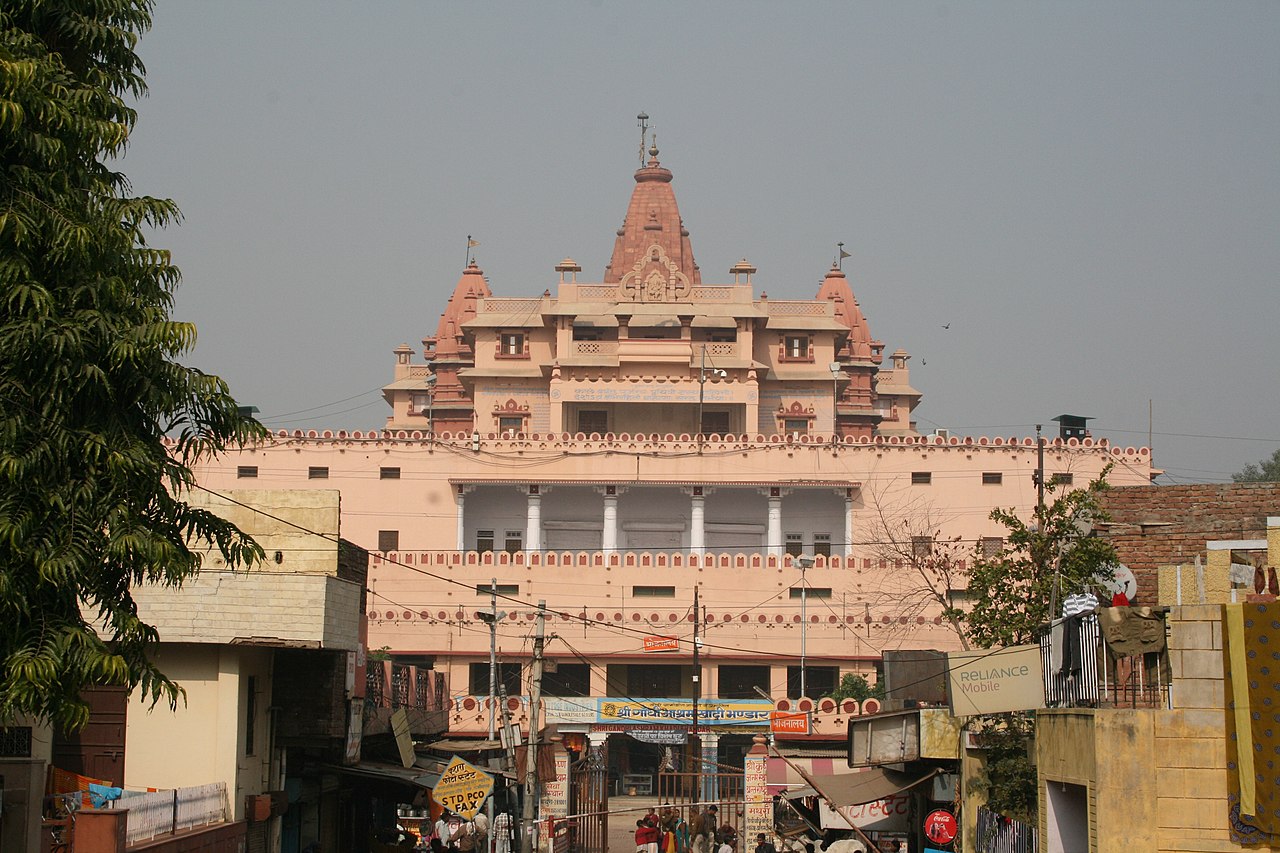
The Śrī Kṛṣṇa Janmasthāna Temple Complex (also called Kṛṣṇa Janmabhūmi) marks the site traditionally identified as the prison cell where Kṛṣṇa was born. The complex houses three main shrines:
-
The Keśavadeva Temple: The main temple dedicated to Lord Keśava (Kṛṣṇa), rebuilt in the 20th century. The original temple at this site has a long and turbulent history: ancient inscriptions from the Kuṣāṇa period (1st-3rd century CE) reference a temple here, and the Vaiṣṇava temple built during the Gupta period (4th-5th century CE) was among the finest in India.
-
The Garbha Gṛha (Birth Chamber): The underground cell believed to be the exact location of Kṛṣṇa’s birth. Pilgrims descend to this small chamber to offer prayers and darśana at the spot marked by a tiny shrine, touching the stones that tradition holds witnessed the divine birth.
-
The Bhāgavata Bhavana: A secondary temple housing the deities of Rādhā-Kṛṣṇa, where regular worship and devotional programs are conducted.
The site has witnessed successive destructions and reconstructions over the centuries. The Gupta-era temple was destroyed during Maḥmūd of Ghazni’s invasion (1017 CE), rebuilt during the medieval period, destroyed again under Aurangzeb (1670 CE), and the current complex was rebuilt in the 20th century adjacent to the Shahi Idgah mosque that was constructed using materials from the earlier temple.
The Ghats of Mathurā
Mathurā’s twenty-five ghats along the Yamunā are integral to the city’s sacred landscape. Each ghat carries mythological and devotional significance.
Viśrāma Ghāṭ
Viśrāma Ghāṭ (“the ghat of rest”) is the most sacred of Mathurā’s ghats. According to tradition, Lord Kṛṣṇa rested here after slaying Kaṃsa. The Varāha Purāṇa declares that bathing at Viśrāma Ghāṭ washes away all sins and is equivalent to performing the Aśvamedha Yajña. The ghat hosts a grand Yamunā Āratī ceremony every evening, drawing thousands of devotees who offer lamps to the river.
Other Notable Ghats
The Dhruva Ghāṭ is associated with the child-devotee Dhruva, who performed severe austerities on the bank of the Yamunā to attain the vision of Lord Viṣṇu (Bhāgavata Purāṇa 4.8-9). The Aśī Kunda Ghāṭ and Vaikuṇṭha Ghāṭ are also of great ritual importance, particularly during the sacred month of Kārtika.
Scriptural and Puranic Authority
Mathurā’s sanctity is established across multiple Purāṇic texts:
- Bhāgavata Purāṇa (Skandha X): The primary and most detailed account of Kṛṣṇa’s birth, childhood, and early life in and around Mathurā.
- Viṣṇu Purāṇa (Book V): Provides an earlier but equally authoritative account of the Kṛṣṇa narrative, describing Mathurā as “the city beloved of Viṣṇu, where the Lord himself took birth for the protection of the world” (Viṣṇu Purāṇa 5.1.2).
- Harivaṃśa: The appendix to the Mahābhārata, containing extensive narratives of Kṛṣṇa’s life in Mathurā and Braj.
- Garuḍa Purāṇa: Lists Mathurā among the seven cities that grant mokṣa.
- Varāha Purāṇa: Contains the Mathurā Māhātmya, a dedicated section extolling the sacred geography and spiritual benefits of pilgrimage to Mathurā.
The Varāha Purāṇa (Mathurā Māhātmya, Chapter 152) declares: “Even the gods desire to be born in Mathurā, for the dust of this city purifies all the worlds. He who dies in Mathurā attains the supreme abode of Viṣṇu without doubt.”
Historical and Archaeological Significance
The Mathurā School of Art
Mathurā was one of the two greatest centres of artistic production in ancient India (the other being Gandhāra). The Mathurā school of sculpture, flourishing from the 2nd century BCE through the Gupta period (4th-6th century CE), produced iconic images of the Buddha, Jain Tīrthaṅkaras, Hindu deities, and the unique standing Kṛṣṇa images that defined the visual vocabulary of Vaiṣṇavism. The Government Museum at Mathurā houses one of the finest collections of ancient Indian sculpture in the world.
The Śūrasena Kingdom
In the pre-Mauryan period, Mathurā was the capital of the Śūrasena kingdom (Mahājanapada), one of the sixteen great kingdoms of ancient India mentioned in Buddhist and Jain texts. The Mahābhārata identifies the Śūrasenas as the clan of Kṛṣṇa’s father Vasudeva, rooting the epic narrative firmly in the historical geography of the Mathurā region.
Major Festivals
Janmāṣṭamī
The birthday of Lord Kṛṣṇa (Kṛṣṇa Janmāṣṭamī) is the greatest festival of Mathurā. Celebrated on the eighth day of the dark half of Bhādrapada (August-September), the entire city observes a fast until midnight, when the moment of Kṛṣṇa’s birth is celebrated with elaborate rituals, abhiṣeka (ceremonial bathing of the deity), and devotional singing. The Janmasthāna temple complex becomes the epicentre of celebrations, with hundreds of thousands of pilgrims converging on the city.
Holī
Mathurā’s Holī celebrations are legendary. The festival of colours, commemorating Kṛṣṇa’s playful sport with Rādhā and the gopīs, extends over a full week in the Braj region. The Holī of Mathurā includes the dramatic Hurāṅgā at Dauji temple, where women tear the clothes of men in a ritual inversion of social norms, recalling the gopīs’ uninhibited play with Kṛṣṇa.
Dīpāvalī and Annakūṭa
The day after Dīvālī is celebrated in Mathurā as Govardhana Pūjā, commemorating Kṛṣṇa’s lifting of Govardhana Hill. Temples prepare mountains of food (annakūṭa) offered to Kṛṣṇa, which are then distributed as prasāda.
The Braj Parikramā: Circumambulating the Sacred Land
Mathurā is the traditional starting point for the Braj Chaurāsī Kos Parikramā, an 84-kos (approximately 300-kilometre) circumambulation of the entire Braj sacred region. This ancient pilgrimage route passes through all the major sites associated with Kṛṣṇa’s pastimes — Vṛndāvana, Govardhana, Barsānā, Nandgāon, Gokula, and the twelve forests of Braj. The Padma Purāṇa and local māhātmya texts prescribe this parikramā as one of the most meritorious pilgrimages a Vaiṣṇava can undertake.
Conclusion: The City That Gave Birth to God
Mathurā endures as one of Hinduism’s most sacred cities — a place where the metaphysical doctrine of divine incarnation (avatāra) is not an abstract theological proposition but a geographical reality: here is the cell, here is the river, here is the arena. For the Vaiṣṇava devotee, to visit Mathurā is to touch the very ground upon which the Supreme Being chose to enter the human world, to breathe the air of the city where Devakī held her divine child, and to walk the streets where Kṛṣṇa, as a young prince, restored dharma by slaying the tyrant and liberating the oppressed. As the Viṣṇu Purāṇa affirms: “Mathurā is the most excellent of all places on earth, for it is the birthplace of the Lord of the Universe” (Viṣṇu Purāṇa 5.1.6).