Introduction: The Land Where God Was a Child
Mathurā and Vṛndāvana — the twin sacred cities on the banks of the Yamunā river in present-day Uttar Pradesh — constitute the geographical and spiritual heart of Kṛṣṇa worship. Together with the surrounding region known as Braj (Vraja) Maṇḍala, they form a sacred landscape of approximately 2,500 square kilometres where, according to Hindu tradition, the Supreme Being chose to appear as a cowherd child, steal butter, play his flute beneath the kadamba trees, dance the Rāsa Līlā with the gopīs under the autumn moon, and lift the mighty Govardhana Hill upon his little finger.
Mathurā, located approximately 150 kilometres south of Delhi, is identified in the Bhāgavata Purāṇa (10.1-4) as the capital of the Yādava dynasty and the birthplace of Lord Kṛṣṇa. Vṛndāvana, situated just 15 kilometres to the north, is the forest (vana) of tulasī (vṛndā) where Kṛṣṇa spent his childhood and adolescence. The Viṣṇu Purāṇa (5.1-38), the Harivaṃśa, and the Bhāgavata Purāṇa — the three principal textual sources for Kṛṣṇa’s life — devote hundreds of chapters to the events that unfolded in this sacred region.
Today, Vṛndāvana alone contains over 5,500 temples dedicated to Kṛṣṇa and his consort Rādhā, making it one of the most densely sacred spaces on earth. Millions of devotees visit annually, drawn by the promise articulated in the Padma Purāṇa: “Among all the abodes of Viṣṇu, Vṛndāvana is the highest, for here the Lord performed his sweetest pastimes.”
The Birth of Kṛṣṇa at Mathurā
The Prison Cell of Kaṃsa
The Bhāgavata Purāṇa (10.3.1-53) narrates in vivid detail the circumstances of Kṛṣṇa’s birth. Kaṃsa, the tyrannical king of Mathurā, had imprisoned his own sister Devakī and her husband Vasudeva after a divine prophecy warned that Devakī’s eighth child would destroy him. One by one, Kaṃsa killed the first six children. The seventh, Balarāma, was mystically transferred to the womb of Rohiṇī in Gokula.
On the aṣṭamī (eighth day) of the dark fortnight of the month of Bhādrapada, at midnight, Kṛṣṇa appeared in the prison cell in his four-armed Viṣṇu form, adorned with the Śrīvatsa mark and carrying the conch, disc, mace, and lotus. He then assumed the form of an infant. The prison doors opened of their own accord, the guards fell into deep sleep, and Vasudeva carried the newborn across the swollen Yamunā — which parted to let them pass — to the cowherd village of Gokula, where he exchanged the child with the newborn daughter of Yaśodā and Nanda (Bhāgavata Purāṇa 10.3.46-53).
The Śrī Kṛṣṇa Janmasthāna temple complex in Mathurā marks the traditional site of this prison cell. Archaeological excavations have revealed structures dating to the 1st century BCE, confirming Mathurā’s antiquity as a major religious and cultural centre.
The Slaying of Kaṃsa
After growing up in Vṛndāvana and Gokula, the young Kṛṣṇa returned to Mathurā with Balarāma, where they were invited by Kaṃsa to a wrestling tournament. The Bhāgavata Purāṇa (10.44.1-38) describes how Kṛṣṇa defeated Kaṃsa’s champions and then killed the tyrant himself, liberating Mathurā and freeing his parents from bondage. This event marked the transition of Kṛṣṇa from the pastoral deity of Braj to the king and statesman of the later narrative.
Vṛndāvana: The Forest of Divine Love
The Rāsa Līlā
The Rāsa Līlā, described in the celebrated five chapters (Rāsa Pañcādhyāya) of the Bhāgavata Purāṇa (10.29-33), is the theological and aesthetic pinnacle of the Vṛndāvana narrative. On a full-moon night in the month of Śarada (autumn), Kṛṣṇa played his enchanting flute, and the gopīs of Vṛndāvana, drawn irresistibly by its sound, left their homes and families to join him in the forest.
Kṛṣṇa multiplied himself so that each gopī believed she was dancing with him alone, forming a great circle dance (rāsa maṇḍala) on the banks of the Yamunā. The Bhāgavata Purāṇa (10.33.3) describes: “Thus the Lord of the gopīs, surrounded by the gopīs who were adorned with ornaments, appeared like the moon among the stars.” Vaiṣṇava theologians, particularly Śrī Jīva Gosvāmī and Rūpa Gosvāmī of the Caitanya school, interpret the Rāsa Līlā as the supreme expression of prema-bhakti (love-devotion), the highest form of relationship between the soul and God.
The Lifting of Govardhana
The Bhāgavata Purāṇa (10.24-25) recounts how the young Kṛṣṇa persuaded the residents of Braj to stop their traditional worship of Indra, the king of the gods, and instead worship Govardhana Hill, which provided pasture for their cows. Enraged, Indra unleashed a devastating storm upon Braj for seven days. Kṛṣṇa lifted the entire Govardhana Hill upon the little finger of his left hand and held it aloft as an umbrella, sheltering all the inhabitants and their cattle beneath it.
Govardhana Hill, located approximately 22 kilometres from Vṛndāvana, remains one of the most sacred sites in Braj. Devotees perform the Govardhana Parikramā, a circumambulation of the hill covering approximately 21 kilometres, believing that the hill is a direct manifestation of Kṛṣṇa himself.
The Sacred Geography of Braj
The Twelve Forests (Dvādaśa Vana)
The Braj Maṇḍala encompasses twelve principal forests (vanas) where Kṛṣṇa enacted his various pastimes, as enumerated in the Varāha Purāṇa and elaborated by the Vaiṣṇava ācāryas:
- Madhuvana — where Kṛṣṇa killed the demon Madhu
- Tālavana — where Balarāma slew the demon Dhenukāsura
- Kumudavana — where Kṛṣṇa played with the cowherds
- Bahulāvana — where a cow attained liberation
- Kāmyavana — where Kṛṣṇa fulfilled desires
- Khadīravana — associated with games and pastimes
- Vṛndāvana — the central forest of the Rāsa Līlā
- Bhāṇḍīravana — where Kṛṣṇa tamed the serpent Kāliya
- Belvana — associated with Kṛṣṇa’s play with fruits
- Lohavana — where the demon Lohajangha was defeated
- Mahāvana — the great forest near Gokula
- Bhadravana — associated with auspicious pastimes
The Braj Chaurāsī Kos Parikramā
The Braj Chaurāsī Kos Parikramā is the great circumambulation of the entire Braj Maṇḍala, covering a distance of approximately 252-300 kilometres (84 kos in the traditional measurement). This pilgrimage circuit was formally established in the 16th century by the Gauḍīya Vaiṣṇava saints, following the paths identified by Śrī Caitanya Mahāprabhu (1486-1534) and his followers, the Six Gosvāmīs of Vṛndāvana.
The Varāha Purāṇa declares: “There are sixty-six billion (66 arab) tīrthas on earth, and they all reside within Braj.” The parikramā passes through 48 different forests (including sub-forests and gardens), 20 sacred water bodies (kuṇḍas), and hundreds of villages associated with specific episodes from Kṛṣṇa’s life.
Major Temples of Mathurā-Vṛndāvana
Śrī Kṛṣṇa Janmasthāna, Mathurā
The Kṛṣṇa Janmasthāna temple complex marks the traditional site of the prison cell where Kṛṣṇa was born. The Garbha Gṛha (innermost sanctum) is believed to be the exact spot of his birth over 5,000 years ago. The complex has been destroyed and rebuilt multiple times throughout history. The current temple structure stands adjacent to the Shahi Idgah mosque, built during the Mughal period.
Baṅke Bihārī Temple, Vṛndāvana
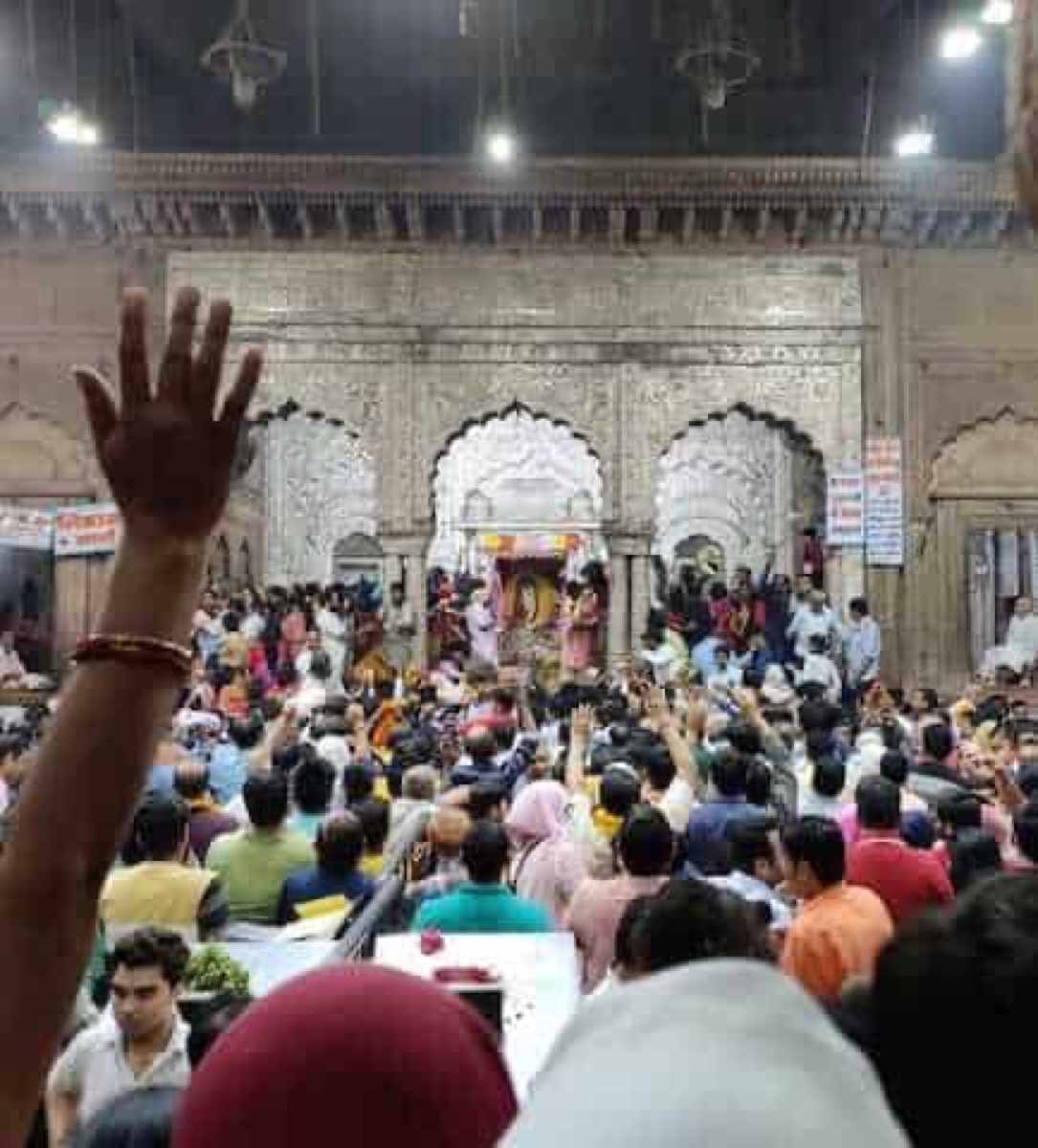
The Baṅke Bihārī Temple, established by Svāmī Haridāsa in 1864 CE, is the most visited temple in Vṛndāvana. The name “Baṅke Bihārī” means “the Playful One who stands in a bent pose” — depicting Kṛṣṇa’s characteristic tribhaṅga (triple-bend) posture. The deity is believed to be the combined form (yugala-svarūpa) of Rādhā and Kṛṣṇa. Uniquely, the temple curtain (jhāṅkī) is opened and closed repeatedly during darśana rather than remaining open, based on the belief that the deity’s gaze is so powerful that prolonged eye contact would cause the devotee to lose consciousness in divine ecstasy.
Govinda Deva Temple, Vṛndāvana
Built in 1590 by Rājā Mān Singh I of Amber under the guidance of Rūpa Gosvāmī, the Govinda Deva Temple was originally a seven-storey red sandstone structure considered one of the finest examples of Indo-Islamic architecture in northern India. The Mughal emperor Aurangzeb ordered the destruction of its upper storeys in the late 17th century, but the surviving structure — four storeys — remains architecturally magnificent. The temple was built to house the Govinda deity discovered by Rūpa Gosvāmī at the instruction of Śrī Caitanya Mahāprabhu.
ISKCON Kṛṣṇa-Balarāma Mandir, Vṛndāvana
The Śrī Kṛṣṇa-Balarāma Temple, established by A.C. Bhaktivedānta Svāmī Prabhupāda (founder of ISKCON) in 1975, is a major centre of international Vaiṣṇava devotion. The principal deities are Kṛṣṇa and Balarāma, with Rādhā-Śyāmasundara and Gaura-Nitāi on flanking altars. The temple is also the site of Prabhupāda’s samādhi (memorial shrine) and attracts devotees from across the globe.
Rādhā Ramaṇa Temple, Vṛndāvana
Founded by Gosvāmī Gopāla Bhaṭṭa in 1542, this temple houses a self-manifested (svayambhū) Śālagrāma deity of Rādhā Ramaṇa. It is one of the most important temples of the Gauḍīya Vaiṣṇava tradition and is renowned for maintaining unbroken daily worship (sevā) since its founding nearly five centuries ago.
The Yamunā: River of Divine Love
The Yamunā river, flowing through Mathurā and Vṛndāvana, is inseparable from Kṛṣṇa’s story. She is the river who parted her waters for Vasudeva carrying the infant Kṛṣṇa, the river on whose banks Kṛṣṇa played his flute and danced the Rāsa Līlā, and the river in whose waters Kṛṣṇa subdued the serpent Kāliya (Bhāgavata Purāṇa 10.16.1-67).
The Bhāgavata Purāṇa (10.15.47) describes the Yamunā at Vṛndāvana as “adorned with lotus flowers, surrounded by humming bees, and graced by the footprints of Kṛṣṇa on her sandy banks.” The Viśrāma Ghāṭ in Mathurā, where Kṛṣṇa is believed to have rested after slaying Kaṃsa, is the most sacred bathing spot on the Yamunā in the Braj region.
Festivals of Braj
Janmāṣṭamī
Kṛṣṇa Janmāṣṭamī, the celebration of Kṛṣṇa’s birth on the eighth day of the dark fortnight of Bhādrapada (August-September), is the most important festival in Mathurā-Vṛndāvana. The midnight celebrations at the Kṛṣṇa Janmasthāna temple, attended by hundreds of thousands of devotees, recreate the moment of Kṛṣṇa’s appearance in the prison cell.
Holī and Lathmar Holī
The Braj region is famous for its extended Holī celebrations, which begin weeks before the main festival. The most distinctive is the Lathmar Holī of Barsānā (the birthplace of Rādhā), where women playfully beat men with sticks (lāṭhīs) in a reenactment of Kṛṣṇa’s visit to Rādhā’s village. Vṛndāvana’s Holī festivities, particularly at the Baṅke Bihārī Temple, feature the throwing of coloured powder and flower petals in a celebration that can last for over a week.
Rādhāṣṭamī
The birthday of Rādhārāṇī, observed on the eighth day of the bright fortnight of Bhādrapada, is celebrated with particular devotion in Barsānā and Vṛndāvana, where Rādhā is revered as the supreme expression of devotional love and the eternal consort of Kṛṣṇa.
The Bhakti Renaissance in Braj
The 15th and 16th centuries witnessed an extraordinary flowering of devotional culture in Braj, transforming the region from a relatively forgotten landscape into the vibrant pilgrimage centre it is today. Śrī Caitanya Mahāprabhu (1486-1534), the Bengali saint whom Gauḍīya Vaiṣṇavas regard as a combined incarnation of Rādhā and Kṛṣṇa, visited Vṛndāvana around 1515 and rediscovered many of the sacred sites that had been lost over the centuries.
Caitanya sent his six principal disciples — the Ṣaḍ-Gosvāmīs (Rūpa, Sanātana, Jīva, Gopāla Bhaṭṭa, Raghunātha Dāsa, and Raghunātha Bhaṭṭa) — to Vṛndāvana to excavate lost tīrthas, build temples, and compose theological and devotional literature. Their collective output — thousands of Sanskrit and Bengali texts on Kṛṣṇa theology, devotional practice, and aesthetic theory — established Vṛndāvana as the intellectual capital of Kṛṣṇa bhakti.
Simultaneously, Vallabhācārya (1479-1531) established the Puṣṭimārga (“Path of Grace”) tradition with its headquarters at Govardhan, and his son Viṭṭhalanātha developed the elaborate system of sevā (deity worship) that characterizes the Haveli tradition of Kṛṣṇa worship in Braj.
Conclusion: The Eternal Braj
Mathurā-Vṛndāvana transcends the category of a mere pilgrimage destination. For the devotee, Braj is not simply a place where Kṛṣṇa once lived — it is where he eternally lives. The Bhāgavata Purāṇa (10.1.28) declares: “Kṛṣṇa never leaves Vṛndāvana” (vṛndāvanaṃ parityajya padam ekaṃ na gacchati). Every tree, every pond, every hillock in Braj is saturated with divine memory and presence. The dust of Vṛndāvana’s lanes, the waters of the Yamunā, the cry of the peacock at dawn — all these, say the poets and saints of Braj, carry the fragrance of Kṛṣṇa’s presence. As the 16th-century poet-saint Sūrdās sang: “Even the very stones of Braj are more fortunate than I, for they have been touched by the lotus feet of Śrī Kṛṣṇa.”