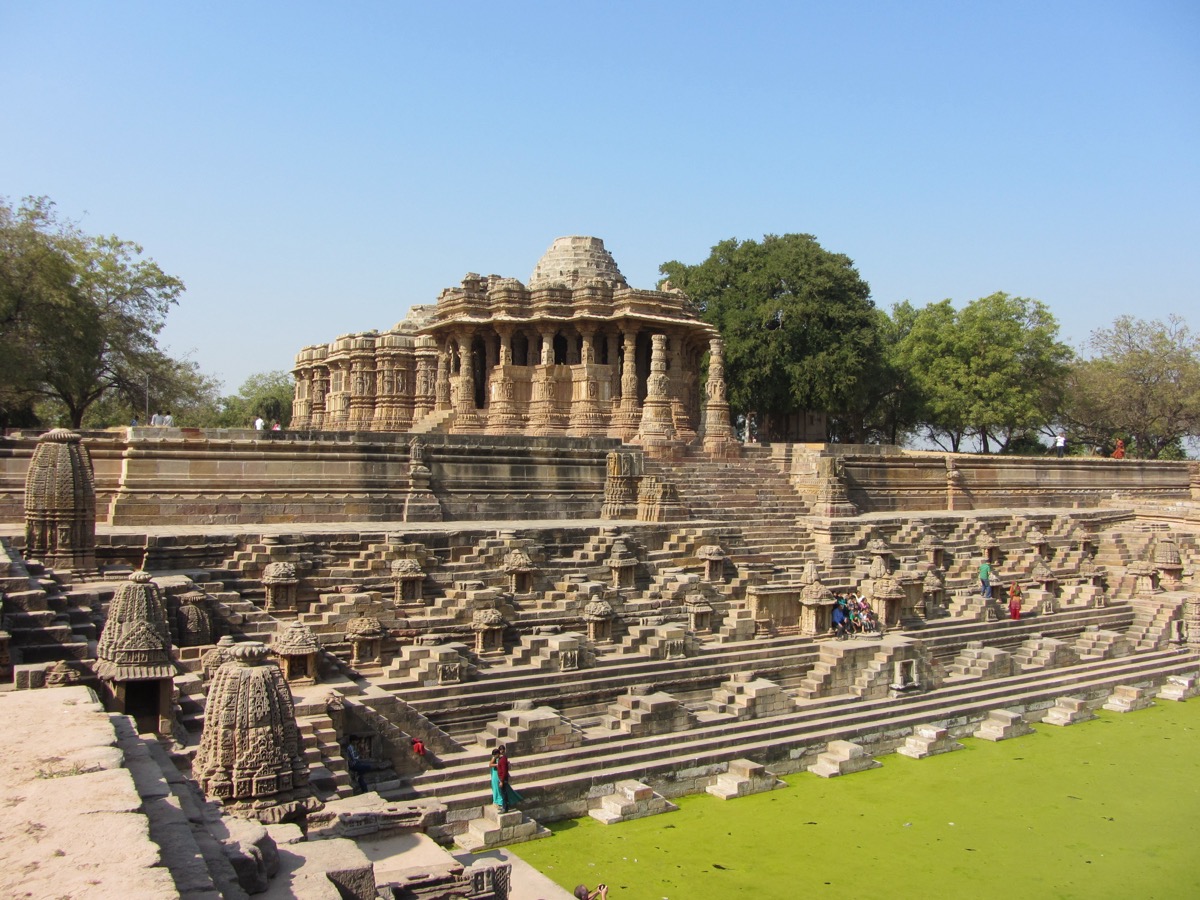
Modhera Sun Temple (मोढेरा सूर्य मंदिर / મોઢેરા સૂર્ય મંદિર) stands on the banks of the river Puṣpāvatī in Mehsana district, Gujarat, approximately 100 kilometers northwest of Ahmedabad. Built shortly after 1026 CE during the reign of Bhīmadeva I (Bhīma I) of the Chaulukya (Solanki) dynasty, this extraordinary temple dedicated to the Sun God Sūrya is one of the finest monuments of Māru-Gurjara architecture — the distinctive temple-building tradition of western India. Though no longer a site of active worship, the Modhera Sun Temple remains an architectural marvel of supreme importance, protected as a Monument of National Importance by the Archaeological Survey of India and inscribed on the UNESCO World Heritage Tentative List in December 2022.
Unlike the more famous Konark Sun Temple in Odisha — conceived as a colossal stone chariot — Modhera achieves its grandeur through a different architectural vision: three axially aligned components of increasing sacredness, culminating in a sanctum designed so that the first rays of the equinoctial sun illuminate the image of Sūrya within. It is a temple where astronomy, geometry, sculpture, and devotion converge into a single, breathtaking statement of Solanki imperial ambition and spiritual aspiration.
Historical Context: The Solanki Dynasty and Bhīmadeva I
The Chaulukya dynasty, commonly known as the Solankis, ruled Gujarat and parts of Rajasthan from approximately 940 to 1244 CE, presiding over one of the most culturally productive periods in western Indian history. Their capital at Aṇahilapāṭaka (modern Patan) was among the wealthiest cities of medieval India, and the Solankis were renowned patrons of architecture, literature, and the arts.
Bhīmadeva I (r. c. 1022–1064 CE) ascended the throne during a period of immense upheaval. In 1024–1025 CE, Maḥmūd of Ghaznī launched his devastating raid on the Somnāth temple, passing through Solanki territory. A Chaulukya force of approximately 20,000 soldiers attempted to check the Ghaznavid advance at Modhera but was unsuccessful. Historian A. K. Majumdar theorizes that the Sun Temple may have been built to commemorate this defense and reassert Hindu sovereignty after the trauma of the Ghaznavid invasion.
A stone inscription found on a block in the western wall of the cella bears the date Vikram Saṃvat 1083, corresponding to 1026–1027 CE. Intriguingly, the inscription is carved upside down, suggesting that it dates to a phase of destruction and subsequent reconstruction rather than the original building. Scholars now generally accept that the Sūrya Kuṇḍa with its corner shrines was built slightly earlier, at the beginning of the 11th century, while the main temple proper and the miniature shrines in the tank were constructed shortly after 1026 CE. The Sabhā Maṇḍapa (assembly hall) was added considerably later, during the third quarter of the 12th century under King Karṇa, along with the gateways and the porch of the temple.
The Three Components of the Temple Complex
The Modhera complex comprises three axially aligned structures, each serving a distinct liturgical and architectural function. From east to west, they are: the Sūrya Kuṇḍa (stepped reservoir), the Sabhā Maṇḍapa (assembly hall), and the Gūḍha Maṇḍapa with Garbhagṛha (shrine hall with sanctum).
Sūrya Kuṇḍa (Rāmakuṇḍa)
The most visually striking element of the complex is the vast stepped reservoir known as the Sūrya Kuṇḍa or Rāmakuṇḍa, which greets the visitor upon entering through the kīrti-toraṇa (ceremonial archway). This rectangular tank measures approximately 176 feet from north to south and 120 feet from east to west, with four terraces of stone-paved steps descending to the water level below.
The steps are arranged in a complex geometric pattern of recessed flights and right-angled staircases, creating a mesmerizing visual rhythm. The first step of each flight is distinctively semicircular, while the rest are rectangular or square. Along the terrace walls, numerous miniature shrines and niches contain images of deities — primarily Vaiṣṇavite gods and goddesses, including Śītalā (the goddess of cooling and disease prevention), Viṣṇu in various avatāras, Śiva, Gaṇeśa, and Nāga figures. These subsidiary shrines transform the kuṇḍa from a mere water reservoir into a sacred complex in its own right — a microcosm of the Hindu pantheon arranged around the purifying waters.
The kuṇḍa served a crucial ritual function: devotees would perform ablutions here before ascending to the temple for darśana of Sūrya. The water, warmed by the Gujarat sun and sanctified by the surrounding deities, prepared the worshipper physically and spiritually for the encounter with the solar deity. The architectural precedent of the stepped tank (vāv or kuṇḍa) is deeply rooted in Gujarat’s temple tradition, and the Modhera Sūrya Kuṇḍa represents its most elaborate and monumental expression.
Sabhā Maṇḍapa (Assembly Hall)
Rising beyond the kuṇḍa on the temple’s axial approach is the Sabhā Maṇḍapa — also called the Raṅga Maṇḍapa or dancing hall — a separate structure placed slightly apart from the main shrine. This parallelogram-shaped hall, with its extensively carved exterior featuring a series of recessed corners that create an impression of a star-shaped layout, is one of the most ornate structures in all of Indian temple architecture.
The hall contains 52 intricately carved pillars, a number widely interpreted as representing the 52 weeks of the solar year — reinforcing the temple’s overarching solar symbolism. These pillars are masterpieces of sculptural art: their shafts feature standing figures of dancers framed within ringed pilasters, horizontal bands depicting scenes of humans and animals, rows of warriors, decorative lozenges, and the distinctive kīrtimukha (face of glory) motifs separated by ornamental chains and bells.
The ceiling of the Sabhā Maṇḍapa rises in tiers to form a walnut-shaped dome reaching approximately 23 feet in height, adorned with numerous floral garlands. The toraṇas (decorated cusped arches) that spring from the lower brackets of the pillars are of two types: semicircular arches with cusped tips and triangular arches with rounded apexes and wavy sides. The lower brackets feature makara (mythical aquatic creatures), giving the structure the name Makara-Toraṇa. Many of these exquisite figures are now partially defaced, but their surviving elements testify to an extraordinary level of artistic accomplishment.
The flat ceilings and lintels of the Sabhā Maṇḍapa are carved with scenes from the great epics — the Rāmāyaṇa and the Mahābhārata — as well as narratives from Kṛṣṇa Līlā. Visitors can identify scenes of Sītā in the Aśoka Vāṭikā in Laṅkā, the Vānara Senā (monkey army) building the bridge to Laṅkā, Kṛṣṇa lifting Govardhana Parvata, and Arjuna with his bow at Draupadī’s Svayaṃvara. These narrative panels transformed the assembly hall into a space of visual storytelling, where devotees could contemplate the great stories of the dharmic tradition while awaiting their turn for worship.
Gūḍha Maṇḍapa and Garbhagṛha (Shrine Hall and Sanctum)
The innermost and most sacred component is the Gūḍha Maṇḍapa — the enclosed shrine hall — which measures approximately 51 feet 9 inches by 25 feet 8 inches and is nearly equally divided between the hall itself and the Garbhagṛha (sanctum sanctorum). Both sections are rectangular in plan, with projections on each side. The three projections on the outer walls originally contained windows fitted with intricately carved perforated stone screens (jālī); only the northern window survives in a ruined condition.
A pradakṣiṇāpatha (circumambulatory passage) is formed between the walls of the Garbhagṛha and the outer walls of the Gūḍha Maṇḍapa, its roof supported by stone slabs carved with rosette motifs. The original śikhara (superstructure) above the sanctum — which once featured a soaring spire resembling Mount Meru with multiple miniature shrines (uruśṛṅga) — no longer exists.
The Garbhagṛha is a square chamber measuring approximately 11 feet on each side. It contains two distinct cells: an upper cell that once housed the primary image of Sūrya (the floor has since collapsed) and a lower cell believed to have served for storage. The doorway is adorned with carved figures of a seated Sūrya, Gaṇeśa, and Kubera, accompanied by dancers and amorous couples — though these have suffered significant damage over the centuries.
The Equinox Solar Alignment
The most celebrated feature of the Modhera Sun Temple is its precise astronomical alignment. The temple is built at approximately 23.6° latitude — near the Tropic of Cancer — and the Garbhagṛha is oriented so that the first rays of the rising sun illuminate the image of Sūrya during the solar equinoxes (approximately March 21 and September 23). On the summer solstice, the sun shines directly above the temple at noon, casting virtually no shadow — a phenomenon that demonstrates the builders’ sophisticated understanding of solar geometry.
This alignment is not incidental but is fundamental to the temple’s theological purpose. The Modhera Sun Temple is, in essence, an astronomical instrument — a built structure that marks the passage of the sun through the year and transforms celestial mechanics into an act of worship. The equinoctial illumination of the sanctum was the climactic moment of the temple’s liturgical calendar, when the deity was literally awakened by his own cosmic light.
The Sculptural Program: Twelve Ādityas and Beyond
The sculptural program of the Modhera Sun Temple is among the richest in western Indian temple architecture. The walls feature twelve large panels, each depicting a different aspect of Sūrya corresponding to each month of the solar year — the Dvādaśa Ādityas (Twelve Ādityas or Solar Manifestations). These figures are shown standing frontally with two arms holding lotuses in upraised hands, wearing a distinctive coat of arms, tall boots, and a special waist cord known as the avyaṅga. Each Sūrya figure is flanked by the same two attendants — Daṇḍī and Piṅgala — and rides a seven-horse chariot. The influence of Persian and Central Asian solar iconography is evident in the boots and belt, reflecting the historical connections between Indian and Iranian sun worship traditions.
Beyond the Āditya panels, the walls are adorned with figures of the Aṣṭadikpālas (Eight Guardians of the Directions): Indra, Varuṇa, Agni, Yama, Nirṛti, Kubera, Vāyu, and Īśāna. Other niches feature Viṣṇu in various forms, Śiva, Brahmā, Viśvakarmā, Gaṇeśa, Sarasvatī, and Nāga figures.
The base moldings of the temple walls follow a precisely ordered sequence: the bhāt (square moldings), padma (inverted lotus), antarita (fillet), patti with the gajathara (elephant frieze), and the narathara (human figure frieze). Above these, the maṇḍovara (wall molding) presents the kumbha (pitcher-shaped base), kalasha, kevala with chaitya windows, and the main jaṅghā panels. Each figure is crowned by a small cornice and a triangular pediment containing a chaitya-window (udgama), creating a dense, layered visual effect that is characteristic of the Māru-Gurjara style.
The erotic sculptures (kāma-mūrti) on the kākṣāsana (bench backrest) of the Sabhā Maṇḍapa, interspersed with rail patterns, follow the same tradition found at Khajuraho and other medieval Hindu temples — representing the integration of kāma (desire) within the broader framework of dharma, artha, and mokṣa.
Modhera and Konark: Twin Temples of the Sun
The Modhera Sun Temple and the Konark Sun Temple in Odisha (built c. 1244–1265 CE by Narasiṃhadeva I of the Eastern Gaṅga dynasty) are the two greatest surviving monuments of solar worship in India. While they share a common deity and astronomical orientation, they differ profoundly in conception:
-
Modhera (11th century) follows the Māru-Gurjara tradition of western India — characterized by an elaborate stepped tank, star-shaped plans, intricate pillar carvings, and subsidiary shrine niches. Its three-part complex of Kuṇḍa, Sabhā Maṇḍapa, and Gūḍha Maṇḍapa represents a processional journey from purification to congregation to divine encounter.
-
Konark (13th century) follows the Kalinga tradition of eastern India — conceived as a single colossal chariot of Sūrya with twenty-four stone wheels, seven galloping horses, and a massive deul tower. Its architecture is more monolithic and dramatically sculptural.
Both temples encode astronomical knowledge — Modhera through its equinox alignment and twelve Āditya panels, Konark through its sundial wheels and solstice orientation. Both were built during periods of political assertion against foreign invasion. And both, tragically, lost their original śikharas and ceased to function as active places of worship. Together, they represent the fullest flowering of the Saura (solar) tradition in Hindu temple architecture.
Sūrya Worship in India: Vedic Roots and Regional Traditions
The Modhera temple belongs to one of the oldest strands of Hindu devotion — the worship of Sūrya, the Sun God. The Ṛg Veda (1.50, 1.115, 10.37) contains some of the most sublime hymns to Sūrya, praising him as the eye of Mitra and Varuṇa, the soul of all that moves and is stationary, and the dispeller of darkness and disease. The Gāyatrī Mantra (Ṛg Veda 3.62.10) — the most sacred verse in Hinduism — is a direct invocation of the solar deity Savitṛ: “Om, let us meditate upon the glorious radiance of that divine Savitṛ; may he inspire our understanding.”
The Sūrya Siddhānta, one of the earliest Indian astronomical treatises, systematized solar observation. The Āditya Hṛdaya Stotra (Rāmāyaṇa, Yuddha Kāṇḍa 107), taught by the sage Agastya to Lord Rāma before his final battle with Rāvaṇa, is recited to this day as a prayer for victory and well-being.
Gujarat had a particularly strong tradition of Sūrya worship. The Bhavishya Purāṇa and Sāmba Purāṇa describe the establishment of solar shrines across India by devotees cured of ailments through Sūrya’s grace. The Solanki kings, who traced their lineage to the Sūryavaṃśa (Solar Dynasty), were natural patrons of Sūrya temples, and Modhera represents the culmination of this royal devotion.
Festivals at Modhera: Uttarārdha Mahotsava and Cultural Revival
Though the temple has not been a site of active Hindu worship for centuries, it has experienced a significant cultural revival in recent decades. Since 1992, the Tourism Corporation of Gujarat has organized an annual three-day dance festival known as the Uttarārdha Mahotsava (also called the Modhera Dance Festival), held during the third week of January, following the festival of Uttarāyaṇa (Makar Saṅkrānti).
The name Uttarārdha derives from uttara (“north”) and ardha (“half”), referring to the sun’s northward journey (uttarāyaṇa) — making the Modhera Sun Temple a symbolically perfect venue for this celebration of the sun’s return. The festival brings together classical dance troupes from across India — performing Bharatanāṭyam, Odissi, Kathak, Kuchipuḍi, Mohiniyāṭṭam, and other traditions — in the ancient Sabhā Maṇḍapa and against the stunning backdrop of the Sūrya Kuṇḍa. The event recreates, in spirit, the original purpose of the assembly hall as a venue for sacred performance.
In the traditional Hindu calendar, the periods of Chaitra (March–April) and Kārtika (October–November) were especially significant for Sūrya worship. Chaitra marks the spring equinox — when the Modhera sanctum would have been dramatically illuminated — while Kārtika, associated with the Chhath Pūjā tradition of sun worship in eastern India, represents the autumnal equinox. These seasonal markers remind us that the entire liturgical life of the temple was structured around the solar calendar.
Architectural Innovations of the Māru-Gurjara Style
The Modhera Sun Temple exemplifies the Māru-Gurjara (also called Chaulukya) architectural tradition, one of the most sophisticated and influential schools of Indian temple building. Key innovations visible at Modhera include:
-
Inverted lotus plinth (padma-pīṭha): The temple platform is shaped like an inverted lotus — a distinctive Solanki feature symbolizing the temple as a cosmic flower emerging from the waters of creation.
-
Star-shaped plan: The Sabhā Maṇḍapa’s series of recessed corners creates a stellate ground plan, a hallmark of mature Māru-Gurjara design later perfected in temples like the Dilwara Jain Temples at Mount Abu.
-
Kīrti-toraṇa gateways: The ceremonial archways that once marked the entrance to the complex — of which two pillars survive — are a distinctively Gujarati architectural feature, marking the transition from profane to sacred space.
-
Makara-toraṇa arches: The cusped arches springing from makara-headed brackets within the Sabhā Maṇḍapa represent one of the most elegant structural-decorative elements in Indian architecture.
-
Modular sculptural grammar: The precisely sequenced horizontal bands of base moldings — from bhāt through gajathara and narathara to jaṅghā panels — create a visual language that is both systematic and endlessly varied, combining geometric order with figurative exuberance.
These innovations influenced temple architecture across western India for centuries, from the great Jain temples of Rajasthan to the later Hindu temples of Saurashtra and Kutch.
Protection and Legacy
The Modhera Sun Temple is classified as a Monument of National Importance and is maintained by the Archaeological Survey of India (ASI). The site was added to the UNESCO World Heritage Tentative List in December 2022, recognizing its outstanding universal value as an exemplar of Māru-Gurjara architecture and Hindu solar worship.
The site was formerly known locally as Sītā nī Chaurī and Rāmakuṇḍa, reflecting the popular association of the stepped tank with episodes from the Rāmāyaṇa — though the temple’s primary dedication was always to Sūrya. The fact that no worship is offered at the temple today is itself a poignant historical testimony: the temple survived the Ghaznavid raids of the 11th century only to fall into disuse in later centuries as patterns of worship shifted and the original Sūrya image was lost.
Yet the Modhera Sun Temple endures as one of the supreme achievements of Indian civilization — a place where the art of building, the science of astronomy, the devotion of worship, and the beauty of sculpture converge in a single, luminous monument to the Sun God who sustains all life. For the modern visitor who stands at the edge of the Sūrya Kuṇḍa at dawn and watches the light spill across the carved steps and miniature shrines, the temple’s original purpose is still palpable: this is a place designed to receive, celebrate, and sanctify the light of the sun.