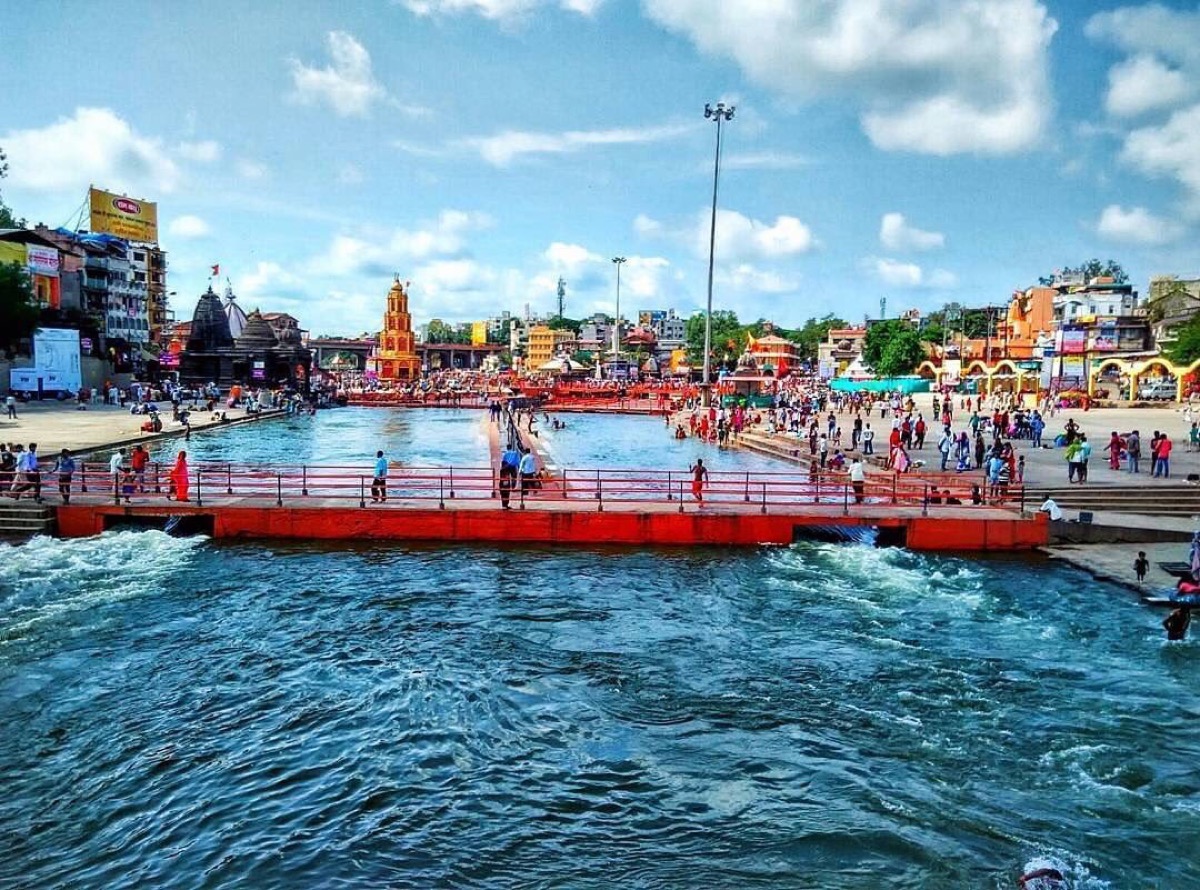
Introduction: Where the Rāmāyaṇa Meets the Godāvarī
Nāsik (also spelled Nashik) — one of the oldest continuously inhabited cities in India — stands on the banks of the Godāvarī, the second-longest river in the Indian subcontinent and a river so sacred that she is called the “Dakṣiṇa Gaṅgā” (Ganges of the South). Within Nāsik lies Pañcavaṭī, the “grove of five banyan trees,” where according to the Rāmāyaṇa, Lord Rāma, Goddess Sītā, and Lakṣmaṇa established their hermitage during the thirteen years of their forest exile.
This convergence of river, scripture, and sacred geography makes Nāsik-Pañcavaṭī one of the most layered and significant pilgrimage cities in Hinduism. It is simultaneously a Rāmāyaṇa tīrtha (linked to the exile narrative), a Kumbha Melā city (one of only four sites where the great congregation of pilgrims gathers), a Śaiva tīrtha (with the Trimbakeshwar Jyotirlinga nearby), and a city of ancient ghāts where the Godāvarī has been worshipped as a living goddess for millennia.
The Padma Purāṇa (Uttara Khaṇḍa) declares: “He who bathes in the Godāvarī at Pañcavaṭī, where Rāma himself dwelt, is freed from the sins of seven lifetimes.” This single verse captures the extraordinary accumulation of sacred merit that the Hindu tradition associates with this city.
Rāma’s Exile at Pañcavaṭī
The Arrival in the Forest of Five Banyan Trees
The Rāmāyaṇa of Vālmīki (Araṇya Kāṇḍa, Cantos 13-15) describes how Rāma, Sītā, and Lakṣmaṇa, guided by the sage Agastya, arrived at Pañcavaṭī during their fourteen-year exile from Ayodhyā. The sage Agastya directed them to this beautiful grove on the banks of the Godāvarī, describing it as a place rich in flowers, fruits, and pure water, suitable for ascetic life.
Vālmīki describes the hermitage that Lakṣmaṇa built for his brother: “In that beautiful grove of five great banyan trees, on the banks of the Godāvarī rich with lotus flowers, Lakṣmaṇa built a spacious leaf-hut, well-plastered with mud and thatched with broad leaves, a dwelling worthy of his noble brother” (Araṇya Kāṇḍa 15.18-20). The description establishes Pañcavaṭī as a sacred sylvan landscape, an intersection of ascetic simplicity and natural abundance.
The Abduction of Sītā: Śūrpaṇakhā and Rāvaṇa
It was at Pañcavaṭī that the pivotal event of the Rāmāyaṇa’s central tragedy occurred. Śūrpaṇakhā, the sister of the demon-king Rāvaṇa, encountered Rāma in the forest and was overcome with desire for him. When Rāma and Lakṣmaṇa rejected her, and Lakṣmaṇa cut off her nose (from which the city derives its name: Nāsik is traditionally linked to the Sanskrit nāsikā, meaning “nose”), she fled to Laṅkā and reported her humiliation to Rāvaṇa.
This episode set in motion the chain of events that would lead to Rāvaṇa’s deceptive abduction of Sītā, Rāma’s alliance with Sugrīva and Hanumān, the construction of the great bridge to Laṅkā, the war, and ultimately the triumph of dharma over adharma. Pañcavaṭī is thus the geographical pivot of the entire Rāmāyaṇa narrative — the place where the story turns from a tale of exile into an epic of war and redemption.
The Sītā Gufā and Lakṣmaṇa Rekhā
Within the Pañcavaṭī area, the Sītā Gufā (Sītā’s Cave) is a subterranean cave shrine believed to be the spot where Sītā was secluded while Rāma went to pursue the golden deer (actually the demon Mārīca in disguise). According to tradition, Lakṣmaṇa drew the famous Lakṣmaṇa Rekhā — a protective line around the hermitage — before leaving to search for Rāma, instructing Sītā not to cross it. It was by luring Sītā across this line that Rāvaṇa, disguised as an ascetic, succeeded in abducting her.
The cave shrine, which pilgrims access by descending a narrow stairway, contains images of Rāma, Sītā, and Lakṣmaṇa. The atmosphere of the dark, intimate cave — believed to have sheltered the divine couple — creates a powerful devotional experience.
The Godāvarī River and the Ghāts
The Dakṣiṇa Gaṅgā
The Godāvarī, which rises at Trimbak (about 30 kilometres from Nāsik) from a spring on Brahmagiri hill, is the most sacred river of the Deccan and one of the seven sacred rivers of Hinduism. The Brahmāṇḍa Purāṇa states: “The Gaṅgā purifies by sight, by touch, and by bathing; but the Godāvarī purifies merely by being remembered” (Brahmāṇḍa Purāṇa III.13.65). The river flows through the heart of Nāsik, and its banks are lined with ancient ghāts that have served as sites of ritual bathing, cremation, and worship for centuries.
Rāma Kuṇḍa and the Sacred Ghāts
The Rāma Kuṇḍa ghāt is the most important bathing ghāt in Nāsik, believed to be the spot where Lord Rāma performed his daily ablutions during his stay at Pañcavaṭī. Adjacent to it is the Sītā Kuṇḍa. The ghāts along the Godāvarī in Nāsik include the Godā Ghāṭ, the Gaṅgā Godāvarī ghāṭ, and the Tapovana ghāṭ, each associated with specific Purāṇic legends and ritual functions. The evening āratī at the Godāvarī ghāts, with oil lamps floating on the dark water and the chanting of mantras echoing from the surrounding temples, is one of the most evocative ritual experiences in western India.
The Kālārāma Temple
Architecture and History
The Kālārāma Temple (Temple of the Black Rāma), the most prominent temple in Nāsik, is a magnificent structure built in the Hemāḍpanthī style during the Peshwa period (mid-18th century) using black basalt stone. The temple enshrines a black stone image of Lord Rāma, which gives the temple its name. The complex includes shrines to Sītā and Lakṣmaṇa and features a large courtyard with the iconic Garuḍa pillar.
The temple’s sanctum is approached through a maṇḍapa (pillared hall) with finely carved columns depicting scenes from the Rāmāyaṇa. The śikhara (tower) rises in an elegant Nāgara style, unusual for a temple in the Deccan, reflecting the cosmopolitan cultural connections of the Peshwa era.
The Temple Satyagraha of 1930
The Kālārāma Temple holds a unique place in the social history of modern India. In 1930, Dr. B.R. Ambedkar led a historic satyāgraha (nonviolent protest) to demand the right of Dalits to enter the temple. The Kālārāma Temple Entry Satyāgraha was one of the earliest and most significant temple-entry movements in India, predating many similar campaigns elsewhere. This event gives the temple a dual significance — as a site of ancient devotion and as a landmark of the struggle for social justice.
Trimbakeshwar: The Nearby Jyotirlinga
The Source of the Godāvarī
Approximately 28 kilometres from Nāsik lies Trimbakeshwar (Tryambakeshwar), one of the twelve Jyotirliṅgas — the most sacred manifestations of Lord Śiva in the form of a liṅga of light. The temple sits at the foot of Brahmagiri hill, from whose summit the Godāvarī river originates. The Śiva Purāṇa (Koṭi Rudra Saṃhitā, chapter 26) describes the Trimbakeshwar liṅga as having three faces representing Brahmā, Viṣṇu, and Śiva, corresponding to the name Tryambaka (“the three-eyed one” or “the one with three mothers/aspects”).
The Temple and the Kuśāvarta Tīrtha
The present Trimbakeshwar temple was built by the third Peshwa, Balaji Baji Rao, in the 18th century, replacing an older structure. The temple is renowned for its intricate stone carvings and its sacred water tank, the Kuśāvarta Kuṇḍa, which is considered the true source of the Godāvarī and one of the holiest bathing sites in Maharashtra. The Nārāyaṇa Nāgbali pūjā, a complex ancestral ritual performed only at Trimbakeshwar, draws pilgrims from across India seeking to resolve ancestral curses and karmic debts.
Kumbha Melā at Nāsik: The Siṃhastha
The Celestial Origin
Nāsik is one of the four sites of the Kumbha Melā, the world’s largest religious gathering. According to the mythology, during the Samudra Manthana (the churning of the cosmic ocean), when the gods and demons fought over the pot (kumbha) of amṛta (the nectar of immortality), drops of the nectar fell at four locations: Prayāga (Allahabad), Haridwāra, Ujjain, and Nāsik. The Kumbha Melā rotates among these four cities in a twelve-year cycle based on the positions of Jupiter (Bṛhaspati) and the Sun.
The Siṃhastha Kumbha
The Kumbha Melā at Nāsik is called the Siṃhastha Kumbha because it occurs when Jupiter enters the zodiac sign of Leo (Siṃha). During this period, lasting approximately three months, millions of pilgrims and tens of thousands of sādhus, nāgā bābās, and mahants gather on the banks of the Godāvarī for ritual bathing on auspicious dates (the royal bathing days, or śāhi snāna). The spectacle of naked nāgā sādhus, covered in sacred ash, charging into the river at dawn is one of the most extraordinary sights in the Hindu world.
The Siṃhastha Kumbha at Nāsik also serves as a massive fair of Hindu religious discourse, with scholars, saints, and philosophers from every sampradāya (tradition) setting up camps and holding discourses. The event reinforces Nāsik’s identity as a city where the deepest currents of Hindu civilization — scripture, ritual, asceticism, and pilgrimage — converge.
The Narasiṃha Jhirā Temple
One of Nāsik’s most unusual sacred sites is the Narasiṃha Jhirā Temple, a cave temple dedicated to Lord Narasiṃha (the man-lion avatāra of Viṣṇu). The temple is located inside a natural cave through which water continuously flows, and devotees must wade through waist-deep water to reach the sanctum containing the image of Narasiṃha. The experience of walking through the cold, dark, water-filled passage to behold the deity is considered both a physical purification and a symbolic passage through the primordial waters of creation.
According to local legend, the cave was discovered by a cowherd whose cow was found daily emptying her udder into a particular spot on the hillside. When the spot was excavated, the ancient image of Narasiṃha was found, with a natural spring flowing around it.
Other Sacred Sites in Nāsik-Pañcavaṭī
The Tapovana
The Tapovana (“forest of austerities”), located on the bank of the Godāvarī opposite Pañcavaṭī, is traditionally identified as the hermitage of the sage Agastya’s disciples, where Lakṣmaṇa cut off Śūrpaṇakhā’s nose. The site contains temples and ghāts and is a significant pilgrimage stop.
The Sundaranārāyaṇa Temple
This ancient Viṣṇu temple, one of the oldest in Nāsik, enshrines an image of Viṣṇu in his beautiful (sundara) form. The temple dates to the Yādava period (12th-13th centuries) and preserves some of the finest medieval temple sculpture in western India.
The Muktidham Temple
A modern temple complex that houses marble replicas of all twelve Jyotirliṅgas under one roof, the Muktidham allows pilgrims to symbolically complete the circuit of all twelve Śiva sites without travelling across India. The complex also includes replicas of the Bādrīnātha temple and an Aṣṭavinayaka shrine.
The Tāpī-Godāvarī River System
Nāsik’s sacred geography is enriched by its position in the watershed of both the Godāvarī and the Tāpī (Tapti) rivers. While the Godāvarī flows eastward to the Bay of Bengal, the Tāpī rises nearby and flows westward to the Arabian Sea. This hydrological convergence is reflected in the Purāṇic understanding of the region as a sacred confluence zone, where the energies of two great river systems meet. The Brahma Purāṇa (chapter 77) describes the region around the Godāvarī’s source as one of the most auspicious locations on earth for performing ancestral rites (piṇḍa dāna and śrāddha).
Festivals and Living Traditions
Rāma Navamī
Rāma Navamī at Nāsik is celebrated with particular fervour at the Kālārāma Temple, where a grand procession (śobhā yātrā) carries images of Rāma, Sītā, Lakṣmaṇa, and Hanumān through the streets of Pañcavaṭī, accompanied by traditional music and the chanting of the Rāmacaritamānasa.
Godāvarī Puṣkara
The Godāvarī Puṣkara (occurring once every twelve years when Jupiter enters Cancer) is a twelve-day festival celebrating the river, during which millions bathe in the Godāvarī at Nāsik and Trimbak. The festival reaffirms the living bond between the city and its river.
The Annual Palkhi Procession
Nāsik participates in the great Pāḷkhī (palanquin) procession tradition of Maharashtra, with the pādukā (sacred sandals) of the Vārkarī saints carried in procession to Paṇḍharpura. This tradition connects Nāsik to the broader devotional landscape of the Bhakti movement in western India.
Conclusion: Where Every Stone Tells a Sacred Story
Nāsik-Pañcavaṭī is a city where the boundary between myth and geography dissolves entirely. To walk along the Godāvarī ghāts at dawn, to descend into the Sītā Gufā, to stand in the black stone temple of Rāma, or to bathe at Rāma Kuṇḍa is not merely to visit historical monuments but to enter the living narrative of the Rāmāyaṇa itself. The Godāvarī, flowing ceaselessly through the city as she has for millennia, is the thread that connects every sacred site, every temple, every ghāt into a single devotional tapestry. As the Brahma Purāṇa declares: “Where the Godāvarī flows and where Rāma once dwelt — that place is the very threshold of heaven on earth” (Brahma Purāṇa 78.42).